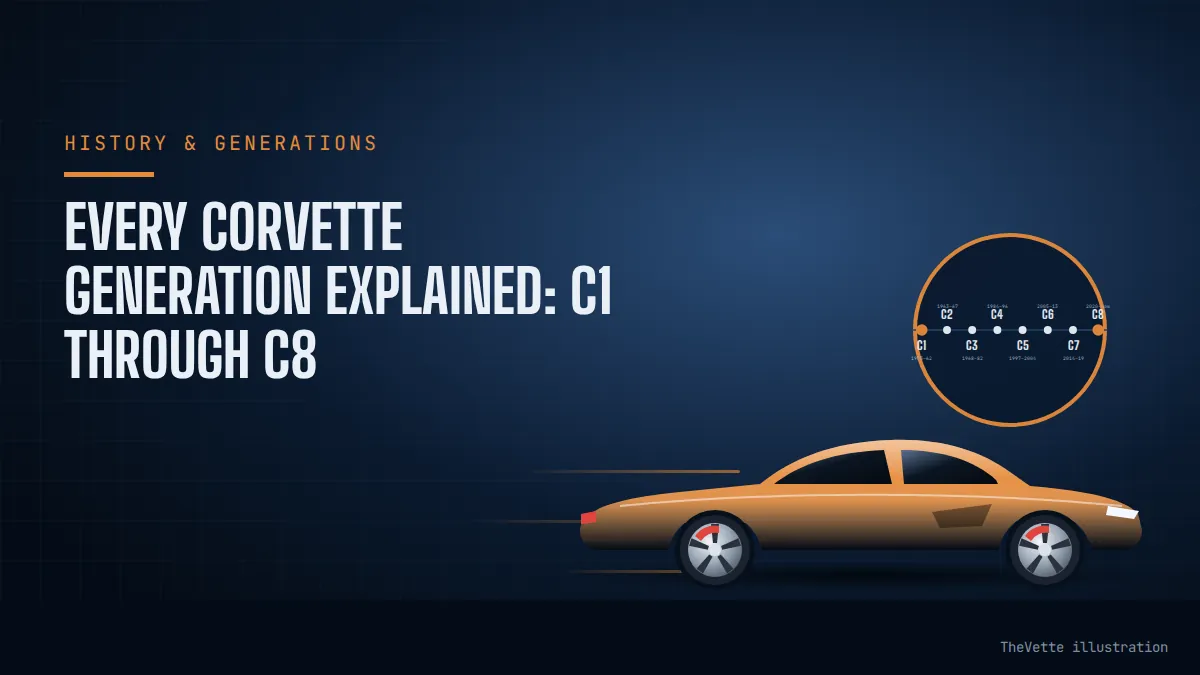
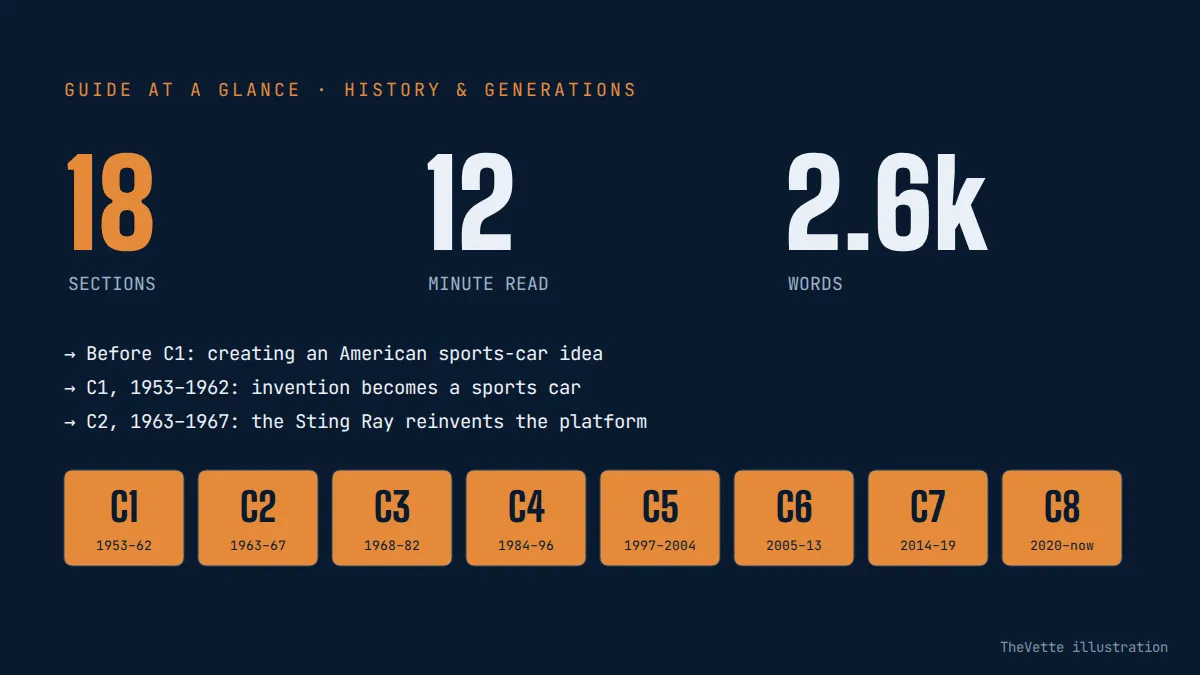
Corvette history is easiest to understand as eight different answers to the same question: what should an American sports car be now? The answer has moved from a fiberglass-bodied roadster with a six-cylinder engine to a family of mid-engine performance cars. Between those points came experiments in independent suspension, fuel injection, aerodynamic shape, digital instruments, lightweight structure, rear-mounted transmissions, electronic chassis control, and electrified all-wheel drive. The familiar C1 through C8 labels help organize that change, although they are enthusiast shorthand rather than the whole story.
To place Every Corvette Generation Explained: C1 Through C8 in a wider ownership and engineering context, continue with How the Small-Block V8 Shaped Corvette History.
This overview gives each generation a clear purpose without compressing every model year into a list. Production dates, equipment, and options changed within generations, so buyers should use the linked generation guides and year-specific General Motors records before evaluating a particular car. TheVette is independent and is not affiliated with Chevrolet or General Motors. Historical manufacturer sources are used for verification; their copyrighted images and branding are not reproduced.
Before C1: creating an American sports-car idea
In the early 1950s, European roadsters represented a kind of light, personal performance car that the high-volume American industry did not offer in the same way. General Motors styling leader Harley Earl and a small team developed a two-seat concept around a low fiberglass body. The material helped make a limited-production shape possible without conventional steel stamping investment, while the design created a distinct identity separate from Chevrolet sedans.
The concept appeared at the 1953 GM Motorama, where public response supported production. The first cars used a modified Chevrolet inline-six and a two-speed automatic transmission. That beginning matters because Corvette was not born with the V8/manual formula later associated with it. The project survived by changing: more convincing power, competition influence, and continuous design development transformed an attention-grabbing roadster into a durable performance nameplate.
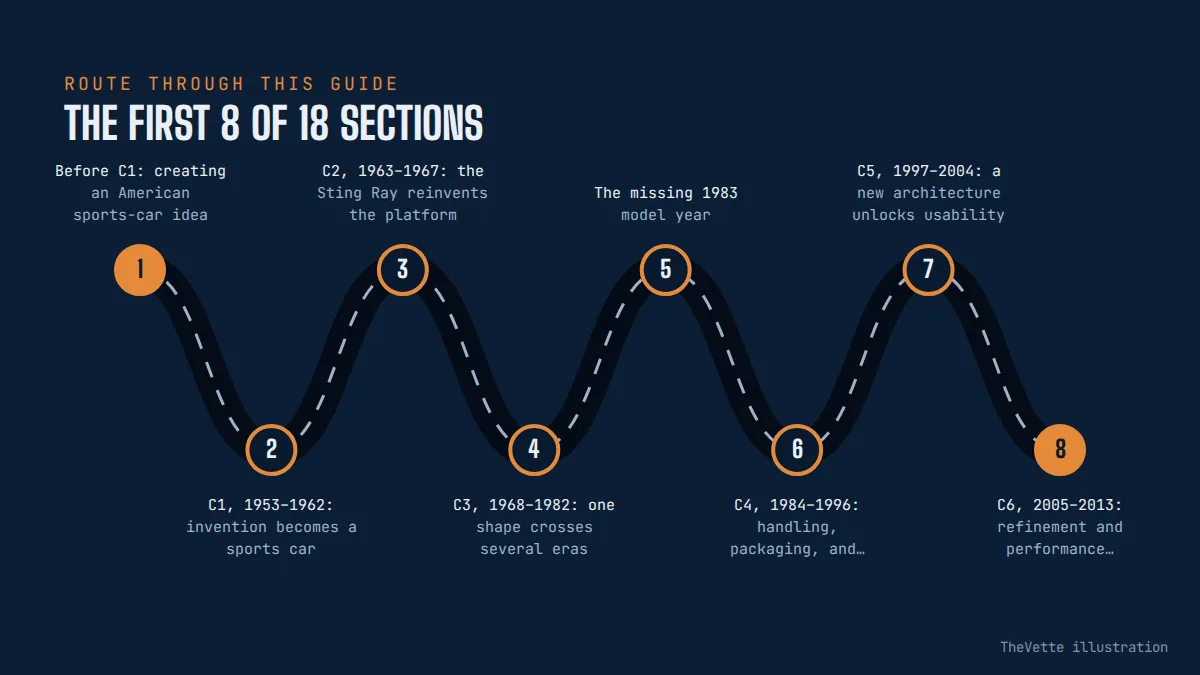
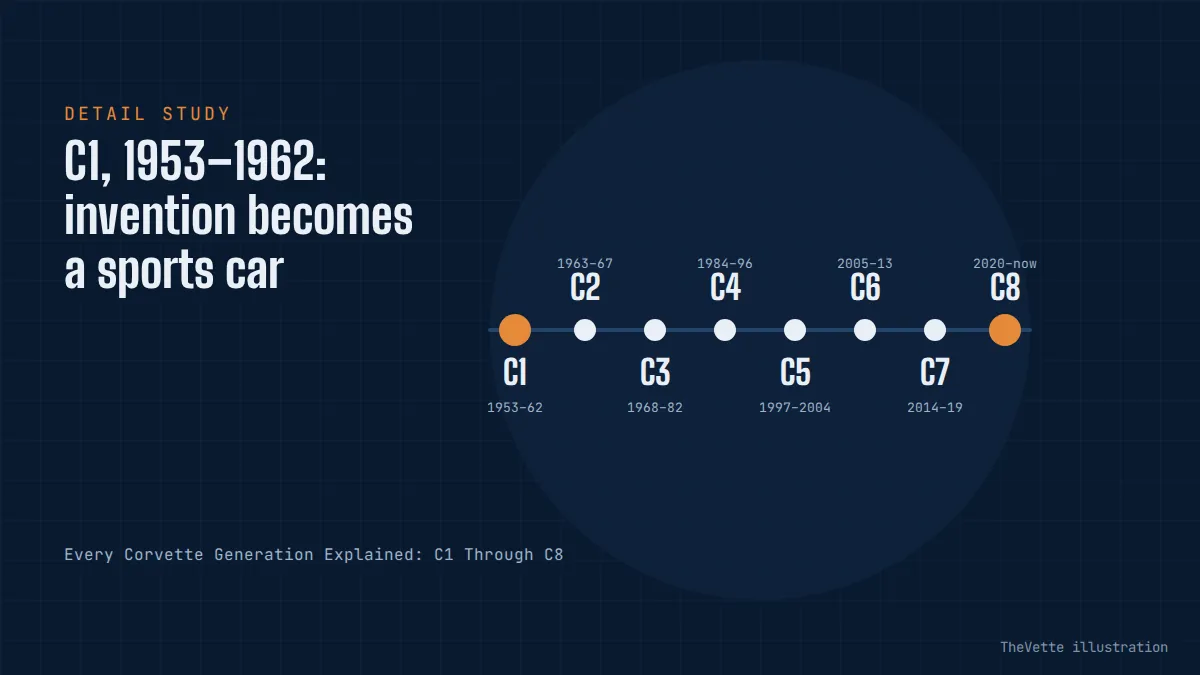
C1, 1953–1962: invention becomes a sports car
The first generation established the fiberglass body, two-seat format, and visual independence of Corvette, but its ten model years contain several distinct eras. Early cars have a spare, delicate appearance and the six-cylinder powertrain. The small-block V8 arrived during the generation, manual transmissions followed, and engine choices broadened. Exterior changes brought new side coves, revised tails, and eventually four headlamps. By 1961–1962, the rear treatment anticipated the next generation even though the chassis remained rooted in the original layout.
C1 is important less because every version was a finished ideal than because development never stopped. The car acquired the performance credibility necessary to continue. Mechanical fuel injection appeared as an advanced option in the late 1950s, while racing-minded engineering shaped the program’s reputation. For today’s reader, the central lesson is variation: a 1953 and a 1962 offer very different driving and collecting experiences. The dedicated C1 buyer’s guide covers identity, frame, fiberglass, and restoration evidence.
C2, 1963–1967: the Sting Ray reinvents the platform
The second generation introduced the Sting Ray production design and, for the first time, a coupe alongside the convertible. The 1963 coupe’s divided rear window became an instant visual marker, though the one-year feature can overshadow the deeper engineering change. A new chassis, independent rear suspension, lower seating, and a more developed cockpit moved Corvette decisively away from its first-generation foundation.
Across five years, body details, vents, brakes, engines, and equipment evolved. Small-block and big-block applications broadened the range from responsive road car to formidable straight-line performer. The short production span and strong year-to-year identity make casual generalization risky. C2’s enduring contribution is the integration of dramatic design with a chassis architecture capable of supporting greater performance. For car-specific due diligence, use the C2 buyer’s guide rather than treating a split window or engine badge as complete evidence.
C3, 1968–1982: one shape crosses several eras
The third generation translated the Mako Shark II show-car influence into the longest-running basic Corvette body style. Its pronounced fenders, low waist, and tightly drawn cabin created a silhouette that remained recognizable while regulations, fuel conditions, emissions standards, and buyer expectations changed around it. Early chrome-bumper cars and later molded-bumper cars belong to visibly different periods, and interiors, rear glass, trim, engines, transmissions, and special editions continued to evolve.
C3 history is often reduced to a story of declining published horsepower, but that misses the rating-method change, wider regulatory context, chassis development, equipment, and the car’s role as a personal luxury-performance machine during the 1970s. The generation carried Corvette through industrial disruption and into the 1980s. Its long run also means condition varies enormously today. The C3 buyer’s guide focuses on the steel birdcage and frame hidden beneath fiberglass, vacuum systems, bumper materials, and era-specific configuration.
The missing 1983 model year
Corvette history moves from the 1982 C3 to the 1984 C4 in customer-facing production. The transition required development and manufacturing preparation for a substantially different car. A small group of 1983 pilot vehicles was built, but the year did not become a normal retail model run. One surviving 1983 car is preserved by the National Corvette Museum, making the gap a tangible piece of development history rather than a simple typographical oddity.
The skipped retail year is useful because it reminds readers that generation boundaries are engineering and production transitions, not merely styling dates. New tooling, validation, regulations, suppliers, and assembly processes must converge. The C4 represented enough change that the old and new cars could not be treated as annual facelifts. That clean break shaped how later enthusiasts came to use generation codes as primary identities.
C4, 1984–1996: handling, packaging, and electronics
The fourth generation replaced the separate-frame character of earlier cars with a much more integrated structure and a wide-opening clamshell hood that exposed its low front suspension. The driving position, low cowl, digital instrumentation, hatchback packaging, and emphasis on lateral performance aligned Corvette with a new 1980s understanding of a modern sports car. It was not simply the C3 made smoother; it changed how the driver sat, saw, and interacted with the machine.
Over its long run, engines progressed from the early Cross-Fire Injection system through Tuned Port Injection and later LT1/LT4 applications. Instrument panels, transmissions, brakes, safety equipment, and exterior details changed. The ZR-1 added a distinct multi-cam LT5 engine and a high-technology flagship role. C4 made electronics and diagnostics inseparable from Corvette ownership. The C4 buyer’s guide explains electrical baselines, display condition, weather sealing, structure, and year-specific drivetrains.
C5, 1997–2004: a new architecture unlocks usability
The fifth generation reorganized the Corvette around hydroformed frame rails, a central torque tube, and a rear-mounted transaxle. Moving transmission mass rearward supported weight distribution while freeing interior packaging. The car gained a roomier cabin, a large hatchback cargo area in the coupe, and a structure that could support coupe, convertible, and fixed-roof forms. It became easier to imagine a Corvette as both long-distance transport and serious performance tool.
The LS1 introduced the Gen III small-block era to Corvette, pairing compact pushrod architecture with modern engine management. The fixed-roof coupe led to the C5 Z06, which emphasized lower mass, focused chassis tuning, and greater output. In parallel, the C5-R racing program built a separate competition record; racing success should not be confused with the history or capability of an individual road car. The C5 buyer’s guide covers torque-tube evidence, modules, pop-up lamps, cooling, and age-related needs.
C6, 2005–2013: refinement and performance specialization
C6 retained the successful front-engine/rear-transaxle concept while becoming more compact in key dimensions and returning to fixed headlamps. The cabin and controls became more conventional, outward visibility changed, and the basic car grew into a broader performance hierarchy. Engine development moved through LS2 and LS3 applications in standard models, while specialized variants took different approaches to output and structure.
The C6 Z06 paired an aluminum-intensive structure with the 7.0-liter LS7 and focused chassis equipment. The ZR1 used the supercharged LS9 and added another level of cooling, brakes, materials, and cost. Grand Sport offered wide-body chassis character with a naturally aspirated engine. These versions make “C6 maintenance cost” an imprecise phrase. The C6 buyer’s guide separates trim-specific lubrication, supercharger, brakes, cooling, torque-tube, and electronic-damper questions.
C7, 2014–2019: Stingray returns with integrated control
The seventh generation revived the Stingray name as one word and presented a sharper body, significantly improved cabin, direct-injected LT1 engine, and a more integrated set of drive modes and electronic chassis systems. The driver could coordinate throttle, transmission, differential, damping, exhaust, steering, and stability behavior through factory controls in ways earlier generations did not offer. A seven-speed manual remained available alongside increasingly capable automatics.
Grand Sport again combined wider performance chassis equipment with naturally aspirated power. The Z06 used a supercharged LT4, adding tremendous output and a need to understand heat management and use conditions. Track data, electronic differential control, carbon-ceramic brakes on relevant configurations, and active damping raised the evidence required in a used-car inspection. The C7 buyer’s guide addresses module records, calibration, thermal history, and specialized consumables.
C8, 2020 onward: the engine moves behind the cabin
The eighth generation made the most visible architectural change in Corvette history by placing the engine behind the occupants. Mid-engine packaging changed proportions, forward visibility, luggage distribution, cooling routes, and how power reaches the road. The Stingray launched with a naturally aspirated LT2 and an eight-speed dual-clutch transmission; no production manual was offered. The new layout created a platform for several propulsion strategies rather than one escalating engine ladder.
As of August 2026, the official lineup includes Stingray, the flat-plane-crank naturally aspirated Z06, the electrified all-wheel-drive E-Ray, and the twin-turbo ZR1, with future products announced separately. Current lineup facts should be dated because production continues. The C8 buyer’s guide stresses VIN-specific recall lookup, current manuals, dual-clutch behavior, multiple cooling circuits, high-voltage boundaries for electrified variants, and correct track preparation.
The engine story is continuity plus reinvention
Corvette began with an inline-six, adopted the small-block V8, expanded through fuel injection and big-block power, navigated emissions-era change, and entered modern LS and LT families without abandoning compact pushrod architecture in most applications. Yet the nameplate has also hosted notable exceptions, including the C4 ZR-1’s LT5 and the C8 Z06’s high-revving flat-plane-crank engine. Engine identity has never been one unchanging formula.
Published horsepower also requires context. Early gross ratings, later net ratings, changing test standards, calibration, and market-specific specifications make a single cross-decade graph easy to misuse. More power does not by itself establish a better road car. Weight, gearing, tires, brakes, cooling, structural stiffness, controls, and intended conditions determine how usable that output becomes. The engine deep dives on LS and modern LT families handle those topics separately.
Chassis development changes what performance means
C1 used a conventional separate frame and live rear axle. C2 introduced independent rear suspension. C4 integrated structure and emphasized low-profile handling. C5 established the torque-tube and rear-transaxle arrangement that continued through C7. C8 moved engine and transmission mass rearward into a mid-engine package. Each transition changed not only limits, but steering feel, service access, cabin space, and the types of evidence a buyer needs.
Brakes evolved from drums to four-wheel discs, anti-lock control, large multi-piston systems, and available carbon-ceramic hardware. Tires became wider, lower-profile, more specialized, and increasingly tied to stability and drivetrain calibration. Dampers progressed from passive units to magnetorheological control. Comparing generations solely by acceleration ignores the systems that make performance repeatable and manageable.
Body material is a theme, not a claim of rust immunity
Fiberglass gave the 1953 Corvette its manufacturing and visual opportunity, and composite exterior panels remained part of the identity. Materials and construction methods evolved, with later cars using different composites, carbon fiber in specialized applications, and metal structures beneath. A non-steel outer panel does not mean the car has no corrosion risk. Frames, birdcages, fasteners, cradles, brackets, and hidden structures still demand inspection appropriate to their material.
Composite repair also varies by era. Early hand-laid fiberglass, later molded panels, flexible bumper covers, structural composites, and exposed carbon fiber require different products and skills. Paint can conceal poor work on any generation. That is why each buyer guide begins below the shine: identity and structure determine whether an attractive surface belongs to a coherent car.
Electronics move from accessory to architecture
Early Corvettes can be understood with mechanical measurement and straightforward circuits. C4 digital instruments and engine controls made voltage and diagnostics more central. C5 and C6 distributed functions across modules. C7 integrated drive modes with differential, damping, steering, transmission, exhaust, and stability behavior. C8 adds deeper software integration, extensive cameras, dual-clutch control, and high-voltage systems in electrified variants.
This progression changes preservation. Keeping a later Corvette operational requires software records, compatible scan tools, stable voltage, module communication, and privacy-aware account transfer as well as parts. An electronic fault is not inherently worse than a mechanical one, but clearing data can destroy evidence. Future collectors will likely value documented calibration and intact system integration just as earlier-car specialists value correct castings and assembly details.
Racing influences the story without defining every road car
Competition has shaped Corvette’s reputation from early factory-supported efforts through modern endurance programs. Racing can accelerate understanding of aerodynamics, cooling, brakes, structures, and durability, while homologation relationships sometimes connect road and competition programs. Those links should be described precisely. A C5-R’s victories do not prove that a street C5 was raced, nor does a road badge turn a modified car into a competition derivative.
For used-car buyers, actual track history is a maintenance question, not a moral category. Documented fluid changes, brake inspection, tire logs, alignment, temperature data, and post-event service can make use understandable. Undocumented claims of “never tracked” are difficult to prove and should not replace inspection. The car’s physical and electronic evidence matters more than a stereotype about its trim.
Design continuity survives dramatic change
Across eight generations, designers repeatedly used a long visual gesture from low nose to powerful rear body, even when C8 reversed the mechanical proportions. Twin-cockpit themes, four-lamp or four-element rear graphics in several eras, pronounced fenders, and a focus on the front wheel relationship create family resemblance without freezing one shape. The Sting Ray or Stingray name appears, disappears, and returns, reflecting changing brand strategy as well as design.
The best generation is therefore not an objective award. C1 offers the invention, C2 concentrated mid-century design, C3 long-running dramatic form, C4 digital-era directness, C5 functional value, C6 specialized performance, C7 front-engine technical maturity, and C8 a new architecture. Preference is meaningful because the cars are not interchangeable.
How to use generation labels responsibly
Use C1–C8 as a map, then move quickly to model year, body style, engine, transmission, option package, market, and individual condition. A generation label cannot establish horsepower, brake type, original equipment, recall status, or service procedure. Even a familiar badge can have different meaning in different eras. Primary model-year documentation should settle specifications; a VIN-specific source should settle identity and recalls.
When shopping, compare cars that serve the same purpose rather than cars that merely share a generation. A preserved early example and a modified late driver should not be judged by one score. When writing history, distinguish launch significance from later development and road cars from race cars. These habits make the generation shorthand useful instead of misleading.
Eight chapters, one continuing project
Corvette endured because it changed before any single definition became permanent. The first car established appearance and possibility. C2 transformed the chassis. C3 carried the idea through regulation and cultural change. C4 reset handling and electronics. C5 solved packaging with a new architecture. C6 expanded specialization. C7 integrated controls around the mature front-engine layout. C8 moved the engine and opened electrified and forced-induction paths.
That continuity does not require treating every change as progress or every older car as primitive. Each generation reflects the roads, rules, technology, economics, and expectations of its time. Understanding those conditions is more rewarding than ranking specification sheets. It also leads to better ownership: choose the chapter whose physical experience, maintenance needs, and historical meaning fit what you want from a Corvette.