The 2014–2019 Corvette Stingray brought a new structure, direct-injected LT-family engines, a more integrated electronic chassis, and a cabin that made long-distance use easier. It also created a broad used-car field: standard Stingray, Z51, Grand Sport, Z06, coupe, convertible, manual, automatic, several suspension and brake combinations, and numerous appearance editions. Their shared styling can make an advertisement feel more comparable than the hardware actually is.
To place C7 Corvette Buyer’s Guide: Stingray, Z06, or Grand Sport? in a wider ownership and engineering context, continue with Modern Corvette LT Engines Explained.
This independent guide is a method for selecting and inspecting a C7, not an authentication certificate or value forecast. It emphasizes configuration, service evidence, module data, structure, thermal history, powertrain condition, and modification quality. Use the General Motors information and manuals for the exact model year and verify recalls through an official VIN lookup. A high-output trim deserves deeper evidence, not a lower standard because the test drive is exciting.
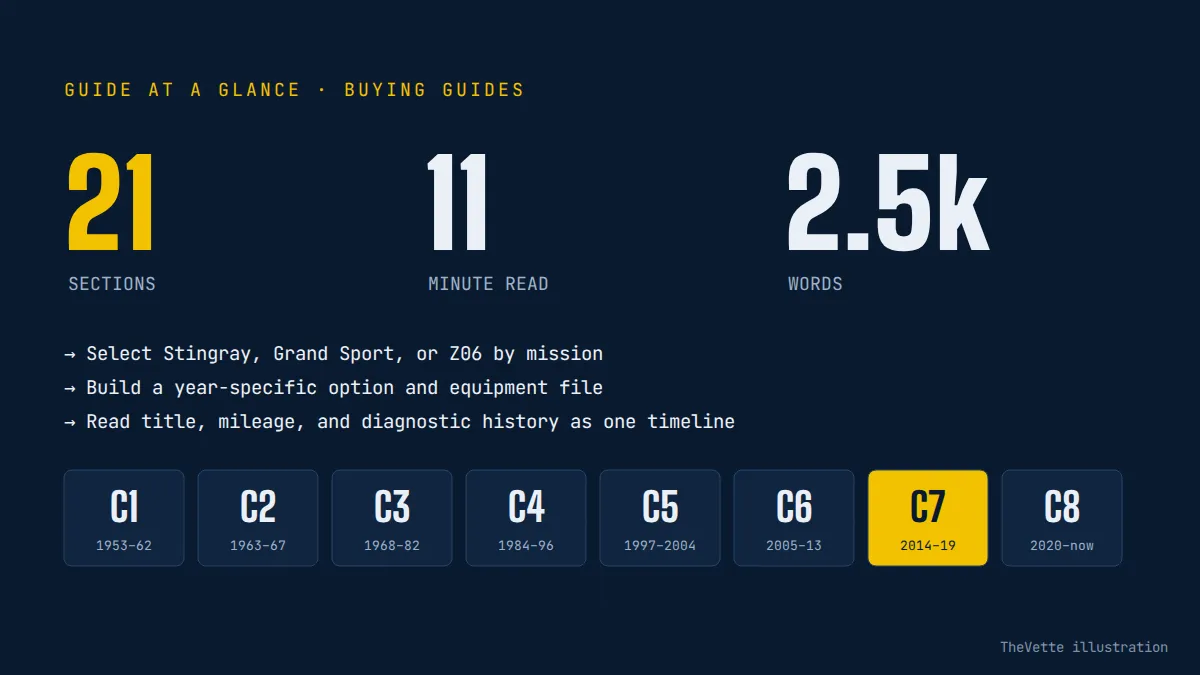
Select Stingray, Grand Sport, or Z06 by mission
A Stingray can be the simplest road-use answer, with performance that already exceeds many public-road opportunities. Z51 changes chassis, cooling, gearing, and related equipment according to year. Grand Sport combines the wider body and performance-oriented chassis with a naturally aspirated engine. Z06 adds supercharged output and greater thermal and consumable demands. Choose around touring, commuting, track use, originality, or modification plans rather than buying the most prestigious badge the budget permits.
Estimate tires, brakes, dampers, fluids, insurance, fuel, alignment, clutch or automatic service, and cooling maintenance for the exact trim. Carbon-ceramic brakes, wide wheels, specialized tires, and supercharger-related work can change ownership cost dramatically. Preserve a first-year reserve for an inspection and recommissioning. A lower purchase price does not make worn high-performance consumables inexpensive.
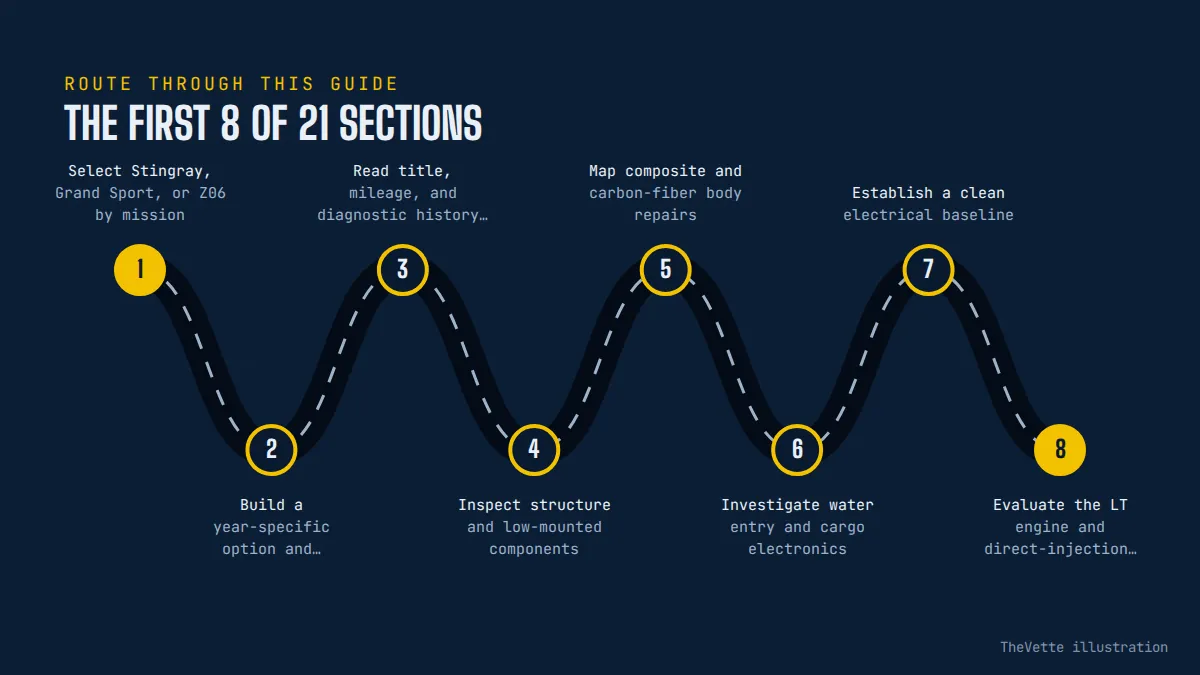
Build a year-specific option and equipment file
Record the correct engine, transmission, axle, brake package, suspension, wheels, tires, seats, roof or convertible equipment, cameras and electronics, and trim details for the model year. Photograph VIN and option information where available. Changes occurred during the generation, so a feature found on a 2019 should not be assumed on a 2014. Compare the physical car with primary records.
Appearance parts can make one trim resemble another. Wide fenders, wheels, spoilers, badges, and stripes do not establish a Grand Sport, Z06, special edition, or factory package. Confirm identity through VIN, production and option records, engine and chassis hardware, brakes, body configuration, and interior. When designation materially affects price, use an independent marque specialist.
Read title, mileage, and diagnostic history as one timeline
Compare the title with the VIN and review registrations, inspections, emissions results, tire dates, and invoices chronologically. Mileage wear varies with entry technique, climate, and track use; seat bolsters and pedals cannot prove a number alone. A vehicle-history report can identify events but cannot prove that no collision or repair occurred.
Scan accessible modules before clearing codes or disconnecting the battery. Save current, history, communication, and readiness information. Recent resets may erase useful context. Ask about track events, long storage, overheating messages, limp modes, tuning, engine work, and transmission service. Do not treat track use as automatic abuse; documented preparation and maintenance can make a used car more understandable than an unrecorded low-mileage example.
Inspect structure and low-mounted components
Use correct lifting procedures and examine frame and cradle areas, suspension pickups, central tunnel, floors, jacking points, bumper reinforcements, body attachments, and underbody panels. Look for crushed points, pulled fasteners, distortion, non-factory welds, corrosion evidence, and fresh coating over unclear work. Compare left and right clearances, wheel position, ducts, exhaust, and alignment.
Low splitters, deflectors, coolers, and undertrays are vulnerable to road and loading damage. Determine whether scraping is superficial or has torn mounts and adjacent panels. Aluminum and composite structural repairs require appropriate expertise. A clean history report cannot verify dimensions, while a documented professional repair need not make a road-use car unacceptable.
Map composite and carbon-fiber body repairs
View paint under diffuse daylight and raking light. Compare texture, gloss, contour, edge masking, fastener disturbance, and overspray across bumpers, hood, fenders, doors, quarters, rockers, roof, vents, lamps, and hatch surround. Specialized hoods and carbon-fiber panels can be expensive and require material-appropriate repair. A fresh finish can hide cracks or excessive sanding around mounting points.
Operate hood, doors, hatch, fuel door, roof latches, and convertible top slowly. Check hinges, latches, seals, drain paths, vent attachments, and panel clearance. A replacement roof or aero component should be identified, correctly secured, and compatible with intended speed and use. List original and take-off parts included with a modified car.
Investigate water entry and cargo electronics
Inspect seals around windshield, doors, roof, hatch, lamps, rear body openings, and convertible top. Lift accessible cargo panels with permission. Look for staining, moisture, mildew, oxidized fasteners, wet insulation, and water tracks. New weatherstrip does not prove that drains, alignment, adhesive, or body repair were corrected.
Moisture can affect connectors and modules before the cabin shows obvious damage. Connect intermittent audio, camera, hatch, keyless-entry, or warning behavior to the water inspection. On a coupe, remove and refit the roof by the approved procedure. On a convertible, cycle the mechanism completely and examine fabric, rear glass, bows, latches, seals, hydraulic components, deck interaction, and storage well.
Establish a clean electrical baseline
Observe the warning-lamp self-check, instrument display, driver information messages, cameras, infotainment, climate control, and selectable drive modes. Scan powertrain, transmission, brake, steering, suspension, body, restraint, and differential modules with compatible equipment. A generic emissions reader leaves much of the car unexamined. Record faults and readiness state before any reset.
Test battery capacity, alternator output, terminals, grounds, fuse centers, and parasitic draw when indicated. Low voltage can generate several symptoms. Trace radar detectors, audio equipment, lighting, exhaust controllers, dash cameras, and performance electronics for fusing and secure routing. An always-connected charger can preserve a battery but also conceal declining capacity or an unresolved drain.
Evaluate the LT engine and direct-injection system
Confirm the installed engine and factory configuration. Arrange a cold start and observe cranking, oil-pressure rise, exhaust after condensation clears, idle quality, misfire data, warning messages, accessory noise, and leakage. Inspect induction, vacuum lines, coils, injectors and high-pressure fuel-system surroundings without loosening pressurized components, belts, tensioners, mounts, grounds, exhaust, cooling connections, and heat shields.
Direct injection, variable valve timing, and active fuel management where fitted change diagnosis and calibration. Ask about oil consumption, misfires, injector or high-pressure pump work, cylinder-deactivation changes, camshaft or valvetrain modifications, and software updates. Compression, leak-down, borescope inspection, oil analysis, and fuel-trim review can be useful when interpreted by a qualified technician. Do not infer internal condition from a clean engine cover.
Understand lubrication before checking the level
Oil capacity and checking procedure depend on the exact engine and lubrication arrangement. Some configurations use dry-sump systems that require specified temperature, timing, and dipstick procedure. Follow the correct owner documentation; an arbitrary cold reading can mislead and overfilling can cause problems. Review invoices for oil specification, quantity, interval, and filter.
Track use can change recommended service and inspection. Ask about oil temperatures, event intervals, cooler maintenance, and analysis results. Look for leaks around tanks, lines, fittings, engine, and coolers as applicable. A catch can, altered ventilation system, or deleted cylinder-deactivation strategy should be documented, securely installed, legally compliant, and compatible with calibration.
Inspect Z06 supercharger and charge cooling as a package
For a Z06, review supercharger service, belt drive, pulley configuration, charge-cooling circuit, pump, heat exchangers, hoses, reservoirs, calibration, injectors, and fuel requirement. A smaller pulley or higher boost changes thermal and fueling margins. Ask for tuner information, logs, dyno conditions, and the complete parts list rather than accepting a peak number.
Listen cold and hot for abnormal drive or bearing noise, look for belt dust and misalignment, and inspect fluid circuits for leakage or air. Review data for intake temperature, knock, fuel trims, misfires, and pressure behavior when available. High-load evaluation belongs in a controlled setting with owner approval. A smooth idle cannot prove charge-cooling performance after repeated acceleration.
Test thermal management in realistic phases
Inspect radiator and condenser faces, ducts, seals, fans, reservoirs, hoses, water-pump area, engine-oil, transmission, differential, and charge coolers where fitted. Low openings collect debris. Missing deflectors or damaged undertrays can change airflow. Added coolers need secure mounts, protected lines, and a clear thermostat or control strategy.
Observe coolant, oil, transmission, and differential temperature data as available during idle, ordinary driving, slower traffic, and heat soak. Interpret it against correct documentation and ambient conditions. Ask about any over-temperature, reduced-power, or limp-mode event and the diagnosis that followed. A car prepared for track use should have records connecting cooling changes to measured needs.
Check manual gearbox, clutch, and rev matching
On a manual, inspect clutch fluid, pedal action, release, engagement, shifter centering, synchronizer behavior, reverse, and noise after warming. Verify active rev matching operation where equipped and any steering-wheel controls. Determine whether clutch, flywheel, hydraulics, shifter, gearing, or calibration changed. An aggressive clutch may suit competition but impose a real street-use compromise.
Listen for torque-tube, gearbox, differential, and mount symptoms at idle, during clutch changes, acceleration, steady speed, and coast. Major access labor makes diagnosis important. Review invoices to see whether related bearings, seals, hydraulics, mounts, and fasteners were addressed together. Vibration should be categorized by engine speed, road speed, load, and gear.
Evaluate the automatic by year and calibration
Confirm the installed automatic and its correct behavior. Assess engagement delay, shift timing, part-throttle smoothness, commanded manual shifts, converter lockup, temperature, and leakage after full warm-up. Software can alter pressure, torque management, and shift schedules. Ask who tuned it, which fuel and hardware the calibration expects, and whether the original file is preserved.
Inspect cooler routing, case and connector areas, mounts, differential interface, and signs of previous removal. A hard shift is not proof of strength, and a seamless shift is not proof of health. Repeated overheating, slipping, flare, delayed selection, or ratio codes require specialist diagnosis. For track use, match fluid and cooling practice to official guidance for that configuration.
Inspect differential and electronic limited-slip behavior
Identify the differential system fitted to the trim. Inspect case, mounts, coolers and lines where present, half-shafts, constant-velocity joints, hubs, wiring, and sensors. On the road, compare noise and vibration under drive, coast, steady load, and gentle cornering. Tire roar, hubs, gears, torque tube, and exhaust resonance can overlap.
Where an electronically controlled differential is fitted, scan its module and verify that drive modes do not create faults or binding. Correct fluid and service procedure matter. Tire diameter, mismatched compounds, altered gearing, and calibration can affect active systems. Ask whether differential or axle work followed launches or track events and review the detailed invoice.
Test steering, suspension, and magnetic damping
Inspect control arms, springs, bushings, ball joints, tie rods, steering system, anti-roll bars, dampers, hubs, and cradle attachments. Look for play, torn boots, leaks, impact damage, ride-height differences, contact marks, and mixed parts. Adjustable suspension should have recorded settings. Lowering must retain bump travel and clearance through steering and compression.
Verify Magnetic Ride Control option identity, warning status, connector condition, damper leakage, and response across modes where fitted. Passive conversions should be disclosed and electronically resolved without hiding other faults. During the drive, note steering center, tramlining, bump response, and stability only after recording tire age, model, pressure, and alignment evidence.
Price brake systems by condition, not appearance
Inspect master cylinder, booster, lines, hoses, calipers, rotors, parking brake, ABS sensors and wiring, and fluid. High-performance brakes need pad-wear comparison, heat-history review, dust-boot and seal inspection, proper hardware, and measured rotor condition. A shiny surface cannot establish remaining life. Ask for track pad, street pad, and fluid practices.
Carbon-ceramic systems require knowledgeable inspection and substantial replacement-cost awareness. Chips, wear measurement, contamination, and handling procedures differ from iron rotors. Begin the road test with controlled low-speed stops. Pedal travel should remain stable and the car should track straight without drag, vibration, grinding, or warnings. Aftermarket systems need correct bias, clearance, fasteners, and electronic compatibility.
Tires reveal age, alignment, and intended use
Record brand, model, size, load and speed description, date code, and pressure at every corner. Inspect inner shoulders, sidewalls, repairs, heat cycles, flat spots, and rubbing. Trim-specific staggered fitments and very wide rear tires make substitutions important. Mixing families can alter wet balance and stability-control behavior even when nominal dimensions fit.
Inspect wheels for bends, cracks, refinishing over damage, incorrect offsets, damaged lug seats, and representation as factory or special-edition equipment. Track wheels should be identified separately from road wheels. Verify tire-pressure monitoring and sensor age. Replace unsafe tires before high-speed evaluation, then measure alignment after hubs, bushings, ride height, and wheels are known.
Operate the entire cabin and data equipment
Test keyless entry, locks, windows, mirrors, seats, belts, steering-column adjustment, climate and air conditioning, wipers, washer, lamps, cameras, parking aids, head-up display, instrument modes, infotainment, audio, navigation, power outlets, hatch and fuel releases, drive-mode selector, and performance data recorder where fitted. Confirm warning lamps are visible during self-check.
Inspect seat bolsters and frames, carpet, pedals, console, switch legends, cargo shade, storage bins, mobility equipment, manuals, keys, roof tools, and electronic accessories. Fuel or exhaust odor requires investigation of tank, lines, seals, hatch fit, and exhaust. Verify included recordings and storage media are handled with the previous owner’s privacy in mind; erase personal data through the proper process after transfer.
Conduct a calm, instrumented road test
Confirm insurance and begin with low-speed steering and braking. Add normal acceleration, multiple shifts, steady cruising, moderate bumps, and enough time for full temperature. Observe starting, idle, throttle response, transmission, steering, brakes, instruments, warnings, cooling, charging, vibration, wind noise, and fumes. Do not test performance limits on public roads.
After shutdown, park over clean ground and inspect for fresh oil, coolant, transmission or differential fluid, fuel, and brake fluid. Observe fan behavior and hot restart, then rescan modules without clearing evidence. Sort findings into safety, reliability, diagnostic work, configuration questions, and cosmetics. Obtain estimates from technicians familiar with the trim and track-related inspection.
Demand documentation proportional to complexity
Useful records include registrations, inspections, recall documents, option information, alignment sheets, module scans, tune files, logs, dyno reports with conditions, engine or transmission invoices, cooler installation, brake measurements, fluid service, tire receipts, and photographs before body repair. Read them chronologically. A parts invoice proves purchase, not correct installation or calibration.
When price depends on special-edition identity, low mileage, original paint, carbon-ceramic brakes, supercharger work, or a modified engine, seek independent expertise. List roof panels, wheels, track parts, take-offs, keys, manuals, covers, chargers, and data devices in the agreement. Preserve original calibration and diagnostic files in formats the next owner can use.
Choose the car whose systems agree
A strong C7 purchase aligns title, VIN, options, physical hardware, service history, module data, structure, road behavior, and intended use. Safe tires and brakes, stable fluids and temperatures, sound voltage, predictable steering, and documented calibration outrank peak output or cosmetic perfection. Estimate known work and retain contingency for problems that appear through regular use.
Walk away when identity evidence conflicts, structure cannot be inspected, safety systems are bypassed, data is repeatedly erased, or major modifications have no records. The generation offers enough combinations to remain patient. The right C7 is not the one with the longest option list; it is the configuration whose performance, complexity, and operating cost fit the owner who will maintain it.