The 1963–1967 Corvette Sting Ray compresses several major design and engineering changes into a five-year shape that can look deceptively uniform at first glance. The 1963 split-window coupe is visually unmistakable, but less famous differences in vents, trim, brakes, engines, transmissions, interiors, and identification details matter just as much when judging a particular car. A useful buyer’s guide therefore starts with a model-year file, not a universal list of “C2 traits.” Build that file from the correct General Motors vehicle information material, reputable judging references, and the evidence carried by the car itself.
To place C2 Corvette Buyer’s Guide: Sting Ray Details That Matter in a wider ownership and engineering context, continue with The Story Behind the Corvette Sting Ray and Stingray Names.
A C2 can be a preserved historical object, a concours restoration, a thoughtfully upgraded road car, or a long-used driver. None of those identities is inherently superior, but price and expectations must match. TheVette is independent and does not authenticate cars or estimate values. The method here is to define the intended use, establish identity, examine structure and repair quality, evaluate safety and mechanical health, and then decide how much originality or model-year correctness you are actually buying.
Choose a use case before choosing a celebrated option
The split rear window, big-block engines, fuel injection, special performance equipment, and desirable colors can dominate a listing. Start somewhere less exciting: how will the car spend its next five years? A buyer who expects long interstate days needs cooling, gearing, seats, weather sealing, and predictable road manners. A preservation buyer needs strong documentation and a high threshold for irreversible changes. A show-focused owner may prioritize finish accuracy and judging standards. A weekend driver can accept non-original components when they improve reliability and are disclosed.
Write an acquisition brief with annual mileage, road types, storage, passenger needs, mechanical ability, and tolerance for cosmetic wear. Add the real first-year budget: inspection, enclosed transport if needed, registration, tax, insurance, tires, fluids, brake commissioning, and a contingency for discoveries after regular use begins. This prevents a premium engine claim from consuming money that should make the car safe and dependable. The best C2 for a particular owner is a coherent package, not automatically the rarest configuration within reach.
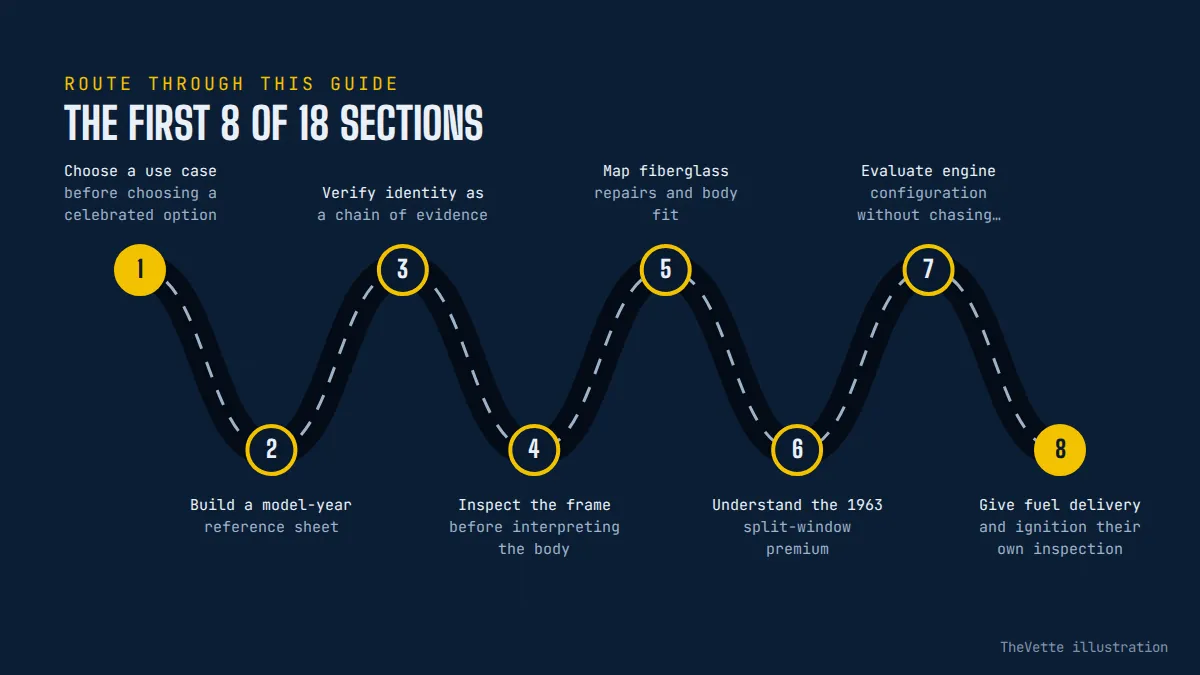
Build a model-year reference sheet
Record the characteristics that should be present for the year under consideration: visible trim, grille and vent treatment, hood style, lamps, interior details, wheel equipment, available engines, transmissions, brakes, and significant options. Use the proper GM information kit as the primary starting point, then consult recognized marque references for production nuances. Avoid relying on online photo galleries whose cars may be modified or mislabeled. A reference sheet turns inspection into comparison and exposes questions that memory would miss.
Do not treat every deviation as fraud. Service replacements, dealer changes, collision repairs, competition use, and decades of owner preference have altered many cars. Identify each departure, ask when and why it occurred, and decide whether it affects safety, historical character, cost, or only judging points. A later engine in a well-sorted driver may be acceptable at an appropriate price. The same engine is a serious contradiction if the sales contract represents it as original. Precision in language protects both parties.
Verify identity as a chain of evidence
Begin with the title and the vehicle identification plate or stamping appropriate to the car. Confirm that characters, attachment, location, and surrounding material are consistent with accepted references. Compare the stated assembly timing with body, trim, powertrain, and component evidence without expecting every dated part to share one day. Production and supplier lead times create ranges. Suspicious disturbance or an implausible sequence calls for a specialist who understands C2 manufacturing, not aggressive scraping or an improvised internet verdict.
Define any “matching numbers” statement component by component. Does it cover the engine assembly stamp and VIN derivative, the transmission, rear axle, carburetor or injection unit, distributor, alternator, starter, radiator, or only the block? Which items have legible dates, and what documentation connects them to the vehicle? Restamps and reproduction tags exist, so the presence of characters alone is weak proof. Their style, location, surface, sequence, and relationship to other evidence must make sense together.
Inspect the frame before interpreting the body
A C2’s separate steel frame carries loads that the fiberglass exterior cannot reveal by paint condition. On a correctly positioned lift, examine the rails, front crossmember, suspension mounts, transmission support, body-mount areas, outriggers, rear kick-up, bumper brackets, and differential support region. Look for perforation, swelling seams, crushed lifting points, collision kinks, torn mounts, and patches that bridge rather than reconstruct original structure. Fresh undercoating is not evidence of repair quality; edges and hidden faces still need inspection.
Compare both sides for shape, weld style, bracket placement, wheelbase relationship, and clearance. Measure when visual evidence suggests misalignment. A repaired frame can be serviceable if straightening, metal work, corrosion protection, and alignment were professionally documented. Conversely, an apparently untouched frame can be unsafe when rust remains hidden. Restoration photographs taken after body removal are especially useful, but verify that identifying features in the photographs belong to the car being offered.
Map fiberglass repairs and body fit
View the car indoors under raking light and outdoors in neutral daylight. Study panel contours, bonding seams, door edges, wheel openings, headlamp doors, hood surround, roof or convertible deck, and the areas near body mounts. Fiberglass can crack from impact, poor support, incorrect repair materials, excessive sanding, or stress that remains active beneath new paint. A small stable flaw in an older finish may be less concerning than broad flawless paint over undocumented reconstruction.
Door operation is highly informative. Open each door slowly, note hinge movement, check whether the latch must lift the door, and compare gaps while latched. Inspect the door posts and adjacent structure as access permits. Operate the hood, headlamp doors, fuel door, and rear storage areas without forcing them. On a coupe, check the roof, glass surrounds, rear window installation, and evidence of water entry. On a convertible, inspect top-frame geometry, latches, header, deck fit, drainage, and the condition of any auxiliary hardtop.
Understand the 1963 split-window premium
The divided rear glass is unique to the 1963 production coupe and carries a powerful market premium. That makes identity and body history unusually important. Examine the center divider, inner structure, window openings, trim fit, glass, weatherstrip, and evidence that a later one-piece opening was converted back. A conversion can be visually convincing but does not recreate factory history. Documentation from before restoration, old photographs, ownership records, and expert examination should support a high-value claim.
Do not let the rear window consume the entire inspection. A genuine split-window body on a compromised frame or with an inaccurately represented powertrain remains a compromised purchase. Likewise, a correctly disclosed car with an older modification can still be an enjoyable driver at the right price. The issue is correspondence between physical facts, documentation, seller language, and valuation. When the premium rests on authenticity, spend proportionally on expert verification.
Evaluate engine configuration without chasing horsepower folklore
C2 engine offerings ranged across small-block and big-block applications, with carbureted and, in earlier years, mechanically fuel-injected configurations. Availability and ratings changed by year. Confirm the exact claimed engine code and compare it with the model-year record before discussing output. Published gross horsepower from the period should not be compared directly with later net ratings or modern chassis-dynamometer results. For a purchase, current health and installation quality matter more than repeating a catalog number.
Request a truly cold start. Observe cranking speed, choke or enrichment behavior, oil-pressure rise, exhaust after condensation clears, idle quality, and noises through warm-up. Inspect for fuel seepage, coolant staining, oil leaks, improvised breathers, damaged ignition shielding, poor grounds, and hoses near exhaust heat. If compression, leak-down, or oil analysis would change the decision, agree on testing with a qualified shop. Treat the results as diagnostic evidence, not a standalone pass/fail score detached from temperature, equipment, and engine history.
Give fuel delivery and ignition their own inspection
Multiple carburetors or mechanical fuel injection demand knowledge beyond verifying that the hardware is present. Check casting and part identification, linkage, return springs, fuel-line routing, filters, heat protection, vacuum connections, and evidence of leakage. Ask who last calibrated the system and under what driving conditions. A rare induction setup that will not start hot, idle cleanly, or transition under load can require expensive specialist attention. An undocumented electric pump or regulator should be traced from power source to safety strategy.
The ignition system must work with the engine and tachometer configuration. Examine distributor identification, shielding, plug-wire routing, coil installation, ballast or resistance arrangements where applicable, and any electronic conversion. Modifications may improve regular use, but they should not masquerade as factory parts or rely on hidden, unserviceable wiring. After a warm drive, restart the car and note cranking, spark behavior, and fuel smell. Heat-soak symptoms often appear only after the listing photos are finished.
Cooling evidence matters more than the seller’s normal-temperature claim
Inspect the radiator type and condition, tanks, cap, hoses, clamps, expansion or recovery arrangements appropriate to the installation, water pump, belts, fan, shroud, and seals that direct air. Look for dried coolant, overflow residue, pinhole spray patterns, solder repairs, and bent fins. Confirm the gauge against an independent temperature measurement if readings seem implausible. A car can appear stable during a short open-road drive yet become troublesome in traffic or during a hot restart.
Diagnose overheating as a system. Airflow, ignition timing, mixture, coolant circulation, radiator capacity, pressure control, combustion leakage, and inaccurate instruments can interact. Added electric fans or aluminum radiators may be reasonable on a touring car, but ask what problem they addressed and whether the installation is electrically protected and physically isolated. A sequence of additions without a documented root-cause diagnosis is less reassuring than a conventional system restored to proper operation.
Check transmission, clutch, driveline, and differential together
Confirm the transmission type and identification promised in the listing. With a manual, assess clutch free play, release, engagement smoothness, shift effort, synchronizer behavior, and noise under acceleration and coast. With an automatic, check fluid condition, engagement delay, shift consistency, kickdown operation, cooler routing, and leakage. A conversion changes pedals, linkage, wiring, tunnel details, speedometer drive, crossmember, driveshaft, and often axle-ratio suitability; examine the whole conversion rather than only the gear lever.
Inspect engine and transmission mounts, universal joints, half-shafts, driveshaft, differential support, axle seals, and clearances. During the road test, separate engine-speed vibration from road-speed vibration and note whether sound changes between drive and coast. Clunks can arise from accumulated lash across several joints rather than one dramatic failure. Confirm the final-drive ratio because it shapes acceleration, cruising rpm, speedometer accuracy, and the suitability of the car for long-distance use.
Rear suspension deserves model-specific attention
The Sting Ray introduced independent rear suspension to the production Corvette. Inspect the transverse spring, trailing arms and their mounts, half-shafts, universal joints, strut rods, differential attachments, wheel bearings, shocks, bushings, and evidence of contact or incorrect hardware. Alignment depends on sound parts and proper adjustment. Uneven rear tire wear, a visibly displaced wheel, or unstable behavior under power and braking requires investigation rather than an assumption that old sports cars are nervous.
At the front, examine control arms, ball joints, tie rods, idler and pitman components, steering gear, springs, shocks, and wheel bearings. Check for lubricant where fittings require it and for exhaust or tire interference through steering travel. On the road, the car should respond consistently and settle after bumps without repeated oscillation. Period steering effort and road texture are part of the experience; binding, dead movement, sudden toe changes, and persistent wander are maintenance or geometry questions.
Brakes changed significantly during the C2 run
Do not apply one brake checklist to every year. Establish the factory system and any later conversion, then inspect master cylinder, booster where fitted, hard lines, hoses, junctions, parking-brake hardware, and each wheel. Look for fluid tracks, contaminated friction surfaces, heat discoloration, seized adjusters or pistons, and hoses old enough that external appearance says little about the inner lining. Ask for the date and scope of the last hydraulic service, not merely whether the shoes or pads “look good.”
Begin the road test with a low-speed stop in a safe area. Pedal travel and effort should remain consistent; the car should not pull, grab, grind, or require pumping. If the system has been converted, assess pedal ratio, bracketry, line routing, proportioning, wheel clearance, and documentation. A dual-circuit master cylinder or modern friction material can be a sensible road-use choice, but the quality of engineering is more important than the label attached to the parts.
Verify wheels and tires before judging handling
Record tire brand, model, size, construction, load description, and date code at all four corners and on the spare. Inspect sidewalls, tread, beads where visible, and signs of contact with body, brake hose, frame, or suspension. A low-mileage show car can be sitting on hardened tires that make any handling impression meaningless. Replace questionable tires before a high-speed evaluation; appearance is not a reason to gamble with aged rubber.
Examine wheels for bends, cracks, elongated stud holes, damaged lug seats, and dimensions appropriate to the installed brakes and tires. Decorative covers and knock-off-style equipment require the correct components and procedures; have a specialist verify anything unfamiliar. Tire pressure should be selected from credible vehicle and tire guidance for the actual combination, not copied from a maximum molded into the sidewall. Alignment should be measured only after worn joints, bearings, and tires are addressed.
Operate every concealed mechanism and electrical load
Test headlamp doors repeatedly, along with exterior lights, turn signals, brake lights, horn, wipers, heater controls, blower, gauges, courtesy lamps, radio, antenna, power windows if equipped, and any aftermarket accessory. Intermittent headlamp movement can involve motors, limit switches, wiring, grounds, alignment, or mechanical drag. Do not cycle a binding mechanism until it damages paint or linkage. Ask for wiring diagrams and receipts for repairs.
Inspect accessible harness sections for brittle insulation, melted connectors, unfused feeds, household terminals, unsupported splices, and wires routed across sharp fiberglass edges. Confirm battery hold-down, cable condition, disconnect installation if present, charging voltage, and hot-start behavior. Added fans, pumps, ignition modules, audio equipment, and alarms increase load and complexity. A discreet modern fuse panel can be useful, but only when circuits are labeled, protected, and serviceable by the next owner.
Use the cabin and weather equipment as evidence
Inspect seat frames and tracks, belt installation, pedal pads, steering wheel, gauges, door panels, carpet, console, storage areas, latches, windows, and seals. Wear should broadly agree with the claimed history, allowing for restored components. Lift removable carpet sections only with permission and look for water marks, corrosion on fasteners, damaged fiberglass, and wiring repairs. Strong fragrance can be an attempt to mask fuel, mildew, or overheated insulation; identify the source of any persistent odor.
For a coupe, examine glass fit, stainless trim, weatherstrip, roof liner, and drainage evidence. For a convertible, raise and latch the top, inspect the frame joints, fabric, stitching, rear window, header seal, and storage well. Confirm that any hardtop fits the body and that latches, glass, headliner, trim, and stand are included as represented. Water testing should be agreed with the owner and performed carefully; visible staining already provides a reason to trace leakage.
Make the road test repeatable and calm
Plan a route containing low-speed turns, ordinary acceleration, steady cruising, gentle bumps, and enough time for operating temperature. Confirm insurance and allow the seller to demonstrate unfamiliar controls. Record observations rather than narrating excitement: cold and hot starting, idle, clutch or shift behavior, steering center, brake response, temperature, oil pressure, charging, driveline noise, fumes, vibration, and rattles. Avoid full-throttle demonstrations or abrupt maneuvers; they add risk without replacing a professional inspection.
After the drive, leave the car on clean ground and reinspect engine, transmission, differential, brakes, and cooling areas for fresh leakage. Watch hot restart and listen during heat soak. Sort findings into immediate safety items, near-term reliability needs, configuration or authenticity questions, and optional cosmetics. Ask the inspecting shop for photographs and estimates that name the affected system. A structured result supports a rational offer and reduces arguments over vague phrases such as “typical for the year.”
Audit the restoration and ownership timeline
Strong documentation connects identity, work, dates, mileage, and people. Look for pre-restoration photographs, body-off images, frame measurements, repair details, machine-shop invoices, component rebuild records, paint materials, alignment results, judging sheets, old registrations, and routine service after completion. A restoration can deteriorate while barely accumulating miles; calendar age matters for seals, brake fluid, tires, fuel residue, and electrical contacts. Determine what has happened since the final beauty photographs were taken.
A judging award records performance under a particular organization’s rules on a particular date. It does not prove current mechanical condition, legal title, or every seller claim. An appraisal is likewise an opinion for a stated purpose and time. Use these documents as parts of the evidence chain, not substitutes for current inspection. When provenance or originality materially affects price, engage an expert who is independent of the seller and familiar with the exact model year.
Conclude with correspondence, not perfection
A defensible C2 purchase has correspondence between the VIN and title, claimed model year and physical features, powertrain representation and component evidence, restoration story and records, asking price and condition, and the car’s setup and your intended use. Imperfections are expected. Undisclosed contradictions are different. Estimate safety and mechanical needs with qualified shops, confirm which parts and documents transfer, and put important representations in the purchase agreement.
Walk away when access is unreasonably restricted, identity remains unclear, structural evidence cannot be reconciled, or the price depends on claims no one will document. Patience is especially valuable in a market where an iconic shape can overwhelm method. The right Sting Ray does not need to be flawless; it needs to be honestly understood. That understanding lets a buyer choose whether originality, restoration detail, touring ability, or driver character is worth the compromise and cost.