The 1984–1996 Corvette is often described as the affordable entry to the nameplate, but price alone is a poor way to choose one. Fourteen model years encompass substantial changes in engines, transmissions, dashboards, brakes, wheels, safety equipment, and body details. A 1984 Cross-Fire car, a late Tuned Port Injection model, an LT1-powered coupe, and an LT4 six-speed Grand Sport share the basic generation while offering different maintenance questions and driving character. The sensible unit of research is the exact year and configuration.
To place C4 Corvette Buyer’s Guide: Finding the Right Driver in a wider ownership and engineering context, continue with A Real-World Corvette Maintenance Schedule.
This independent guide does not authenticate a particular car, endorse a seller, or promise appreciation. It provides a sequence for checking identity, structure, electronics, powertrain, chassis, and records. Use the corresponding General Motors vehicle information kit and owner or service documentation for year-specific specifications. Verify open safety recalls through a VIN-based official lookup. The objective is a C4 whose condition, history, and setup match its description and the buyer’s intended use.
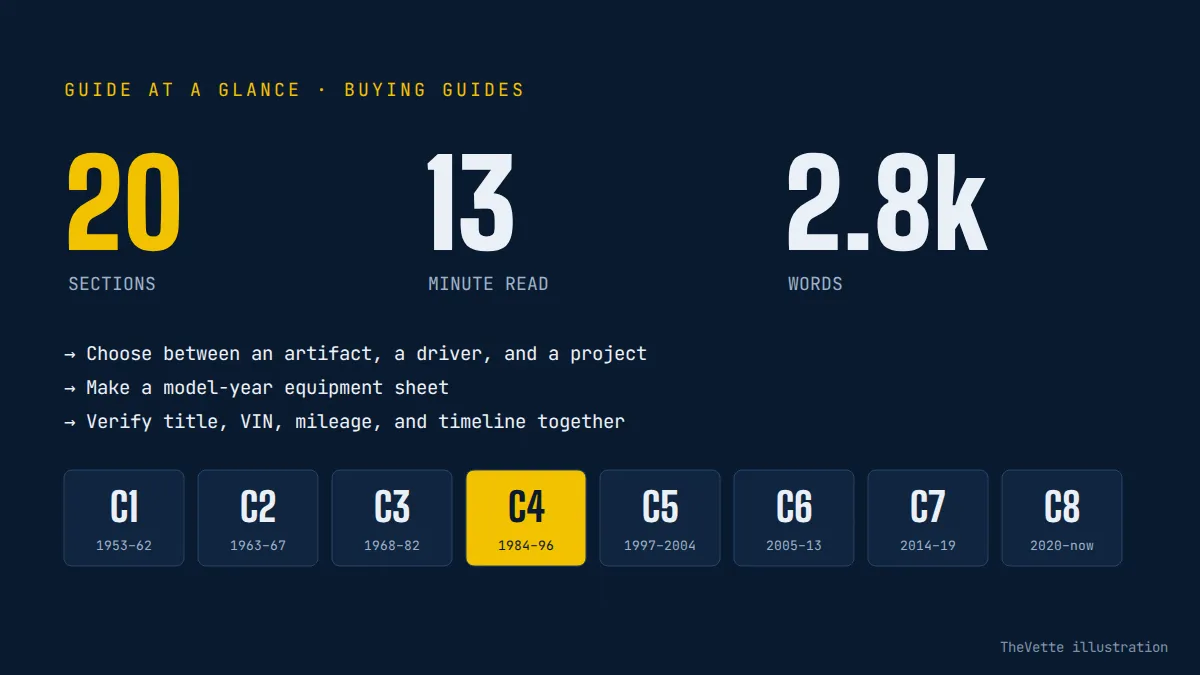
Choose between an artifact, a driver, and a project
A low-mileage survivor may preserve finishes and equipment but still need extensive age-related recommissioning. A frequently used driver can show cosmetic wear while benefiting from regular fluid circulation and recent repairs. A modified car may be quicker or easier to service, yet its wiring, calibration, cooling, brakes, and emissions compliance must work as one system. Decide whether originality, road use, shows, autocross, touring, or hands-on rebuilding is primary before comparing advertisements.
Reserve money beyond the purchase. Tires, battery, fluids, rubber hoses, brake service, weatherstrips, hatch struts, window mechanisms, cooling components, suspension bushings, and electronic diagnosis can erase the apparent bargain. Include transport, registration, insurance, storage, and an inspection by a shop familiar with C4 architecture. A well-documented car at a higher purchase price can cost less over two years than an inexpensive example with several unrelated faults.
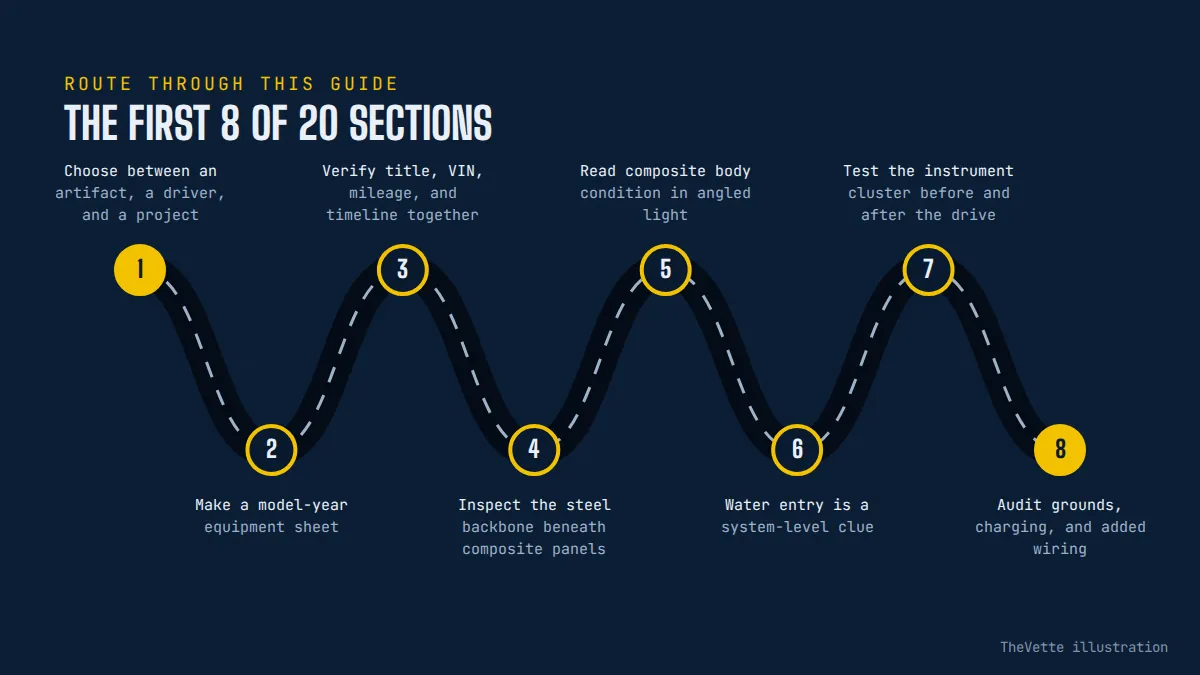
Make a model-year equipment sheet
Record the correct engine, transmission choices, instrument design, wheel and brake package, exterior trim, restraint equipment, and important options for the year. Note major transitions without assuming a calendar boundary applies to every component. Use primary records, not a compilation assembled from modified cars. This sheet helps distinguish a normal service replacement from a configuration that contradicts the listing.
Identify special editions cautiously. Paint and decals can be reproduced; identity depends on the VIN, production records, option codes, and physical details. A Grand Sport, Collector Edition, anniversary model, ZR-1, or other limited configuration warrants specialist review when the designation carries a premium. Do not use an online VIN decoder as the only proof. Examine the service-parts identification label where applicable and confirm that its condition and content make sense.
Verify title, VIN, mileage, and timeline together
Compare the title with the VIN visible on the car and check that the plate, characters, and surrounding area appear consistent. Review registration history, inspection records, service invoices, and mileage entries in chronological order. A five-digit odometer on some early instrumentation or replaced electronic cluster can complicate mileage claims. “Actual mileage” should be supported by continuity, not inferred from clean seats or pedal pads.
A cluster repair or replacement is not automatically negative. Ask who performed it, what mileage was recorded, and whether receipts document the before-and-after readings. Compare wear across steering wheel, seat bolster, carpets, pedals, door sill, switch legends, weatherstrip, and cargo area. No single surface proves mileage; a coherent pattern and records are stronger. Put any material mileage representation in the purchase documents.
Inspect the steel backbone beneath composite panels
The C4 uses composite exterior panels over a steel-intensive structure. Lift the car correctly and examine front and rear suspension attachment areas, central structure, floors, jacking points, crossmembers, transmission support, differential mounts, and bumper reinforcements. Look for collision distortion, torn mounts, crushed lift points, corrosion, poor welds, and fresh coatings applied without documentation. Compare left and right dimensions and wheel position.
Body-panel appearance can hide chassis repair. Inspect panel gaps, windshield and hatch openings, door fit, roof-panel seating, headlamp alignment, and bumper-cover shape. A competent collision repair may be acceptable when measurements and invoices establish what was done. Uneven tire wear, steering-wheel misalignment, a roof that will not seat, or repeated weatherstrip adjustments can be symptoms of geometry rather than isolated trim problems.
Read composite body condition in angled light
Check hood, doors, roof panel, quarters, bumper covers, lamp openings, mirrors, and hatch surround for cracks, waves, sanding marks, shrinkage, paint lifting, and mismatched gloss. Flexible bumper materials age differently from rigid panels and require compatible preparation. Stone chips on a regularly driven car are not structural defects. Broad contour changes, recurring cracks at mounting points, or fresh paint over unclear repairs deserve closer investigation.
Open the clamshell hood slowly and inspect hinges, latches, supports, inner panels, bonding, and clearance around adjacent parts. Confirm that headlamp doors cycle without scraping. Remove the roof only with the owner’s consent, using the correct procedure, and examine its mounting inserts, seals, storage hardware, and panel condition. Replacement transparent panels and painted panels may have different value to different buyers; list what is included.
Water entry is a system-level clue
Inspect weatherstrip around doors, roof, windshield, hatch, and rear body joints. Look beneath removable mats and cargo trim for dampness, staining, corrosion on fasteners, swollen sound material, or musty odor. Check hatch pull-down or latch operation and whether the glass sits evenly. New seals can leak when adjustment, drains, or body alignment are wrong, while old seals may look acceptable until the car flexes or sits in rain.
Water can damage connectors, grounds, modules, seat mechanisms, carpet, and interior finishes. Ask whether leaks were traced and test repairs only with permission. A hose directed indiscriminately at the cabin can create problems and is not a substitute for methodical diagnosis. Follow staining upward, inspect drain paths, and distinguish condensation from exterior entry. A dry car with older seals may be preferable to one recently detailed after repeated wet storage.
Test the instrument cluster before and after the drive
Early digital displays are central to the C4 experience and can develop dim, intermittent, or failed segments and illumination. Later clusters have their own electronic and mechanical concerns. With the key on, observe the warning-lamp check, display brightness, gauges, odometer, trip functions, and backlighting. Start the engine and compare readings with known measurements where practical. A stable display when cold may flicker after cabin heat builds.
Cluster repair services can restore function, but receipts and workmanship matter. Ask whether mileage memory, power supply, bulbs, lenses, and circuit connections were serviced. Do not accept a working temperature or oil-pressure display as proof that the underlying sender is accurate. Diagnostic decisions require independent measurements. Check that warning lamps have not been removed to conceal faults and that no aftermarket panel blocks required indicators.
Audit grounds, charging, and added wiring
C4 systems depend on sound voltage and grounds. Inspect battery condition and hold-down, cable ends, engine and chassis grounds, alternator output, starter behavior, fuse panels, and accessible harness sections. Look for green corrosion, overheated terminals, brittle insulation, wires pinched by the hood, and unfused leads connected directly to the battery. Low voltage can create several misleading electronic symptoms at once.
Trace alarms, audio equipment, fans, fuel-pump controls, lighting conversions, and other additions. Each should have appropriate fuse protection, relays where required, secure routing, and documentation. Twisted wires, quick taps, household connectors, and unidentified switches predict difficult troubleshooting. A battery cutoff may help storage but should not be used to mask a parasitic drain. Measure the drain using a correct procedure rather than repeatedly replacing batteries.
Identify the engine system before diagnosing it
Engine management changed across the generation, from early Cross-Fire Injection through Tuned Port Injection and later LT1 or LT4 systems, with the ZR-1’s LT5 requiring its own expertise. Confirm what should be present for the VIN and year, then document modifications. Calibration, injectors, intake, camshaft, exhaust, ignition, gearing, and cooling must be compatible. A collection of performance parts without a build sheet is uncertainty, not added value.
Request a cold start and observe cranking, idle flare, oil-pressure rise, exhaust after moisture clears, warning lamps, and transition to closed-loop operation where applicable. Listen for knocks, persistent valve-train noise, accessory bearings, exhaust leaks, and vacuum leaks. Inspect for oil and coolant seepage, damaged connectors, improvised vacuum routing, deteriorated fuel hoses, and heat-affected wiring. Scan diagnostic information with equipment appropriate to the year; later generic readers do not communicate with every early system.
Cooling must be judged in the C4’s airflow environment
The low nose collects debris and relies on unobstructed airflow through the intended path. Inspect the lower intake area, radiator and condenser faces, seals, fan operation, shroud, hoses, pressure cap, reservoir, water pump, and evidence of coolant leakage. Leaves and road debris can accumulate where a quick engine-bay glance misses them. Bent fins, missing seals, or a fan wired permanently on may indicate an unresolved issue.
Observe temperature during idle, steady driving, slower traffic, and heat soak, interpreting readings with the correct year’s strategy and verified instrumentation. Avoid assuming that any number above a modern expectation proves overheating; control calibrations differ. Equally, do not accept coolant odor, discharge, repeated fan overrides, or boiling as normal. Diagnosis can involve airflow, sensor accuracy, fan controls, radiator condition, pump, thermostat, cap, mixture, ignition, or combustion leakage.
Check transmission behavior and clutch hydraulics
C4 transmissions vary significantly. Establish the exact unit and its operating method before the test. On early manual arrangements, understand the overdrive system and verify engagement, indicators, controls, and behavior under appropriate conditions. On later six-speeds, assess clutch release, synchronizers, shifter action, noise, and any forced-skip feature or modification. Automatic cars should engage promptly, shift consistently, and show clean fluid without burned odor.
Inspect clutch hydraulics where fitted, linkage or wiring, cooler lines, mounts, driveshaft, universal joints, seals, and evidence of tunnel or crossmember alteration. A conversion can be enjoyable but may affect cruise control, reverse lamps, speedometer, starting interlock, final drive, and emissions calibration. Ask for parts lists and diagrams. Vibration should be categorized by engine speed, vehicle speed, throttle load, and gear so that the inspection does not blame the nearest visible component.
Rear axle and wheel-bearing noise require careful separation
Inspect differential housing and mounts, half-shafts, universal joints, hubs, seals, and suspension links. During the drive, listen on acceleration, steady throttle, coast, and gentle turns. Differential whine, universal-joint clunk, tire roar, and hub-bearing noise can overlap inside the C4 cabin. A lift examination and controlled loading are more useful than a seller’s guess.
Check for lubricant leaks and evidence that exhaust or aftermarket suspension parts contact the driveline. Establish final-drive ratio and tire diameter when engine speed seems inconsistent. If the car has been drag raced or used with sticky tires, look closely at mounts, joints, transmission, differential, and wheel studs. Do not fabricate a competition history from one modification, but ask how the car was used and what service followed.
Inspect suspension and steering as a complete chassis
Examine control arms, transverse composite springs, bushings, ball joints, tie rods, steering rack and mounts, shocks, anti-roll bars, wheel bearings, and fasteners. Look for cracked bushings, leakage, play, contact marks, ride-height differences, and mixed components. Adjustable or performance parts should have known settings. A lowered car needs adequate bump travel, tire clearance, and alignment, not merely an aggressive stance.
On the road, note steering center, return, tramlining, response over bumps, and stability under modest braking and acceleration. Wide tires can follow pavement grooves, but looseness or sudden toe change is not an unavoidable C4 quality. Selective Ride Control or other adjustable systems should change modes without warning lights or uncontrolled bouncing. Replacement passive shocks may be acceptable when disclosed; understand how the change affects originality and controls.
Brake condition matters more than rotor appearance
Inspect master cylinder, booster, hard lines, flexible hoses, calipers, rotors, parking brake, ABS wiring and hydraulic components where equipped, and fluid condition. A polished rotor face cannot show hose age or internal contamination. Ask when fluid was replaced and whether calipers, master cylinder, and ABS faults have been addressed. Confirm that warning lamps illuminate during the self-check and then behave normally.
Begin the test with gentle low-speed stops. Pedal travel should stay consistent and the car should track straight without drag, pulsation, grinding, or warning lamps. Afterward, compare wheel heat cautiously without touching components. Aftermarket brake packages require correct master-cylinder relationship, hose routing, wheel clearance, fasteners, and bias. A safety system disabled to extinguish a complaint is not a repair.
Tire age can dominate the entire driving impression
Record brand, model, size, load and speed description, date code, and condition at all four corners. Later C4s and performance versions can use different front and rear sizes. Verify fitment for the exact wheels and suspension. Inspect inner sidewalls, shoulders, flat spots, repairs, and rubbing. Deep tread on old tires is not reassurance; hardened rubber can create poor braking, noise, and abrupt breakaway.
Check wheels for cracks, bends, corrosion, damaged lug seats, incorrect directional installation where relevant, and refinishing that obscures defects. Confirm that special-edition or ZR-1 wheels are represented accurately when they contribute to price. Replace unsafe tires before attempting a high-speed evaluation. Alignment data becomes meaningful only after tire condition, bearing play, ride height, and worn joints are resolved.
Operate every cabin feature deliberately
Test windows, mirrors, locks, seats, lumbar or sport-seat functions, climate controls, air conditioning, blower speeds, wipers, washer, horn, lamps, radio, antenna, hatch release and pull-down, rear defogger, cruise control, and steering-column adjustments. Switches and trim can be difficult or costly to restore correctly. Record each failure rather than accepting that all old electronics behave that way.
Inspect seat frames, tracks, belts and anchorages, pedals, steering wheel, door panels, console, carpet, headliner, cargo shade, storage bins, and spare-tire equipment. Compare wear with mileage documentation. Strong fuel or exhaust odor demands investigation of tank, lines, hatch sealing, and exhaust leaks. Verify that doors latch securely and that the hatch cannot release unexpectedly. Interior cosmetics also reveal whether the car was stored in sun, moisture, or heat.
Use official recall lookup by VIN
Safety campaigns and recall applicability depend on the exact VIN and completion history. Search the official NHTSA recall database and obtain supporting documentation from an authorized repair channel where appropriate. Do not conclude that a car is clear merely because a model-year list does not mention it, and do not assume every vehicle in a broad internet list remains unrepaired. Preserve the lookup result with the inspection file.
Recall status is separate from ordinary wear and service campaigns. A completed recall does not certify the whole car, while an open recall may have a defined remedy. Ask about airbag, restraint, lighting, brake, fuel, and steering work documented in the history without treating rumor as fact. Safety equipment should never be bypassed to avoid a warning lamp or parts search.
Conduct the road test in phases
Confirm insurance and begin with braking and steering at low speed. Add ordinary acceleration, steady cruising, moderate bumps, gentle curves, and enough time for full operating temperature. Observe cold and hot starting, idle, throttle response, shifts, clutch behavior, steering, brakes, instruments, warning lamps, cooling, charging, vibration, fumes, wind noise, and rattles. Aggressive driving is unnecessary and can hide more than it reveals by overwhelming subtle symptoms.
After shutdown, park over clean ground, inspect for fresh leaks, observe fan and heat-soak behavior, and perform a hot restart. Scan for stored diagnostic information using year-appropriate equipment. Sort findings into immediate safety issues, reliability work, electrical diagnosis, configuration questions, and cosmetics. Obtain estimates from specialists rather than applying generic parts prices to labor-intensive access and diagnosis.
Let documentation connect the car’s life
Useful records include original sales material tied to the VIN, service-parts label photographs, registrations, inspection reports, cluster repair invoices, alignment sheets, emissions results, diagnostic printouts, parts receipts, and dated images. Read them chronologically. Long storage, repeated battery replacement, recurring cooling work, or several alignments can point to unresolved patterns. A thick folder is valuable only when the entries identify the car and the work actually performed.
Special-edition provenance, very low mileage, rare options, and original paint can justify independent expert review. Appraisals and awards describe opinions at particular dates; they are not current mechanical warranties. Confirm which roof panels, wheels, manuals, keys, diagnostic tools, take-off parts, and covers transfer with the sale. Put material claims and included items in writing.
Select the understandable car
A good decision aligns identity, configuration, records, physical condition, and intended use. Prioritize safe tires and brakes, sound structure, reliable fuel and cooling systems, predictable steering, and electrical integrity. Then price cosmetics, originality, special equipment, and modifications according to your goal. Do not let one repaired display or fresh repaint define the whole car.
Walk away when VIN or title evidence conflicts, access to the underside is refused, safety systems are deliberately defeated, major modifications lack documentation, or pressure replaces answers. The C4 market offers enough variety to be patient. An honest, maintained example can deliver distinctive analog performance and practical hatchback usability without pretending to be a newer Corvette. Understanding its compromises before purchase is the foundation of that value.