A useful Corvette maintenance schedule is not a universal mileage chart. Eight generations span carburetors and direct injection, points ignition and networked controllers, manual gearboxes and dual-clutch transmissions, wet and dry sumps, iron and carbon-ceramic brakes, and now electrified all-wheel drive. The correct interval and procedure belong to the exact VIN, model year, equipment, market, and use.
To place A Real-World Corvette Maintenance Schedule in a wider ownership and engineering context, continue with How to Store a Corvette the Right Way.
This guide shows how to build a real-world plan from authoritative documents, condition evidence, time, mileage, and operating severity. It does not replace an owner or service manual or sell premature flushes. Maintenance prevents predictable deterioration; diagnosis responds to symptoms; repair corrects faults; recalls address defined safety or compliance defects. Keeping those categories separate saves money and improves records.
Start with a vehicle identity sheet
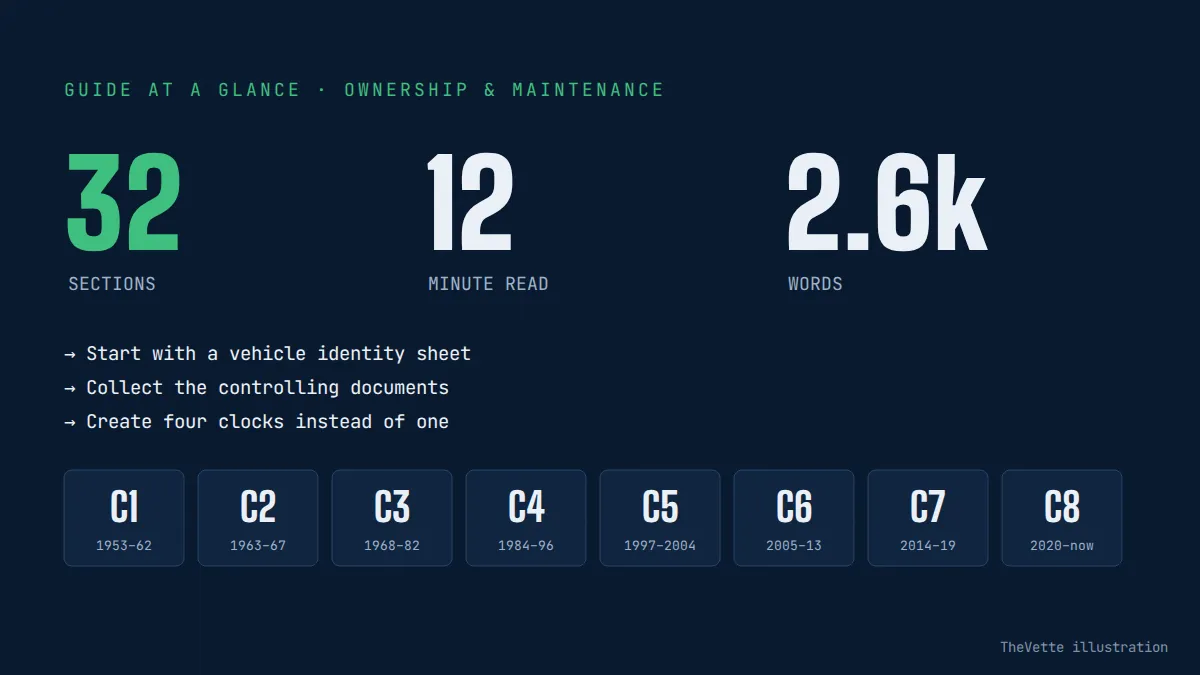
Record VIN, model year, trim, engine, transmission, axle, suspension package, brake system, oiling system, wheel and tire specifications, market, and meaningful modifications. Note whether the car has dry-sump lubrication, Magnetic Ride Control, carbon-ceramic brakes, front lift, hybrid drive, or track aero.
Photograph build labels and current part numbers. An engine swap, brake conversion, aftermarket supercharger, or changed wheel package creates additional maintenance obligations not covered by the original schedule. The identity sheet prevents ordering by “C7” or “small-block” when precise configuration matters.
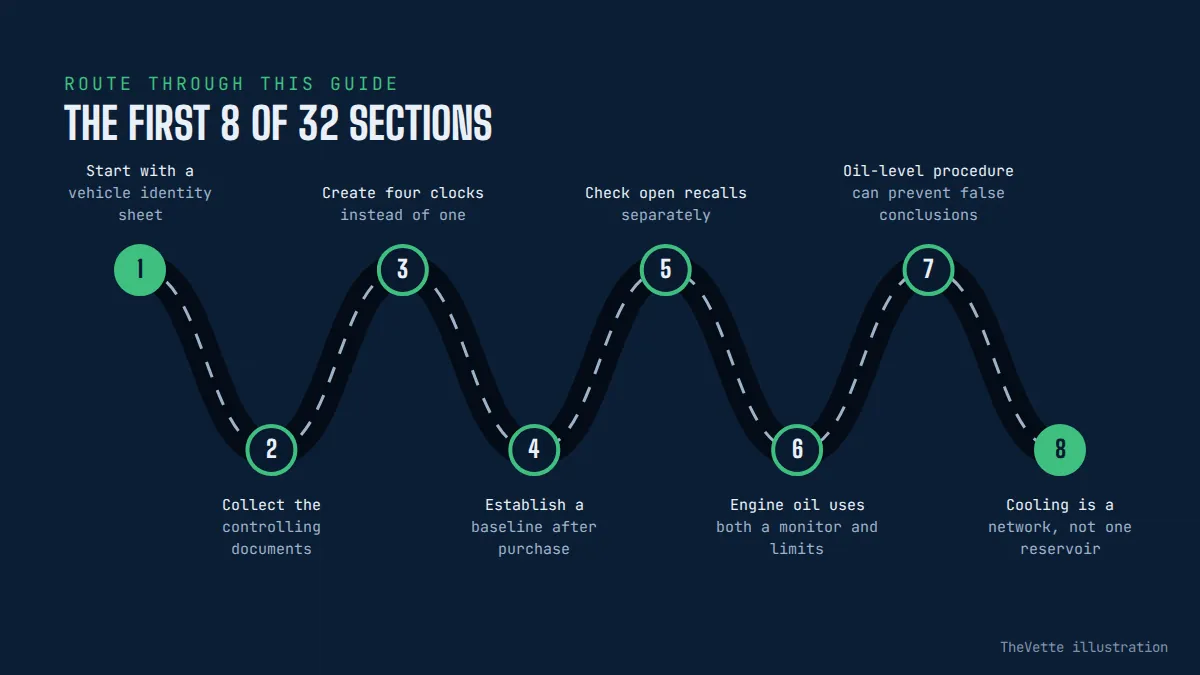
Collect the controlling documents
Download the exact owner manual, maintenance schedule, warranty guide, track-preparation guide if applicable, and current service information. Chevrolet's general maintenance pages explicitly direct owners to the vehicle manual for specific requirements. Preserve PDFs with publication date and model year.
Also collect instructions for aftermarket components, tires, battery, charger, protection film, and specialty fluids. A forum checklist can prompt questions but should not override a manual. Update documents when Chevrolet publishes a revision or service bulletin.
Create four clocks instead of one
Track odometer mileage, calendar time, engine or operating hours where available, and event severity. Some parts degrade through use; others absorb moisture or age while parked. Track sessions, repeated short trips, dusty roads, extreme temperature, and long storage can advance service without high mileage.
Use a spreadsheet or bound log with last service, next threshold, specification, quantity, source page, installer, and evidence. Calendar reminders catch time items. Never reset a monitor until the associated service is actually completed and documented.
Establish a baseline after purchase
Review invoices, digital history, owner entries, date labels, and physical condition. A verbal “fully serviced” statement does not identify fluid specifications, quantities, filters, torque, or dates. Do not automatically replace every fluid if credible recent evidence exists, but treat undocumented safety-critical items as unknown.
A specialist inspection should scan modules before clearing codes, verify recalls, examine leaks, tires, brakes, steering, suspension, cooling, belts, hoses, battery, wiring, filters, and modifications. Build the first schedule from these findings rather than a cosmetic clean-up.
Check open recalls separately
Use the VIN on Chevrolet and NHTSA recall tools. NHTSA explains that VIN lookup identifies certain unrepaired recalls and that manufacturers provide the remedy. A maintenance visit does not automatically prove every recall is closed.
Save completion documentation and follow interim safety instructions. Technical service bulletins, warranty extensions, customer-satisfaction programs, and recalls have different legal and cost status; ask the provider to identify which applies.
Engine oil uses both a monitor and limits
Later Corvettes calculate remaining oil life from operating conditions, but the monitor does not measure level and does not replace other maintenance. The 2014 manual, for example, explicitly notes that additional scheduled work exists alongside the oil-life system. Calendar maximums and track requirements still apply.
Older cars use time and mileage schedules. Modified engines may require a documented builder plan. Record oil brand, viscosity, specification, filter, quantity, mileage, date, monitor value, and use. Never extend because the oil looks clean or shorten solely from color.
Oil-level procedure can prevent false conclusions
Wet-sump and dry-sump systems are checked differently. Dry-sump readings may require full operating temperature and a defined shutdown window; an arbitrary cold reading can invite overfill. Some engines consume more during break-in or track work.
Use level ground, the stated temperature, correct dipstick or display procedure, and consistent records. Investigate change with leak inspection, consumption trend, crankcase ventilation, and operating conditions. Do not top above the mark for “insurance.”
Cooling is a network, not one reservoir
Depending on generation, Corvette may have engine, charge-air, transmission, differential, hybrid, or power-electronics cooling paths. Inspect levels only by safe cold or specified procedure, plus caps, hoses, clamps, tanks, pumps, fans, seals, radiators, heat exchangers, ducts, and warning history.
Replace coolant on the exact time and mileage schedule with approved chemistry and water quality. Color does not prove compatibility. Air bleeding can be model-specific, and an improperly purged mid-engine circuit can overheat despite a full-looking tank.
Brake fluid is usually time-sensitive
Brake fluid absorbs moisture and faces high temperature. Follow the model schedule and stricter track guide when applicable. A clear reservoir does not measure water content or boiling margin. Use only specified fluid from sealed containers.
Record flush date and product, bleed with correct electronic procedures, and inspect hoses, hard lines, fittings, calipers, master cylinder, and leaks. A low level may indicate pad wear or leakage; topping it without diagnosis can hide the cause.
Brake friction material is condition-based
Measure inner and outer pad thickness and rotor condition at every service. Iron rotors have thickness and crack criteria; carbon-ceramic systems use different inspection, mass, surface, and handling procedures. Noise alone neither condemns nor approves a performance brake.
Track use can consume pads rapidly, while a stored car may corrode rotors. Record measurements rather than “good.” Replace compatible axle sets, inspect hardware, and complete the prescribed burnish in an appropriate controlled environment.
Tires need monthly attention even at low mileage
Check cold placard pressure, tread across the full width, both sidewalls, date codes, repairs, valve stems, and recurring loss. TPMS warns after significant underinflation and does not replace a gauge. Infrequently driven collector cars may age out before wearing out.
Staggered sizes, directional tread, and different wheel offsets can restrict rotation. Follow the exact manual. Log track heat cycles and inspect inner shoulders hidden by negative camber. Replace for condition, age requirement, or performance change, not tread alone.
Alignment and balance are triggered by evidence
Uneven wear, impact, steering offset, pull, vibration, suspension work, or planned track use justify measurement. Alignment settings differ by model and mission. Keep before-and-after reports and restore street settings when required after an event.
Balancing corrects mass distribution; it cannot repair a bent wheel, separated tire, worn bearing, or loose joint. Diagnose the symptom rather than scheduling repeated balance by habit.
Wheel hardware requires exact procedure
Inspect barrels, spokes, bead seats, studs or bolts, lug seats, center interface, and valve hardware. Clean mating surfaces as specified and use correct fasteners. Wheel torque depends on design and whether threads must be dry; lubricant changes clamp load.
Use a calibrated wrench and documented sequence. Recheck only when the manual or wheel maker requires it. After curb or pothole impact, inspect wheel, tire, bearing, alignment, brake, and nearby suspension.
Air filters reflect environment
Engine filter restriction depends on dust, insects, leaves, moisture, and intake placement, not simply mileage. Inspect at scheduled intervals and after dusty events. A reusable aftermarket filter has its own cleaning and oiling limits; excess oil can contaminate sensors.
Cabin filters affect airflow, odor, defogging, and evaporator cleanliness. Clear cowl and body drains without forcing debris inward. Replace rodent-damaged filters and inspect wiring and nesting before starting.
Spark plugs and ignition are application-specific
Plug material, heat range, gap, torque, and interval vary with engine and forced induction. Coil, wire, boot, shield, and connector designs change across generations. Modified boost or fuel may impose a tuner or builder interval, which should be written and evidence-based.
Do not replace plugs merely to cure every misfire. Save scan conditions and inspect ignition, injectors, compression, fuel pressure, air leaks, wiring, calibration, and deposits. Read removed plugs by cylinder and preserve their order.
Accessory drives age in time and heat
Inspect belts for cracks, glazing, contamination, fraying, tracking, and missing ribs, plus tensioners, idlers, pulleys, harmonic balancer, alternator, water pump, and supercharger drive where equipped. A new belt on a wobbling pulley is not maintenance completed.
Keep oil and coolant off rubber. Replace using correct routing and tension. Some older Corvettes have multiple belts or vacuum-driven accessories that need generation-specific inspection.
Fuel systems require cleanliness and safety
Use required octane and fuel chemistry, inspect cap or sealing, lines, hoses, tank, pump area, injectors, and vapor controls for leak or odor. Direct injection carries dangerous high pressure and requires formal depressurization and often single-use parts.
Fuel filters may be serviceable on one generation and integrated on another. Do not add injector cleaner or stabilizer by calendar without compatibility and need. Stale-fuel diagnosis requires more than topping the tank.
Manual transmissions include clutch hydraulics
Follow fluid type, interval, level and temperature procedure for the exact gearbox. Inspect shifter, linkage, mounts, case, cooler where equipped, driveshaft or torque tube, half-shafts, and leakage. Clutch fluid can darken from heat and contamination and may have a separate service need.
Pedal behavior, engagement change, noise, difficult shifts, or slip requires diagnosis. A fluid change cannot restore a worn clutch or damaged synchronizer. Avoid additives that alter friction without approval.
Automatic and dual-clutch service are different
Conventional automatics and C8 dual-clutch units have different fluids, filters, fill temperatures, capacities, adaptation, track preparation, and service messages. C8 documentation has included time, mileage, and track-use obligations that changed across publications, so use the current VIN-specific version.
Record fluid, filter, quantity, procedure, software, and reset. Underfill, overfill, or contamination can be costly. New harshness or slipping deserves scan data and qualified diagnosis before a generic flush.
Differential maintenance depends on hardware and use
Open, limited-slip, electronically controlled, and transaxle-integrated systems need correct lubricant and service. Some require friction characteristics that a universal gear oil does not provide. Track temperature and break-in can trigger additional changes.
Inspect seals, vent, cooler, pumps, wiring, mounts, axle joints, and noise. Chatter may involve fluid, tire mismatch, clutch wear, calibration, or geometry. Record the exact product and whether additives are approved.
Steering and suspension are inspection systems
Check ball joints, tie rods, control arms, bushings, wheel bearings, springs, anti-roll links, shocks, mounts, steering rack, boots, fasteners, ride height, and leaks. Older hydraulic steering adds reservoir, fluid, pump, hoses, and cooler; later electric steering adds sensors, wiring, software, and calibration.
Magnetic dampers require electronic as well as mechanical diagnosis. A mode change does not prove health. Measure looseness and alignment rather than replacing an entire suspension at a round mileage.
Body drains and weather seals prevent expensive damage
Inspect roof, top, hatch, door, cowl, lamp, and body drains; weather seals; glass bonding; and water evidence. Clean with safe tools, preserve adhesives and coatings, and avoid forcing compressed air into hidden joints.
Lubricate seals and latches only with specified products. Water in a module, carpet, or connector can create intermittent faults long after a wash. Fix the entry path before drying electronics.
Battery maintenance begins with testing
Check chemistry, age, state of charge, capacity or conductance, terminals, hold-down, venting, cables, grounds, charging voltage, and parasitic draw when suspected. Modern modules can take time to sleep, so draw testing needs the correct procedure.
Use a compatible maintainer during storage and follow model connection points. Replacing a battery may require window, steering, or module learns. High-voltage E-Ray service is separate and belongs to trained technicians.
Electronic scans are part of a modern inspection
Read all modules, save current and history codes, status, freeze frames, and relevant counters before clearing. A generic engine-code reader misses chassis, suspension, transmission, body, and hybrid information. Software updates should have a documented symptom or campaign and correct applicability.
A code is a starting point, not a failed-part verdict. Test voltage, wiring, connectors, network communication, mechanical condition, and calibration as service information directs. Preserve before-and-after reports.
Air conditioning needs seasonal observation
Measure outlet behavior, pressures only with qualified equipment, condenser cleanliness, compressor operation, drains, odor, and leak evidence. Refrigerant type and charge quantity vary; vent temperature alone does not justify adding gas.
Refrigerant recovery is regulated and high pressure is hazardous. Hybrid electric compressors may require special nonconductive oil and high-voltage precautions. Use trained service rather than a universal recharge can.
Wipers, lights, and safety equipment still matter
Inspect wiper blades, washer fluid and aim, exterior lights, horn, mirrors, seat belts, airbags, cameras, sensors, emergency release, tire inflator or mobility kit, tow eye, and first-aid supplies. Check expiration dates on sealant and emergency items.
Do not place coatings over cameras or sensors without approval. After glass, bumper, suspension, or alignment work, newer driver-assistance systems may require calibration. Verify no warning remains.
Track use creates a parallel schedule
Use the current Chevrolet track guide for break-in, oil, brake fluid, pads, tires, alignment, wheel torque, transmission, cooling, aero, and post-event work. Track hours or tanks of fuel can matter more than odometer mileage. Do not average intense sessions into a normal road interval.
Before and after every event, record measurements, pressures, temperatures, warnings, off-course events, and fluid consumption. End a session for changed pedal, pressure, vibration, leakage, or warning. Cooldown does not erase damage.
Low-mileage cars need more time-based care
Storage can age tires, fuel, seals, fluids, battery, belts, hoses, and brake surfaces while the odometer barely moves. Exercise should be a real safe drive that brings systems through normal operation, not a few minutes of idling. If driving is impossible, use a model-specific storage plan.
Inspect for rodents, moisture, stuck brakes, flat spots, and stale fuel before recommissioning. A collector vehicle can be cosmetically exceptional and mechanically overdue.
High-mileage cars benefit from trending
Regular use exposes small changes early. Track oil consumption, pressure, temperatures, fuel economy, misfire counts, battery tests, tread depth, pad thickness, alignment, and fluid leakage over time. A trend often provides more insight than one pass/fail inspection.
Do not replace sound original assemblies because of mileage alone when the schedule calls for inspection, but do not ignore fatigue or corrosion because the car still drives. Plan grouped labor where access overlaps without creating unnecessary work.
Modifications need their own maintenance record
Superchargers, turbochargers, camshafts, fuel systems, exhaust, coolers, coilovers, wheels, aero, cages, and calibration change heat, loads, clearances, legality, and service access. Record installer, parts, software version, torque checks, filter or belt intervals, approved fluids, and spare components.
Inspect heat shielding, hoses, wiring, mounts, welds, and fasteners more often until stability is proven. A warning suppressor or emissions defeat is not maintenance. Preserve original parts and disclose changes honestly.
Choose providers by competence and evidence
Ask who will work on the car, what current service information and scan equipment they use, how low-lift and carbon components are protected, and whether they document measurements. A specialist independent shop may suit an older Corvette; certain programming, recall, warranty, or high-voltage work may require authorized capability.
Approve work in writing with parts, specifications, quantities, labor, and diagnostic limits. Request old parts where lawful, itemized invoices, alignment sheets, scan reports, and photographs. Decline vague packages that cannot tie each operation to condition or schedule.
Build a rolling twelve-month plan
At each annual review, copy the exact manual requirements due by time, mileage, monitor, condition, and planned use. Add registration, inspection, insurance mileage, recall review, storage, road trip, and track dates. Reserve budget for tires and brakes before cosmetic upgrades.
Review the log after every service and advance only completed items. A real-world schedule stays alive: it honors factory minimums, reacts to measured wear, accounts for age and severity, and avoids maintenance theater. The result is not a universal chart but a traceable history that helps the next technician—and the next owner—understand the Corvette.