A first Corvette track day should be an organized driving school, not an attempt to discover the car's maximum speed. Preparation begins with the event's rules and the exact Chevrolet owner and track-preparation information for the car. Requirements differ among generations, engines, transmissions, brake systems, tires, aero packages, and model years. Advice copied from another Corvette can be wrong for yours.
To place How to Prepare a Corvette for Its First Track Day in a wider ownership and engineering context, continue with Corvette Tire Guide: Fitment, Age, Grip, and Touring Comfort.
The successful first day is quiet: the car passes inspection, the driver attends every briefing, sessions end before fatigue or heat becomes a problem, and the Corvette goes home under its own power. Lap time is secondary to repeatable braking, smooth vision, predictable passing, and a written post-event inspection.
Choose instruction rather than competition
Look for a novice high-performance driver-education group with classroom time, an in-car instructor or structured coaching, controlled passing, corner workers, and clear emergency procedures. SCCA describes its track days as non-races in which passing is limited to defined zones and uses a point-by. Other organizers have different rules, so read the current supplement before paying.
Ask how run groups are assigned, whether timing is allowed, how convertibles are treated, what helmet certification is accepted, and whether noise limits apply. Confirm cancellation, weather, insurance, towing, fuel, food, and guest policies. A bargain event that lacks suitable novice supervision is poor value.
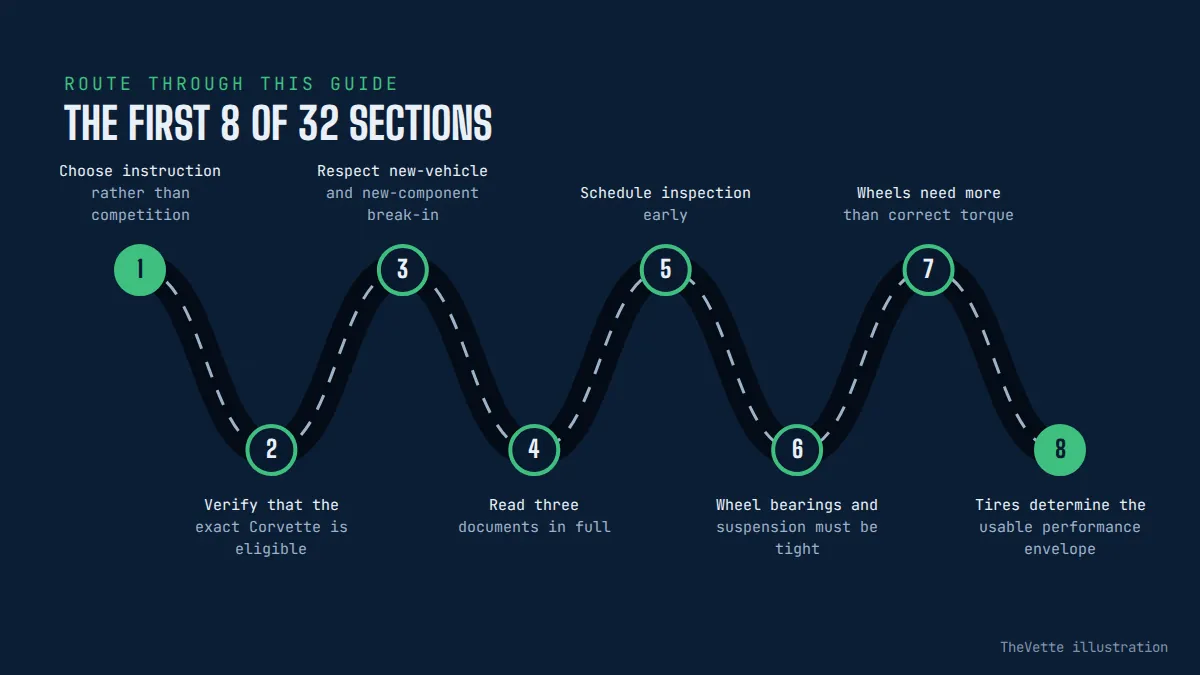
Verify that the exact Corvette is eligible
Some events apply roll-protection rules to convertibles or removable-roof cars. Factory hoops may be accepted by one organizer and rejected by another venue or jurisdiction. Modified seats, harnesses, cages, fire systems, batteries, and aero pieces can trigger additional inspection. Send photographs and specifications before registration rather than arguing at the gate.
Chevrolet also identifies model- or package-specific track suitability and preparation. A base model should not be assumed to have the cooling, lubrication, brakes, or tires of a performance package. Decode the VIN and option content, then match the current manual and track guide.
Respect new-vehicle and new-component break-in
Factory guidance specifies break-in limits before competitive or track driving, and the distance has varied by generation. Brakes and tires also need controlled conditioning after replacement. Do not compress a mileage requirement into a hard street drive or use public roads for a brake-burnish procedure that requires closed-course conditions.
Record odometer, engine hours where available, oil service, brake installation mileage, and tire mileage. A recently replaced engine, transmission, differential, wheel bearing, or fastener may carry its own inspection or break-in requirement. The event is not the place to discover an assembly error.
Read three documents in full
The event rules govern participant behavior and equipment. The Corvette owner's manual covers controls, warnings, fluids, loading, towing, and normal procedures. The model-specific track guide adds configuration, burnishing, pressure, alignment, cooling, and post-track steps. Current service information addresses inspection and repair.
Create a one-page checklist referencing page numbers rather than copying old numeric values from a forum. Note every item that changes before and after the event, such as brake deflectors, tire pressure, alignment, aero settings, oil, or transmission preparation. This prevents a track setting from remaining on the car during the trip home.
Schedule inspection early
Have a Corvette-knowledgeable technician inspect the car several weeks ahead, leaving time to obtain parts and retest. Provide the organizer's tech form and disclose modifications, warnings, leaks, impact history, and prior track use. A general maintenance visit does not automatically include high-load wheel, brake, suspension, and cooling checks.
After repair, drive normally and reinspect. Fresh work can reveal a loose connection, seep, balance problem, or incorrect part. Arriving with untested pads, tires, or software adds uncertainty exactly when the driver has the most to learn.
Wheel bearings and suspension must be tight
Lift and inspect using approved points. Check wheel-bearing play and noise, ball joints, tie rods, control arms, bushings, shock mounts, springs, anti-roll links, fasteners, ride-height hardware, and electronic damper wiring. Look for contact marks, torn boots, cracked mounts, leaks, bent pieces, and missing underbody fasteners.
A track alignment cannot cure mechanical looseness. Replace defective parts first, torque using factory procedures, settle the suspension, and measure again. Document baseline ride height and alignment so later tire wear or handling change has context.
Wheels need more than correct torque
Remove each wheel and clean mating surfaces as specified. Inspect inner and outer barrels, spokes, bead seats, lug seats, studs or bolts, and valve stems for cracks, bends, corrosion, impact, wrong hardware, or repair. Verify size, offset, load capacity, and brake clearance. Cosmetic appearance does not prove structural health.
Use a calibrated torque wrench, correct sequence, dry or lubricated condition specified by the manual, and exact value for the car. Marking hardware can help reveal movement but does not replace checking. Never apply a generic torque or add lubricant without authorization, because clamp load can change substantially.
Tires determine the usable performance envelope
Verify model, size, service description, construction, date code, tread, heat history, repairs, and sidewall condition at all four corners. No cords, bulges, cuts, cracking, embedded objects, or unexplained pressure loss are acceptable. A tire can age or suffer internal track damage before reaching a tread-wear bar.
Do not select an extreme tire to compensate for inexperience. A progressive road-performance tire can communicate more clearly and tolerate temperature variation. Match all positions as the vehicle manufacturer requires, and never mix compounds casually on a chassis calibrated for a coordinated set.
Use model-specific cold and hot pressure guidance
Pressure rises as a tire heats, but the amount depends on pace, weather, load, construction, and starting value. The latest Corvette track guide may state model- and tire-specific cold minimums or hot targets. Those numbers do not transfer to a different generation or tire. The door placard remains the normal-road reference after the event.
Measure with one accurate gauge, record each corner before and immediately after every session, and adjust only within authoritative guidance. Never bleed a hot tire and forget to restore safe cold road pressure. A rapid loss, repeated outlier, or visible damage ends the session.
Alignment is a controlled compromise
Track camber and toe can improve loaded contact and response, but may accelerate inner-edge wear or make the road trip nervous. Use only the specification for the exact model and package, set by a capable shop with sound suspension. Keep a printed before-and-after report.
Mark eccentric positions only as a diagnostic aid, not a substitute for measurement. Inspect the entire tread after every session because the inner shoulder can deteriorate while the outer face looks healthy. Return to a suitable street alignment when the track guide requires it.
Brake fluid is a time and temperature component
Track braking can boil moisture-contaminated fluid and create long or lost pedal travel. Use the exact fluid specification and preparation interval in the current guide. Do not judge fluid by reservoir color alone. Bleeding must remove air without introducing dirt or damaging electronic brake systems.
Record product, specification, sealed-container date, flush date, and technician. Keep incompatible fluid away from painted surfaces and never mix types unless explicitly approved. A firm paddock pedal does not prove boiling margin under repeated high-energy stops.
Pads and rotors need measured condition
Measure pad material at every corner, including the harder-to-see inner pad, and compare with track minimums. Inspect rotors for thickness, heat checking, cracks, lip, scoring, transfer, and approved wear limits. Carbon-ceramic and iron systems have different inspection and handling methods.
Brake pad friction material must suit the rotor, fluid, tire, temperature, and driver. A very aggressive pad can add heat, noise, dust, and rotor wear. Do not install race pads on the eve of the event without bedding, testing, and understanding cold behavior.
Burnish brakes only by the correct procedure
Chevrolet track guides publish model- and brake-code-specific burnish sequences. They may deliberately create fade and require long cooling intervals, which makes them unsuitable for public traffic. Other brake systems, especially certain carbon-ceramic configurations, can require different treatment.
Identify the brake option before acting. Perform the procedure in a legal controlled environment with an experienced operator, then inspect. A generic series of panic stops can overheat seals, crack components, glaze material, or endanger others.
Pedal changes are an immediate stop signal
During a session, increasing travel, softness, vibration, pulling, grinding, smoke, warning lights, or a changed braking point requires a safe pit entry. Do not “use one more lap” to confirm it. Tell the instructor, signal following traffic, and avoid setting a hot parking brake if the model guidance warns against it.
Let trained personnel inspect fluid, pads, rotors, tires, bearings, leaks, and data. Cooling can mask a problem without fixing it. The next session begins only after the cause is understood and the event's technical staff agrees.
Engine oil preparation varies sharply
Wet-sump, dry-sump, naturally aspirated, supercharged, and turbocharged Corvettes can have different oil grade, level-check, and track instructions. A dry-sump level often must be checked within a defined temperature and time window. Overfilling is not a safety margin.
Use the correct manual, filter, quantity, and track specification. Inspect pan or tank, cooler, lines, fittings, filter area, and underbody for leakage. Record consumption by checking consistently before and after sessions; stop for pressure warnings or unexplained loss.
Cooling relies on clean, sealed airflow
Inspect radiators, charge coolers, side inlets, brake ducts, fans, pumps, hoses, caps, reservoirs, seals, and undertrays. Remove debris with approved methods and repair bent or missing guides. A larger opening cannot compensate for a blocked core or air bypassing its intended path.
Monitor every available temperature and warning, not just engine coolant. Transmission, differential, oil, charge-air, electric drive, and brake systems can reach limits independently. Hot ambient conditions and automatic-transmission use have produced model-specific restrictions in past guides; current documentation governs.
Fuel quantity requires planning
Arrive with the octane and fuel type required by the manual and calibration. Estimate consumption conservatively and locate reputable fuel near the circuit. Too little fuel can cause starvation under sustained cornering; excessive cargo or portable containers introduce weight and fire risk.
Transport fuel only if the venue permits it, using approved containers and storage away from heat and ignition. Never refuel a hot car against paddock rules. Close the cap and inspect for odor or leakage before returning to grid.
Transmission and differential need their own checks
Verify fluid type, level procedure, service interval, cooler condition, leaks, and track preparation for the exact gearbox and axle. Manual, conventional automatic, and dual-clutch transmissions impose different thermal and operating constraints. Do not add fluid or additives based on another generation.
During sessions, use modes and shift behavior recommended by Chevrolet and the instructor. A warning, harsh new engagement, clutch smell, or rising temperature ends hard running. Cool-down laps reduce load but do not authorize ignoring a service message.
Remove every loose object
Empty both cargo areas, door pockets, cup holders, console, seat gaps, roof storage, and floor. A phone, bottle, tool, floor mat, or camera can become a projectile or lodge near pedals. Secure the battery and any permanently installed equipment with proper hardware.
Cameras and data devices must use organizer-approved mounts and tethers, preserve airbag deployment, and not obstruct vision. Suction cups may be prohibited. Test recording before grid so the driver does not manipulate equipment on track.
Seats and belts must work as a system
Factory seats and three-point belts are usually appropriate for novice street-car events when accepted by the organizer. Modified seats, multi-point harnesses, roll bars, cages, and head restraints require compatible geometry and inspection. One racing-looking component can increase risk when the rest of the system is absent.
Set seating so wrists reach the wheel with shoulders supported, knees remain bent at full pedal travel, and the helmet clears the roof. Belts should lie flat and latch correctly. Instructor and passenger protection must be equivalent where rules require it.
Helmet acceptance is event-specific
Buy or borrow only after confirming the organizer's current standard and allowed certification years. A motorcycle or road helmet is not automatically accepted. Fit should be snug without pressure points, the strap should fasten securely, and the shell and liner must be undamaged.
Open cars may require a full-face design and closed visor. Do not paint, drill, mount a camera, or use solvents unless the helmet maker permits it. Present the helmet for inspection and replace it after a significant impact according to manufacturer guidance.
Personal readiness is mechanical readiness
Sleep, hydration, heat, medication, stress, and nutrition affect vision and decision-making. Avoid alcohol and impairing substances, disclose relevant medical concerns through appropriate event channels, and wear required clothing and closed shoes. Bring water, food, sunscreen, rain protection, and hearing protection if suitable.
Fatigue often appears as missed flags, late turn-in, rushed shifts, or tunnel vision before the driver admits it. Skip a session without embarrassment. The entry fee does not obligate anyone to consume every minute of track time.
Learn flags and pit procedure before moving
Know every flag, passing signal, pit-in route, pit-out blend line, speed limit, and emergency instruction. Point-bys grant permission where the event permits; they do not transfer responsibility to the passing car. Never surprise another driver by passing outside the rule.
If confused, maintain predictable pace, acknowledge workers, and enter the pits as briefed. Do not stop on course except when required by an emergency. Follow directions after a red, black, yellow, or mechanical-warning flag exactly as the organizer teaches.
Vision and smoothness come before speed
Look through the corner, use reference points, and build one element at a time. Abrupt steering, braking release, or throttle can exceed tire capacity even below the car's theoretical limit. Listen to the instructor rather than using horsepower to close every straight-line gap.
A clean line at reduced pace teaches more than a heroic correction. Allow faster traffic by the prescribed signal, create space, and avoid chasing. The first day's goal is consistent awareness, not an internet lap comparison made under unknown conditions.
Stability systems are not driving instructors
Use the mode recommended for the novice group and exact vehicle. Track mode can coordinate damping, steering, powertrain, exhaust, differential, and displays, while Performance Traction Management changes intervention strategies. Turning systems off removes a safety layer and is not proof of skill.
Electronic control cannot create tire grip or overcome fluid on the track. Do not experiment with launch control, drift modes, or reduced intervention without explicit instruction in an appropriate environment. A flashing indicator is information that the car is managing a limit.
Warm-up and cool-down protect the system
Begin each session at reduced load while checking brakes, steering, traffic, flags, tires, and temperatures. Tires and fluids do not become ready simultaneously. The out lap is not a qualifying lap, and weaving unpredictably can be more dangerous than useful.
Finish with reduced braking and power as directed, allowing airflow through coolers. Avoid crawling so slowly that it obstructs others. In the paddock, follow guidance about parking brake, hood opening, engine running, and cooldown; practices vary by system and venue.
Use a between-session inspection routine
Park in the same safe area and record pressures and temperatures immediately. Walk around for fluid, odor, smoke, tire pickup, cuts, rubbing, wheel damage, missing aero hardware, and brake condition. Look under the car without crawling beneath an unsupported vehicle.
Check wheel hardware only by the documented hot or cold method; blindly tightening hot wheels can create incorrect clamp load. Review warnings and data, drink water, and debrief with the instructor. Change one setup variable at a time.
Weather changes every margin
Rain reduces grip, hides standing water, cools tires differently, and limits visibility. Painted lines, curbs, rubber, oil, and puddles can be extremely slippery. Use appropriate tires, larger following distances, smoother inputs, and the event's wet-line instruction.
Heat raises driver stress and system temperatures; cold can prevent tires from reaching range. Lightning, fog, wind, or darkness may alter operations. The organizer can stop a session, and the driver can always choose not to participate.
Plan for a mechanical problem before it occurs
Bring contact details, roadside or trackside coverage information, a suitable towing destination, and access to the correct tow-eye procedure. Confirm whether the car can be flat-towed—it usually cannot—and identify lift points. A low splitter and dual-clutch transmission require informed recovery.
Do not work under a car supported only by a jack. Bring modest tools only if competent to use them, plus a pressure gauge, torque wrench, towels, tape, forms, and fluids specifically approved for the car. Complex repair belongs with trained support.
Insurance must be confirmed in writing
Ordinary road policies often exclude closed-course or performance events, even when the day is educational and untimed. Ask the insurer precise questions using the event name and format. Separate track-day coverage may address physical damage but still carry exclusions, deductibles, valuation rules, and no liability coverage.
Understand damage to barriers, cleanup, towing, medical costs, and other vehicles. Do not interpret admission by an organizer as insurance. Save the policy and declarations for the event date and disclose vehicle modifications accurately.
Post-event service completes the day
After the car cools, inspect tires inside and out, wheels, brakes, bearings, suspension, fluids, ducts, underbody, and aero. Review pressures, warnings, video, and notes. Restore street tire pressure, alignment, aero settings, brake deflectors, cargo, and drive mode as the documentation requires.
Track use can shorten service intervals. Change or analyze fluids only on model-specific guidance, not ritual. Record date, circuit, sessions, weather, mileage, fuel, setup, temperatures, pad and tire measurements, and any off-course event for the next inspection.
A first-day decision framework
Go only when the rules are understood, the exact Corvette preparation is complete, the inspection is documented, weather and driver health are acceptable, and a recovery plan exists. Delay for leaks, tire damage, marginal brakes, unresolved warnings, loose components, missing safety gear, or uncertainty about convertible eligibility.
At the circuit, choose instruction over ego, predictability over a last-second pass, and an early stop over one doubtful lap. Corvette capability can make speed arrive easily; disciplined preparation makes that capability educational. The measure of the first event is not a stopwatch but a safer, more observant driver and a sound car ready for the next one.