A Corvette tire is simultaneously a structural air container, spring, damper, steering element, and the car's only contact with the road. Horsepower, brakes, alignment, stability control, and aerodynamic load all reach the pavement through four small, changing contact patches. Choosing by brand reputation or tread appearance alone ignores most of that job.
To place Corvette Tire Guide: Fitment, Age, Grip, and Touring Comfort in a wider ownership and engineering context, continue with A Real-World Corvette Maintenance Schedule.
The correct choice starts with the vehicle placard and owner manual, then adds the exact wheel, load, speed capability, climate, use, and tire-maker requirements. This guide explains how to read those constraints without prescribing one tire or pressure for every generation. Safety-critical fitment belongs with a qualified tire professional who inspects the actual car.
Begin with the vehicle, not a shopping filter
Record VIN, model year, trim, performance package, front and rear placard sizes, recommended cold pressures, and maximum vehicle loading. Corvettes commonly use staggered fitment, meaning rear size differs from front. Never assume all four positions should match or rotate front-to-rear.
Inspect wheel diameter, width, offset, markings, and modifications. A previous owner may have changed wheels or installed a package appearance without the supporting chassis. Confirm clearance at full steering and through suspension travel, including brakes, liners, ducts, sensors, and bodywork.
A size code describes several dimensions
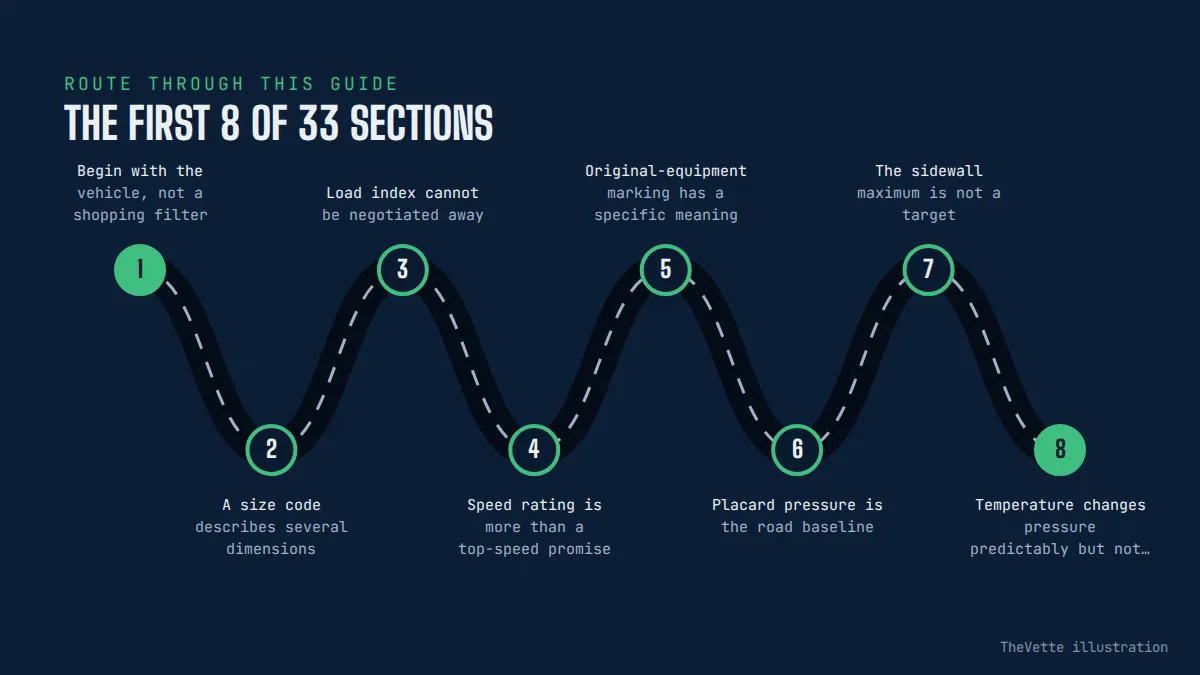
In a designation such as 275/35R18, the first number is nominal section width in millimeters, the second is aspect ratio rather than sidewall height, R indicates radial construction, and the last number is wheel diameter in inches. Actual dimensions vary with design and measuring rim even when sidewall codes match.
Changing width or aspect ratio alters overall diameter, sidewall behavior, rim compatibility, load capacity, gearing, speed indication, ride height, and clearance. Compare tire-maker specification sheets, not mental arithmetic alone. Front-to-rear rolling relationship also can matter to ABS, stability control, electronic differential, transmission, and all-wheel drive.
Load index cannot be negotiated away
The service description includes a numeric load index and usually a speed symbol. Load capacity depends on inflation and standards, so a physically fitting tire may still be unsuitable. Use a rating that meets the vehicle and tire manufacturer's requirements at every position and operating condition.
Track aero, passengers, luggage, heat, and cornering add demands beyond parked weight. Never compensate for an inadequate load rating by exceeding placard pressure or the tire limit. Account for the heavier axle and unequal corner loads where relevant.
Speed rating is more than a top-speed promise
A speed symbol reflects standardized laboratory capability under specified load, pressure, and time. It does not authorize that road speed, guarantee survival after damage, or establish compatibility with a particular Corvette. Real heat, underinflation, age, repairs, and overload reduce margin.
High-speed operation requires exact vehicle guidance, inspected tires, appropriate pressure, legal controlled conditions, and correct load. A tire that carries a high symbol can still be wrong in size, construction, season, or model tuning.
Original-equipment marking has a specific meaning
Some tires carry manufacturer-specific homologation marks showing that a version was developed or approved for an application. Two products with the same family name and size may differ in construction, compound, tread, mass, or tuning. The generic replacement is not necessarily identical.
Determine whether Chevrolet specifies an OE-marked version for the exact model and use. If considering an alternative, obtain written load, wheel, pressure, and system compatibility from capable sources. Marketing category alone is weak evidence.
Placard pressure is the road baseline
NHTSA directs owners to the vehicle Tire and Loading Information label or owner manual for recommended cold pressure, not the maximum molded on the tire. “Cold” generally means the car has been parked at least three hours and not meaningfully driven. Front and rear recommendations may differ.
Use an accurate gauge monthly and before long trips, track use, storage release, or major temperature change. Replace valve caps and investigate recurring loss. Pressure is not a set-once service; air permeates rubber and weather changes its measured value.
The sidewall maximum is not a target
Maximum pressure printed on the tire accompanies load and construction labeling. It is not the automaker's comfort, handling, wear, or normal-load recommendation. Filling every Corvette tire to that number can reduce compliance and change contact behavior while still failing to meet a model-specific track process.
Likewise, lowering pressure for a softer ride adds deflection and heat. Only deviate when authoritative instructions define the use, load, temperature state, and restoration procedure. Never exceed tire, wheel, or vehicle limits.
Temperature changes pressure predictably but not perfectly
As contained air heats, pressure rises; cold weather lowers it. Sun on one side, nearby brakes, pace, and measurement timing create corner differences. A seasonal warning may reflect temperature rather than a puncture, but it still requires a cold check and inspection.
Do not bleed a normally inflated warm road tire merely to match the cold placard. It may be low after cooling. If a hot tire is believed dangerously underinflated, follow NHTSA and vehicle guidance, then recheck cold as soon as practical.
TPMS is a warning system, not a gauge replacement
Tire Pressure Monitoring alerts after pressure is significantly low or a system fault exists. NHTSA and Chevrolet both emphasize that it does not replace monthly manual maintenance. Display values also may update only after driving and can differ slightly from a service gauge.
Learn the distinction between low-pressure and malfunction indicators. Wheel changes require compatible sensors and a correct learn procedure. A bypass or warning suppressor conceals information and does not correct pressure.
Summer tires have a temperature operating window
High-performance summer tread and compound prioritize dry and wet grip in suitable temperatures. Chevrolet warns on equipped Corvettes that performance decreases in cold conditions and on ice or snow, recommending seasonally appropriate tires around the threshold given in the exact manual. Cold rubber also can crack if moved or flexed outside its stated storage range.
Check both vehicle and tire-maker temperature guidance. A sunny dry road does not make a summer tire safe when air and pavement are cold. Store removed sets away from prohibited temperatures, ozone, sunlight, moisture, and deformation.
All-season means a wider compromise, not all conditions
All-season tires usually tolerate a broader temperature range and light winter conditions better than a maximum-performance summer product, while trading some warm-condition response or ultimate grip. Their tread still cannot guarantee control in deep snow, severe ice, flooding, or extreme cold.
Evaluate actual climate, plowing, hills, trip flexibility, and compound designation. A Corvette driven year-round in a severe winter may need a dedicated winter set. Confirm appropriate sizes and clearance rather than choosing only the narrowest available tire.
Winter tires work as a four-tire system
Winter compounds remain flexible in low temperature, and tread features manage snow or slush. Installing only two can create a severe front-to-rear grip imbalance during braking, steering, or power application. Use four compatible tires meeting vehicle requirements.
Cold-weather wheels must clear brakes and suspension and carry adequate load. Protect TPMS function, use correct hardware, and retorque as specified. Wash corrosive salt from wheels and chassis without directing damaging pressure at seals or electronics.
Run-flat construction provides limited mobility
Many modern Corvettes use extended-mobility tires with reinforced sidewalls that can support the car for a limited distance and speed after pressure loss. The exact limits and conditions come from the owner manual and tire maker. It is not permission to finish a trip normally.
Slow down, avoid hard inputs and load, monitor warnings, and arrange qualified inspection. Heat and internal damage can make a tire unrepairable even when the outside looks normal. The 2021 Corvette performance guide notes that minimizing distance after pressure loss can improve the chance of repair.
Conventional tires change the contingency plan
Owners sometimes replace run-flats for ride, noise, mass, cost, or product choice. A suitable conventional tire may be available, but loss-of-pressure mobility disappears. The car may have no spare, jack, or safe roadside lifting provision.
Plan roadside assistance, communications, towing, sealant compatibility, and travel coverage before conversion. Disclose the change and never assume an inflator repairs sidewall damage or a large puncture. Sealant can complicate TPMS and professional repair.
Ride comfort comes from the complete assembly
Sidewall stiffness, construction, wheel diameter, unsprung mass, tread pattern, pressure, seat, bushings, springs, and dampers all affect perceived ride. Replacing run-flats may change impact character, but brand category alone cannot predict the result.
Compare on the same roads with correct cold pressure, alignment, and sound suspension. Oversized wheels and very short sidewalls reduce impact space. Do not chase softness by using an unapproved size or pressure.
Noise has several sources
Tread blocks excite air and structure; pavement texture, wear pattern, pressure, wheel bearing, alignment, cargo cavity, and roof configuration alter what reaches the cabin. A quiet new tire can become loud after cupping or hardening. Corvette's wide rear tires make some road noise unsurprising.
Identify whether sound changes with surface, speed, steering, temperature, or rotation direction. Inspect inner tread and bearings before ordering tires. Directional and asymmetric products must be mounted according to sidewall markings.
Tread depth is only one retirement signal
Replace for legal or manufacturer wear limits, but also for cuts, bulges, cracking, exposed material, impact, separation, repeated pressure loss, or performance change. Wet resistance declines as grooves lose depth even before the wear bars are flush. Track tires can reach heat-cycle or internal limits with visible tread remaining.
Measure multiple grooves across each tire and record inner, center, and outer values. Corvette alignment can wear an inner shoulder hidden from a casual walk-around. Inspect on a lift after track use or suspected contact.
Age is independent of mileage
Rubber and internal materials change through time, heat, oxygen, flex, storage, and environment. Low-mileage collector Corvettes are specifically vulnerable to old tires that look deep-treaded. NHTSA states that some vehicle and tire makers recommend replacement between six and ten years, but the applicable manufacturer limit and condition control.
Do not create a universal birthday from that range. Inspect regularly, follow the earliest applicable requirement, and replace sooner for damage or change. Storage indoors does not stop aging.
Read the full Tire Identification Number
On modern tires, the last four digits of the DOT Tire Identification Number show production week and year: for example, 2324 means week 23 of 2024. The full code may appear on only one side, requiring inspection of the inner sidewall. Record every tire rather than extrapolating from one.
The code supports recall identification as well as age review. Register new tires with the manufacturer or appropriate system, keep invoices, and check recalls. A newly purchased tire may have spent time in inventory; discuss date and warranty before mounting.
Puncture location and damage determine repairability
A qualified professional must demount the tire and inspect inside. Industry-approved repairs generally address limited tread-area injuries using a combination repair; shoulder or sidewall damage, excessive size, run-flat operation, secondary damage, or unsuitable history can rule repair out. An external plug alone does not reveal the interior.
Follow the tire maker's rules for that product, speed rating, and use. Track events may prohibit repaired tires or require replacement. Never inject multiple sealants and assume the structure is restored.
Impact damage can hide inside
Potholes and curbs can break cords, bend wheels, disturb alignment, or damage a bearing without immediate air loss. A bulge signals structural damage and requires removal from service. Vibration, pull, new noise, steering-wheel offset, or recurring pressure change also deserves prompt inspection.
Photograph the obstacle and tire, avoid continued speed, and inspect both wheel surfaces. Balancing a bent assembly may mask but not repair it. Check nearby suspension and the opposite axle for related impact.
Wear patterns are diagnostic evidence
Center wear can relate to pressure, shoulder wear to pressure or loading, one-sided wear to alignment, and cupping to damping, balance, looseness, or geometry—but no pattern proves one cause by itself. Driving style, road crown, rotation limitations, and compound complicate interpretation.
Measure pressure and alignment rather than diagnosing from a photograph. Repair the cause before mounting expensive replacements. Keep tread-depth and alignment records to see whether a pattern is progressive.
Staggered and directional fitment limits rotation
Different front and rear sizes prevent conventional front-to-rear rotation. Directional tread may restrict side-to-side movement unless tires are dismounted and remounted; asymmetric tread must keep its “outside” orientation. Wheel offsets also may differ despite similar appearance.
Follow the manual and tire maker. Mark wheel positions when removed and verify arrows, outside labels, sensor location, and torque after service. Never let a shop assume four identical corners.
Balance and road-force diagnosis solve different problems
Balancing corrects mass distribution using weights. A road-force machine also loads the assembly to identify stiffness variation, seating, or wheel issues. Neither fixes structural damage, wrong centering, bad bearings, or unsuitable fitment.
For vibration, record speed, throttle, gear, temperature, road, and steering involvement. Inspect cleanliness and wheel mounting, then measure radial and lateral runout. Repeatedly adding weights without diagnosis can waste a new tire.
Wheel alignment preserves grip and value
Toe, camber, caster, ride height, bushing compliance, and thrust angle affect contact and wear. Track alignment may improve loaded cornering while rapidly wearing inner tread on road trips. Use the specification for exact model, package, and mission.
Request printed readings, verify mechanical condition first, and inspect after curb strikes or suspension work. Electronic steering centering and driver-assistance calibration may be required on newer cars. Alignment cannot straighten a wheel or repair a shifted belt.
Track use accelerates the inspection clock
Sustained load builds heat through tread and carcass. Use the exact Corvette track guide and tire instructions for cold minimums, hot targets, load limits, alignment, and replacement. Recent Chevrolet guidance includes application-specific limits that must not be generalized to an older model or different tire.
Record each session's pressures, temperatures, laps, weather, tread and behavior. Inspect both sidewalls and the entire tread after every session. A fast driver, rough surface, heavy aero load, or off-course event can consume life quickly.
Do not chase an ideal hot pressure blindly
One internet number cannot cover different tire structures, vehicle weights, axle loads, camber, weather, tracks, and driving pace. Start with authoritative model guidance and minimums. Measure immediately after stopping because pressures begin changing at once.
Adjust in small documented steps and never below safe limits. Unequal readings may reveal driving direction or setup, not a need to force all corners identical. Restore placard road pressure after cooling.
Tire temperatures require careful interpretation
Inner, middle, and outer tread readings can help evaluate loading, but surface temperatures change rapidly in the paddock. Infrared tools show surface rather than internal condition; probe technique, timing, and location affect results. C8 displays broad temperature states, not a complete setup analysis.
Combine temperature with pressure, tread wear, lap data, alignment, and driver notes. Do not alter camber or pressure from one noisy reading. Qualified track support can establish a repeatable method.
Mixing tires can unbalance the chassis
Different compounds, constructions, tread depths, or age can respond differently to wet, cold, steering, and braking. The best individual tire does not create the best axle pair. Stability systems cannot fully erase a large mechanical grip mismatch.
Replace all four when required for compatibility. If replacing fewer is permitted, follow vehicle and tire-maker placement instructions and match the remaining product closely. Never mix radial and other constructions or incompatible seasonal categories.
Modifications need clearance under motion
A stationary tire can clear while rubbing during steering, compression, roll, or heat growth. Wider section, different shoulder shape, spacer, offset, lowering, alignment, and aero load all change position. Contact can cut a sidewall or wiring without obvious cabin noise.
Use measured wheel and tire specifications, suspension travel, and safe clearance. Inspect liners and sidewalls for polished areas after gentle validation. Spacers alter fastener engagement and bearing loads and require properly engineered hardware.
Storage protects tires but does not reset age
Before storage, clean and inspect, set pressure according to vehicle and tire guidance, avoid petroleum contamination, and keep the car away from ozone sources, direct sun, extreme heat, and standing moisture. Use approved support or movement practices to limit flat spotting without unsafe lifting.
On return, check cold pressure, date, cracking, deformation, leaks, and vibration at low speed. A temporary flat spot may relax with safe warming, but persistent vibration needs inspection. Never drive old tires hard simply to “wake them up.”
A replacement decision should be documented
Write down the existing size, service description, OE mark, production dates, tread measurements, damage, pressure history, wheel dimensions, climate, annual mileage, road or track use, desired comfort, and mobility plan. Compare candidate specification sheets and warranties on that basis.
Include mounting method, sensor service, valves, balance, alignment, disposal, and road-hazard terms in the quote. Ask whether the installer has correct low-profile and run-flat equipment. Photograph wheels before service and verify torque afterward.
The safest tire is the correctly managed system
No product label compensates for old age, underinflation, overload, damage, wrong wheel, cold-weather misuse, or an ignored warning. Start with placard and manual, select sufficient size and service capability, fit four compatible corners, and inspect where the inner tread hides.
Then manage pressure cold, respect climate and run-flat limits, document dates and track heat, and stop for vibration, loss, bulge, cords, or warning. That discipline improves grip, comfort, and ownership confidence more reliably than chasing the loudest performance claim.