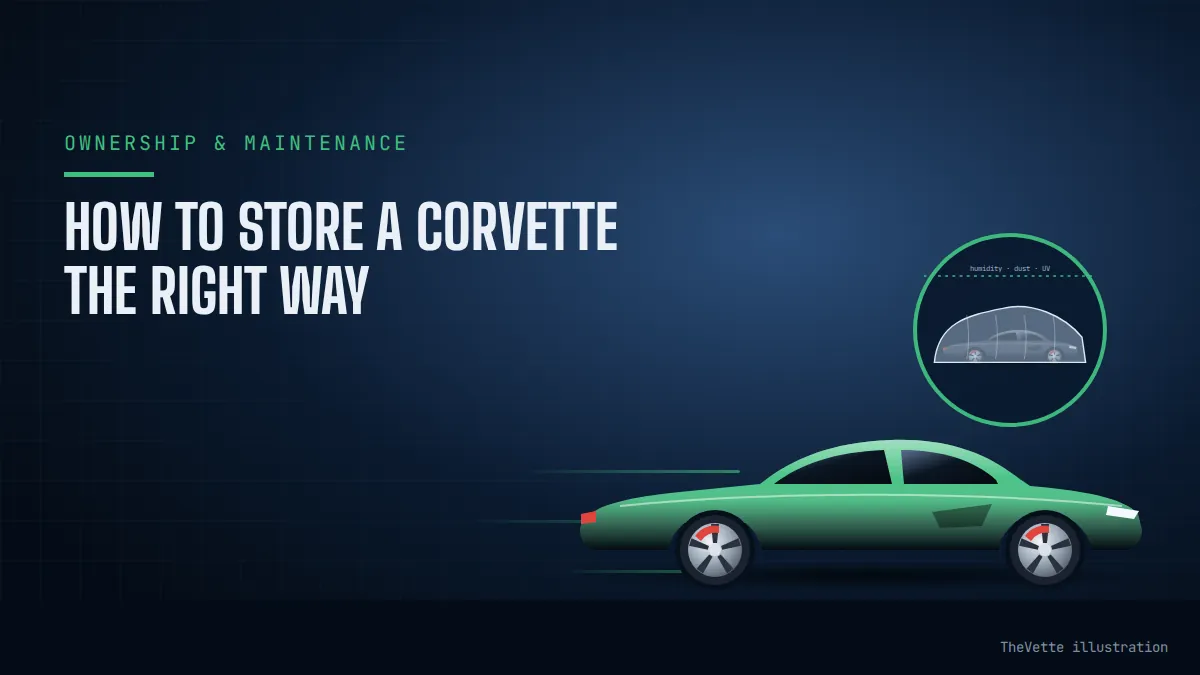
Good Corvette storage preserves safety and function rather than merely keeping dust off the paint. A parked car continues to change: a 12-volt battery self-discharges, fuel ages, moisture moves, tires lose pressure, rubber takes a set, brake surfaces oxidize, and animals look for shelter. The correct response depends on storage length, climate, generation, equipment, and whether the location has reliable power.
To place How to Store a Corvette the Right Way in a wider ownership and engineering context, continue with A Real-World Corvette Maintenance Schedule.
This guide builds a documented plan without prescribing one universal additive, tire pressure, battery disconnect, or start-up interval. Use the exact owner and service information for the VIN, plus instructions from the battery, tire, fuel-product, cover, and facility manufacturers. C8 E-Ray high-voltage equipment requires different knowledge from an early carbureted Corvette.
Define the storage period and exit date
A week in a home garage needs little beyond security and normal inspection. A winter, a year, or indefinite museum storage needs staged preparation, monitoring, and recommissioning. Write the expected duration, access frequency, local temperature and humidity range, power reliability, insurance conditions, and who may enter the space.
Set calendar reminders for inspections and the planned return. If the period extends, deliberately renew the plan rather than allowing seasonal storage to become abandonment. Record mileage, fuel level, battery strategy, tire readings, fluids, keys, and photographs at entry.
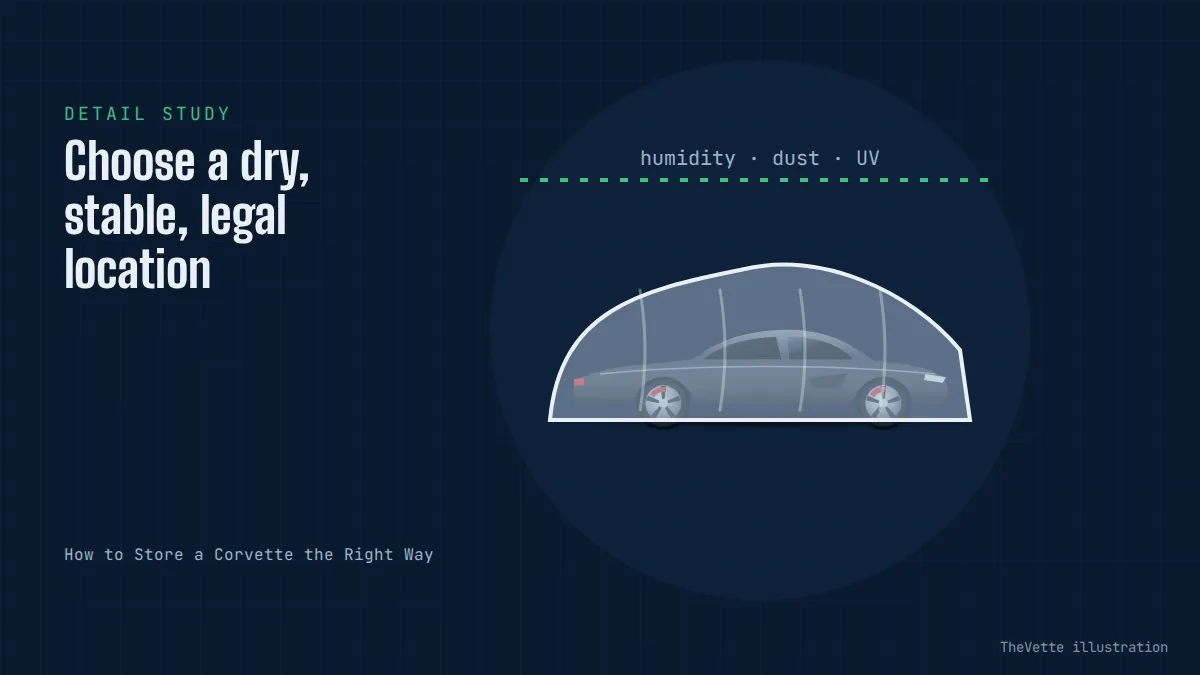
Choose a dry, stable, legal location
An enclosed weather-tight structure protects from ultraviolet light, rain, tree debris, vandalism, and rapid temperature swings. Good drainage and ventilation matter more than luxury flooring. Avoid areas that flood, drip condensation, share corrosive chemicals, or expose the car to grinding, welding, paint spray, or ozone-producing motors.
Confirm fire rules, electrical capacity, lease terms, access, surveillance, pest control, and insurer approval. Measure door width, ramp angle, ceiling, and turning space for the low nose and wide doors. A facility should provide a safe route for a flatbed if the car will not start.
Inspect before hiding problems
Scan for warnings and document battery voltage, fluid levels, tire pressure, leaks, noises, odors, and recent maintenance. Inspect tires, wheels, brakes, hoses, belts, cooling openings, underbody, weather seals, glass, drains, and exterior fasteners. Repair active leaks and unsafe tires before storage; a drip can damage both the car and floor for months.
Check recalls and service campaigns by VIN. A storage plan should not defer a fuel, electrical, or fire-risk remedy. Save a dated condition report so post-storage changes are distinguishable from pre-existing wear.
Wash without trapping water
Remove road salt, insects, bird contamination, brake dust, and organic debris using products safe for the finish, wheels, brakes, top, film, and coatings. Clean wheel arches and accessible underbody areas gently. Aggressive pressure can force water into connectors, seals, bearings, or cabin vents.
Dry thoroughly, including mirrors, lamps, emblems, seams, hatch channels, door jambs, weather seals, wheel cavities, and convertible-top areas. A final drive can warm brakes and evaporate water only if conditions, tires, and storage timing make it safe. Never cover damp paint.
Protect paint with clean contact
Apply a compatible wax or sealant after decontamination as appropriate. Document existing paint-protection film and ceramic coatings because their cleaning and storage needs differ. Do not polish thin original paint or fresh repairs without measuring and following cure instructions.
Anything touching the body must be clean and soft. Dirty microfiber, plastic sheeting, cardboard, and improvised blankets can scratch or trap moisture. Avoid resting items on the roof, hood, windshield, spoiler, or engine cover.
Select a cover for the actual environment
An indoor fitted breathable cover can reduce dust while limiting movement. Outdoor storage requires a product designed for weather, secure attachment, water management, and the car's aero pieces, but even a premium cover can abrade paint in wind. Never allow straps or grommets to strike the body.
Leave the car uncovered if a damp cover, construction dust, rodents, or frequent access makes covering riskier. Follow the cover maker's washing and installation instructions. Label front and rear so a contaminated cover is not dragged repeatedly across paint.
Clean the cabin without adding fragrance
Remove food, receipts, cups, leather products not meant for long dwell, and every loose object. Vacuum seams and under seats. Clean leather, fabric, microfiber, plastic, displays, and trim only with compatible products; oily dressings can stain and attract dust.
Check carpet and under-mat areas for moisture. Clear drain paths and verify windows, roof panel, hatch, and convertible top are fully latched in the manufacturer-recommended storage configuration. Do not leave scented products or open desiccants where they can spill or damage surfaces.
Climate control requires measurement
Humidity promotes corrosion and mold, while extremely dry air can affect materials. Temperature stability reduces condensation when the car is colder than incoming humid air. Use a reliable temperature and humidity logger instead of judging from how the room feels.
A dehumidifier needs drainage, safe power, maintenance, and an appropriate target. Heating without ventilation can create other hazards. Never place an open-flame heater near fuel, batteries, covers, or solvents. Follow building and fire codes.
Fuel strategy depends on the system
Fuel ages through oxidation, evaporation, and contamination, while ethanol blends can interact with water and older materials. A full tank may reduce vapor space in some guidance; other systems, very long storage, or facility rules may call for a different approach. Carburetors, return systems, direct injection, and modern sealed tanks are not interchangeable.
Consult the exact manual and a knowledgeable fuel supplier. Use fresh fuel of the required octane. If an approved stabilizer is chosen, measure it precisely, add it in the prescribed order, and run only as instructed to distribute treated fuel. An additive cannot restore already stale fuel or repair corrosion.
Do not idle the car casually
Starting an engine for a few minutes can add condensation to oil and exhaust without bringing the entire powertrain to stable operating temperature. It also creates carbon-monoxide risk and can move an unattended car. Periodic idling is not a universal storage requirement.
Either follow a documented model-specific cycling procedure under safe ventilation and supervision or leave the engine off until recommissioning. If the car is driven, the trip must be long and safe enough to exercise brakes, transmission, differential, tires, and climate system—not merely warm the coolant gauge.
Engine oil timing is condition-specific
Contaminated or overdue oil should not sit indefinitely, but automatically changing fresh oil again adds no value. Check oil life, date, mileage, specification, level method, track history, fuel dilution risk, and storage length. Dry-sump Corvettes have temperature- and time-dependent level procedures.
If service is due, use the correct oil and filter and inspect for leakage after running. Record quantity and date. Do not overfill for storage, add unapproved corrosion products, or fog a modern direct-injected engine based on an antique-car ritual.
Coolant and other fluids have time limits
Verify coolant protection, age, level, concentration, and leaks in every applicable circuit. Engine, charge-air, hybrid, transmission, differential, brake, clutch, power-steering, and lift systems vary by Corvette. Never open a hot pressurized system or mix coolants by color alone.
Brake fluid absorbs moisture and has a service schedule independent of mileage. Transmission and axle procedures can require specific temperature and tools. Storage is an opportunity to bring documented service current, not to pour additives into each reservoir.
The 12-volt battery needs a deliberate plan
Modern Corvettes have continuous security, keyless-entry, telematics, memory, and module loads. A parked battery can discharge enough to shorten life or prevent entry. Older cars may have radio, alarm, clock, or aftermarket drains. Test battery condition and charging before storage.
Choose the manufacturer-approved strategy: a compatible conditioner or maintainer, specified disconnect procedure, or monitored periodic charging. Battery chemistry matters; flooded lead-acid, AGM, and lithium-compatible equipment are not automatically interchangeable. A basic constant-output charger can overcharge and is not the same as a conditioner.
Connect a maintainer only as instructed
Some Corvette manuals identify a particular always-powered outlet or underhood points for the equipped maintainer. Others require different connections. Verify polarity, ground point, extension-cord rating, receptacle protection, cable routing, ventilation, and charger mode before energizing.
Keep cords away from sharp panels, hood latches, hot parts, water, tires, and walkways. Do not close a door or hatch hard on a cable. Check the status indicator periodically and after power outages. A green lamp does not excuse inspecting a swollen, leaking, hot, or odorous battery.
Battery disconnection has consequences
Disconnecting can disable security, remote entry, windows, hatch releases, emissions readiness, clocks, seat memory, and module learning. On some Corvettes, access becomes difficult with no electrical power. Aftermarket alarms or trackers complicate the choice.
Read the exact sequence, retain mechanical access, and use eye and hand protection. Never disconnect merely to silence a parasitic draw that should be diagnosed. Reconnection may require window indexing, steering or module learns, and careful terminal torque.
E-Ray has two electrical worlds
The C8 E-Ray includes a high-voltage propulsion system in addition to a low-voltage battery. Orange high-voltage cables and components are not owner-service points. The correct long-storage state of charge, permitted connection, temperature range, and wake-up procedure must come from current Chevrolet information for that model.
Do not apply generic battery-electric advice or attempt to isolate the pack. Damage, water exposure, collision history, warning messages, unusual heat, odor, or sound requires trained high-voltage service and emergency guidance. A 12-volt conditioner does not directly maintain the propulsion battery.
Tires lose air and continue aging
Set cold pressure according to model- and tire-specific storage guidance, never a number borrowed from another marque. NHTSA identifies infrequently used collector cars as vulnerable to tire aging and emphasizes monthly cold-pressure and condition checks. Record all four date codes and readings.
Inspect tread and both sidewalls for cracking, bulges, cuts, flat spots, leaks, and contamination. Restore normal placard pressure before driving if the approved storage value differs. The tire sidewall maximum is not a storage recommendation.
Flat-spot prevention must preserve safety
Long dwell can temporarily or permanently deform a loaded tire, depending on construction, temperature, pressure, duration, and tire condition. Approved curved tire cradles may spread load. Periodic movement can change the contact point only when someone can safely operate the vehicle and repark it accurately.
Do not put the car on improvised blocks, soft foam, narrow lumber, or unsuitable jack stands. Suspension droop can stress bushings and create unsafe instability. If the manufacturer or preservation plan calls for lifting, use exact lift points, rated equipment, a level floor, and professional technique.
Brakes can corrode while parked
Light rotor surface rust may form quickly in humidity and can clear during careful normal braking; deep pitting, seized pads, contaminated friction surfaces, or hydraulic leaks require service. Carbon-ceramic systems have different handling and inspection concerns. Never coat rotors or pads with oil.
Whether to leave a mechanical or electronic parking brake applied depends on vehicle instructions, slope, duration, and safe wheel restraint. Do not release it based on generic advice. Chocks must be rated and placed without damaging tires, and the transmission must be left in the specified state.
Rodent control begins outside the car
Remove food, nesting material, standing water, and clutter from the building. Seal structural entry points and monitor traps according to local law and safety practice. Inspect exhaust, intake, cabin filter, cowl, wiring, insulation, and cargo spaces regularly.
Do not place poison where an animal can die inside the car, and do not use mothballs, dryer sheets, ultrasonic devices, or peppermint as if they guarantee protection. Repellents can damage materials or create persistent odor. Never block an opening without a large visible reminder and a removal checklist.
Exhaust and intake plugs need control
Purpose-made breathable barriers may help against pests in some environments, but a forgotten plug can prevent starting, overheat a catalyst, or be expelled dangerously. It also may trap moisture. If used, select material safe for the system and never insert it deeply.
Attach bright tags at the steering wheel and ignition checklist, record every installed barrier, and have a second person verify removal. Inspect inside with suitable lighting before start-up.
Protect against leaks from above and below
Use a clean light-colored vapor-compatible floor mat or drip detector only if facility and fire rules permit. It makes new fluid visible without trapping moisture against the chassis. Never use flammable cardboard beneath a hot exhaust after a drive.
Inspect roof pipes, sprinklers, concrete dust, and shelves. Do not park beneath stored liquids, heavy objects, or a battery that can leak. Maintain clearance around the car for visual inspection without brushing the paint.
Security should not defeat emergency access
Keep keys, mechanical key blades, alarm instructions, and maintainer shutoff accessible to authorized people but separate from public view. Tell the facility how to contact the owner for water, fire, power failure, or alarm. Do not leave the key inside the car.
Photograph the location and document odometer and contents for insurance. Confirm coverage for storage address, modifications, flood, rodent, falling objects, and limited annual use. A disconnected battery may disable a tracker the insurer expects to operate.
Monthly inspection is observation, not tinkering
Check building moisture and pests, cover position, floor evidence, tire pressure and shape, battery-maintainer status, odors, glass, paint, seals, and visible fluid levels. Log readings and photographs. Do not open pressurized systems, move controls, or repeatedly unlock a sleeping modern car without need.
If a trend appears—falling tire pressure, rising humidity, charger fault, fuel smell, droppings, or fresh leak—act promptly. Isolate electrical or fire hazards and obtain professional help. Silence is not proof of stability.
Recommission in stages
Before power or movement, remove cover, exhaust or intake barriers, chocks as appropriate, cords, desiccants, tags, and pest controls using the written inventory. Inspect beneath, inside, and around the car. Look for chewed wiring, nests, leaks, fluid contamination, corrosion, tire damage, and blocked air paths.
Verify battery state and connections, cold tire pressure, oil by the exact procedure, coolant, brake fluid, fuel condition, brake pedal, lights, wipers, and warnings. Do not start if fuel odor, damaged high-voltage equipment, a major leak, or rodent nesting is present.
The first start is not the first drive
Ventilate fully and keep the exit clear. Follow the owner's starting procedure without prolonged cranking or pumping controls unless the system requires it. Observe oil-pressure indication, warning lamps, sound, exhaust, smoke, leaks, voltage, and temperature. Shut down for abnormal behavior.
After stable operation and any required learning, inspect again. Confirm brakes release and steering moves normally before leaving the parking space. Old fuel, stuck components, or dry seals may reveal themselves only after pressure builds.
Build speed only after a low-speed check
Begin on private or low-risk space at walking pace, testing brakes, steering, transmission, and tire feel. Then use a short legal drive close to support, avoiding high rpm, heavy braking, sharp cornering, and highway speed until temperatures and systems stabilize.
Watch for vibration, flat spotting, pull, noise, odor, warnings, and fluid loss. Recheck tire pressure cold later and inspect underbody and wheel areas. Complete due maintenance and alignment before performance driving.
Store the documentation with the ownership record
Keep entry and exit dates, mileage, photographs, fluid services, fuel and additive details, battery method, tire pressure and dates, inspection logs, repairs, facility conditions, and recommission results. This record guides the next storage cycle and supports honest resale disclosure.
A thoughtful plan avoids two extremes: abandoning the Corvette under a sheet and over-servicing it with unverified rituals. Clean and dry the car, manage energy and pressure by exact instructions, monitor change, control pests and moisture, and return it to use through measured inspection. Preservation is a process, not a parking spot.