“Corvette,” “Sting Ray,” and “Stingray” are related names, not interchangeable synonyms. Corvette is the enduring model family. Sting Ray—two words—belongs most famously to the 1963–1967 second generation. Stingray—one word—appeared on later third-generation cars and returned as the standard-model identity for the seventh and eighth generations. Some Corvette generations never carried either form as a production nameplate. The spaces, absences, and returns form a compact history of how Chevrolet positioned the car.
To place The Story Behind the Corvette Sting Ray and Stingray Names in a wider ownership and engineering context, continue with Every Corvette Generation Explained: C1 Through C8.
This article follows official historical usage rather than rewriting every reference into one modern spelling. It does not reproduce manufacturer logos or imply that TheVette is an official publication. General Motors heritage records, model-year information kits, and Chevrolet history material are used to establish chronology. Because current naming can evolve with future model years, present-lineup references are dated to August 2026.
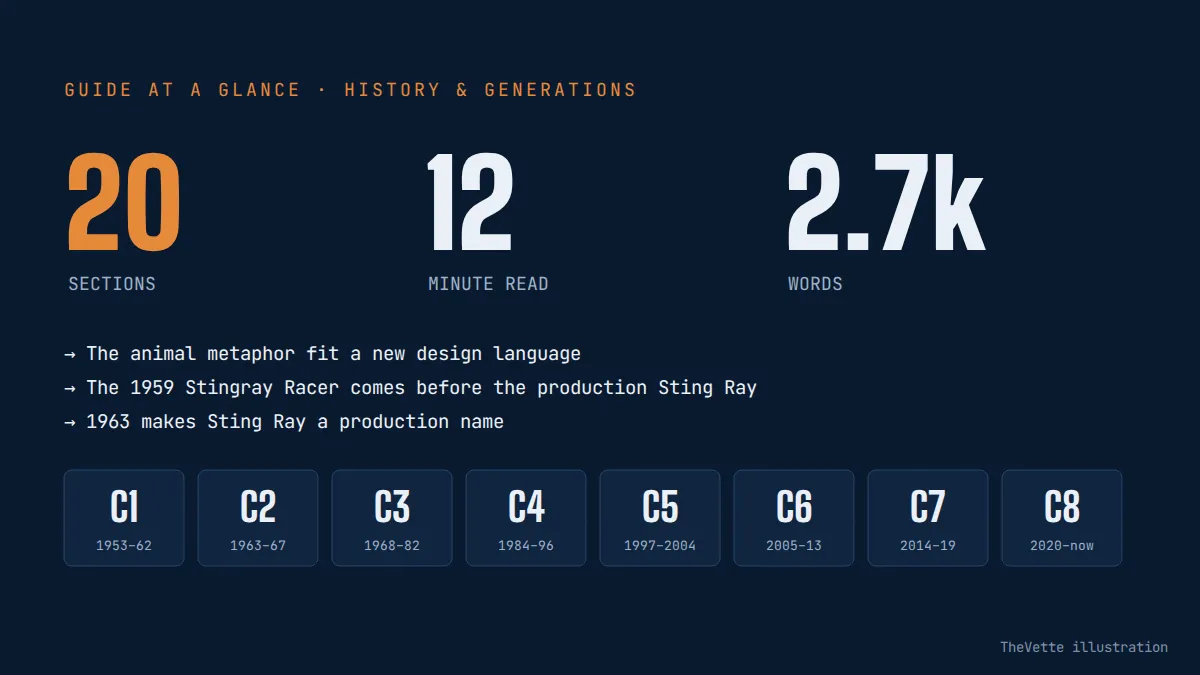
The animal metaphor fit a new design language
A stingray’s flattened body, broad lateral shape, and fluid movement made it a persuasive metaphor for the low, wide sports-car forms explored by General Motors designers around the end of the 1950s. Marine names also appeared in related concepts, including Mako Shark and Manta Ray. The point was not literal imitation. The names communicated a body that seemed shaped by flow, with pronounced fenders, a low central mass, and motion suggested even while standing still.
That metaphor helped distinguish a new Corvette design era from the upright, rounded first-generation roadster. It also gave writers and owners a vivid shorthand. A technical chassis description could explain independent rear suspension and packaging; “Sting Ray” immediately evoked an attitude and silhouette. The name became powerful because the production car delivered a design memorable enough to sustain it.
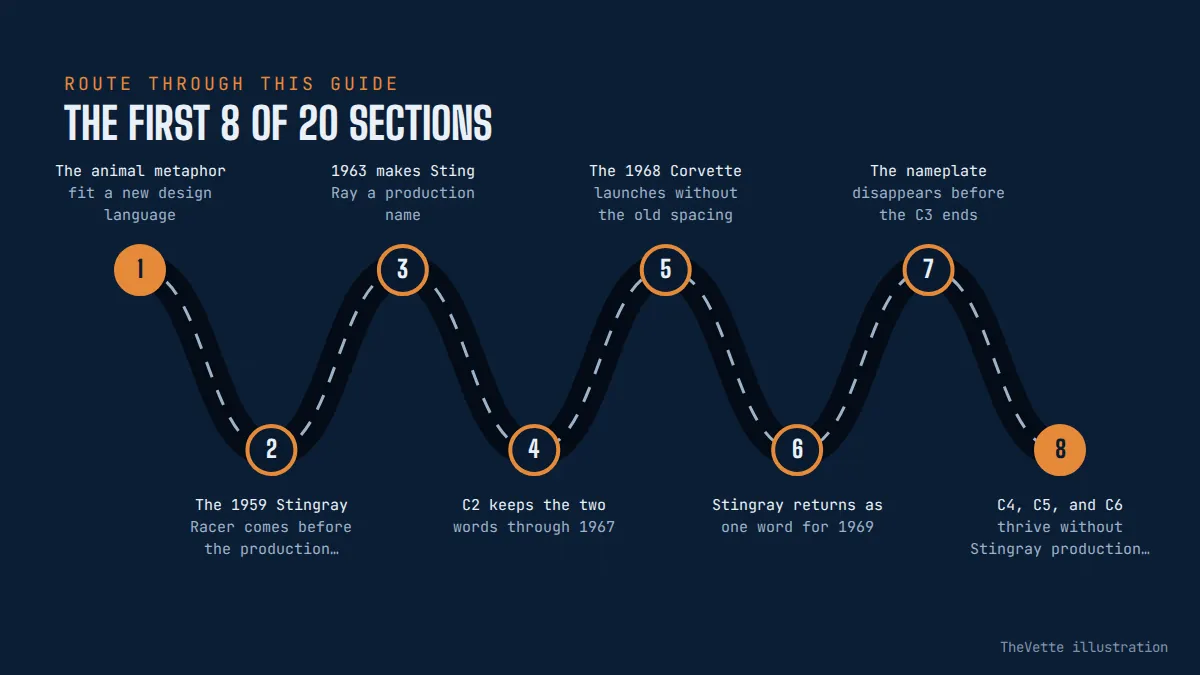
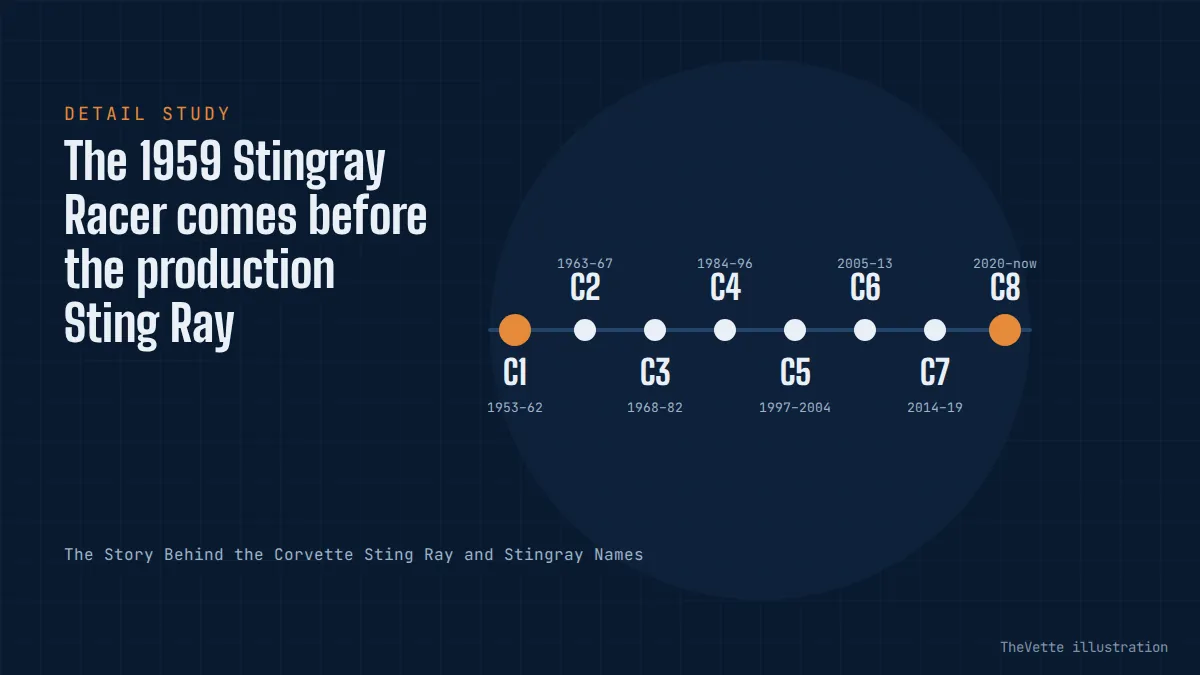
The 1959 Stingray Racer comes before the production Sting Ray
Official GM heritage material identifies the 1959 Stingray Racer as an influence on later concepts and design work. The racer predates the 1963 production Sting Ray and provides the essential bridge between experimental competition-minded form and the road-car name. It should not be described as a normal production C1 or as a retail prototype in the modern sense. Its purpose, construction, and history were distinct.
Historical accounts often connect the racer with designer Bill Mitchell and the continuation of ideas from earlier experimental Corvette work. The safe editorial distinction is that the 1959 car carried the Stingray identity before the public could buy a production Sting Ray. When a museum label, archive, or period document uses a particular spelling, preserve that usage; later one-word branding should not be projected backward without explanation.
1963 makes Sting Ray a production name
The all-new 1963 Corvette arrived as the Sting Ray, two words, in both coupe and convertible form. The coupe’s divided rear window became the most recognizable single-year detail, but the name represented more than that feature. The new chassis, independent rear suspension, lower body, hidden headlamps, and cockpit-focused interior established a complete break from C1. “Sting Ray” marked the reinvention.
Official GM heritage material for the 1963 car uses the two-word construction. That matters when writing captions, restoring badges, evaluating literature, or describing a car for sale. Calling a 1963 model a “Stingray” in casual modern conversation is understandable, but historically precise writing should retain “Sting Ray.” Precision also discourages the mistaken idea that any badge with the modern spelling belongs on any C2.
C2 keeps the two words through 1967
The Sting Ray designation continued across the five-year C2 generation while body vents, trim, brakes, engines, and details changed. The split rear window disappeared after 1963, but the name did not. A 1967 remains a Sting Ray even though it looks cleaner and carries equipment unavailable at the generation’s launch. The two words therefore describe the production generation more broadly than the split-window nickname.
For collectors, correct spelling is one part of model-year authenticity, not proof by itself. Reproduction scripts and literature exist. A nameplate should be assessed with its location, fasteners, body condition, part style, and year-specific references. The VIN, powertrain evidence, trim, records, and physical structure establish the car; a script confirms only that a script is present.
The 1968 Corvette launches without the old spacing
The third generation arrived for 1968 with a body influenced by the Mako Shark II design direction. The production transition did not simply carry every C2 identification detail forward. Model-year literature and emblems must be checked individually, because the first C3 year occupies a naming transition. Treating the whole 1968–1982 generation as though every car wore the same Stingray script erases real variation.
This is a useful warning about retrospective labels. Enthusiasts commonly say “C3 Stingray” to describe the shape, even when discussing a year in which the nameplate was absent or later dropped. That shorthand may communicate the general car, but a restoration guide, sale listing, or historical article needs the exact year’s factory usage. The GM vehicle information kits provide a primary checkpoint.
Stingray returns as one word for 1969
For 1969, the production name appeared as “Stingray,” one word. The missing space is a small typographic change with lasting historical importance. It distinguishes later C3 usage from the C2’s “Sting Ray.” Owners, auction descriptions, parts catalogs, and modern Chevrolet pages sometimes normalize the spelling, so the date and source should govern editorial choice.
The one-word script remained associated with the C3 during part of its run, but it did not stay on every C3 through 1982. Its presence or absence should be verified against the model year rather than inferred from body shape. A later car fitted with a Stingray script may be an owner preference. That can be visually pleasing while still differing from its original exterior identification.
The nameplate disappears before the C3 ends
Stingray identification was dropped during the long C3 generation, even though the fundamental body family continued. This separation shows that the name was a branding choice, not a technical generation code. A Corvette did not stop being a Corvette when the script left the fender. Special editions, engine labels, and model-year styling could carry the identity without the marine name.
For restorers, absence is a detail worth preserving. Adding a familiar script to a car that did not originally use it can create false confidence in viewers who assume the badge is factory evidence. Documentation should state whether exterior identification is original, reproduced, replaced in the correct position, or added later. Honest labeling allows aesthetic personalization without rewriting history.
C4, C5, and C6 thrive without Stingray production branding
The fourth generation made a clean technological and visual break for 1984, emphasizing a low integrated structure, digital instrumentation, and handling. Its principal identities included Corvette itself and later specialized names such as ZR-1, Grand Sport, and Collector Edition. Stingray was not required to connect the new car with its predecessors. The shape and crossed-flags heritage performed that work within official branding.
C5 and C6 likewise developed strong identities through architecture and performance variants. Rear transaxles, LS-family engines, fixed-roof and Z06 models, modern racing, Grand Sport, and ZR1 created their own vocabulary. Calling every base C5 or C6 a “Stingray” is historically inaccurate, even if a seller uses the term as a generic synonym for Corvette. Modern replacement badges do not change the factory model name.
Concept cars keep the word available
Names can remain culturally active even when absent from production. The 2009 Corvette Stingray Concept demonstrates that designers and marketers still considered the word a powerful link to experimental form. GM states that the concept drew influence from the original 1959 Stingray Racer while incorporating heritage cues from other generations. Its futuristic body appeared in connection with the film “Transformers: Revenge of the Fallen.”
A concept is not a production trim and should not be described as a customer C6 or preview whose every feature was promised for sale. Its significance lies in testing visual ideas and refreshing the name in public memory. It also shows how “Stingray” had become broader than one historical script: it could signal a design philosophy reaching from a 1959 racer to a modern entertainment-oriented concept.
C7 earns the one-word name again
For the 2014 seventh-generation launch, Stingray returned as the standard production model’s identity. Chevrolet history material records that the car was expected to earn the name through its design and performance. The return was not merely a badge added to a C6. C7 introduced a new structure, direct-injected LT1 engine, revised cabin, sharper body, and integrated drive-mode controls.
The modern one-word spelling connected C7 to C3 usage while the launch narrative invoked the broader Sting Ray heritage. It also clarified hierarchy: Stingray described the core model, while Z06, Grand Sport, and ZR1 named other configurations during the generation. Not every C7 is therefore best identified as a Stingray. A C7 Z06 is a Corvette Z06, not simply a Stingray with more power.
C8 carries Stingray into the mid-engine era
The 2020 mid-engine Corvette retained Stingray for the naturally aspirated entry model. This continuity helped anchor the most radical production-layout change in the nameplate’s history. The engine moved behind the cabin and the dual-clutch transmission replaced both conventional automatic and manual choices, yet a familiar word linked the new proportions to decades of design experimentation.
As of August 2026, the C8 family contains distinct Stingray, Z06, E-Ray, and ZR1 models in the current official lineup. Future products have been announced, but this article dates current-lineup statements to avoid turning future information into timeless history. The central rule remains: all these models are Corvettes, but not every one should be called a Stingray.
Stingray can mean a model, not the entire generation
Modern configuration makes the distinction practical. Searching for parts, insurance, service procedures, tires, brakes, or cooling information under “C8 Stingray” can produce an answer wrong for a Z06 or E-Ray. The same applies to C7 performance variants. The word is not simply affectionate vocabulary; it can identify a specific propulsion and chassis package within a wider Corvette family.
Historical usage is different. “C2 Sting Ray” generally describes the production generation because that name spanned it. “C3 Stingray” may be used culturally for the body era even though exact badge usage changed. Context determines whether the term is a precise model name, a period nameplate, or enthusiast shorthand. Good writing makes that context explicit.
Why the space matters to editors and owners
A space can preserve chronology. “Sting Ray” points toward the 1959 racer and the 1963–1967 production identity; “Stingray” points toward later C3 and modern usage. Style guides that automatically collapse the terms lose information. The safest approach is to quote the spelling used by the relevant official model-year source and explain any difference from present branding.
Search engines and marketplaces complicate this because users type both forms. An article may include both terms for discoverability while keeping the historical name correct in headings and captions. A sale listing should state “1965 Corvette Sting Ray,” for example, and can mention that buyers often search “Stingray.” Accuracy and findability do not require the same spelling in every context.
Badges are evidence of a component, not of identity
Scripts are replaceable. Bodies are repainted, fenders repaired, trim holes filled, and reproduction emblems installed. A correct-looking badge can be mounted on the wrong year, in the wrong place, or over a repaired panel. Conversely, an otherwise authentic car may be missing a script after collision work. Authentication must connect VIN, body, chassis, powertrain, option data, documentation, and model-year detail.
Inspect an emblem without damaging the car. Compare style and placement with reliable references, look for disturbed paint or irregular holes, and ask when it was installed. Do not remove trim during a viewing without permission. If badge originality materially affects a concours claim, a marque specialist and judging manual are more appropriate than an image-search comparison.
The name influences restoration choices
A model-year-correct restoration needs the proper script, finish, location, fasteners, and surrounding panel treatment—or no script where none belongs. Reproduction quality varies. An emblem with inaccurate proportions or plating can undermine an otherwise careful exterior. More importantly, drilling a body to add a non-original badge creates irreversible work. Decide whether the project aims for factory correctness or personal expression before ordering trim.
Keep removed original parts labeled and protected even when a reproduction is installed for regular use. Photograph mounting areas before paint and record hole locations from trusted references. If the body was previously altered, document the decision to restore or retain that history. Transparency matters more than pretending a modern correction has always been present.
The name shapes collecting language and value claims
“Split-window Sting Ray,” “chrome-bumper Stingray,” and “C7 Stingray” can direct buyers toward very different markets. The emotional strength of the word sometimes encourages sellers to apply it broadly. A name alone does not establish rarity, engine, options, originality, or condition. Production data and individual evidence remain necessary. A script should never carry a price premium without the car that legitimately supports it.
Collectors can also value name history without pursuing maximum originality. A driver may wear an added emblem because the owner enjoys it. The ethical line is disclosure when the car is sold or judged. Describe the addition as an addition. Enthusiast culture is rich enough to accommodate personalization and historical accuracy when they are not confused.
Stingray in popular culture
The word’s visual force made it useful beyond brochures. Corvettes appeared in television, film, toys, games, songs, and advertising, and “Stingray” often became a generic audience label for a sleek Corvette. The 2009 concept’s film connection is a direct example of design and entertainment reinforcing each other. Cultural memory does not always preserve spaces or model years, which helps explain modern casual usage.
Popular culture is valuable evidence of reputation, not always of production detail. A screen car can be modified, duplicated, or represented as another year. A toy package may simplify the name. When a cultural artifact is the subject, quote its own label; when identifying the underlying vehicle, check independent model-year sources. This prevents nostalgia from becoming a parts manual.
The marine-name family extends beyond Stingray
Mako Shark, Mako Shark II, and Manta Ray concepts show a broader marine vocabulary around Corvette design. GM heritage material describes the 1969 Manta Ray concept as an evolution of the Mako Shark II and connects the inspiration to marine form. These names belong to specific concept histories; they are not production trims that every similar body inherits.
The family of names reveals a design method: use a recognizable natural form to communicate speed, tension, surface, and movement. Sting Ray endured because it crossed from experimental car to production identity and later returned. Other marine names remained more closely tied to dream cars. Their influence can be discussed without claiming that a production panel was copied literally from an animal or concept.
How to name a Corvette correctly
Start with year, then official model and trim. Use “1963 Corvette Sting Ray” for the two-word C2 identity, “1969 Corvette Stingray” for the one-word return, and year-specific references for later C3 badge usage. Use “2014 Corvette Stingray” and “2020 Corvette Stingray” for the modern standard models. Use Z06, E-Ray, ZR1, or another factory designation when that is the actual model rather than appending Stingray automatically.
For an unknown photograph, avoid precision the image cannot support. “C2 Corvette” may be safer than assigning a year and engine. For a modified car, identify the underlying VIN and factory configuration, then describe changes. For search-friendly publishing, include alternate spellings in explanatory text while preserving the correct historical form in the title and primary references.
A small word carries several reinventions
The name began in the orbit of an experimental racer, became the identity of a completely new 1963 production Corvette, changed its typography for the C3, disappeared from production for decades, surfaced in concept work, and returned with C7 before anchoring the mid-engine C8 entry model. Its history parallels Corvette’s habit of using continuity to make major change understandable.
That is why the distinction is worth more than trivia. “Sting Ray” and “Stingray” locate a car in design, marketing, and model history. Used carefully, they help an owner order the right part, a restorer place the right script, a buyer understand a listing, and a writer respect the record. The name remains powerful precisely because it has never meant every Corvette in exactly the same way.