ZR1 is Corvette’s recurring maximum-performance designation, but its four major appearances share little hardware. The 1970–1972 ZR1 was a competition-oriented option package built around the LT-1 small-block. The 1990–1995 ZR-1—officially hyphenated—used the Lotus-designed, Mercury Marine-built LT5 double-overhead-cam V8. C6 revived ZR1 without a hyphen for 2009 using the supercharged LS9; C7 followed for 2019 with the supercharged LT5; and the mid-engine C8 introduced the twin-turbo LT7. The name marks a summit for its period, not one continuous engine family.
To place Corvette ZR1 History: The Fastest Flagship Evolves in a wider ownership and engineering context, continue with Corvette Aerodynamics Explained for Everyday Drivers.
This independent history uses official sources and distinguishes production cars, option packages, concepts, nicknames, and later ZR1X. Output figures belong to their original rating contexts and are not a substitute for chassis or historical analysis. TheVette is not affiliated with Chevrolet or General Motors and does not reproduce official logos or media.
What ZR1 has come to signal
Across its appearances, ZR1 has sat above an already capable Corvette range. The formula normally adds a distinctive engine, stronger cooling, brakes, tires, structure or chassis calibration, and visual cues appropriate to the capability. It is closer to a flagship engineering statement than a permanent specification.
The meaning differs from Z06. Z06 has repeatedly emphasized track-focused integration, while ZR1 has usually represented the outer boundary of performance and technology for the generation. Those missions overlap, but neither badge is simply a horsepower rank that applies forever.
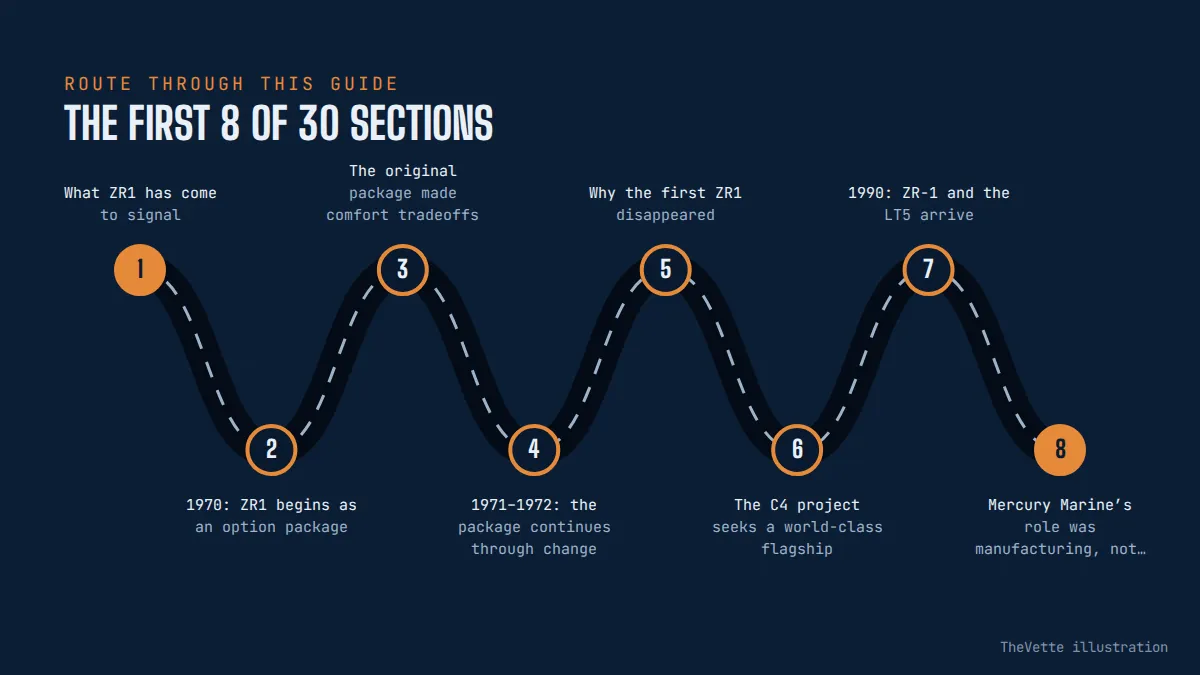
1970: ZR1 begins as an option package
Chevrolet’s legacy history places the ZR1 performance package debut in 1970. It was not a wide-body model with a unique engine family. The package combined the high-revving solid-lifter LT-1 small-block with equipment intended for demanding use, including chassis, brake, cooling, and driveline selections appropriate to the package.
Exact content and availability should be checked against the model-year GM information kit and recognized judging references. The package’s significance lies in coordination. Like the 1963 Z06, it treated sustained performance as more than an engine order, while remaining rare enough that modern authentication requires specialist evidence.
The original package made comfort tradeoffs
Competition-oriented equipment can conflict with convenience. Historical package descriptions identify omissions or restrictions affecting comfort features because cooling airflow, engine operation, mass, and intended use mattered more. This tells owners not to “correct” an original car by adding equipment without understanding the package.
For collectors, absence can be evidence. A missing comfort option may support the configuration rather than indicate an incomplete restoration. Authentication must connect VIN, build data, engine, transmission, axle, suspension, brakes, radiator and cooling pieces, and documentation—not merely an emblem or seller statement.
1971–1972: the package continues through change
ZR1 remained available for a short early-C3 period while engine ratings, emissions requirements, fuel expectations, and the wider market changed. The surrounding Corvette line evolved, so a 1970 reference cannot automatically settle a 1972 detail. Each year’s records and component dates matter.
The brief run and low production make surviving examples historically significant. They also invite reconstruction. A car assembled from correct-type components can be an appealing tribute, but it should not be represented as a factory ZR1 without documentary and physical support.
Why the first ZR1 disappeared
Changing regulation, insurance, fuel, emissions, and customer priorities reshaped high-performance cars in the early 1970s. Corvette continued, but the ZR1 package did not become an annual fixture. Its disappearance reinforces that internal option codes respond to a specific product plan rather than guaranteeing a permanent sub-brand.
The dormant name retained potential because it had not been diluted across ordinary models. When Chevrolet needed a designation for an extraordinary C4 project, the old code could return with an entirely new technical meaning.
The C4 project seeks a world-class flagship
By the 1980s, Corvette had adopted a low integrated structure, electronic fuel injection, digital instrumentation, and a modern handling focus. A flagship beyond the standard pushrod V8 required more than a traditional option package. General Motors worked with Lotus on a new multi-cam engine and a comprehensive high-performance car.
The resulting ZR-1 used a hyphen in its official production name. Preserving that punctuation helps distinguish the C4 from later ZR1 models and from the original option code. The “King of the Hill” nickname captured its ambition but was not a substitute for the formal designation.
1990: ZR-1 and the LT5 arrive
The production C4 ZR-1 debuted for 1990 with the 5.7-liter LT5, an aluminum double-overhead-cam, four-valve-per-cylinder V8. Lotus led its design, while Mercury Marine assembled production engines. This architecture departed dramatically from the pushrod small-blocks that powered contemporary standard Corvettes.
The engine’s broad visual presence under the clamshell hood made the difference unmistakable. It delivered a different sound, airflow strategy, service layout, and high-speed personality. ZR-1 therefore became a technology story as much as a performance one.
Mercury Marine’s role was manufacturing, not branding
Mercury Marine’s Stillwater operation brought expertise in aluminum manufacturing and precision assembly to LT5 production. The engines remained General Motors powerplants for Corvette; the outside assembly relationship does not make the car a marine-engine conversion. Clear language respects each participant’s role.
For preservation, original engine records, casting and assembly details, service tools, and specialist knowledge matter. The unusual supply chain makes documentation particularly interesting, while decades of repair and parts substitution mean that a clean plenum alone cannot establish originality.
The wider tail makes the first cars visually distinct
C4 ZR-1 packaging and tires required wider rear bodywork. Early cars also used a rounded rear treatment that previewed the later base Corvette update, creating a visual distinction when new. Wheels, high-mounted stop lamp placement, badges, and rear proportions help identify the model, but appearance parts can be transferred.
A genuine ZR-1 claim begins with VIN and factory records, then engine, body, brakes, wheels, interior controls, and other year-specific evidence. Conversions and replicas can be enjoyable; disclosure separates them from factory cars.
Secondary-port control shapes the C4 experience
The LT5 induction system used staged airflow and fuel strategies, with a driver-controlled power mode on production cars. This gave the flagship a visible sense of unlocking full capability while supporting ordinary use. Age can complicate vacuum controls, actuators, injectors, wiring, and calibration.
Modern owners sometimes simplify or delete original controls. A modification can improve serviceability for a driver, but it changes historical operation and should be documented. A functioning key or indicator is not proof that the entire secondary system works under load.
1993 brings a stronger final form
For 1993, the LT5 received updates that raised its official output, and those later specifications continued through the end of production. The revision helped keep the flagship distinct as the standard Corvette also improved. Comparing early and late cars therefore requires more than exterior color and mileage.
Collectors may prefer the first-year significance, the later engine, or a particular option combination. None is universally best. Service history and specialist access can matter more than the nominal rating when choosing a car to drive.
1995 closes the C4 ZR-1 chapter
ZR-1 production ended after 1995, one year before the C4 generation itself concluded. The final-year separation again shows that flagship names follow product cycles rather than generation boundaries. The LT5 did not become the standard Corvette engine or continue into C5.
The C5 instead launched a new rear-transaxle architecture and LS1 pushrod V8. Its performance halo became Z06, not ZR1. This pause protected ZR-1 as a distinct C4 achievement rather than stretching the badge across unrelated early C5 products.
C5 has no production ZR1
C5 dramatically improved structure, packaging, and performance, and its Z06 delivered focused capability. Yet no retail C5 ZR1 joined the range. Claims of a factory C5 ZR1 should therefore be treated as misuse, an aftermarket name, or confusion with a concept or project unless extraordinary primary evidence exists.
The absence matters because Corvette history is not a ladder where every generation receives every badge. ZR1’s rarity across generations contributes to its flagship meaning.
2009: C6 revives ZR1 without the hyphen
The ZR1 name returned for the 2009 model year at the top of the C6 range, now normally styled without a hyphen. Instead of a multi-cam naturally aspirated engine, the car used the supercharged 6.2-liter LS9. The architecture returned to pushrods while forced induction moved output far beyond the standard car.
This combination demonstrates that ZR1 did not mean “DOHC Corvette.” It meant the flagship engineering answer for C6, built around compact small-block architecture, supercharging, specialized cooling, and a chassis prepared to use the output.
LS9, charge cooling, and hand assembly
The LS9 combined a positive-displacement supercharger with an integrated charge-cooling system and high-performance internal components. Engines were hand assembled in the Performance Build Center tradition, giving the powerplant both industrial and craft significance. Its official output placed the C6 ZR1 above the contemporary Z06.
For owners, the system adds belts, supercharger drive, coolant circuits, pumps, heat exchangers, and calibration to inspection. A pulley change or tune can alter thermal and fuel margins. Historical appreciation should include the maintenance demands that made repeatable power possible.
Carbon-ceramic brakes and carbon fiber broaden the flagship
C6 ZR1 used carbon-ceramic brakes and visible carbon-fiber body components, joining engine output with mass, stopping capability, and materials. A hood window made the supercharger cover part of the visual identity. Wide bodywork and specific wheels completed the package.
These features age differently from conventional parts. Carbon repair, clear-coat condition, brake-rotor measurement, wheel damage, and replacement cost are central to used-car evaluation. A badge and engine tune cannot recreate the factory package.
The C6.R relationship needs careful language
Official Corvette Racing history describes production-based components and close relationships between road and race programs during the C6 era. The GT-spec C6.R used a profile and selected structural or aerodynamic ideas connected to production Corvettes, including ZR1 context.
That does not turn a customer ZR1 into a homologated race car or transfer race victories to its VIN. The accurate achievement is coordinated development within rules, with road and competition machines serving different purposes.
2019: C7 ZR1 becomes a one-year climax
The C7 ZR1 arrived for 2019, late in the final front-engine generation. Its supercharged 6.2-liter LT5 produced an official 755 horsepower, placing it above the C7 Z06. A prominent cooling and aerodynamic package made the car visually and thermally distinct.
Both seven-speed manual and eight-speed automatic versions were offered, broadening transmission choice beyond C6 ZR1’s manual-only identity. The one-model-year run gave it a concentrated place in Corvette history: the highest expression of the front-engine/rear-transaxle architecture before C8.
LT5 reuses a code, not an architecture
The C7’s LT5 engine code echoes the C4 ZR-1’s LT5, but the engines are not developments of the same mechanical architecture. The earlier unit is a naturally aspirated DOHC four-valve design; the later is a supercharged pushrod Gen V small-block. Shared lettering creates heritage, not parts interchangeability.
This is why engine codes need generation context. Saying “LT5 Corvette” without year can describe fundamentally different machines. Good documentation always pairs code with displacement, architecture, generation, and model year.
Aero packages create two C7 personalities
C7 ZR1 configurations ranged from lower-drag road and speed emphasis to high-downforce track intent with larger aero. Wings, splitters, underbody elements, tires, and chassis calibration worked together. Visible high wings became shorthand for the model, but not every car left the factory with the same setup.
Aftermarket replicas can change balance if front and rear devices are not matched. Authenticity and safety require option records, correct mounting, and inspection for curb or track damage. Aero is engineering, not decoration alone.
C8 changes ZR1 more radically than any revival
The mid-engine platform moved the C8 ZR1’s powerplant behind the cabin and paired it with an eight-speed dual-clutch transmission. For the first time in a factory Corvette, the engine uses turbocharging. The flagship therefore changes placement, induction type, transmission, proportions, and airflow at once.
The 2025 launch material describes coupe and convertible versions, making ZR1 no longer a fixed-roof-only idea. Its mission remains top-tier output and track capability, but accessibility, electronics, and body choice reflect a modern production family.
The twin-turbo LT7
The C8 ZR1 uses the 5.5-liter LT7, a double-overhead-cam flat-plane-crank V8 derived from the same broad “Gemini” architecture as the naturally aspirated LT6 but extensively redesigned for twin turbochargers. Chevrolet rates it at 1,064 horsepower under SAE guidelines for the launch configuration.
The number is historically dramatic, yet the engineering story includes turbo integration, dual fuel strategies, oil and coolant routing, charge-air management, reinforced transmission components, and adaptive controls. Adding turbochargers to an LT6 would not reproduce an LT7.
Cooling shapes the body
C8 ZR1 uses additional openings, heat exchangers, ducts, and a functional split rear-window spine that helps extract engine-compartment heat. The design reference to 1963 is therefore tied to a modern thermal task rather than a simple applied graphic.
Cooling damage or debris can affect one circuit without an obvious general-temperature warning. Owners and buyers need model-specific inspection of every opening, cooler, pump, line, undertray, and control strategy. High power is sustainable only when heat leaves the car as designed.
Standard and ZTK configurations
Chevrolet developed a lower-drag standard chassis and a ZTK-focused high-downforce configuration. Carbon-fiber aero, tires, springs, brakes, and underbody details create different priorities. One aims to balance road use and speed; the other accepts greater drag and consumable demands for circuit behavior.
A used listing should identify factory package content rather than equating any tall wing with ZTK. Replacement aero must be mounted to the intended structure and matched front to rear. Damage at extreme speed can have consequences far beyond cosmetic value.
ZR1 and ZR1X are not synonyms
The later ZR1X combines the ZR1’s twin-turbo rear powertrain with an electrified front axle and all-wheel drive. It is a separate model identity with high-voltage systems and a different total output and operating strategy. Calling every C8 flagship “ZR1X” erases a meaningful propulsion distinction.
For history, ZR1 remains the rear-wheel-drive twin-turbo model described here. ZR1X extends the platform into another category. Future lineup changes should be dated and sourced rather than projected backward.
Why C8 performance records do not define the whole history
Official and independent closed-course results demonstrate the C8 ZR1’s capability under specific drivers, tracks, weather, tires, packages, and procedures. They do not make a road owner capable of reproducing those results or prove the condition of a used car.
Records are useful historical markers when the course configuration and source are clear. The larger ZR1 story is engineering evolution across five decades, not a leaderboard detached from safety and context.
How to authenticate each era
For 1970–1972, use GM records, engine and driveline evidence, package components, dates, and expert inspection. For C4, preserve the ZR-1 hyphen and verify VIN, LT5, wide body, controls, brakes, wheels, and year detail. For C6 and C7, option data, engine, carbon components, brakes, aero, transmission, and modules form the chain.
For C8, add software, full-module diagnostics, turbo and cooling configuration, aero package, brake system, and current recall status. No era can be authenticated by badge alone. A replica may be desirable when honestly described; a factory claim requires factory evidence.
Horsepower figures need historical boundaries
The original LT-1-era package used rating practices and performance expectations unlike today. C4 LT5 output, C6 LS9, C7 LT5, and C8 LT7 figures come from different engines, standards, transmissions, vehicle masses, tires, and aerodynamic goals. A numerical chart is not a fair measure of significance.
The C4’s multi-cam engine was revolutionary in its context even though later base Corvettes exceed its output. C6 made supercharged production repeatable; C7 maximized the front-engine platform; C8 integrates four-figure output into a mid-engine car. Historical achievement is relative to the problem solved.
The flagship carries flagship maintenance
ZR1 ownership adds specialized engine parts, cooling circuits, tires, brakes, carbon fiber, aero, electronics, and often low production volume. A low-mileage car can still need age-based service. A modified example may require tuner support and unavailable original parts.
Inspection should include fluid history, full diagnostics, tire dates, brake measurements, cooling operation, structural and aero condition, and documentation of every major modification. Budget follows the hardware, not the used purchase discount.
The enduring idea is an engineering summit
The first ZR1 coordinated a competition-oriented LT-1 package. C4 pursued multi-cam international technology. C6 combined supercharging, carbon materials, and ceramic brakes. C7 pushed the mature front-engine layout to its final extreme. C8 uses twin turbos, mid-engine packaging, advanced aero, and a strengthened dual-clutch driveline.
Nothing mechanical remains constant across that sequence. The continuity is ambition: use the generation’s most advanced feasible systems to move Corvette’s upper boundary. That makes each ZR1 a record of its era—and makes differences, not superficial similarity, the heart of the name’s history.