Z06 is one of Corvette’s most durable performance designations, but it has never described one fixed recipe. In 1963 it was an optional special-equipment package intended for competition-minded buyers. When the name returned for 2001, it identified a focused fixed-roof C5 road car. C6 paired it with a 7.0-liter engine and aluminum structure; C7 used supercharging; C8 moved to a mid-engine chassis and a naturally aspirated double-overhead-cam V8 with a flat-plane crankshaft. The connecting idea is track capability, not a shared engine architecture.
To place Corvette Z06 History: From Track Package to Supercar in a wider ownership and engineering context, continue with How to Prepare a Corvette for Its First Track Day.
This independent history follows official generation records and keeps road cars separate from Corvette Racing competition machines. Manufacturer horsepower figures are presented in their proper eras rather than used for direct cross-decade ranking. TheVette is not affiliated with Chevrolet or General Motors, and no official logos or press images are reproduced.
What the designation means
Z06 began as an internal-style option code rather than a poetic model name. That origin explains its compact, technical sound. Over time the code became publicly recognizable enough to function as a badge and model identity. Chevrolet has repeatedly used it for a Corvette positioned around circuit performance, braking, cooling, tires, structure, and powertrain as a coordinated package.
The code does not guarantee that every later Z06 contains a literal descendant of each 1963 part. It signals a mission renewed with the available technology of the generation. Reading the history as a checklist of differences is more useful than searching for one component that makes a “true” Z06.
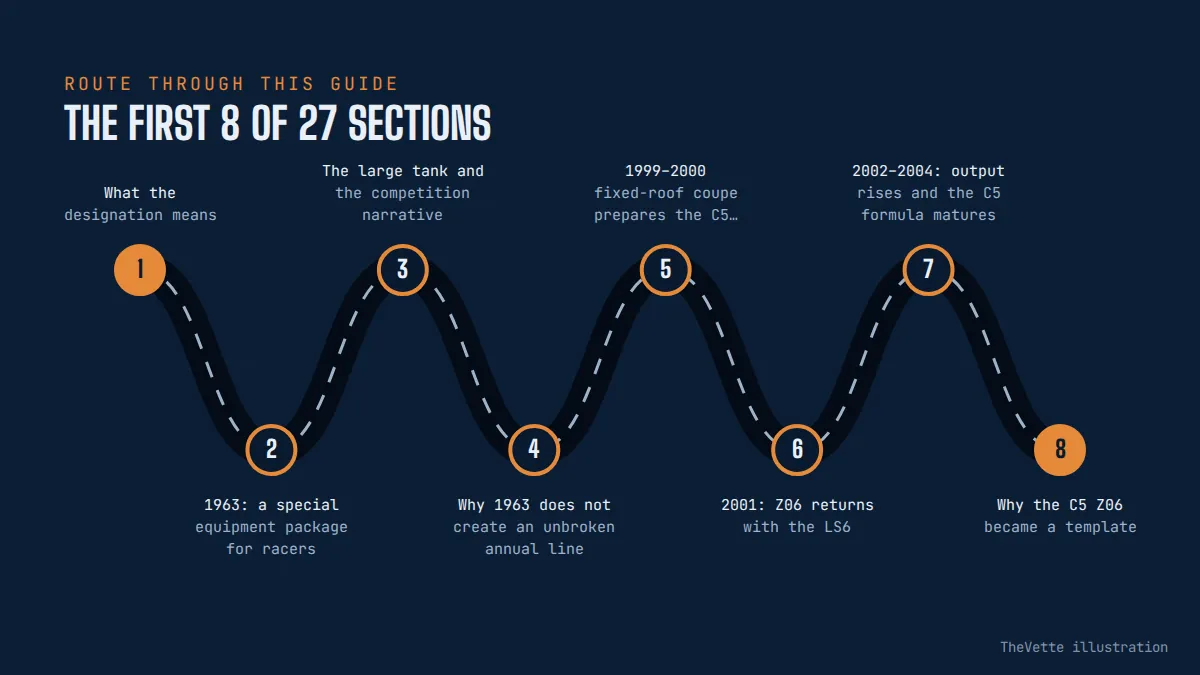
1963: a special equipment package for racers
The first Z06 appeared with the new 1963 Sting Ray. Chevrolet’s official history describes a package intended for racers, with stiffer suspension, heavy-duty brakes, a thicker front stabilizer bar, and a large fuel tank intended to reduce stops in longer events. The package required the fuel-injected 327-cubic-inch V8 and a close-ratio four-speed manual transmission.
That combination matters because the original was not merely an engine option. Chassis, brakes, fuel capacity, and required powertrain worked toward sustained competition use. It also arrived when the C2 itself introduced a new chassis and independent rear suspension, giving the package a stronger platform than the previous-generation Corvette.
The large tank and the competition narrative
The 36-gallon tank is one of the most memorable details in the official 1963 description because it makes the endurance intention visible. A larger tank does not increase cornering speed, yet it changes race strategy by extending time between stops. It shows how factory performance packages can address the complete event rather than only acceleration.
Not every original Z06 received or retains every celebrated component in the way modern summaries imply, and production detail requires model-specific judging sources. For collectors, package identity must be established through records and physical evidence. A large tank, brake part, or badge alone cannot authenticate a high-value car.
Why 1963 does not create an unbroken annual line
The designation did not continue as a regular production model through C2, C3, or C4. Corvette performance continued through powerful engines, suspension packages, racing efforts, ZR-1, Grand Sport, and other identities, but Z06 itself went dormant. That gap is central to its story: the 2001 car was a revival, not the forty-eighth edition of an uninterrupted series.
Dormancy also allowed the meaning to be reinterpreted. When the name returned, customer expectations, safety standards, tire technology, engine control, brakes, and manufacturing had changed. Chevrolet could preserve the mission while building a completely different road car.
1999–2000 fixed-roof coupe prepares the C5 foundation
The C5 introduced a hydroformed-frame and rear-transaxle architecture for 1997. A convertible followed, then a fixed-roof coupe. Chevrolet history notes that the fixed-roof model had initially been conceived as a lower-cost entry, but modest sales led the company to use the stiff, lighter configuration as the basis for a new performance model.
This is an instructive product-development turn. A body style created for one market position became valuable for another because its structure, mass, and packaging suited a focused car. The Z06 revival depended on C5 architecture and the existence of that fixed roof, not only on a more powerful LS-family engine.
2001: Z06 returns with the LS6
The 2001 C5 Z06 paired the fixed-roof body with the 5.7-liter LS6, a six-speed manual, performance-oriented chassis calibration, specific tires, brakes, exhaust, and weight-conscious equipment. Chevrolet’s official Z06 table lists 385 horsepower for the first model year. In context, the car offered performance comparable with much more expensive machinery while remaining recognizably based on the regular-production C5.
The return established a modern pattern: Z06 as a distinct production model rather than a rarely ordered competition package. It could be purchased for road use, serviced within the production ecosystem, and recognized by a broad audience. Yet its fixed roof and manual-only specification kept the mission narrow.
2002–2004: output rises and the C5 formula matures
For 2002, the official rating rose to 405 horsepower and remained there through 2004. The numerical increase is easy to headline, but maturity also came from refinement of the whole package. Owners experienced steering, brake, tire, gearing, cooling, and structural choices together, not an engine on a stand.
The C5 Z06 also arrived during the growth of the C5-R racing program. The road car and race car shared a generation and contributed to the same performance reputation, but they were not the same vehicle. C5-R victories belong to the competition program; a production Z06’s history belongs to its own VIN and records.
Why the C5 Z06 became a template
The C5 established expectations that later Z06 models would be lighter or more focused than the base car, use a distinctive engine calibration or architecture, carry upgraded brakes and chassis equipment, and communicate track intent without becoming a race car. Later generations changed individual choices, but the production-model identity remained.
It also demonstrated that performance value can come from coherence. The LS6, fixed-roof body, six-speed, and chassis calibration supported each other. Modifying only the engine of a base C5 does not recreate that total configuration, even if peak output exceeds the factory Z06.
2006: C6 Z06 adopts the 7.0-liter LS7
The C6 Z06 arrived for 2006 with the naturally aspirated 7.0-liter LS7. Chevrolet’s official generation table lists 505 horsepower and a six-speed manual. Displacement connected the car emotionally with large-engine Corvette history, while the engine itself belonged to the modern Gen IV small-block family and used specialized components for its high-performance role.
The C6 body was more compact in key dimensions than C5 and used exposed fixed headlamps. Z06 widened the visual stance and added cooling and aerodynamic distinctions. It was not simply the C5 concept with another engine; structure and materials changed as well.
Aluminum structure changes the C6 package
Chevrolet history highlights the C6 Z06’s racing-inspired aluminum chassis. Compared with the steel structure used for standard models, aluminum supported lower mass while retaining the stiffness required by the performance target. Magnesium and carbon-fiber applications in selected areas extended the material strategy.
These materials affect ownership decades later. Collision inspection and repair require facilities familiar with aluminum and composites. A low curb weight is a historical achievement; for a buyer it also means that inappropriate welding or concealed structural damage deserves particular scrutiny.
Dry-sump lubrication and sustained use
The LS7 application used a dry-sump lubrication arrangement designed to support oil control under demanding conditions. Its presence reinforces the original Z06 principle: equipment chosen for sustained performance rather than a single acceleration result. Correct oil-level procedure, capacity, temperature, and service practice differ from a conventional wet-sump check.
Owners should follow the exact manual rather than treating the system as folklore. Overfilling after an incorrect cold check or using an unsuitable procedure can create problems. Historical appreciation and maintenance discipline meet here; specialized hardware only delivers its purpose when serviced correctly.
C6 Z06 and Corvette Racing are related but distinct
The C6.R competition program used production-based architectural ideas, and official racing history describes shared components and close relationships in the era. Racing visibility strengthened Z06’s credibility, while the road car provided homologation and identity context. Still, a C6.R is a purpose-built race car governed by series rules.
Writers should not assign C6.R race victories to a customer Z06 or imply that shared profile means identical construction. The accurate story is more interesting: road and race programs informed a performance ecosystem while producing machines for different rules, service lives, and owners.
2015: C7 Z06 changes from displacement to supercharging
The C7 Z06 arrived for 2015 using the supercharged 6.2-liter LT4. Chevrolet’s official table lists 650 horsepower and offers both seven-speed manual and eight-speed automatic transmissions. This broke two apparent traditions at once: the engine was smaller in displacement than the LS7 and customers no longer had to choose a manual.
Supercharging delivered a broad rise in output, but it also added charge-air cooling, belt drive, heat management, and calibration to the Z06 ownership equation. The model widened the gap between a specification understood on paper and a system that had to repeat performance under temperature.
The automatic expands the audience
Earlier modern Z06 models were manual-only. Offering an automatic recognized the speed and sophistication of contemporary control systems and made the car accessible to drivers who preferred or required two-pedal operation. It also changed track preparation, cooling, fluid, and diagnostic questions.
Transmission choice does not determine whether a car is authentic or serious. Each version should be evaluated for its own behavior and service history. A tuned automatic or modified manual changes the evidence needed; factory availability is not proof that a particular example remains factory calibrated.
Z07 turns one model into several capability levels
Performance packages such as Z07 could add more aggressive aerodynamics, tires, suspension calibration, and carbon-ceramic brakes depending on configuration and year. That made “C7 Z06” an incomplete description for operating cost and track behavior. Two cars with the same engine could require very different budgets for tires and brake replacement.
This layering continues the 1963 idea of coordinated equipment, but within a broader customer range. A buyer could choose road-oriented specification or move closer to a circuit setup. Used-car descriptions need exact option data rather than assuming every visible wing proves factory Z07 content.
Thermal history becomes part of C7 evaluation
High output and track use made cooling and heat management prominent in discussion of the C7 Z06. Historical judgment should avoid reducing the entire model to anecdotes, but a used-car inspection should ask about over-temperature or reduced-power events, model-year updates, added coolers, track conditions, and service response.
Context matters: ambient temperature, transmission, speed, session length, aero, calibration, and maintenance affect thermal load. A documented solution is stronger evidence than either “they all overheat” or “mine never did.” Module data and invoices can replace argument with a timeline.
2023: C8 Z06 moves engine and expectations
The C8 Z06 began production for the 2023 model year on Corvette’s mid-engine architecture. The engine sits behind the cabin, the transmission is an eight-speed dual clutch, and the body is wider than Stingray. Moving mass and drive layout transformed traction, proportions, airflow, and service access.
Official history frames the car as the next Z06 generation, yet its hardware makes it the least mechanically similar to the original. That contrast validates the broader definition: Z06 is a performance mission recreated for its era, not a promise of front-engine pushrod continuity.
The LT6 departs from the traditional pushrod formula
The C8 Z06 uses the naturally aspirated 5.5-liter LT6 with double overhead camshafts and a flat-plane crankshaft. Chevrolet lists 670 horsepower and an 8,600-rpm redline in its launch material. The architecture prioritizes breathing and engine speed rather than supercharging or the large displacement of the LS7.
Its sound and response give the model a distinct identity, but the numbers should not obscure maintenance. Oil procedure, break-in, fuel, software, and track preparation belong to the exact owner documentation. A high redline is an engineering capability, not permission to ignore temperature and service requirements.
The dual-clutch era ends the manual Z06 sequence
No production C8 Z06 manual is offered in the covered model years. The dual-clutch transmission integrates rapid shifts, launch functions, cooling, electronic control, and mid-engine packaging. For some enthusiasts this changes the emotional definition of Z06; historically, it shows that mission has repeatedly taken priority over one control layout.
Used examples require fluid and filter records, software history, temperature context, and evaluation cold and hot. Behavior should be judged against dual-clutch characteristics, not a torque-converter automatic, while persistent shudder, delay, faults, or reduced performance still deserve diagnosis.
Aerodynamics become more visible and adjustable
C8 Z06 body width, vents, underbody work, and available aero packages make airflow part of the visible identity. High-downforce configurations affect ground clearance, drag, cooling interaction, tire load, and how the car is used. Carbon-fiber wheels and carbon-ceramic brakes can further change unsprung mass and replacement cost.
Aftermarket wings and splitters should not be assumed equivalent to tested factory packages. Mounting, balance, material quality, sensor compatibility, and intended speed matter. A historical designation can inspire modifications, but the result should be described accurately rather than presented as a factory configuration.
Z06 versus ZR1 and Grand Sport
Corvette’s performance hierarchy contains names with different missions. Grand Sport has often combined wider chassis equipment with a standard naturally aspirated engine. ZR1 generally represents a maximum-output flagship for its era. Z06 emphasizes track-focused integration, though C7 showed that it can also carry very high supercharged output.
The boundaries are not mathematical. A later Grand Sport may outperform an older Z06, and a ZR1 may use equipment related to Z06. Historical identity comes from the package and period, not a permanent ranking. Buyers should compare use, running cost, and condition rather than badge prestige alone.
Road Z06 versus race Corvette
Every modern Z06 benefits from a racing narrative, but production and competition cars must remain distinct in reporting. Race cars use series-specific safety structures, aerodynamics, engines, restrictions, service intervals, and data systems. Shared chassis ideas or engine architecture are meaningful without making them identical.
Likewise, a road Z06 used at track days does not become a race car. Its VIN, registration, safety systems, warranty context, and maintenance remain those of a production vehicle. Clear terminology respects both engineering programs and prevents competition results from becoming misleading sales claims.
How to verify a Z06 claim
Start with VIN and factory option or build records, then compare body, engine, transmission, brakes, wheels, suspension, cooling, interior, and identification details for the model year. Badges and wide panels can be installed on other Corvettes. A genuine car can also be modified until factory equipment is difficult to see.
For 1963, authentication requires particular historical expertise because package rarity and restoration can create high stakes. For modern cars, electronic modules and calibration add evidence. In every era, one component is insufficient. Identity is a chain that links paperwork, physical construction, date-consistent parts, and a credible ownership timeline.
How to read horsepower across the generations
The official table moves from 360 horsepower in 1963 to 385 and 405 for C5, 505 for C6, 650 for C7, and 670 for C8. Those numbers describe different engines, rating eras, standards, transmissions, weights, tires, and test contexts. They are not a clean graph of how one design improved.
Gross-versus-net rating history particularly complicates comparison with 1963. More importantly, Z06 capability includes braking, cornering, cooling, aero, controls, and repeatability. A lower-powered generation may provide the more involving road experience for a particular owner. Historical figures should locate the car, not settle its value.
Why condition matters more than the badge
Track-focused cars can accumulate heat cycles, brake wear, tire wear, aero damage, stone chips, and fluid stress at low mileage. They can also receive unusually careful maintenance. Low use can age tires, seals, fuel, and batteries. The badge predicts possible use and component cost; it does not prove condition.
Review logs, module scans, invoices, alignment, fluid dates, tire dates, brake measurements, and cooling history. Inspect structure and underbody. A well-documented track car may be clearer than an allegedly untouched example with erased data. Purchase the evidence, not a stereotype.
The through-line is coordinated purpose
The original package coordinated fuel capacity, brakes, suspension, stabilizer bar, engine, and transmission for competition. C5 coordinated a stiff fixed roof, LS6, manual gearbox, and chassis. C6 added specialized materials and the LS7. C7 combined supercharged power with active controls and available advanced brakes and aero. C8 integrates a mid-engine chassis, LT6, dual clutch, and sophisticated airflow.
This is the most useful definition of Z06: a Corvette whose major systems are organized around sustained high performance for its generation. The formula changes because technology changes. Continuity lies in the completeness of the package.
From obscure code to public identity
In 1963, Z06 was a special-equipment code known to a narrow competition audience. After decades away, C5 turned it into a widely recognized model. C6 and C7 made it a global performance reference, and C8 reinterpreted it with engine architecture and placement unlike any earlier production Corvette.
The code’s survival is not nostalgia alone. It gives Chevrolet a name for a specific engineering ambition while allowing the hardware to evolve. For enthusiasts, that creates five distinct historical objects rather than five copies. Understanding those differences makes the badge more meaningful—and makes it harder for marketing shorthand to replace the actual car.