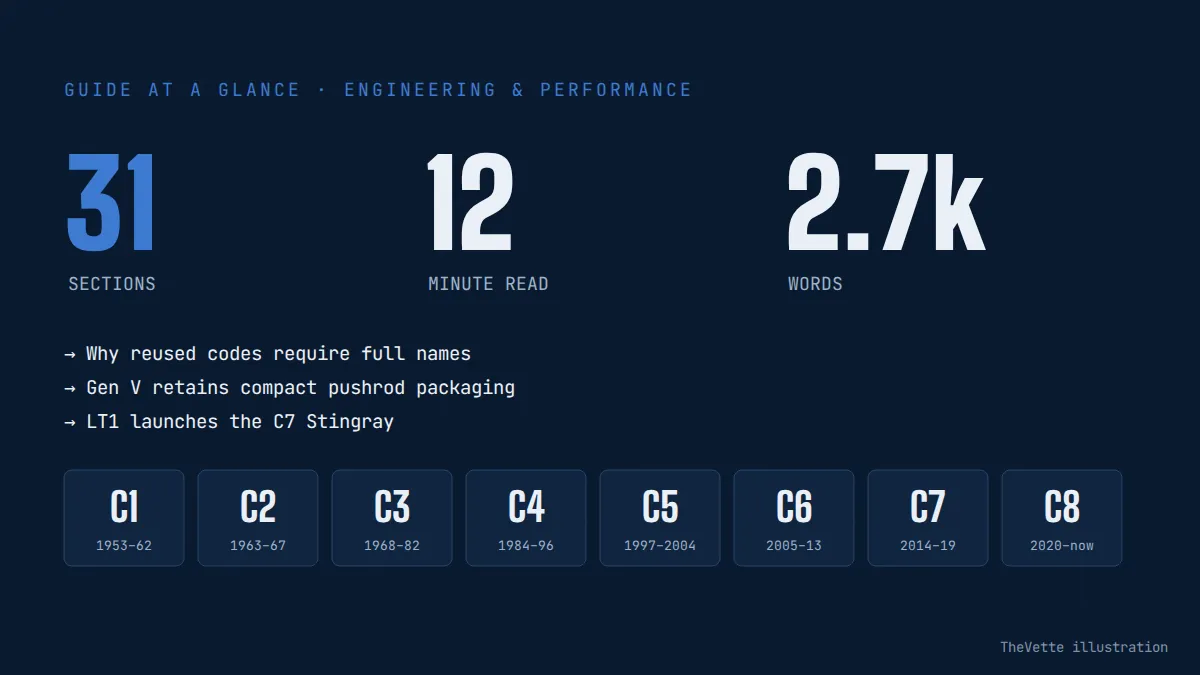
Modern Corvette “LT engines” divide into two architectural groups. C7’s LT1, LT4, and LT5 and C8 Stingray/E-Ray’s LT2 belong to the Gen V pushrod small-block family. C8 Z06’s LT6 and ZR1’s LT7 use a separate double-overhead-cam, four-valve, flat-plane-crank architecture Chevrolet calls Gemini. The shared LT prefix expresses Corvette heritage; it does not make the six engines variations of one block.
To place Modern Corvette LT Engines Explained in a wider ownership and engineering context, continue with C8 Corvette Buyer’s Guide: A Practical Mid-Engine Checklist.
This independent guide explains factory Corvette applications, direct injection, variable timing, cylinder deactivation where fitted, lubrication, forced induction, diagnostics, and modification boundaries. It does not replace the correct owner or service manual. Oil grade and capacity, level-check procedure, track preparation, fuel, fastener torque, software, and warnings must be verified for the exact VIN and model year.
Why reused codes require full names
Chevrolet used LT-1 for an early-1970s small-block, LT1 for a 1990s Gen II engine, and LT1 again for C7’s Gen V engine. LT5 identifies both the C4 ZR-1’s DOHC engine and the 2019 C7 ZR1’s supercharged pushrod engine. The characters alone do not prove lineage.
Accurate writing pairs code with generation, years, displacement, aspiration, and architecture: “2014–2019 C7 Gen V LT1,” for example. Parts ordering needs even more detail, including vehicle, transmission, oil system, sensors, calibration, and market.
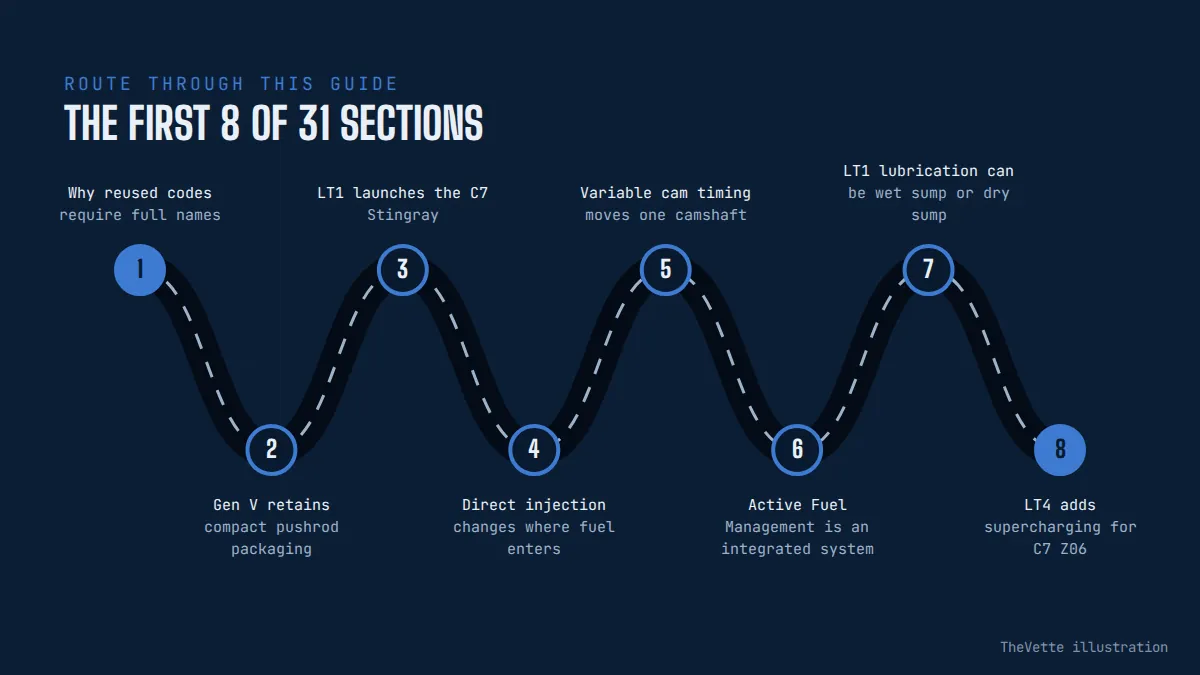
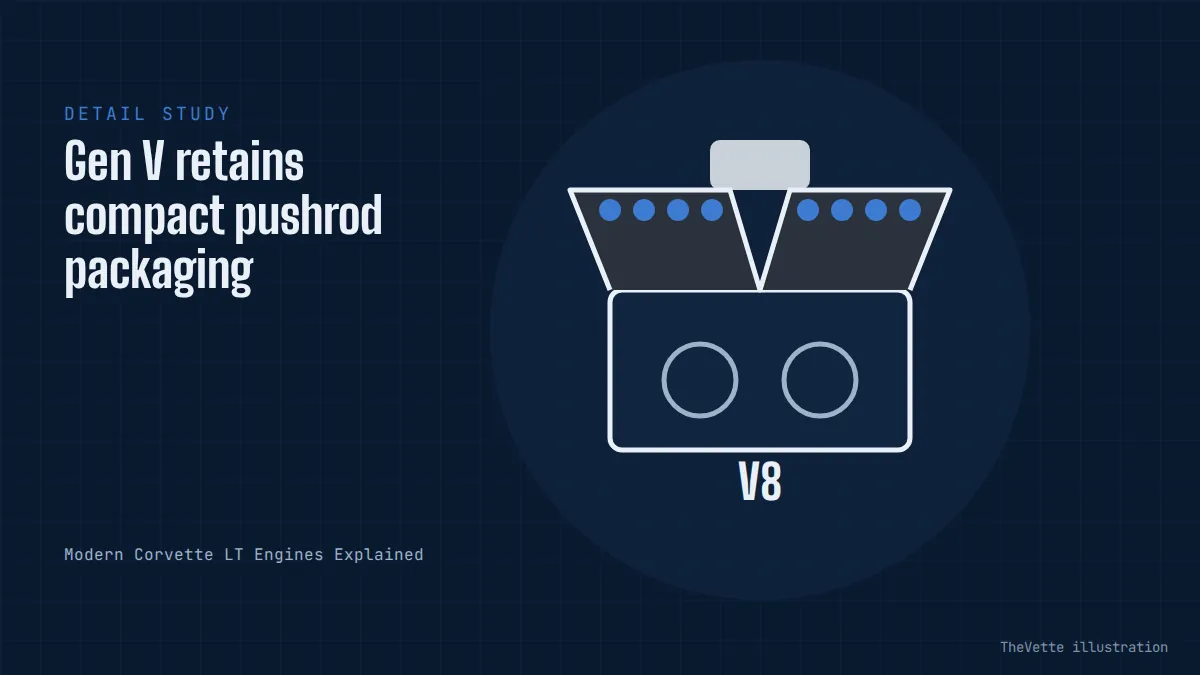
Gen V retains compact pushrod packaging
The C7 engines keep a camshaft in the block operating two valves per cylinder through lifters, pushrods, and rocker arms. This limits overall cylinder-head width and height, helping Corvette maintain a low hood and compact engine bay while using substantial displacement.
Traditional layout does not mean traditional controls. High-pressure direct injection, variable valve timing, electronic throttle, individual coils, knock control, and cylinder-deactivation hardware where applied make oil, fuel, voltage, sensors, and software part of mechanical health.
LT1 launches the C7 Stingray
The 6.2-liter LT1 arrived with the 2014 Stingray. It combined naturally aspirated response with direct injection, continuously variable cam timing, and Active Fuel Management in the production strategy. Dry-sump lubrication appeared in particular performance configurations rather than every LT1 Corvette.
That last distinction is essential. “LT1 oil capacity” is not one universal number independent of year, package, and oiling system. Confirm build information and follow the correct warm-check procedure. A base wet-sump car and a Z51 dry-sump car may share the engine code while requiring different service.
Direct injection changes where fuel enters
Port injection sprays fuel into the intake port before the valve. Direct injection places fuel inside the combustion chamber at high pressure. Precise timing and charge cooling can support compression, efficiency, and knock resistance, but the hardware adds a high-pressure pump, lines, rails, injectors, and control strategy.
Never loosen direct-injection components casually; pressure can be dangerous. Diagnosis uses commanded and actual pressure, low-side supply, injector balance, fuel trims, misfire data, electrical testing, and approved depressurization. A pump sound or visible spray pattern is not an appropriate driveway test.
Variable cam timing moves one camshaft
A phaser alters camshaft position relative to the crankshaft. In a single-cam pushrod V8, intake and exhaust timing move together, allowing engineers to trade idle, torque, power, emissions, and efficiency across operating conditions. Oil pressure and cleanliness help the phaser and control valve operate.
Faults can arise from wiring, solenoid, phaser, timing set, oil condition, pressure, sensor correlation, or calibration. Locking the cam in one position for a modification removes a control tool and requires a coherent tune. It should not be done merely to silence a code.
Active Fuel Management is an integrated system
Where fitted and enabled, Active Fuel Management can deactivate selected cylinders under suitable light-load conditions by controlling special lifters and fuel or spark strategy. The engine continues rotating all pistons while some cylinders stop producing combustion work. Oil pressure, solenoids, lifters, valley hardware, sensors, and calibration cooperate.
Owners debate deletes and disablers, but electronic deactivation of the command is not the same as replacing special hardware. Any change affects emissions legality, calibration, diagnostics, and resale disclosure. Diagnose noise or misfire before assuming the system name identifies the failed part.
LT1 lubrication can be wet sump or dry sump
A wet-sump engine stores its operating oil primarily in the pan. A dry-sump system uses a separate tank and multiple pump stages to scavenge and supply oil, supporting control under sustained acceleration. C7 performance packages and applications determine which system is fitted.
Dry-sump level must be checked using the specified temperature and time window. Oil can migrate after shutdown, making an arbitrary cold reading misleading. Inspect tank, lines, coolers, fittings, filter, engine, and underbody for leaks. Record specification and quantity at every service.
LT4 adds supercharging for C7 Z06
The C7 Z06’s 6.2-liter LT4 combines Gen V direct injection and variable timing with a positive-displacement supercharger and integrated charge cooling. Factory calibration coordinates boost, throttle, fueling, spark, cylinder controls, cooling, transmission torque limits, and protection strategies.
The engine is not an LT1 with a blower bolted on. Compression, heads, internal parts, induction, fuel delivery, lubrication, exhaust, cooling, and software support the intended output. Building an LT1 to similar peak power requires a parts and validation plan rather than copying an external supercharger shape.
Charge-air cooling determines repeatability
Compressing intake air adds heat. LT4’s charge-cooling circuit transfers that heat through intercooler cores into coolant and then to front heat exchangers. Pump operation, coolant level, trapped air, restrictions, debris, ambient temperature, and airflow affect intake temperature.
When temperature rises, the controller may reduce spark or torque. A car can deliver one strong acceleration and fade during repeated use without a conventional coolant warning. Log intake temperature, spark, knock, pressure, fuel, and vehicle speed under controlled conditions before changing hardware.
C7 Z06 thermal history needs context
Track discussions around C7 Z06 often collapse transmission, model year, ambient conditions, aero, speed, session length, and updates into one claim. A used-car review should instead request over-temperature messages, reduced-power events, cooling modifications, software, service invoices, and data.
A larger heat exchanger or additional cooler can help a measured bottleneck, but blocked airflow, missing ducts, pump faults, unsuitable fluid, tune, or extended operation can remain. Documented diagnosis is stronger than either blanket reassurance or blanket condemnation.
LT5 is the final front-engine flagship
The 2019 C7 ZR1 uses the supercharged 6.2-liter Gen V LT5, officially rated at 755 horsepower. It expands airflow and fuel capability beyond LT4 and requires extensive cooling and visible hood packaging. Both manual and automatic transmissions were available in the one-year production model.
This LT5 is unrelated to the C4 ZR-1’s naturally aspirated DOHC LT5. The reused code honors a flagship past. For a sale or article, “2019 supercharged Gen V LT5” prevents a fundamental misunderstanding.
LT5 supplements direct injection with port fuel
At very high airflow, fuel volume and injection-window constraints become important. LT5 adds a supplementary port-injection strategy to its direct-injection system, giving the controller another delivery path. Rails, injectors, pumps, pressure controls, and calibration all need to agree.
Aftermarket changes must characterize both systems. Raising injector size or pump capacity without correct data can disrupt idle, transitions, fuel trims, and safety. Use traceable injectors and preserve complete calibration files.
Pulley changes alter more than boost
A different supercharger pulley changes drive ratio, airflow, heat, belt load, fuel demand, cylinder pressure, and torque. Engine speed, supercharger limits, octane, exhaust restriction, charge cooling, and transmission capacity constrain the result.
Ask for pulley dimensions, belt, injectors, pumps, fuel, tuner, dyno conditions, logs, and original parts. A peak graph without temperature, knock, lambda, pressure, and repeatability information is incomplete. Calibration should retain appropriate protections.
LT2 adapts Gen V for the mid-engine C8
The C8 Stingray’s 6.2-liter LT2 places the pushrod small-block behind the cabin. Revised intake, exhaust, accessory packaging, oiling, and cooling suit the new orientation and body. The dual-clutch transmission replaces the C7 manual and conventional automatic choices.
Relocating the engine changes service access and heat paths but preserves the compact architectural advantage. The low engine helps rear visibility and center-of-mass goals relative to a wider multi-cam design, while side and front heat exchangers manage distributed cooling circuits.
E-Ray combines LT2 with front electric drive
C8 E-Ray uses LT2 for rear propulsion and an electric motor at the front, creating electrified all-wheel drive. The V8 remains mechanically related to Stingray’s LT2, but total propulsion, cooling, controls, battery systems, drive modes, and service safety differ.
Combined system output is not an engine-only rating. High-voltage components require trained service and official isolation procedures. A conventional engine scan does not cover the electric drive and battery. Tire circumference and condition across axles matter to integrated control.
LT6 starts the Gemini DOHC branch
C8 Z06’s 5.5-liter LT6 uses double overhead camshafts, four valves per cylinder, and a flat-plane crankshaft. Chevrolet describes an 8,600-rpm redline and naturally aspirated output far beyond earlier production Corvette engines of similar displacement. It is hand assembled for the application.
LT6 is not a Gen V LT2 with different heads. Block, crankshaft, valvetrain, heads, intake, exhaust, lubrication, firing behavior, vibration strategy, and calibration belong to another architecture. The LT prefix does not override those facts.
A flat-plane crank changes firing character
A flat-plane crank arranges crankpins differently from the cross-plane layout familiar in most Corvette V8s. It can support evenly spaced exhaust pulses by bank, lower rotating inertia, and high engine speed, while introducing different vibration behavior that structure, mounts, fasteners, and accessories must address.
The resulting sound is not a cosmetic exhaust trick. Headers, catalysts, mufflers, firing order, and control valves shape it, but the crank and combustion sequence provide the foundation. An aftermarket exhaust should preserve heat control, legality, and valve operation.
DOHC valvetrain changes service concepts
LT6 uses camshafts in the cylinder heads rather than lifters and pushrods from a block cam. Timing drives, followers, springs, valves, phasers or controls, clearances, oil delivery, and assembly procedures differ. A pushrod-LT camshaft guide is irrelevant.
High-rpm valvetrain diagnosis requires engine-specific tools and data. Noise, misfire, oil condition, correlation codes, and borescope findings need specialist interpretation. Do not open or adjust the system based on a generic “LS/LT” tutorial.
LT6 dry sump supports sustained acceleration
The high-revving track-oriented application uses dry-sump lubrication with model-specific checking and track preparation. Oil temperature, aeration control, scavenging, tank level, and cooler operation matter during sustained cornering and braking.
Follow the exact owner manual and current supplement. Inspect lines, fittings, tank, cooler, filter, and engine. Record event hours or mileage, temperatures, and service. “Fresh oil” without specification, quantity, and procedure is weak evidence.
LT7 is not simply a turbocharged LT6
C8 ZR1’s 5.5-liter LT7 shares the Gemini architectural concept with LT6 and adds twin turbochargers, but Chevrolet states that virtually every system was optimized for boost. Head ports and chambers, valvetrain profile, intake, pistons, rods, crank counterweights, oil and coolant passages, and fuel delivery differ.
Describing it as “LT6 plus turbos” hides the engineering required for pressure, temperature, and torque. Shared bore centers or broad architecture do not make internals interchangeable or a home-built conversion equivalent to a production LT7.
Integrated turbo placement controls response and heat
LT7 uses turbochargers integrated closely with the exhaust manifolds to reduce gas volume and distance between exhaust valve and turbine. Electronic wastegates and adaptive anti-lag strategies help manage response. Close placement also concentrates heat that requires shielding, airflow, coolant, and oil control.
Inspect turbine-area plumbing, heat shields, oil and coolant lines, intake ducting, charge coolers, wastegate control, catalysts, wiring, and surrounding body. Modifications can disturb thermal protection even when they increase peak airflow.
LT7 uses two fuel-delivery paths
Chevrolet’s technical material describes secondary port injection in addition to direct injection for LT7. High airflow and output demand sufficient fuel across pressure and engine speed. Low-side supply, high-pressure system, port rails, injectors, sensors, and software cooperate.
Fuel-system changes need verified flow, pressure, electrical capacity, material compatibility, and injector data. A lean condition at four-figure output can cause rapid damage. Controlled professional logging is essential; public-road full-load testing is unsafe.
Transmission capacity is part of the engine program
C8 ZR1’s LT7 required changes to the eight-speed dual-clutch transmission, including shafts, gears, oil management, valves, and clutch clamping strategy according to Chevrolet’s launch information. Engine output cannot be separated from the driveline designed to transmit it.
A tune that raises torque also affects clutch pressure, heat, gears, differential, axles, tires, and control limits. “The engine can take it” is not a complete engineering argument. Preserve transmission calibration compatibility and temperature protections.
Cooling has become a vehicle-wide network
LT1-era front-engine Corvettes place the primary heat source ahead of the cabin. C8 distributes engine, transmission, differential, charge-air, and hybrid heat through multiple front and side exchangers, pumps, ducts, and underbody paths. One dashboard coolant value cannot describe every circuit.
Inspect openings for debris and impact, verify pumps and fans, compare sensor data, and retain seals and undertrays that route air. Added protective screens can restrict flow if poorly selected. Diagnose which circuit reaches a limit before buying a larger cooler.
Carbon deposits require evidence, not folklore
Direct-injected engines do not wash the back of intake valves with port fuel in the same way as port-injected engines. Oil vapor and operating conditions can contribute to deposits, but severity varies. Misfire, airflow, compression, borescope inspection, and service history should guide diagnosis.
Do not perform abrasive cleaning without an approved process that protects cylinders, valves, catalysts, sensors, and the operator. Catch cans change ventilation and may affect emissions compliance. Port injection on LT5/LT7 serves fueling needs and should not be oversimplified as a universal cleaning device.
High-pressure fuel safety is non-negotiable
Direct-injection lines can retain dangerous pressure. Use official depressurization, protective equipment, specified single-use components where required, clean assembly, and leak testing. Never search for a leak with a hand or loosen a fitting on a running engine.
Fuel odor, wetness, pressure faults, or a current recall instruction should stop operation until properly addressed. Verify recall status by VIN because production range and equipment determine applicability.
Oil choice supports hydraulic controls and bearings
Oil viscosity and specification affect bearings, piston cooling, timing controls, cylinder-deactivation lifters where fitted, turbochargers, scavenge pumps, and temperature. Track guidance may differ from normal service and can change by model year.
Use the current official manual for the exact car. Record oil, filter, quantity, temperature procedure, and interval. Additives can alter chemistry and should not substitute for diagnosis. Oil analysis trends are more useful than one isolated sample.
Misfire diagnosis begins with conditions
Record cylinder, rpm, load, temperature, fuel level, cold or hot state, and whether the fault occurs during deactivation, boost, or transient operation. Ignition, injector, mechanical sealing, wiring, fuel pressure, airflow, calibration, and sensor errors can all contribute.
Swapping coils can be a controlled test when procedures permit, but random parts replacement can move faults or damage connectors. Review freeze-frame and counters, then perform compression, leak-down, borescope, injector, and wiring tests as evidence directs.
Modifications need an architecture-specific plan
A camshaft package for Gen V pushrod LT1 has no application to DOHC LT6. A supercharger pulley strategy for LT4 or LT5 has no direct equivalent on twin-turbo LT7. Even within Gen V, wet versus dry sump, fuel capacity, transmission, compression, and cooling alter choices.
Define power and use target, fuel, emissions legality, thermal limit, driveline capacity, and service access. Select parts with measured compatibility and document calibration. Preserve original hardware and software for resale and recovery.
How to inspect a used LT Corvette
Confirm VIN, build data, engine code, oil system, transmission, and modification history. Start cold, record pressure, exhaust, idle, misfires, warnings, noise, and leaks. Scan all modules before clearing data. Inspect fuel, induction, oil, cooling, wiring, grounds, mounts, exhaust, and heat shielding.
Drive safely through full temperature and review fuel trims, knock, temperatures, pressure, transmission, and hot restart. For supercharged, turbocharged, dry-sump, DOHC, or hybrid applications, use trained specialists. Verify recall status and retain the report.
The LT prefix tells a story, not a parts list
C7 LT1 modernized the pushrod small-block, LT4 added supercharging, and LT5 maximized the front-engine platform. C8 LT2 adapted Gen V to mid-engine packaging and electrified E-Ray use. LT6 and LT7 began a separate high-revving DOHC branch with natural aspiration and twin turbos.
The progression shows Corvette using two engine philosophies at once. Compact pushrod torque remains valuable, while Gemini DOHC engines serve specialized high-rpm and boosted missions. Understanding where the architectures divide is the first step toward accurate history, correct service, and modifications that respect the complete car.