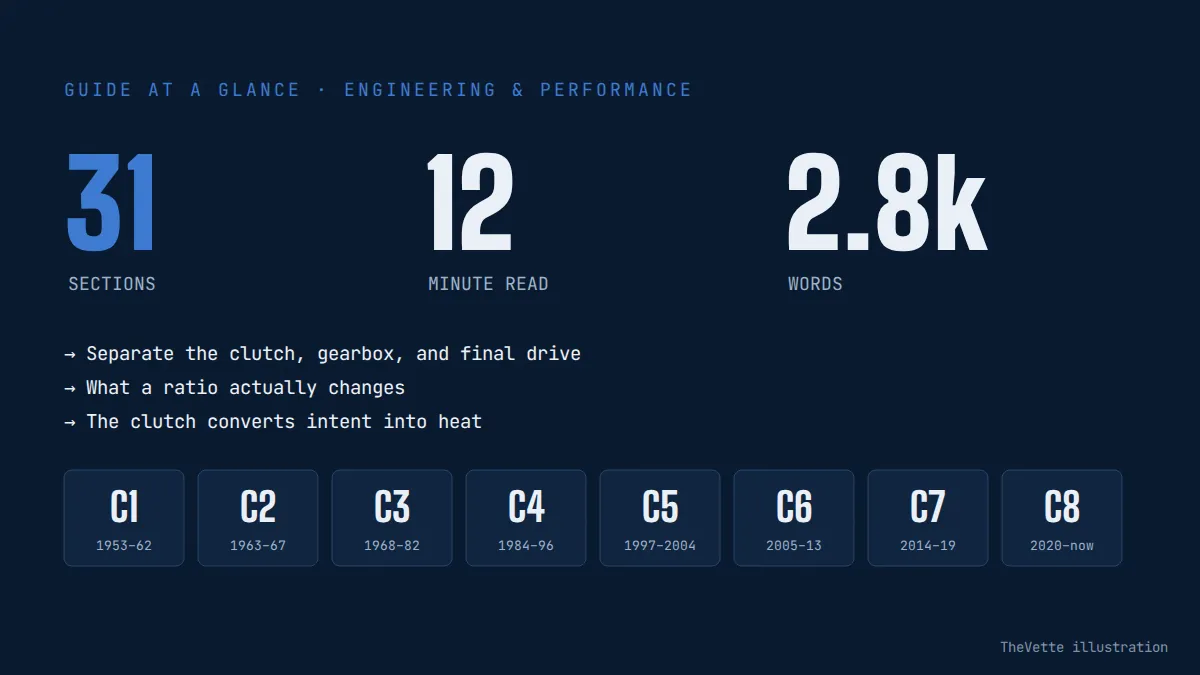
A manual Corvette is not one experience repeated with more gears. Early three- and four-speeds sit directly behind the engine and operate through mechanical clutch linkage. C4 introduced the unusual 4+3 overdrive and later a ZF six-speed. C5 moved the transmission behind the cabin and connected it to the engine through a torque tube. C6 refined that rear-transaxle formula, while C7 added a seventh ratio and active rev matching. C8 ended the production manual sequence, using an eight-speed dual-clutch transmission instead.
To place Corvette Manual Transmissions: A Driver’s Guide in a wider ownership and engineering context, continue with C7 Corvette Buyer’s Guide: Stingray, Z06, or Grand Sport?.
This independent guide explains how the layouts feel, why gearing and final drive matter, what a road test can reveal, and when a specialist is needed. It is not a repair manual. Fluid types, adjustment, fastener torque, lifting, clutch bleeding, skip-shift operation, and towing procedures vary by model year and unit; use the exact GM owner and service information.
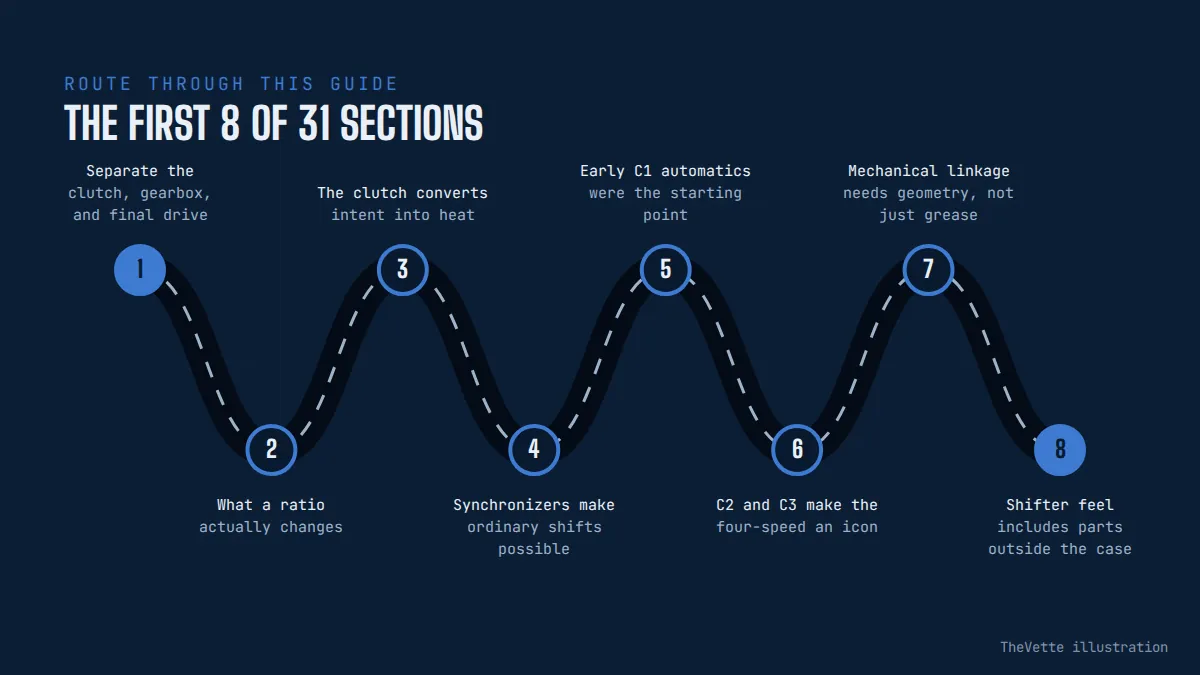
Separate the clutch, gearbox, and final drive
Drivers often call every shift problem “the transmission,” but three systems interact. The clutch disconnects engine torque. The gearbox selects ratios and synchronizes speeds. The differential provides final reduction and allows wheel-speed difference in turns. Linkage, hydraulics, mounts, torque tube, driveshaft, axles, wheels, and tires add more variables.
A difficult first-gear selection at rest may come from incomplete clutch release rather than damaged first gear. A whine that follows road speed may be differential or hub related. Accurate description prevents expensive guessing.
What a ratio actually changes
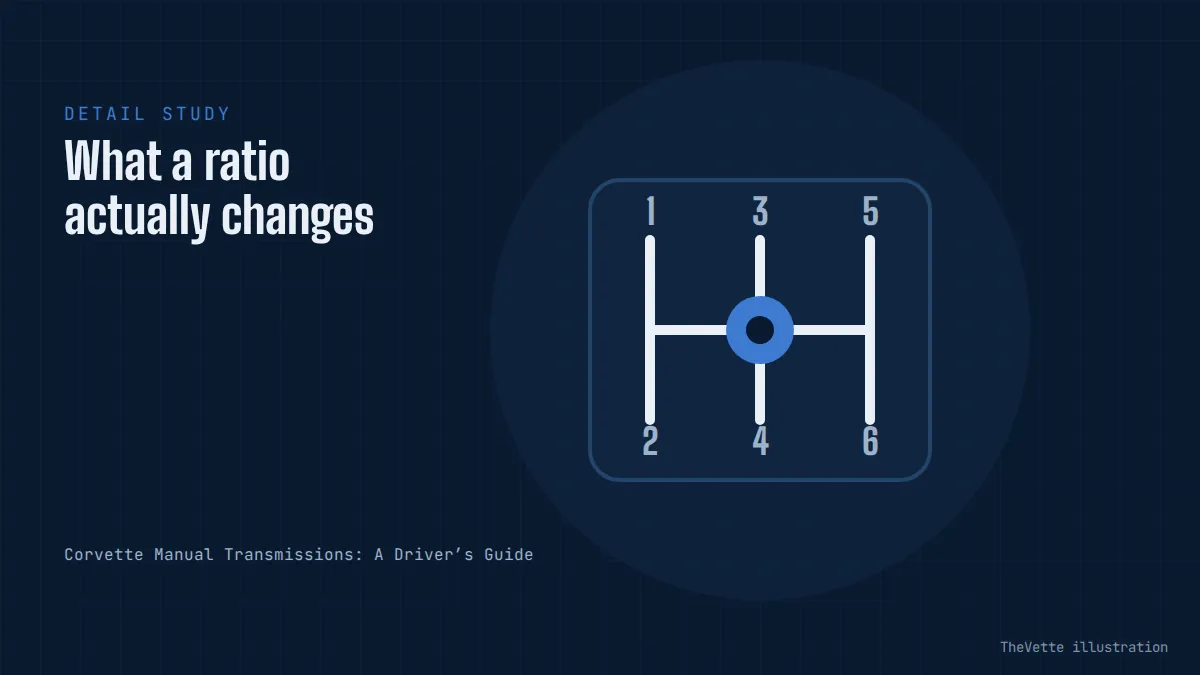
Lower gears multiply torque more strongly, improving launch at the cost of road speed per engine revolution. Higher gears reduce engine speed for cruising. Final-drive ratio and tire diameter multiply every transmission choice, so two identical gearboxes can feel different in cars with different axles or tires.
Published ratio tables need the exact transmission code and year. A replacement unit may have different internal ratios while fitting the same space. Record engine rpm, road speed, gear, tire size, and speedometer accuracy before concluding that an axle or transmission is original.
The clutch converts intent into heat
A clutch transfers torque through friction. Starting from rest and slipping during a shift convert energy into heat, while full engagement should minimize slip. Higher engine torque, vehicle mass, aggressive launches, and an unsuitable pressure plate or disc can overwhelm the system.
More clamp load is not automatically better for a road car. It can increase pedal effort, hydraulic load, engagement abruptness, and driveline shock. A well-chosen clutch matches engine torque, flywheel, street or track use, driver preference, and the rest of the driveline.
Synchronizers make ordinary shifts possible
Synchronizers use friction to bring gear and shaft speeds together before engagement teeth lock. Rushing the lever, using incorrect lubricant, incomplete clutch release, or accumulated wear can produce resistance and grinding. A problem isolated to one gear under repeatable conditions points differently from difficulty in every gear.
Cold lubricant can make a healthy gearbox feel slower. Test from cold through full temperature and note shift speed, engine rpm, throttle, and direction. Do not force the lever; the sound of a destructive test is not useful evidence.
Early C1 automatics were the starting point
The first production Corvettes used a two-speed automatic, reminding enthusiasts that manual control was not present at launch. A manual became available as Corvette developed into a stronger sports car. Early three-speeds and later four-speeds helped establish the connection between small-block response and driver-selected gearing.
Exact availability changed by year and engine. A conversion may be enjoyable but should be described as a conversion. Pedals, linkage, bellhousing, floor opening, speedometer drive, wiring, driveshaft, crossmember, and axle ratio all contribute to whether it works like a complete system.
C2 and C3 make the four-speed an icon
Four-speed manuals became central to the classic Sting Ray and early C3 performance image. Wide- and close-ratio choices could change the spacing between gears and the usefulness of a given axle. Engine torque and intended use determined which combination felt coherent.
A close-ratio unit does not guarantee faster road driving. It may require a shorter final drive and more engine speed on the highway. A touring owner can prefer broader spacing or an overdrive conversion, while a preservation buyer may prioritize the correct case, date, shifter, and linkage.
Mechanical linkage needs geometry, not just grease
Early clutch systems use rods, pivots, springs, brackets, and frame or engine-side attachments. Worn holes, bent rods, missing return springs, broken mounts, engine movement, and incorrect adjustment can reduce release or change pedal effort. Lubrication cannot correct distorted geometry.
Inspect every pivot and attachment while someone operates the pedal safely. Confirm free play using year-specific procedure. Headers and engine swaps can interfere with linkage. A hydraulic conversion can solve packaging but introduces master-cylinder, slave-cylinder, hose, pedal-ratio, heat, and bleeding questions.
Shifter feel includes parts outside the case
Bushings, rods, levers, centering springs, mounts, and console alignment affect what the hand feels. A vague or blocked shift may originate between the lever and transmission. Body or drivetrain movement can make an otherwise adjusted linkage contact the tunnel.
Inspect from lever to selector and check reverse lockout operation. Aftermarket short-throw shifters reduce movement but can increase effort and encourage rushed shifts. Keep the original assembly when collectibility matters and document every installed part.
The C4 4+3 is a hybrid idea
Early C4 manuals used a four-speed gearbox paired with an electronically controlled overdrive unit on selected forward gears, commonly called 4+3. The system attempted to combine strong direct gearing with fuel-efficient cruising before a suitable production six-speed arrived.
Its controls, switches, wiring, hydraulic operation, fluid requirements, and driver logic make it different from a conventional seven-speed. A car whose overdrive has been disabled is not fully functional merely because four gears remain. Diagnose the system using the correct manual and understand how operating conditions command engagement.
4+3 road testing requires a known sequence
Confirm indicators and controls, then test overdrive engagement and release under conditions specified by the owner manual. Note temperature, throttle, gear, and whether operation is delayed, harsh, or absent. Do not repeatedly provoke a fault when fluid pressure or control is uncertain.
Previous owners may add manual switches or bypass circuits. Trace modifications and ask why they were made. A rebuilt unit should have detailed invoices identifying internal and control work, not only a statement that “the transmission was done.”
The ZF six-speed modernizes late C4
From 1989, the ZF six-speed gave Corvette a conventional multi-ratio manual with overdrive and a different shift character. It served standard cars and the ZR-1, with application details that require year-specific verification. Its strength and ratios supported the rising performance of late C4 engines.
Gear whine or neutral rattle should be assessed by a specialist familiar with the unit; some sounds may be characteristic while others indicate wear, bearings, or clutch-flywheel changes. Correct lubricant is essential. An aftermarket label on a bottle is not proof of compatibility.
Clutch hydraulics change the diagnostic path
Hydraulic systems replace much mechanical linkage with a master cylinder, line, and slave or release-bearing assembly. Fluid condition, air, seal leakage, hose expansion, heat, pedal travel, and component geometry affect release. A pedal that stays down or changes after heat requires investigation.
Bleeding can be difficult when the line traps air or the bleeder location is inaccessible. Use approved fluid and procedure. Repeated fluid darkening can indicate contamination or component wear; replacing the clutch disc alone will not correct a hydraulic fault.
C5 moves the gearbox to the rear
The C5 placed the manual transmission and differential in a rear transaxle, connected to the engine by a torque tube. Moving mass rearward supported weight distribution and opened cabin packaging, while changing service access and the path through which vibration and noise travel.
A clutch job can involve separating major driveline sections. Torque-tube bearings, couplers, mounts, hydraulics, seals, transmission, and differential deserve coordinated inspection when labor overlaps. A low parts price does not predict total repair cost.
The T-56 becomes part of the modern formula
The six-speed T-56 family served C5 manual applications in rear-transaxle form. TREMEC literature documents the broader T-56 design family, but an aftermarket F-body or standalone service specification should not be imposed on an OEM Corvette transaxle. Case, tail, ratios, controls, and lubrication can differ by application.
Identify the exact unit through VIN, build data, tags, and service information. A replacement or rebuilt transmission may use mixed parts. Invoices should list ratios, synchronizers, bearings, gears, and setup rather than only “T-56 rebuild.”
C5 skip shift is a control feature, not a missing gear
Some manual Corvettes use computer-controlled skip-shift logic under specified low-load conditions, guiding the driver from first toward a higher gear. The feature supports certification goals; it does not remove the intermediate ratios from the gearbox. Owner manuals explain the indicator and conditions.
Aftermarket eliminators are common. They should be disclosed, weather-sealed, and not used to hide unrelated wiring faults. Drivers unfamiliar with the feature should learn its operation before judging the shifter during a short test.
C6 evolves into the TR-6060 era
C6 manual hardware evolved, including later use of the TR-6060 family. TREMEC describes TR-6060 as a development beyond T-56, with capacity and design changes, but exact Corvette ratios and components vary with year and trim. Base, Z06, and ZR1 torque and gearing needs are not identical.
Clutch, flywheel, torque tube, transmission, differential, and axle modifications should be planned together. A gearbox rated for a large torque number in an aftermarket configuration does not certify the whole production driveline for that load.
Remote location changes shift linkage feel
With the transmission at the rear, the cabin lever operates through remote linkage. Bushings, alignment, drivetrain mounts, and tunnel temperature influence feel. A short shifter can sharpen movement while transmitting more vibration or noise.
Inspect the lever, boot, linkage, mounts, and exhaust clearance. If shift quality changes during acceleration or cornering, drivetrain movement may be involved. Do not rebuild the gearbox before checking the parts that position and command it.
C7 adds a seventh gear
The C7 manual uses seven forward ratios. The extra ratio supports a broader spread between acceleration and cruising while keeping intermediate steps useful. It also creates a gate pattern that rewards deliberate hand placement; forcing the lever toward the wrong plane is not a test of strength.
Gear selection, skip-shift behavior, reverse lockout, clutch release, and transmission temperature should be evaluated from cold to hot. The seven-speed belongs to the final front-engine production generation; C8 did not carry it forward.
Active rev matching separates driver choice from hardware
C7 introduced steering-wheel-controlled active rev matching on applicable manual configurations. The system commands throttle during shifts to help align engine and lower-gear speed. It can be switched according to the car’s controls, allowing the driver to perform the technique unaided.
Rev matching cannot repair worn synchronizers or an incomplete clutch release. Test the gearbox with system behavior understood, and note faults in sensors, switches, throttle control, or calibration. Aftermarket tunes can alter response and should be documented.
Double-clutching and heel-and-toe have specific purposes
Double-clutching uses neutral and an additional clutch engagement to change shaft speed, valuable in non-synchronized gearboxes and sometimes gentler to worn units. Heel-and-toe combines braking with a throttle blip for a downshift. Pedal layout, shoe, road, and driver anatomy affect technique.
Neither is required theater for every street shift. Smooth timing and observation matter more than speed. Practice in a safe environment without compromising brake control. Active rev matching can demonstrate the target principle, but drivers remain responsible for selecting a safe gear.
Over-rev risk comes from the lever
An electronic limiter can reduce engine power at excessive rpm under acceleration; it cannot always prevent a driver from selecting too low a gear at high road speed. The wheels can force the engine beyond its intended range through the drivetrain. This mechanical over-rev may leave data or damage.
Use deliberate gates and avoid rapid downshifts for display. During a purchase, appropriate module data and engine inspection can help assess an alleged event. Absence of a warning is not proof that no money shift occurred.
Clutch slip has a repeatable signature
Slip occurs when engine speed rises without a corresponding increase in road speed under load. It may be most apparent in a higher gear at moderate rpm, but testing should be safe and not deliberately overheat a suspect clutch. Oil contamination, worn friction material, pressure-plate issues, or hydraulic preload can contribute.
A high engagement point alone does not prove failure. Compare pedal action, free return, fluid, release, smell, and load behavior. Obtain a specialist diagnosis before authorizing the extensive labor common to rear-transaxle cars.
Clutch drag looks different
Drag means the clutch continues transmitting some torque with the pedal depressed. Symptoms can include difficult first or reverse selection at rest, creeping, or gear clash. Causes include air, hydraulic leakage, warped parts, insufficient travel, pilot-bearing drag, adjustment, or heat.
Turn the engine off and compare selection. If gears engage easily stopped but resist running, release becomes a stronger suspect. Do not keep grinding synchronizers while blaming them for a clutch problem.
Noise must be classified by condition
Record whether noise appears in neutral, with pedal up or down, in every gear, in one ratio, under drive, on coast, or during turns. Input, release, pilot, torque-tube, gear, differential, axle, hub, and tire sounds overlap inside a Corvette.
Video can help document timing but often distorts frequency. A technician needs to reproduce the condition and inspect fluid and components. Draining lubricant through a clean screen may reveal material, but follow safe service procedure and do not contaminate evidence.
Fluid is an engineered component
Manual transmissions may specify automatic-transmission fluid, dedicated manual fluid, or another formulation depending on unit. Viscosity and friction characteristics affect bearings, synchronizers, pumps, and cold shifting. “Gear oil” is not a universal safe choice.
Use the exact model-year service specification and account for updates. Record brand, specification, quantity, date, and drained condition. Additives marketed as shift cures can alter synchronizer behavior and complicate diagnosis.
Flywheel mass changes behavior
A lighter flywheel allows engine speed to change more quickly, which can sharpen response and rev matching. It also stores less energy for launches, can increase gear rattle, and may make smooth low-speed driving harder. Dual-mass or factory assemblies can damp vibration differently.
Choose flywheel, clutch, and calibration as a system. Confirm starter compatibility, balance, fasteners, runout, and release geometry. A race-oriented part is not automatically an upgrade for touring.
Differential ratio can transform the same manual
A shorter final drive improves acceleration in every gear while increasing engine speed and shift frequency. A taller ratio relaxes cruising but may make the engine feel less responsive. Electronic speed reporting, stability control, and calibration may require updates after changes.
Verify installed ratio mechanically or through trustworthy data. Do not infer it solely from tachometer and speedometer when tire size or instruments may be wrong. Document ring-and-pinion setup, bearings, fluid, and break-in.
Road testing should protect the car
Begin cold and operate each gear at light load. Observe clutch release, engagement, pedal return, shift effort, centering, synchro behavior, vibration, and noise. Repeat after full temperature. Include gentle acceleration and coast in several ratios, but do not rush shifts or attempt maximum-load tests on public roads.
Afterward, inspect hydraulic fluid, leaks, mounts, torque-tube and transaxle areas, and smell. Record exact conditions. A five-minute drive can miss heat-related release, bearing, and synchronizer problems.
The C8 dual clutch is not a manual replacement mechanism
C8 uses an eight-speed dual-clutch transmission controlled electronically, with two internal clutches and paddle selection. It can deliver rapid commanded shifts but does not provide a clutch pedal or mechanically gated lever. Calling it a manual because the driver can request gears confuses control interface with transmission architecture.
The change reflects mid-engine packaging, performance targets, launch control, and integration. It ends the production Corvette manual sequence for the covered years without making earlier manuals obsolete. Each system provides a different kind of involvement.
Choosing the right manual era
Early four-speeds offer direct mechanical character but no overdrive. C4 4+3 is historically fascinating and system-intensive. ZF six-speeds combine C4 shape with modern ratios. C5 and C6 manuals deliver rear-transaxle balance with greater service labor. C7 adds seven gears and electronic rev matching.
Choose by use, parts and specialist access, desired effort, gearing, noise tolerance, and originality. The best manual is not necessarily the one with the most ratios; it is the complete car whose controls and maintenance fit the owner.
A manual is a relationship among systems
Good shift quality comes from clutch release, hydraulic or mechanical linkage, lever and remote linkage, synchronizers, gears, shafts, bearings, mounts, torque tube, differential, calibration, fluid, and driver timing. Repairing one visible part may not correct the interaction.
That systems view is the central lesson of Corvette manual history. The lever connects the driver to decades of changing architecture, but the quality of that connection depends on everything between crankshaft and tires.