“LS engine” is useful shorthand and a frequent source of confusion. In factory Corvettes, the core sequence covered here is LS1 and LS6 in C5, followed by LS2, LS3, LS7, and LS9 in C6. They share a compact pushrod small-block philosophy, but displacement, block details, heads, intake, camshaft, lubrication, aspiration, output, sensors, and vehicle integration differ. A part that fits physically may not be correct electrically, mechanically, or historically.
To place Corvette LS Engines Explained: LS1 Through LS9 in a wider ownership and engineering context, continue with How the Small-Block V8 Shaped Corvette History.
This independent guide explains the production Corvette applications and the evidence needed to identify, maintain, or modify them. It is not a service manual or interchange chart. Exact oil grade and capacity, fastener torque, clearances, calibration, emissions equipment, and diagnostic procedure must come from the correct VIN and model-year service information.
LS means a family, not one 5.7-liter engine
The LS1 launched a new Gen III small-block architecture. LS6 developed the same displacement for a higher-performance role. Gen IV LS2 and LS3 increased displacement, LS7 used a 7.0-liter naturally aspirated strategy, and LS9 combined 6.2 liters with factory supercharging. Shared external compactness does not make their internals interchangeable.
Outside Corvette, many car and truck engines use related architecture and different codes. Calling every Gen III/IV engine an “LS” may help casual conversation, but buying parts requires block casting, code, crank reluctor pattern, sensor locations, accessory drive, sump, heads, intake, and controller.
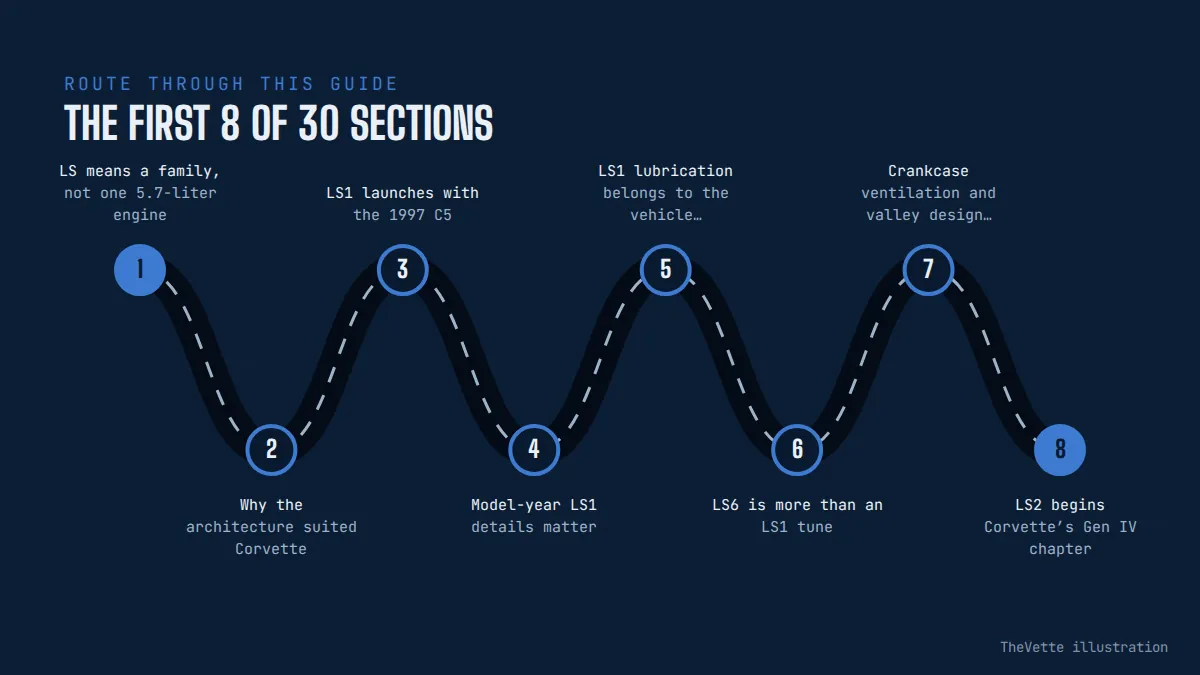
Why the architecture suited Corvette
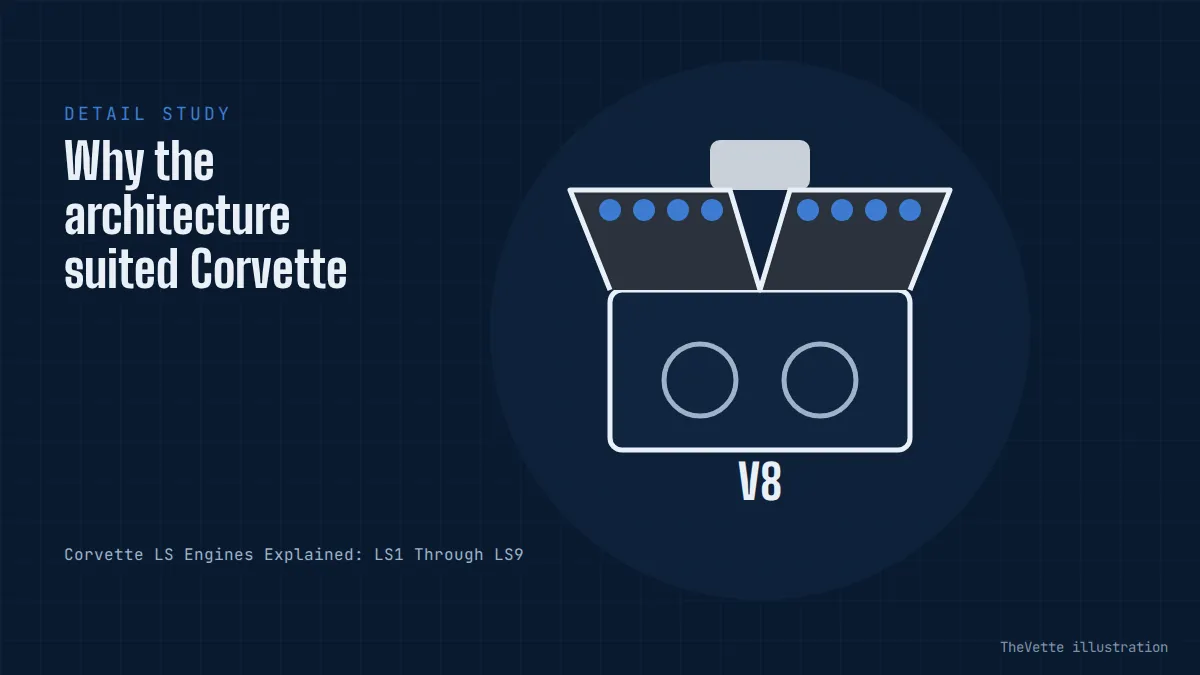
A camshaft in the block and two-valve heads keep overall height and width relatively low. The engine can use substantial displacement without the broad cylinder heads of a multi-cam design. In C5 and C6, this supported a low hood, low engine placement, steering clearance, and a favorable center of mass.
Compact does not mean unsophisticated. Sequential injection, coil-near-plug ignition, electronic throttle in later applications, knock control, emissions diagnostics, variable provisions in Gen IV, dry-sump systems, and supercharger controls make correct voltage, sensors, software, and data essential.
LS1 launches with the 1997 C5
The 5.7-liter LS1 arrived with the C5’s new hydroformed-frame, torque-tube, rear-transaxle architecture. An aluminum block and heads reduced front mass, while a deep-skirt block, six-bolt-style main-cap fastening strategy, and revised port and combustion design separated it from the previous Gen II LT1.
Coil-near-plug ignition removed a conventional distributor. A composite intake reduced heat transfer and mass. Electronic controls managed fuel and spark with modern diagnostics. The engine’s smooth torque and packaging helped make C5 both a daily-usable hatchback and a credible performance platform.
Model-year LS1 details matter
C5 LS1 output, intake, controls, emissions hardware, exhaust, and supporting components evolved during 1997–2004. A later component may be a sensible service upgrade without making the whole engine a later specification. Verify year and market before repeating a rating or ordering electronics.
Engine identification uses more than the plastic covers. Inspect VIN relationship where applicable, block casting and markings, heads, intake, throttle arrangement, sensors, accessory drive, oil pan, harness, controller, and calibration records. A replacement long block can retain original external pieces.
LS1 lubrication belongs to the vehicle installation
Oil pickup, pan, windage control, filter, cooler arrangements, and capacity are part of the C5 installation. Track use can expose oil-control limits that ordinary road driving never reaches. Follow the exact owner guidance for level checking, oil specification, and track preparation rather than applying a generic LS swap rule.
Oil pressure varies with temperature, speed, viscosity, sensor accuracy, bearing clearance, pump, pickup sealing, and level. A dashboard number is a clue, not a full diagnosis. Confirm suspicious readings with appropriate mechanical testing before replacing parts.
LS6 is more than an LS1 tune
The 2001 C5 Z06 introduced the 5.7-liter LS6. Chevrolet Performance documentation describes differences including block breathing, heads, intake, and camshaft, with other production changes supporting the higher-performance application. Output increased for the 2002 model year.
An LS1 fitted with an LS6 intake or camshaft is not automatically a factory LS6. Conversely, service replacement can blur visual identification. A high-value Z06 claim requires VIN and build data, block and component evidence, and a continuous history—not a red engine cover.
Crankcase ventilation and valley design evolve
High-speed operation moves air as pistons travel in their bores. Gen III block breathing and crankcase ventilation details influence windage, oil control, and pressure. LS6 development addressed breathing and ventilation as part of the performance system rather than treating the camshaft alone as the source of output.
Aftermarket catch cans and ventilation changes can reduce oil carried into the intake in some conditions, but installation must preserve appropriate flow, metering, freeze protection, and emissions compliance. A sealed or restricted crankcase can create leaks and oil-control problems.
LS2 begins Corvette’s Gen IV chapter
The 2005 C6 launched with the 6.0-liter LS2. Gen IV architecture added provisions for evolving control technologies across the wider family, although a provision does not mean every Corvette used every feature. The engine combined larger displacement with the lighter, more compact C6 package.
LS2 electronics, crank and cam sensing, throttle control, intake, accessories, and oil-pan configuration must be matched when used outside the original car. Hybrid builds that mix generations need an explicit parts and calibration plan. “Plug and play” should identify the exact harness and controller, not function as advertising shorthand.
Reluctor patterns and sensors are compatibility gates
Engine controllers determine crank position from a toothed reluctor and sensor strategy. Gen III and Gen IV applications can use different patterns and cam-sensor arrangements. A mismatch may prevent starting or produce incorrect timing; software alone cannot interpret hardware it was not designed to read.
Before combining a block, crankshaft, timing set, camshaft, front or rear cover, harness, and controller, document each component. Conversion modules exist, but they add another diagnostic layer. In an original Corvette, unusual harness adapters can reveal a prior engine change.
LS3 expands the standard C6 formula
The 6.2-liter LS3 arrived in the C6 for 2008. Chevrolet Performance material describes larger bores and a strengthened casting relative to LS2, along with high-flow heads and intake appropriate to the application. It became the standard engine for later base C6 models and powered Grand Sport configurations.
Grand Sport context matters because body, cooling, dry-sump availability, transmission, and package content can vary. An LS3 code alone cannot settle oil procedure or track preparation. Identify the car and options before applying a specification.
Rectangular-port airflow changes parts choices
LS3-family heads use a high-flow rectangular intake-port strategy different from earlier cathedral-style ports. Intake manifold and head ports must match appropriately. Port shape is only one variable; valve size, chamber, piston clearance, compression, camshaft, and calibration determine whether a combination works.
A larger port can reduce useful velocity in an unsuitable build. Street performance depends on torque across the operating range, not peak flow alone. Select heads and intake around displacement, rpm, gearing, exhaust, and vehicle use.
LS7 reaches 7.0 liters naturally aspirated
The C6 Z06’s LS7 uses 7.0 liters of displacement, high-flow cylinder heads, a performance camshaft, specialized valvetrain components, forged crankshaft, and dry-sump lubrication. Chevrolet rated the production application at 505 horsepower. Its response and broad torque came without forced induction.
LS7 is not an overbored LS3 assembled from ordinary catalog parts. Bore, stroke, block, sleeves, heads, valves, rods, pistons, crankshaft, oil system, and machining form an integrated design. Rebuild work should go to specialists with LS7-specific measurement and assembly experience.
Dry-sump oil checking is procedure-dependent
The LS7 stores oil in a separate tank and uses multiple pump stages. Level checking requires the temperature and timing procedure specified in the owner manual. A cold reading after long storage can be misleading; adding oil from that reading risks overfill.
Inspect tank, lines, fittings, coolers, filter, engine, and underbody for leakage. Service invoices should record quantity and specification. Track preparation and post-event checks belong to the correct year’s guidance, not an online summary from another dry-sump Corvette.
LS7 cylinder-head claims need documentation
Discussion of LS7 valve guides and valvetrain condition is widespread. A responsible inspection does not declare every engine defective or every repair adequate. Ask whether heads were measured or rebuilt, by whom, to what specification, with which valves, guides, seats, springs, and retainers, and at what mileage.
Compression, leak-down, borescope, oil analysis, noise, misfire data, and service history can support a decision but require interpretation. A receipt saying “heads done” without measurements and parts is weak evidence. Modified camshafts add their own geometry and spring-load questions.
LS9 combines 6.2 liters with supercharging
The C6 ZR1’s LS9 uses a 6.2-liter Gen IV foundation with a positive-displacement supercharger and integrated charge cooling. Strengthened internals, high-capacity fueling, dry-sump lubrication, cooling, and hand assembly distinguish it from a standard LS3 with an aftermarket blower.
Chevrolet rated LS9 at 638 horsepower. The number is only an entry point. Belt drive, supercharger coupler and bearings, intercooler bricks, pump, heat exchanger, coolant circuit, injectors, fuel pumps, calibration, clutch, transmission, differential, tires, and brakes support the total result.
Charge cooling controls more than intake temperature
Compressing air raises its temperature. The LS9 charge-cooling circuit transfers heat from air passing through the supercharger to coolant and then to a heat exchanger. Pump operation, coolant level, trapped air, restrictions, debris, and ambient conditions influence performance.
When temperature rises, engine control may reduce spark or torque to protect the system. A car can idle perfectly with a failed pump and lose performance only under repeated load. Diagnose with temperature data and circuit inspection rather than assuming a pulley or tune is responsible.
Supercharger changes must be calibrated as a system
A smaller pulley can raise supercharger speed and boost, but it also changes belt load, heat, airflow, fuel demand, cylinder pressure, and calibration needs. Injector capacity, pump delivery, octane, spark, intercooling, exhaust, and engine condition set the safe boundary.
Ask for pulley size, belt routing, injectors, fuel-system parts, tuner, fuel requirement, dyno conditions, and data logs. A peak graph without air-fuel, knock, temperature, and repeatability context is not a durability record. Preserve the original calibration and parts where possible.
LS engine codes stop with C6 Corvette
C7 returned to LT codes for its Gen V small-blocks. C8 Stingray continues with LT2, while C8 Z06 and ZR1 use DOHC LT6 and LT7 outside the conventional pushrod LS sequence. Modern announcements may reuse LS codes in future Gen VI applications, but that does not make them Gen III/IV LS engines.
Therefore “Corvette LS engines” in this guide means the factory C5 and C6 sequence. Extending the label to every later Corvette V8 destroys useful family boundaries.
Common architecture does not guarantee interchange
LS blocks may share bellhousing patterns and broad dimensions, encouraging swaps. Differences in crank flange, reluctor, cam sensor, oil pan, pickup, accessories, water pump, heads, intake, throttle, injectors, fuel pressure, exhaust, controller, harness, emissions, and calibration can turn a physical fit into an incomplete installation.
Build an interface table before buying parts. List mechanical mounting, driveline, fuel, cooling, lubrication, intake, exhaust, electrical, controls, gauges, security, emissions, and diagnostics. A running engine is not the same as a finished vehicle.
Aluminum blocks still need careful inspection
Threads, deck surfaces, cylinder bores, main saddles, sleeves, and sealing areas can be damaged by overheating, improper torque, debris, corrosion, or poor machining. Aluminum changes repair methods; it does not make the block disposable or immune to failure.
Pressure-test, measure, and clean using appropriate procedures. Thread inserts can be valid repairs when correctly installed. A machine shop should document bore, taper, clearance, deck, line bore, and crack testing relevant to the build.
Cooling begins with airflow
C5 and C6 draw cooling air through low front openings where debris can collect between heat exchangers. Inspect ducts, seals, condenser, radiator, fans, shroud, cap, reservoir, hoses, pump, thermostat, and external fins. Added engine output increases heat that must reach and pass through the radiator.
Diagnose temperature using sensor accuracy, ambient conditions, vehicle speed, fan command, coolant pressure, airflow, and engine calibration. A larger radiator cannot cure missing duct seals, trapped debris, combustion leakage, or incorrect fan logic.
Oil leaks often require cleaning before diagnosis
Oil can travel from pressure sender, valley cover, crank seals, oil-pan joints, filter area, cooler fittings, rocker covers, dry-sump lines, or another source and appear far away. Airflow under a Corvette spreads residue. Degrease safely, add approved tracer if needed, and reinspect after a controlled drive.
Replacing the lowest wet gasket first can waste labor. Confirm crankcase ventilation and oil level because pressure or overfill can create multiple leaks. Protect exhaust and tires from fluid during diagnosis.
Harmonic balancer condition is visible evidence
Inspect the crankshaft damper for wobble, separation, damaged rubber, unusual belt tracking, noise, or movement. Accessory misalignment can damage belts and bearings. A video taken from a safe distance may help document runout, but measurement and service procedure belong to a technician.
Replacement requires correct pullers, installers, fasteners, torque-angle procedure, and inspection of the crank nose and keying strategy for the application. Hammering a damper into place can damage the engine.
Valvetrain modifications need geometry checks
A camshaft change affects valve lift, duration, piston clearance, spring travel, retainer clearance, pushrod length, lifter preload, rocker sweep, idle vacuum, emissions, and calibration. Selecting by sound or peak power ignores the system.
Measure installed height, coil bind margin, seal clearance, piston-to-valve clearance, and pushrod length with the actual parts. Match springs, retainers, lifters, timing set, oil pump, and tune. Document results for the next owner.
Fuel injectors are data, not color codes
Injector flow depends on pressure and test conditions. Connector, physical length, rail fit, spray targeting, dynamic behavior, offset data, minimum pulse, and controller characterization matter. An injector with enough static flow can still idle poorly when calibration data are guessed.
Use authentic components from a traceable source; counterfeit injectors create unpredictable fuel distribution. Record part number, flow data, fuel pressure, pump capacity, and tune. Verify fuel trims and individual-cylinder evidence where available.
Knock control is protection, not permission
Knock sensors and control logic can reduce spark when abnormal combustion is detected, but they cannot make unsuitable fuel, excessive temperature, lean operation, or an unsafe tune harmless. Mechanical noise can also complicate interpretation.
Review commanded and delivered fuel, spark, knock retard, intake temperature, coolant, misfires, and pressure under controlled conditions. Use the fuel octane specified for the configuration. Persistent knock deserves diagnosis, not desensitized sensors.
Compression and leak-down answer different questions
A compression test measures pressure produced during cranking under a specified setup. Leak-down introduces regulated air with the piston positioned and measures loss, helping locate paths through valves, rings, or cooling system. Neither result should be read without battery speed, throttle position, temperature, gauge accuracy, and engine design.
Consistency can be as informative as the absolute number. Modified camshafts change cranking pressure. Record every cylinder and the test procedure. An expert combines results with borescope, oil, coolant, misfire, and running data.
Engine swaps affect the whole Corvette
An LS swap into an earlier Corvette can provide compact power and modern control, but mounts, oil pan, steering, brakes, fuel return, tank venting, cooling, exhaust, transmission, driveshaft, differential, wiring, gauges, security, emissions, and legal registration must work together.
Cutting a rare original chassis or body can alter value. Reversible engineering and preserved take-off parts help. A swap should be described by its actual engine and parts, not advertised as a factory LS model.
How to inspect a used LS Corvette
Confirm VIN, option data, engine code and replacement history. Start cold, observe pressure, exhaust, idle, warning lamps, misfires, and noises, then inspect leaks, fluids, belts, mounts, intake, fuel, wiring, grounds, cooling, and exhaust. Scan all relevant modules before clearing data.
Drive through full temperature at safe loads. Watch oil and coolant data, fuel trims, clutch or automatic behavior, and hot restart. For LS7 or LS9, use specialists familiar with dry sump, head history, and supercharger systems. Documentation should support every major claim.
The LS achievement is integration
LS1 made the new C5 architecture viable and usable. LS6 turned the fixed-roof coupe into Z06. LS2 and LS3 developed the standard C6. LS7 paired large naturally aspirated displacement with a focused lightweight chassis. LS9 combined supercharging, dry sump, carbon materials, and flagship cooling.
The family’s reputation comes from compact packaging, torque, parts support, and adaptability, but each production engine succeeded because Corvette systems were engineered around it. The most reliable way to understand an LS is therefore to start with the complete car, then move inward—not to begin with a code and assume the rest.