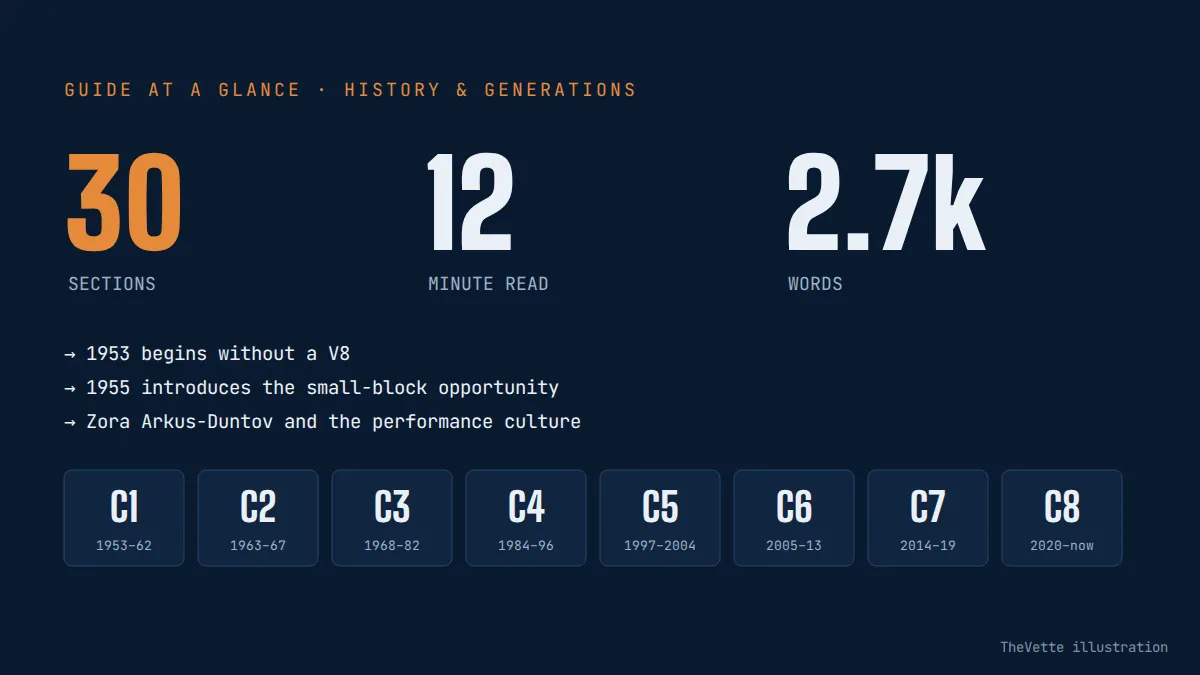
The Chevrolet small-block V8 did not power the first Corvette, but it became the mechanical idea most closely associated with the car. Introduced to Chevrolet’s passenger-car line for 1955 and offered in Corvette that year, the compact overhead-valve V8 gave the young two-seater the performance identity it needed. Across seven decades, successive small-block generations have changed block design, combustion, fuel delivery, ignition, materials, displacement, controls, and lubrication while retaining a compact pushrod layout as a central advantage.
To place How the Small-Block V8 Shaped Corvette History in a wider ownership and engineering context, continue with Corvette LS Engines Explained: LS1 Through LS9.
This independent history distinguishes family lineage from familiar engine codes. The original small-block, Gen II LT, Gen III and IV LS, Gen V LT, and the officially announced Gen VI are related chapters, not one unchanged engine. Corvette has also used V8s outside that sequence, including big-blocks, the C4 ZR-1’s DOHC LT5, and the C8 Z06/ZR1 DOHC engines. Official model-year records should settle exact availability and ratings.
1953 begins without a V8
The first production Corvette used Chevrolet’s inline-six with a two-speed automatic. The combination suited rapid creation from available components but did not deliver the acceleration or competition promise that the shape suggested. Early sales and uncertain direction made mechanical change essential to the project’s survival.
Remembering the six-cylinder beginning prevents a false creation myth. Corvette was not conceived as an immutable V8 formula. It became one through development, customer response, and engineering leadership. That willingness to change would remain as important as any engine architecture.
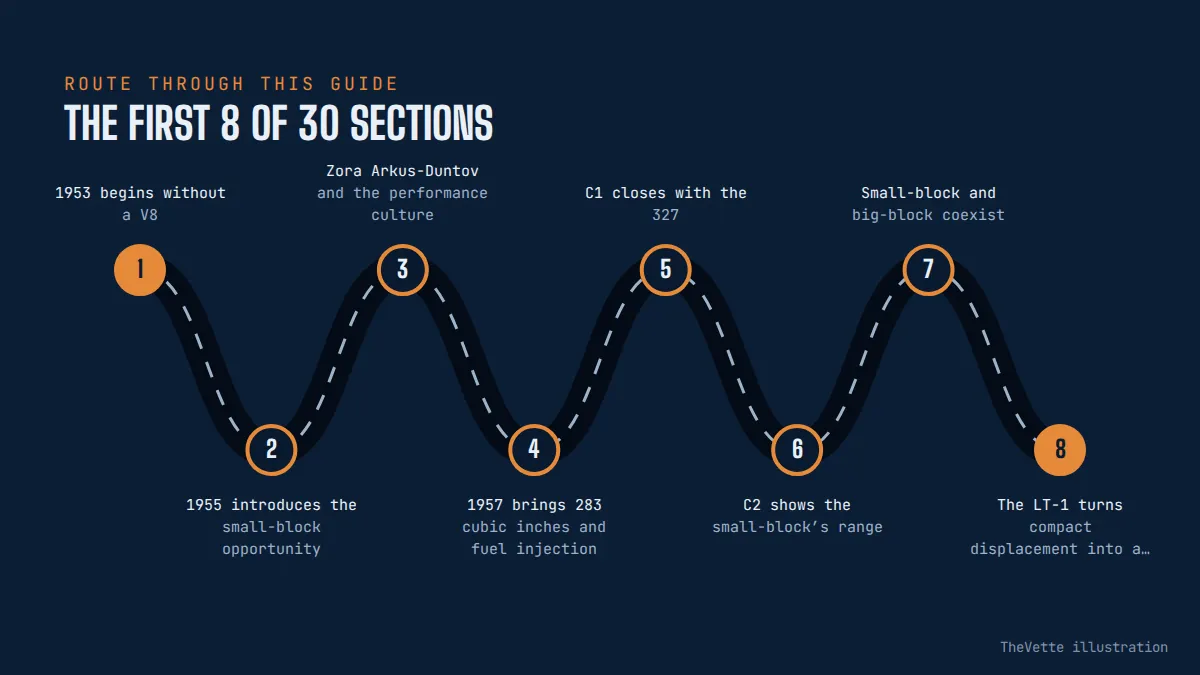
1955 introduces the small-block opportunity
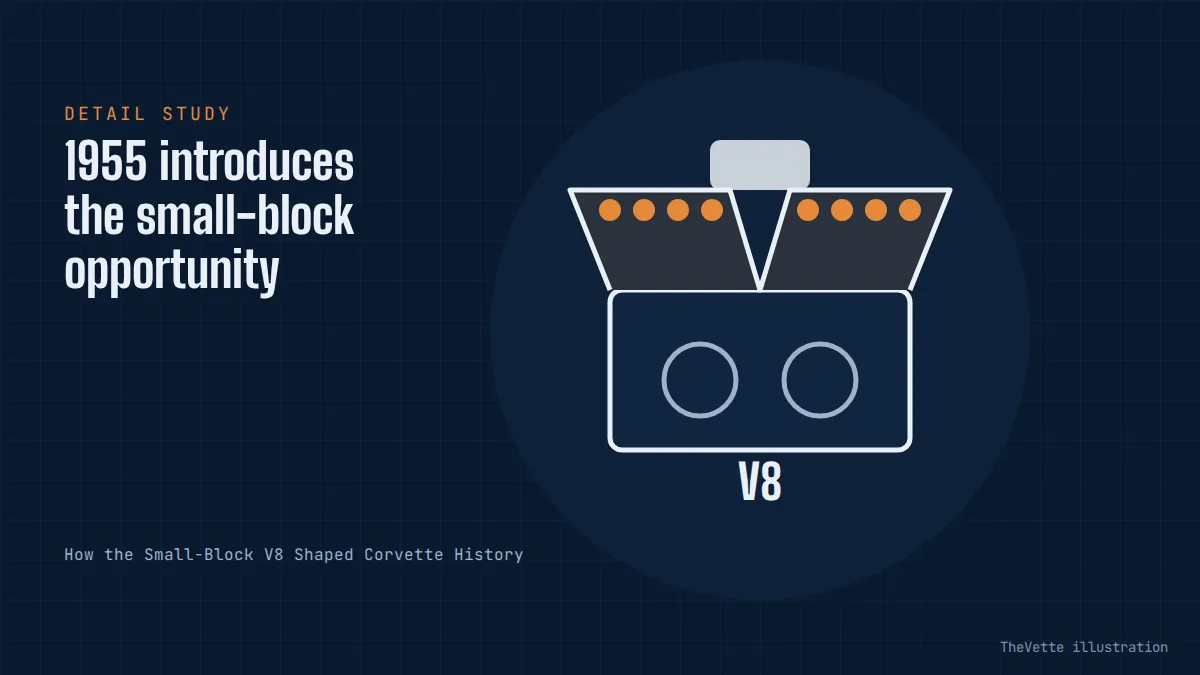
Chevrolet launched its new small-block V8 for 1955. Compact external dimensions, relatively low mass, overhead valves, and room for development made it suitable for a sports car that needed more power without a huge nose or excessive front weight. Corvette gained the V8 option and began moving toward the performance identity familiar today.
The early displacement was 265 cubic inches. Numbers would grow, but the architectural lesson came first: a physically efficient engine could support many levels of output and fit within a relatively small car. Packaging became part of performance rather than a separate concern.
Zora Arkus-Duntov and the performance culture
Zora Arkus-Duntov did not single-handedly invent Corvette or Chevrolet’s small-block, yet his engineering and competition advocacy helped connect them. Official Chevrolet history describes him developing the V8 for racing applications and pushing Corvette toward credible performance. His role is best understood as influential leadership within a larger team.
The small-block responded well to airflow, camshaft, compression, exhaust, and fuel-system development. That tunability gave engineers and racers a common platform. Corvette could improve annually without waiting for an entirely new engine family.
1957 brings 283 cubic inches and fuel injection
Displacement increased to 283 cubic inches, and mechanical fuel injection appeared as an advanced Corvette option. Contemporary ratings and the celebrated one-horsepower-per-cubic-inch claim belong to period gross-rating context; they should not be compared directly with modern net figures.
Fuel injection mattered beyond a headline. It offered precise high-performance fuel delivery for the time and became part of Corvette’s technology identity. The system’s present-day rarity and specialist maintenance needs also illustrate how innovation can become a preservation challenge.
C1 closes with the 327
By 1962, the final C1 used 327-cubic-inch small-block choices. The car’s chassis still traced back to the first generation, but its powertrain character had transformed. A decade that began with a six and automatic ended with strong V8 and manual combinations.
This progression helped make the all-new 1963 Sting Ray possible as a credible complete sports car. The small-block was no longer an emergency correction; it was a foundation around which chassis, gearing, brakes, and competition packages could be planned.
C2 shows the small-block’s range
The 1963–1967 Sting Ray used 327 small-block configurations ranging from street-oriented carbureted engines to high-output fuel-injected applications. The original Z06 package required a fuel-injected 327 and close-ratio four-speed, connecting the compact V8 with sustained competition equipment.
Big-block engines arrived later in C2 and offered a different torque and prestige story. Their presence did not make the small-block obsolete. A lighter, compact engine could support steering balance and rev response that some drivers preferred. Corvette became a range rather than one escalating displacement contest.
Small-block and big-block coexist
During the later 1960s and early 1970s, Corvette buyers could choose between small-block and big-block personalities. The larger engines generated dramatic output and cultural status; the small-block remained the standard, versatile core. This coexistence is central to Corvette history because “V8” alone does not describe weight, dimensions, response, or service.
Modern collecting sometimes treats the most powerful catalog option as the only important car. That overlooks production volume, road balance, fuel requirements, cooling, and intended use. Small-block Corvettes sustained the model commercially while exceptional big-blocks created headlines.
The LT-1 turns compact displacement into a package
The original LT-1 appeared around the start of the 1970s as a high-performance 350-cubic-inch small-block. In the ZR1 package, it worked with chassis, brake, cooling, and driveline equipment intended for demanding use. The hyphenated LT-1 code distinguishes this engine from the later Gen II LT1.
Reused letters create confusion. The 1970 LT-1, 1990s LT1, C7 LT1, and different LT5 engines are not one mechanical family. Editorial accuracy requires year, generation, displacement, and architecture alongside the code.
Emissions-era development is more than decline
During the 1970s, compression, camshaft timing, fuel calibration, exhaust treatment, emissions control, and rating methods changed. Published output generally fell, but a gross-to-net rating transition also complicates simple charts. Engineers had to make engines start, idle, meet regulation, and survive with changing fuel.
The small-block’s adaptability helped Corvette continue. Electronic ignition, catalytic converters, feedback controls, and later injection were not romantic in the way multiple carburetors were, yet they formed the path to modern drivability and emissions performance.
1982 Cross-Fire Injection marks an electronic transition
The final C3 used Cross-Fire Injection, an electronically controlled dual-throttle-body system. Its output is modest by later standards, but its historical role is a bridge from carburetion toward integrated electronic engine management. The system requires correct fuel pressure, sensors, synchronization, vacuum integrity, and calibration.
Owners sometimes replace it rather than diagnose it. A conversion can suit a driver, but it removes a key piece of the transition story. Preservation requires understanding the system on its own terms rather than expecting modern port-injection behavior.
1984 keeps the small-block while the chassis resets
The C4 was an all-new car around an evolved Chevrolet small-block. Its first-year engine continued Cross-Fire Injection, but the low integrated structure, clamshell hood, and digital controls changed how the powertrain was packaged and experienced. Engine continuity reduced risk during a major vehicle transition.
That pattern appears repeatedly in Corvette history: change the chassis dramatically while carrying a known engine architecture, or introduce a new engine within a maturing platform. Staggering innovation can make development manageable.
Tuned Port Injection broadens torque and drivability
For 1985, Tuned Port Injection arrived in Corvette. Long intake runners emphasized usable torque, while port fuel delivery and electronic control improved the modern character. Over subsequent years, engine management, cylinder heads, camshaft, and related systems evolved.
The visual intake became an icon of the C4 era. Its performance also depends on the entire system: sensors, injectors, fuel pressure, ignition, vacuum, and calibration. A clean plenum is not a diagnostic result.
Gen II LT1 changes cooling and ignition
The 1992 Corvette introduced the Gen II LT1, still a pushrod small-block but substantially redesigned. It used reverse-flow cooling that directed coolant to the cylinder heads before the block, supporting combustion and compression strategy. The front-mounted distributor and optical trigger became another defining feature.
Gen II demonstrates that family resemblance can coexist with major system change. Service procedures and parts cannot be inferred from an older 350 merely because displacement and pushrod layout look familiar. The later LT4 further developed the Gen II performance branch for the final C4 year.
The C4 ZR-1 LT5 sits outside the sequence
The 1990–1995 ZR-1 used a 5.7-liter DOHC, four-valve LT5 designed with Lotus involvement and assembled by Mercury Marine. Despite the LT code and Corvette installation, it is not the conventional pushrod Gen II small-block. It represents a deliberate alternative architecture.
This exception strengthens the small-block story by showing that Corvette could explore another path while the regular line continued. Later reuse of LT5 for the C7 ZR1 again describes a different engine. Codes are names, not genealogies.
1997 LS1 starts Gen III
The C5 introduced the all-aluminum LS1 and a new generation of small-block engineering. Official Chevrolet Performance material identifies it as the Gen III platform. Although displacement remained 5.7 liters, the block, heads, intake, ignition, and controls were new. Coil-near-plug ignition and modern port injection became visible signatures.
Compact dimensions allowed the engine to sit low in the new C5 architecture, while the torque tube connected it to a rear transaxle. The combination showed how a pushrod V8 could support modern packaging, emissions, efficiency, and performance rather than surviving only through nostalgia.
LS6 makes the C5 Z06 focused
The LS6 arrived in the 2001 C5 Z06. Chevrolet Performance documentation notes unique block breathing and differences in heads, intake, and camshaft relative to LS1. Output increased for 2002, but the engine worked within a lighter fixed-roof car, manual transmission, and specific chassis package.
LS6 established the idea that an LS code could identify a distinct factory performance combination, not merely a tune. Modern builders often interchange LS-family parts, but production identity still depends on the original block, components, calibration, and vehicle record.
Gen IV adds capability for new controls
The C6 introduced Gen IV branches, with provisions for technologies such as variable valve timing and cylinder deactivation across the wider engine family, though not every Corvette application used every feature. LS2 powered early C6 models; LS3 followed with greater displacement and output.
Family-level capability should not be confused with vehicle equipment. A block provision does not prove a particular Corvette used active fuel management. Always check the model-year application. This distinction prevents catalog descriptions from becoming incorrect vehicle claims.
LS7 uses displacement, airflow, and dry-sump control
The C6 Z06’s 7.0-liter LS7 stretched naturally aspirated Gen IV performance through large displacement, high-flow heads, specialized components, and dry-sump lubrication. The compact pushrod layout helped fit that displacement within a low sports-car nose while the aluminum Z06 structure controlled mass.
LS7 history includes service and inspection responsibilities. Dry-sump oil checking follows a specific procedure, and valvetrain or cylinder-head claims require documented expert work. A famous code does not make an undocumented engine healthy.
LS9 brings factory supercharging
The C6 ZR1 used the supercharged 6.2-liter LS9. Charge cooling, belt drive, fuel delivery, strengthened internals, dry-sump lubrication, and calibration created a complete forced-induction engine, not an LS3 with a blower attached. Hand assembly added to its flagship identity.
LS9 demonstrated how the small-block’s compact foundation could accept supercharging while leaving room for cooling and crash structure. It also raised the maintenance stakes: pulley changes, tuning, pump function, and heat-exchanger condition influence durability.
Gen V LT1 modernizes combustion
The C7 introduced a new Gen V LT1 with direct injection, variable valve timing, and cylinder deactivation in its production strategy. The code intentionally recalled earlier LT1 engines, but architecture and controls were new. Higher fuel pressure and combustion-system integration changed diagnosis.
Direct injection can support efficiency and knock resistance, while adding injectors, pumps, and calibration demands different from port injection. Active fuel management and variable timing make oil quality, solenoids, sensors, and software part of mechanical health.
LT4 and C7 Z06 combine Gen V with supercharging
The C7 Z06 used the supercharged LT4. Direct injection, variable timing, cylinder-deactivation capability, charge cooling, and a compact supercharger package supported high output beneath a low hood. Thermal management became a prominent part of ownership and track discussion.
The engine cannot be understood from peak horsepower alone. Cooling configuration, transmission, aero, ambient conditions, session length, fuel, and calibration affect repeatability. Documented updates and data matter more than broad claims about every car.
The C7 ZR1 LT5 is another distinct reuse
The 2019 C7 ZR1 used a higher-output supercharged Gen V engine called LT5. It is not related mechanically to the C4 ZR-1’s DOHC LT5 despite sharing the code. It extended front-engine Corvette output with more airflow, fueling, cooling, and visible hood packaging.
Code reuse creates heritage and search confusion. Writing “LT5” without “1990–1995 DOHC” or “2019 supercharged Gen V” leaves the reader without the most important fact.
C8 Stingray turns the small-block around
The 2020 C8 Stingray uses the Gen V LT2 behind the cabin. Relocating the engine required revised induction, exhaust, lubrication, accessory packaging, cooling routes, and integration with an eight-speed dual-clutch transmission. The architecture remained pushrod and naturally aspirated while the vehicle layout changed completely.
This is a powerful example of continuity enabling reinvention. A compact V8 that once solved front-engine packaging now supports rear-mid-engine proportions and luggage compartments at both ends. Familiar architecture does not imply familiar service access.
C8 Z06 and ZR1 are not traditional small-block branches
The C8 Z06’s LT6 and ZR1’s LT7 use double overhead camshafts, four valves per cylinder, and flat-plane crankshafts; LT7 adds twin turbochargers. They are Corvette V8s and central to the modern lineup, but not part of the conventional pushrod small-block sequence described here.
This boundary avoids turning “small-block” into a synonym for every physically compact Chevrolet V8. Engine family describes architecture and lineage, not only displacement or badge.
The announced Gen VI shows the lineage continuing
In March 2026, Chevrolet officially announced a sixth-generation small-block for 2027 Corvette applications, including a 6.7-liter LS6. The reused code references both the new family generation and earlier Chevrolet history. Because these are future-model facts at the article’s August 2026 date, they should remain explicitly dated.
The announcement reinforces a seventy-year pattern: retain compact pushrod packaging while redesigning combustion, structure, controls, and output for new requirements. Future service and production experience will add context that launch specifications cannot provide.
Why pushrods remain useful
A camshaft located in the block and two-valve heads can produce a physically compact engine with low overall height and width. In a sports car, that can help hood line, center of mass, crash packaging, steering clearance, and service access. Large displacement supplies airflow without requiring extreme engine speed.
Pushrods are a design choice with tradeoffs, not proof of simplicity in the entire vehicle. Modern small-blocks use high-pressure fuel systems, variable timing, cylinder deactivation, advanced controls, emissions equipment, and complex lubrication. External compactness can coexist with sophisticated operation.
Why displacement alone misleads
A 5.7-liter 1950s small-block, Gen II LT1, LS1, and C4 LT5 share approximate displacement while differing in block, heads, valvetrain, fuel, ignition, cooling, and controls. A 6.2-liter LS3, LT1, LT4, LS9, and LT2 likewise represent different generations or purposes.
Parts ordering and historical writing must include code, year, vehicle, and generation. “It is a 350” or “it is a 6.2” is not enough to choose oil procedure, sensor, gasket, calibration, or value.
The small-block shaped the whole vehicle
Compact dimensions allowed lower hoods and supported weight distribution. Broad torque influenced gearing and everyday drivability. High production volumes supported parts and specialist knowledge. Performance branches gave Z06 and ZR1 models distinctive engines without requiring an unrelated vehicle architecture.
The influence is therefore larger than an engine list. Corvette chassis, styling, cooling openings, exhaust, transmission placement, and customer expectations developed around the possibilities and limits of each small-block era.
How to describe an engine honestly
Identify the installed block and major components, then distinguish factory configuration from replacement, rebuild, crate engine, or modified assembly. A car can be excellent with a later engine, but “numbers matching,” “original,” and “correct type” are different claims. Document stamps, casting dates, invoices, machine work, parts, and calibration.
Never infer internal specification from paint, valve covers, or an intake badge. Dyno results describe one test under stated conditions, not factory identity. For high-value cars, use an independent engine and marque specialist.
A changing architecture with a consistent advantage
From 265 to 283, 327, 350, Gen II, LS, modern LT, and the announced Gen VI, the small-block changed repeatedly while preserving a useful proposition: substantial displacement and torque in a compact package. That proposition helped Corvette survive, mature, and reinvent its layout.
The story is not that pushrods defeated every alternative. Corvette has successfully used big-blocks and several DOHC engines. The deeper achievement is choice: engineers could rely on an adaptable core when it suited the vehicle and depart from it when another architecture served the mission better.