The eighth-generation Corvette changed the purchase question from “which front-engine version?” to “which mid-engine system?” A 2020 Stingray and a later Z06, E-Ray, or ZR1 differ in engine architecture, driven wheels, electrification, cooling, brakes, body width, tires, controls, and operating cost. The generation also remains in production, so equipment, software, recalls, and service guidance can change after an article is published. Any buying decision must be tied to a specific VIN, model year, trim, build record, and current official information.
To place C8 Corvette Buyer’s Guide: A Practical Mid-Engine Checklist in a wider ownership and engineering context, continue with Corvette Aerodynamics Explained for Everyday Drivers.
This independent guide does not authenticate a vehicle, guarantee reliability, or reproduce manufacturer claims as an ownership verdict. It organizes the inspection of a C8’s structure, mid-engine powertrain, dual-clutch transmission, thermal systems, electronic modules, active chassis, bodywork, and records. Consult the exact year’s owner manual and supplements, verify recall status by VIN, and use technicians trained for the selected variant. The fastest trim is not automatically the best match for public-road use.
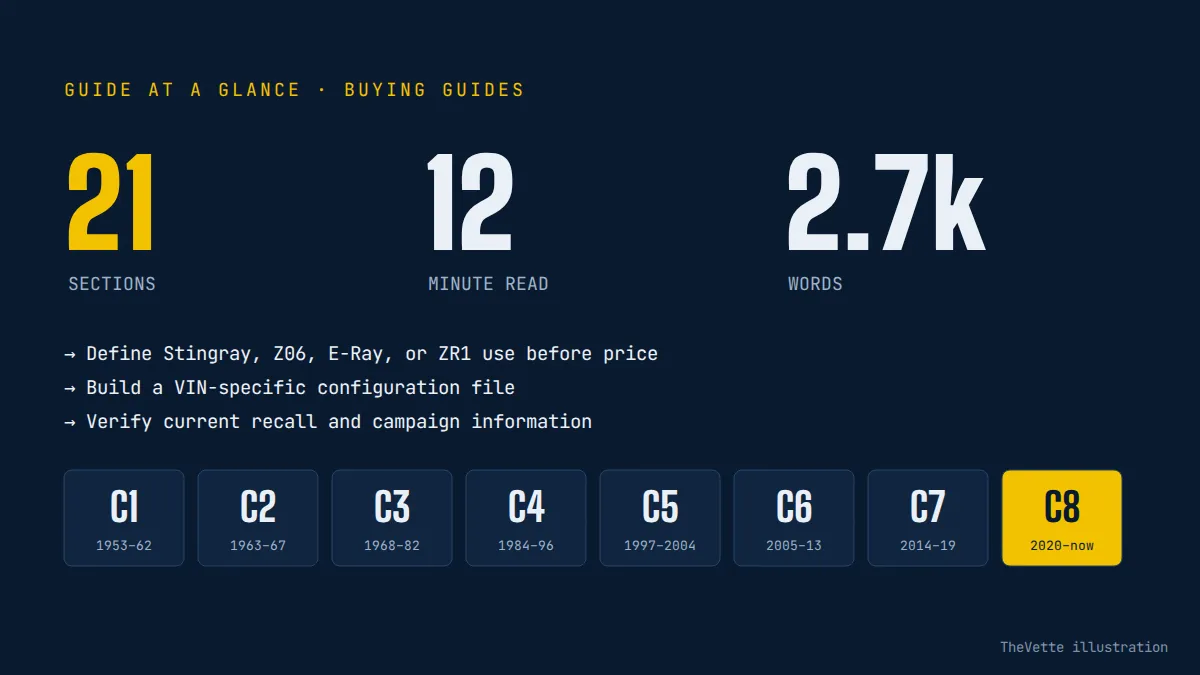
Define Stingray, Z06, E-Ray, or ZR1 use before price
Stingray provides the core mid-engine layout with a naturally aspirated V8 and rear-wheel drive. Z06 uses a distinct high-revving engine and performance-focused chassis. E-Ray combines V8 propulsion with an electrified front axle and all-wheel drive. ZR1 adds a much higher-output forced-induction system and specialized thermal and chassis requirements. Model availability and equipment vary by year and market, so confirm current facts rather than treating the latest lineup page as a description of an earlier car.
Write down road use, climate, annual mileage, luggage needs, track intentions, charging or storage arrangements for electrified systems, and tolerance for wide tires and large brakes. Price a first year that includes inspection, insurance, registration, transport, fluids, tires, alignment, battery support, software updates, and trim-specific consumables. A high-performance model bought at the limit of the budget can become unusable when one set of wear items is due.
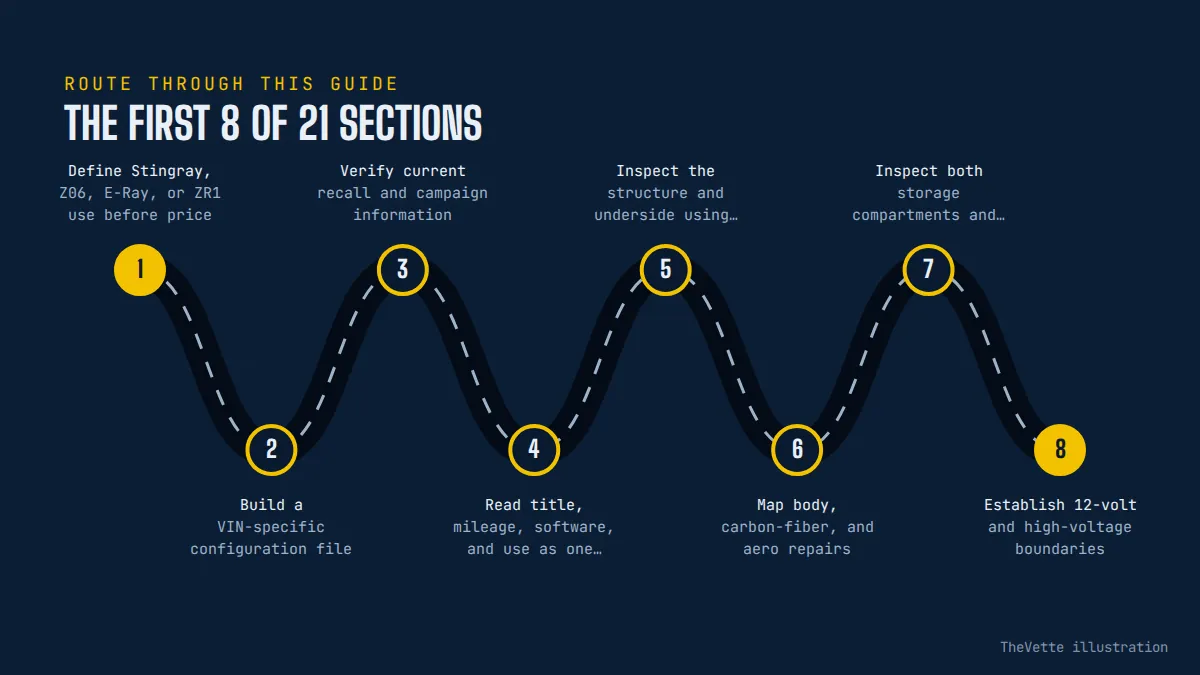
Build a VIN-specific configuration file
Collect the VIN, build or option information, window label if available, title, delivery documents, and service records. Record engine, driven wheels, body style, trim level, suspension, brake system, wheels, tires, seats, aero package, front-lift equipment, cameras, and performance-data hardware. Compare each feature with the correct model-year manual and official product information. Do not infer factory equipment from a badge, wing, wheel, or wrap.
Special editions and appearance packages can be recreated visually. A substantial premium should be supported by factory records and a physical configuration that agrees. Cars may also be updated with later-style trim or aftermarket aero. Such changes can be attractive when disclosed, securely installed, and compatible with cooling, sensors, ground clearance, and intended speed. Keep a list of original parts included in the sale.
Verify current recall and campaign information
Search the official NHTSA system using the exact VIN near the purchase date. C8 recall reports demonstrate why broad model-year summaries are insufficient: production dates, installed cooling equipment, body style, and trim can affect the population. Preserve the lookup result and ask for documentation of completed remedies. Follow any current manufacturer or agency instruction, including restrictions, rather than relying on a forum summary.
Separate safety recalls from software updates, service bulletins, warranties, customer-satisfaction programs, and ordinary repair. A completed recall does not certify the surrounding system, while an open recall may have a defined no-cost remedy. Warning messages, fuel odor, leaks, camera faults, or restraint faults require diagnosis regardless of lookup status. Never accept a disabled alert as a repair.
Read title, mileage, software, and use as one history
Compare the title with the VIN and review registration, inspection, tire, fluid, and service dates chronologically. Ask about track events, driver-school use, long storage, transport damage, over-temperature messages, reduced-power events, wheel impacts, and body repair. Track use is not automatic abuse; preparation, data, fluid service, and post-event inspection can make it understandable. A low odometer does not prove gentle treatment.
Request a full module scan and software-update history before anyone clears faults or disconnects batteries. Save current, history, communication, and readiness information. Performance Data Recorder files may document use, but privacy and ownership permission matter; absence of recordings proves nothing. Review launch-control counters or over-rev information only when supported by appropriate factory-capable tools and expert interpretation.
Inspect the structure and underside using correct lift points
The low mid-engine chassis can be damaged by incorrect lifting, road contact, or transport. Inspect frame and cradle areas, suspension pickups, floors, jacking points, front and rear bumper structures, undertrays, ducts, cooler mounts, and body attachments. Look for crushing, distortion, pulled fasteners, non-factory welds, cracks, corrosion evidence, and fresh coating over unclear work. Compare left and right wheel position and component clearance.
Front-lift equipment, steering components, coolant and brake lines, aero pieces, and cooling ducts sit in areas where an impact can affect more than appearance. Determine whether scrape marks end at a replaceable deflector or continue into mounts and structure. Aluminum and composite repairs require material-appropriate facilities. A history report cannot verify the underside; a documented professional repair can be evaluated on evidence.
Map body, carbon-fiber, and aero repairs
View paint and exposed composite in diffuse daylight and raking light. Compare texture, gloss, panel contour, fastener disturbance, edge masking, and overspray across front fascia, hood, fenders, doors, quarters, nacelles, roof, rear deck, vents, lamps, and diffuser. Wide-body and carbon-fiber components can be expensive. Cracks around mounts or irregular weave under clear finish require specialist assessment.
Operate doors, front compartment, rear deck or engine cover, fuel door, roof latches, and convertible hardtop slowly. Check hinges, latches, seals, drains, vent attachments, camera housings, radar or sensor areas, and panel clearances. Aftermarket wings and splitters need known ratings, correct reinforcement, and compatible cooling airflow. Cosmetic attachment to a thin panel is not adequate engineering.
Inspect both storage compartments and water paths
Remove accessible liners with permission and look for moisture, staining, damaged fasteners, loose tools, coolant traces, wiring repairs, and impact evidence. Examine seals and drain paths around the front compartment, doors, removable roof, rear openings, and convertible mechanism. New weatherstrip does not prove alignment or drainage was corrected. Water near connectors can cause delayed intermittent faults.
Confirm that the removable coupe roof can be released, lifted, stored, and refitted without contact or warning. On a convertible, cycle the retractable hardtop completely and inspect panel fit, latches, seals, hydraulic or electric operation, storage clearances, and warning messages. Top repair can involve calibration and sensors as well as visible mechanisms. Verify emergency procedures in the correct manual.
Establish 12-volt and high-voltage boundaries
All variants rely on a healthy low-voltage electrical system. Test battery condition, charging behavior, terminals, grounds, fuse centers, and parasitic draw when indicated. Low voltage can produce multiple messages and prevent normal release or access functions. Trace dash cameras, radar detectors, lighting, exhaust controllers, and audio additions for fusing and secure routing.
E-Ray and later electrified variants include high-voltage components that must be inspected and serviced only by appropriately trained personnel using official safety procedures. Do not probe orange cables, open enclosures, or improvise isolation. Review battery and electric-drive diagnostic information, cooling, warning history, warranty status, and collision repair with qualified equipment. Ensure emergency and first-responder information appropriate to the exact model is available.
Scan every accessible control system
Observe warning-lamp self-check, driver messages, instrument layouts, cameras, infotainment, climate control, drive modes, front lift, suspension, brake, steering, transmission, engine, differential, restraint, and body functions. Use compatible full-vehicle diagnostic equipment. A generic emissions reader leaves most systems unexamined. Record faults, data, and readiness before resets or updates.
Ask why software was updated and whether symptoms changed afterward. Over-the-air or dealer programming can alter features and diagnostics, but software should not be used as a vague explanation for physical noise, leakage, or overheating. Confirm that keys, profiles, connected-service ownership, and privacy data can transfer or be reset correctly. Do not ask a seller to expose unrelated personal recordings or account credentials.
Evaluate the engine that belongs to the trim
Stingray, Z06, and ZR1 engines differ substantially; procedures and expectations cannot be transferred casually. Arrange a cold start and observe cranking, oil-pressure behavior, exhaust after condensation clears, idle, misfire data, warning messages, accessory or valvetrain noise, and leakage. Inspect induction, coils, injectors, high-pressure fuel areas without opening them, belts, mounts, grounds, exhaust, cooling connections, and heat shielding.
Ask about oil consumption, fuel requirement, misfires, engine replacements, valvetrain work, forced-induction service, and calibration changes. Compression, leak-down, borescope inspection, oil analysis, and data review can be appropriate when interpreted by a technician familiar with the exact engine. A clean engine cover and smooth idle do not establish condition under heat and load.
Follow the exact oil-level and track-preparation procedure
Lubrication configuration and checking procedure vary by engine and package. Use the exact owner manual for oil specification, capacity, temperature, timing, and dipstick method. Track supplements add configuration-specific steps and warnings; they also distinguish cars and tire packages intended for track use. Do not copy preparation from another C8 or leave track settings in place for public-road operation.
Review invoices for fluid type, quantity, interval, filter, and any cooler service. Ask about oil temperatures and event logs. Inspect tanks, lines, fittings, engine, and cooler areas for leakage where applicable. After an event, correct alignment, tire pressure, brake components, and other settings for road use as official guidance requires. “Track ready” is a process, not a permanent sales description.
Inspect cooling as several connected circuits
Mid-engine packaging uses extensive ducting and multiple heat exchangers. Inspect front and side openings, radiators, condensers, ducts, seals, fans, reservoirs, pumps, hoses, undertrays, and coolers for engine, transmission, differential, charge air, or hybrid components as fitted. Debris and impact can affect one circuit while ordinary coolant temperature appears normal.
Observe available temperatures during idle, public-road driving, slower traffic, and heat soak. Ask about over-temperature, fan, pump, or reduced-power messages and the recorded diagnosis. Added guards can protect heat exchangers but may change airflow; damaged mesh can contact fins. Cooling changes should be supported by measured need, secure installation, and compatibility with the car’s control strategy.
Evaluate the dual-clutch transmission cold and hot
Every production C8 in the covered period uses a dual-clutch transmission rather than a conventional manual. Assess selection, creep, low-speed modulation, upshifts, downshifts, commanded manual operation, reverse, parking engagement, temperature, warning messages, and leakage. Behavior differs from a torque-converter automatic, but persistent shudder, delay, flare, harsh impact, or faults require diagnosis rather than normalization.
Review fluid and filter service, software updates, clutch or transmission repairs, cooler work, and track procedures. Calibration changes for added engine output must respect clutch capacity and thermal protection. Ask whether the car has experienced a no-move or reduced-performance event. Major unit replacement should have complete invoices and current scan evidence, not only a statement that it was handled under warranty.
Separate differential, axle, and hybrid-drive evidence
Inspect rear differential or integrated drivetrain areas, mounts, half-shafts, constant-velocity joints, hubs, coolers, wiring, and sensors. Compare noise under drive, coast, steady load, and gentle cornering. Tires, hubs, gears, transmission, pumps, and exhaust can create overlapping sounds. Record the condition precisely rather than assigning a component during the test drive.
On E-Ray, include the front electric drive and related controls in professional diagnostics. Verify drive-mode behavior and fault history without attempting unsafe service. Tire circumference and condition across both axles are especially important to an all-wheel-drive system. Collision or wheel-impact evidence at the front deserves review of drive components as well as steering and suspension.
Test front lift, steering, suspension, and magnetic damping
Inspect control arms, springs, bushings, ball joints, tie rods, steering system, anti-roll bars, dampers, hubs, and cradle attachments. Look for torn boots, leaks, impact damage, ride-height differences, contact marks, and mixed components. If front lift is fitted, operate it repeatedly, inspect for hydraulic leakage and warning history, and confirm saved-location behavior only where safe.
Verify Magnetic Ride Control option identity, connectors, damper condition, and mode response. Lowering or alignment changes must retain travel, sensor relationships, aero clearance, and tire clearance. During the drive, note steering center, tramlining, bump response, and stability after recording tire model, date, pressure, and alignment. Active systems cannot compensate for worn or damaged hardware.
Price brakes using measurements and heat history
Inspect master cylinder, lines, hoses, calipers, rotors, parking-brake system, ABS wiring, cooling ducts, and fluid. Performance brakes need pad-wear comparison, heat evidence, seal and boot review, proper hardware, and rotor measurements. Ask which pads and fluid were used on road and track. Surface shine does not establish remaining life.
Carbon-ceramic systems where fitted need qualified inspection and replacement-cost awareness. Handling, wear measurement, chips, and contamination differ from iron rotors. Begin driving with controlled low-speed stops. Pedal travel should remain stable, and the car should stop straight without drag, vibration, grinding, or warnings. Aftermarket systems need correct bias, clearance, fasteners, cooling, and software compatibility.
Tires are trim-specific safety equipment
Record brand, model, size, load and speed description, date code, pressure, and condition at every corner. Inspect inner shoulders, sidewalls, repairs, heat cycles, flat spots, and contact. Stingray, Z06, E-Ray, and ZR1 combinations differ; substitute tires can affect wet behavior, launch, braking, active controls, and all-wheel-drive operation. Verify that the exact combination is approved for the wheel and use.
Inspect wheels for bends, cracks, damaged lug seats, refinishing over defects, incorrect offsets, and representation as factory equipment. Wide wheels and low-profile tires are impact-sensitive. Verify pressure-monitoring operation and sensor identity. Replace questionable tires before performance evaluation, then measure alignment only after hubs, suspension, ride height, and wheel integrity are known.
Operate every cabin and visibility feature
Test keys, locks, windows, mirrors, seats, belts, steering-column adjustment, climate control, cameras, rear-camera mirror, head-up display, instrument modes, infotainment, audio, navigation, performance data recorder, drive selector, front lift, roof or top controls, exterior lights, wipers, washer, horn, parking aids, and compartment releases. Confirm warning lamps appear during self-check.
Inspect seat bolsters and frames, carpet, pedals, console, switch legends, storage bins, mobility equipment, charging accessories where relevant, manuals, keys, and roof tools. The mid-engine layout makes camera and mirror function important to visibility. Fuel, coolant, or exhaust odor requires investigation, not perfume or an assumption that all mid-engine cars smell hot.
Conduct the road test without chasing headline numbers
Confirm insurance and begin with low-speed steering, braking, transmission modulation, and visibility. Add ordinary acceleration, manual shift commands, steady cruising, moderate bumps, and enough time for full temperature. Observe starting, idle, throttle response, transmission, steering, brakes, temperatures, messages, vibration, wind noise, and odors. Do not attempt launch control or performance limits on public roads.
After shutdown, park over clean ground and inspect for engine oil, coolant, transmission or differential fluid, fuel, and brake fluid. Observe pumps, fans, heat soak, and hot restart, then rescan modules without erasing evidence. Sort findings into immediate safety, reliability, diagnostics, configuration, recall, and cosmetics. Obtain estimates from a facility equipped for the exact trim, including high-voltage qualifications when required.
Demand records that match the car’s complexity
Useful records include title and registrations, official recall results, build and option data, full module scans, software and tune files, alignment sheets, track logs, engine and transmission invoices, cooling work, brake measurements, fluid service, tire receipts, and photographs before body repair. Read them chronologically. A parts invoice proves purchase, not correct installation or programming.
When price depends on early production status, special appearance, low mileage, carbon equipment, high-performance brakes, engine work, or expensive modifications, use independent expertise. List roof panels, wheels, track parts, take-offs, keys, manuals, chargers, and data devices in the agreement. Reset connected accounts and personal recordings through the proper ownership-transfer process.
Buy the exact C8 you can understand and support
A defensible purchase aligns title, VIN, factory configuration, service history, recall status, diagnostic data, structural condition, thermal behavior, road test, and intended use. Safe tires and brakes, stable fluids and temperatures, sound low-voltage supply, correct software, and documented repairs rank ahead of acceleration claims. Retain contingency for issues that appear only after regular use.
Walk away when identity conflicts, structural access is refused, safety alerts are disabled, module data is repeatedly cleared, or major engine, aero, cooling, or electrical work lacks records. The C8 lineup is broad and evolving. Patience allows the buyer to select the propulsion system, capability, and complexity that fit real ownership instead of purchasing a specification sheet that is expensive to maintain and rarely used.