The 1997–2004 Corvette combines performance, luggage space, and parts support in a package that often appears unusually inexpensive beside newer sports cars. That value can tempt a buyer to skip inspection, especially when the LS1 starts cleanly and the body looks bright. The C5’s hydroformed frame rails, rear transaxle layout, torque tube, composite body panels, electronic modules, and model-year changes require a method of their own. Age now matters as much as mileage: seals, tires, wiring, fluids, weatherstrip, and stored diagnostic faults can outlive a polished listing.
To place C5 Corvette Buyer’s Guide: Performance Value Explained in a wider ownership and engineering context, continue with Corvette LS Engines Explained: LS1 Through LS9.
This independent guide does not certify any car or promise a particular ownership cost. It explains how to establish identity and use, evaluate structural and mechanical evidence, verify safety-recall status by VIN, and distinguish routine age-related work from a poorly understood project. Consult the appropriate General Motors owner and service information for the exact year and configuration. A coupe, convertible, fixed-roof coupe, and Z06 can share major systems while differing in body details, suspension, wheels, equipment, and intended character.
Choose the body style and mission first
The hatchback coupe offers removable-roof flexibility and generous cargo space. The convertible adds top mechanisms, seals, drainage, and structural-use questions. The fixed-roof coupe and Z06 emphasize a different equipment mix and performance purpose. Decide whether the car will commute, tour, attend track days, remain close to original, or become a modification platform. Seats, ride, luggage, noise, weather protection, gearing, and tire cost matter differently in each role.
Keep a first-year reserve beyond the purchase. Tires may be old despite deep tread. Fluid service, battery, belts, hoses, brakes, wheel alignment, weatherstrip, window regulators, headlamp mechanisms, dampers, mounts, and electronic diagnosis can accumulate quickly. Add inspection, transport, insurance, registration, and secure storage. A higher-mileage car with a continuous maintenance file can be a stronger driver than a low-mileage example recommissioned only for sale.
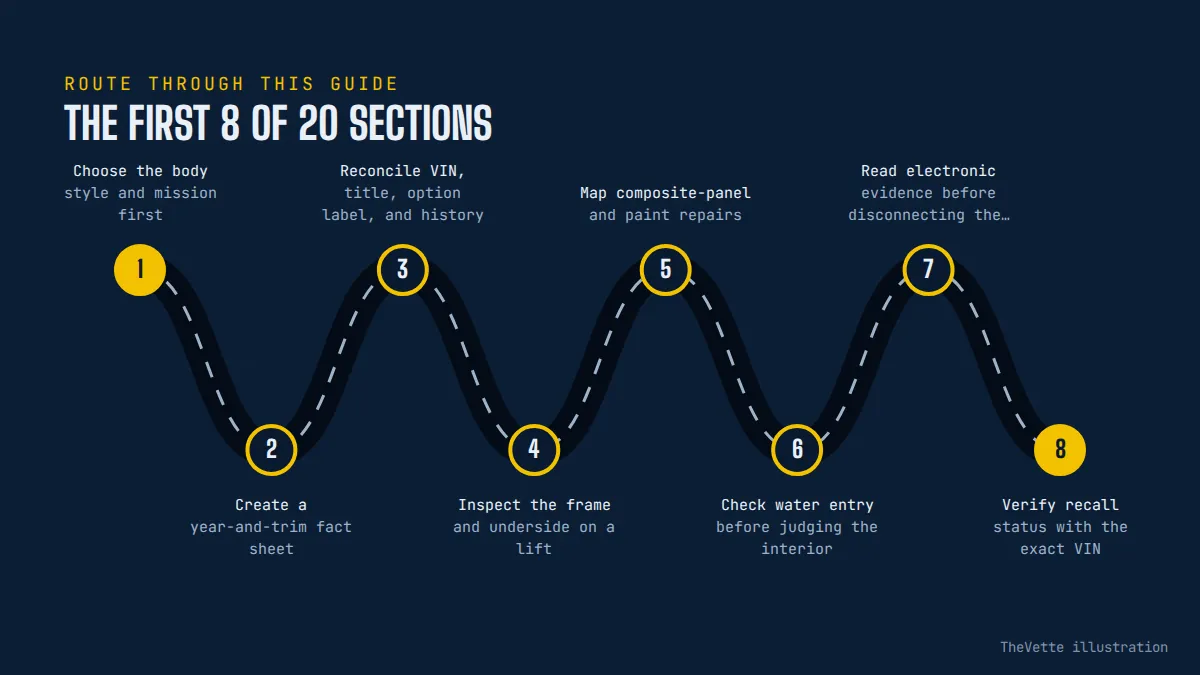
Create a year-and-trim fact sheet
Record the correct engine, transmission, axle options, wheel and tire sizes, brake package, suspension choices, exterior details, interior equipment, and available body styles for the model year. Note when a desired feature appeared rather than assuming all C5s have it. Use GM vehicle information and service references as the starting point. Internet listings frequently apply Z06, handling-package, or commemorative language loosely.
For a special edition or Z06, connect the VIN, option label, production documentation, body configuration, wheels, brakes, engine details, interior, and exterior appearance. Decals and painted parts alone do not establish identity. Modifications are common and can be useful, but the advertisement should distinguish factory configuration from later upgrades. If rarity materially affects the price, obtain an independent specialist’s written assessment.
Reconcile VIN, title, option label, and history
Compare the title with the VIN visible on the car and review the plate, characters, and surrounding area. Locate the service-parts identification information where applicable and preserve a clear photograph. Decode it with a reliable year-specific reference. Check registrations, inspection records, emissions results, and invoices in date order. Mileage continuity is stronger evidence than clean upholstery, and a history report is a lead rather than a complete ownership record.
Ask about collision repairs, paintwork, track use, long storage, flood exposure, and changes to engine, transmission, differential, suspension, brakes, or calibration. Avoid turning modifications into assumptions about abuse. Instead, inspect the relevant systems and ask for parts lists, installer invoices, alignment sheets, and tuning records. Put material representations and included take-off parts in the bill of sale.
Inspect the frame and underside on a lift
The composite exterior does not make the C5 structurally immune to damage. Use correct lift points and inspect the hydroformed rails, front and rear cradles, suspension pickups, central tunnel areas, floors, jacking points, bumper reinforcements, and body attachments. Look for crushed points, torn mounts, distortion, corrosion, poor welds, fluid saturation, and fresh coatings that conceal texture. Compare left and right wheel position and component clearances.
Road debris and incorrect lifting can damage panels and underbody pieces without appearing in standing-height photographs. Check fasteners, air deflectors, brake ducts where fitted, exhaust hangers, and signs that suspension or drivetrain parts have contacted the body. A repaired car can be a sound purchase when measurements, photographs, parts, and workmanship are documented. A clean history database cannot substitute for this physical examination.
Map composite-panel and paint repairs
View the car in diffuse daylight and under angled artificial light. Compare gloss, orange peel, edge masking, fastener disturbance, overspray, and panel contours. Inspect front and rear bumper covers, hood, doors, quarters, roof panel, rocker areas, mirror mounts, lamp openings, and hatch surround. Stone chips and lower-panel wear can be consistent with road use; mismatched shapes, cracking around mounts, or broad sanding waves suggest deeper work.
Open the hood, doors, fuel door, hatch, and roof latches slowly. Gaps should remain stable and closures should not need lifting or force. Inspect hood hinges and latches, door hinges and strikers, hatch hinges, pull-down or release operation, and the roof-panel mounting hardware. A replacement roof or body panel is not automatically negative. The question is whether it fits, seals, and corresponds with the disclosed repair history.
Check water entry before judging the interior
Inspect door, roof, windshield, hatch, and convertible-top seals. Look under cargo carpet and accessible interior sections for dampness, staining, mildew, oxidized fasteners, swollen material, or water tracks. Verify drains and weatherstrip channels rather than assuming new rubber solved the cause. A C5 that lives outside can direct water toward electronic connectors and modules, turning a seal concern into intermittent electrical faults.
On a coupe, remove and refit the roof only with permission and the correct procedure. Check panel type, mounting points, latch engagement, storage hardware, and wind noise history. On a convertible, operate the top through a complete cycle, inspect fabric, rear glass, bows, latches, seals, hydraulic or mechanical elements as applicable, and storage-well condition. A quick open-top viewing does not prove weather protection.
Read electronic evidence before disconnecting the battery
Turn the key on and observe the warning-lamp self-check. Start the car and note which lamps remain, what messages appear, and whether the driver information center responds normally. Use appropriate diagnostic equipment to inspect current, history, and communication codes across available modules, not only generic engine emissions codes. Record results before clearing anything or disconnecting power. A recently cleared system may need a complete drive cycle before monitors and symptoms return.
Low voltage and poor grounds can create several unrelated-looking complaints. Load-test the battery when indicated, check alternator output, inspect terminals, major grounds, fuse centers, and accessible harness connections. Trace alarms, audio amplifiers, lighting changes, fans, and other additions for fuse protection and routing. A battery cutoff can support storage, but it should not conceal a parasitic draw or reset evidence every time the car is parked.
Verify recall status with the exact VIN
Use the official NHTSA recall lookup and retain the result with the inspection file. Applicability and completion depend on VIN and campaign records; a model-year discussion board cannot establish that an individual car has an open or completed recall. Ask for dealer repair documentation when available. If the car displays a steering-column, restraint, lighting, or other safety-related symptom, do not improvise a bypass or infer the remedy from hearsay.
Separate recalls from service bulletins, warranties, and ordinary wear. A completed campaign does not certify the surrounding system, and an open campaign may have eligibility or parts procedures that require an authorized channel. Confirm current information near the purchase date. Warning lamps and altered wiring should be investigated regardless of a lookup result; defeating an alert is not evidence that the underlying condition was corrected.
Assess the LS engine by condition and calibration
Arrange a cold start. Observe cranking speed, oil-pressure rise, initial exhaust, idle stability, accessory noise, warning messages, and leakage during warm-up. Inspect oil and coolant levels when safe, belt and tensioner condition, hoses, engine mounts, intake ducting, air filter, vacuum connections, fuel lines, injector area, ignition coils, grounds, and exhaust manifolds. Look for improvised repairs near heat and moving parts.
Modifications may include intake, exhaust, camshaft, cylinder heads, forced induction, injectors, throttle body, and software calibration. Ask for the complete build sheet, installer, tuner, fuel requirement, emissions status, and diagnostic baseline. A powerful dyno chart does not prove cold drivability, cooling, knock control, or durability. On the road, evaluate part-throttle transition, hot restart, detonation signs, smoke, oil pressure, and temperature before considering full-load claims.
Cooling performance must be tested through heat soak
Inspect radiator and condenser faces, lower intake path, air seals, fans, shroud, cap, reservoir, hoses, thermostat and water-pump areas, and evidence of dried coolant. Debris can collect low in the airflow path where it is not visible from above. Bent fins, missing deflectors, or a manual fan switch may point to earlier diagnosis. Confirm that both commanded and temperature-based fan operation make sense for the year and calibration.
Observe temperature during idle, ordinary cruising, slower traffic, and after shutdown. Validate suspicious sensor or gauge data with suitable equipment. An aftermarket radiator can be appropriate, but added capacity will not cure every cause: airflow, pressure control, fan logic, thermostat, pump, mixture, tune, or combustion leakage may contribute. Coolant odor, discharge, or repeated overheating is not normal sports-car character.
Inspect the torque tube and rear transaxle as a system
The engine drives a rear-mounted transmission through a torque tube, which helps weight distribution and changes where noise and labor arise. Listen for rattles, bearing-like sounds, clunks, and vibration during idle, clutch engagement, acceleration, steady speed, and coast. Inspect engine, torque-tube, transmission, and differential mounting areas for leakage, contact, damaged fasteners, and signs of previous removal.
Diagnosis should separate engine-speed, driveshaft-speed, wheel-speed, and load-dependent symptoms. A sound that changes with clutch position is different from one that follows road speed. Major access work can be labor intensive, so obtain a specialist opinion rather than pricing one guessed component. Review invoices for clutch, torque-tube bearings, transmission, and differential work; confirm which related seals, mounts, fasteners, and hydraulics were renewed at the same time.
Judge manual and automatic transmissions on their own terms
On a manual car, check clutch-fluid condition, pedal action, release, engagement, shifter centering, synchronizer behavior, reverse selection, and noise hot and cold. Determine whether the clutch, flywheel, hydraulics, shifter, or gearing has been changed. An aggressive clutch may be acceptable for a high-output project but unpleasant in traffic. Verify that cruise, reverse lamps, and starting interlock operate correctly.
On an automatic, inspect fluid condition and leakage, then evaluate selection delay, shift timing, part-throttle behavior, kickdown, converter lockup, and response after full warm-up. A tune can alter shift feel and protection strategies. Ask who changed it and why. Transmission cooling additions should have secure lines and appropriate routing. Do not interpret a harsh shift as proof of strength or a smooth shift as proof of internal health.
Listen to differential, axle, and hub behavior
Inspect the differential and transaxle case, output areas, half-shafts, constant-velocity joints, hubs, seals, and mounting hardware. On the road, compare sound under drive and coast, then during gentle left and right loading. Tire roar, hub noise, differential whine, and driveline resonance can overlap. Record the conditions that reproduce the symptom so a shop can test efficiently.
Modified final-drive ratios, wider tires, lowered suspension, and high-output engines change loads and speedometer or calibration requirements. Ask whether the electronic configuration was updated and whether traction and stability systems behave correctly. Evidence of drag-strip use should lead to focused inspection of clutch or automatic, differential, axles, hubs, studs, and mounts, not an unsupported conclusion that the entire car was abused.
Inspect suspension, steering, and selective damping
Examine control arms, composite springs, bushings, ball joints, tie rods, steering rack and mounts, anti-roll bars, shocks, wheel bearings, and cradle attachments. Look for torn boots, leakage, play, ride-height differences, contact marks, loose fasteners, and mismatched components. Replacement dampers should suit the spring and intended use. If an adjustable factory system is fitted, verify modes and scan for related faults.
During the drive, note steering center, return, tramlining, kickback, response over bumps, and stability under braking and modest acceleration. Wide or aged tires can dominate behavior, so record pressure, model, and date before blaming the chassis. A good alignment report is useful only when tires, bearings, bushings, ride height, and joints are sound. Lowering should retain travel and clearance rather than resting near the bump stops.
Brakes and active safety systems need separate checks
Inspect master cylinder, booster, hard lines, flexible hoses, calipers, rotors, parking brake, ABS sensors and wiring, and hydraulic control components. Confirm warning lamps illuminate at key-on and then follow the expected sequence. Ask when fluid was changed and which components were serviced. Storage can create corrosion or sticking even when pads show little wear.
Begin with gentle low-speed stops. Pedal travel should remain consistent and the car should stop straight without pulsation, drag, grinding, or warning messages. Evaluate ABS and traction or stability functions only in a safe, appropriate professional setting; do not provoke loss of grip on public roads. Aftermarket brakes need correct bias, master-cylinder relationship, hose routing, fasteners, wheel clearance, and calibration compatibility.
Record every tire’s date, size, and location
C5 fitments may be staggered and use performance-oriented constructions. Write down brand, model, size, load and speed description, date code, pressure, and condition at every corner. Inspect inner shoulders, sidewalls, repairs, cracking, flat spots, and rubbing. Mismatched front and rear tire behavior can confuse active-control systems even when the nominal sizes fit.
Check wheels for cracks, bends, corrosion, damaged lug seats, incorrect offsets, refinishing over defects, and loose or inappropriate hardware. Confirm that wheels represented as Z06 or special-edition equipment are the correct type when the claim affects price. Replace questionable tires before a high-speed evaluation. Deep tread cannot reverse age-related hardening, and an inexpensive old tire can transform the handling of an otherwise sound Corvette.
Operate all cabin, lamp, and access mechanisms
Test windows for speed and alignment, locks, mirrors, seat tracks and motors, belts, steering-column adjustment, climate control, air conditioning, blower speeds, wipers, washer, horn, exterior lamps, fog lamps, radio, antenna, power outlets, hatch release, and fuel-door release. Cycle pop-up headlamps several times and listen for slipping or continued motor operation. Inspect linkage and clearance rather than forcing a stuck door.
Review seat-bolster wear, carpet, pedals, switch legends, console, cargo shade, storage compartments, spare or inflator equipment as configured, manuals, and keys. Strong fuel or exhaust odor needs investigation of tank area, lines, seals, hatch fit, and exhaust. Verify that the parking brake holds and releases, that doors latch securely, and that no warning has been hidden with tape or removed bulbs.
Road-test in a sequence that protects the evidence
Confirm insurance and begin with steering and braking at neighborhood speed. Add ordinary acceleration, several gear changes, steady cruising, moderate road texture, and enough time for full temperature. Observe cold and hot starting, idle, throttle response, clutch or automatic behavior, steering, brakes, instruments, messages, cooling, charging, vibration, wind noise, and fumes. Aggressive driving is unnecessary for a purchase inspection.
After shutdown, park over clean ground and inspect for fresh engine oil, coolant, transmission fluid, differential lubricant, fuel, and brake fluid. Observe fan behavior and perform a hot restart. Rescan modules without erasing data. Sort findings into immediate safety needs, near-term reliability, diagnostic work, configuration questions, and cosmetics. Obtain written estimates from shops that understand the labor implications of the rear-transaxle layout.
Make documentation explain the car
Useful records include registrations, emissions and inspection results, recall completion documents, option-label images, alignment sheets, module scans, tuning files, engine or clutch invoices, fluid-service records, tire receipts, and photographs before collision or restoration work. Read them chronologically and look for recurring problems, unexplained mileage gaps, or major modifications without supporting parts and calibration details.
A clean history report cannot prove absence of damage, and an appraisal cannot prove current mechanical health. Special-edition status, unusually low mileage, original paint, or expensive engine work deserves independent verification when it drives the price. List all included roof panels, wheels, take-off parts, keys, manuals, covers, and electronic devices in the agreement. Preserve digital tune or scan files in a format the next owner can access.
Buy a coherent C5, not a collection of selling points
The final decision should align legal identity, configuration, service history, structural evidence, diagnostic data, road behavior, and intended use. Safe tires and brakes, dry fuel and cooling systems, predictable steering, stable voltage, and understandable modifications take priority over dyno figures or perfect paint. Estimate known work and retain contingency for symptoms that appear only after regular driving.
Walk away when title or VIN evidence conflicts, module data is repeatedly cleared without explanation, safety systems are bypassed, structural access is refused, or major modifications have no documentation. Many C5s were produced, so patience is an advantage. The right example earns its reputation for value because its performance and practicality are available to use—not because neglected systems were hidden behind a low asking price.