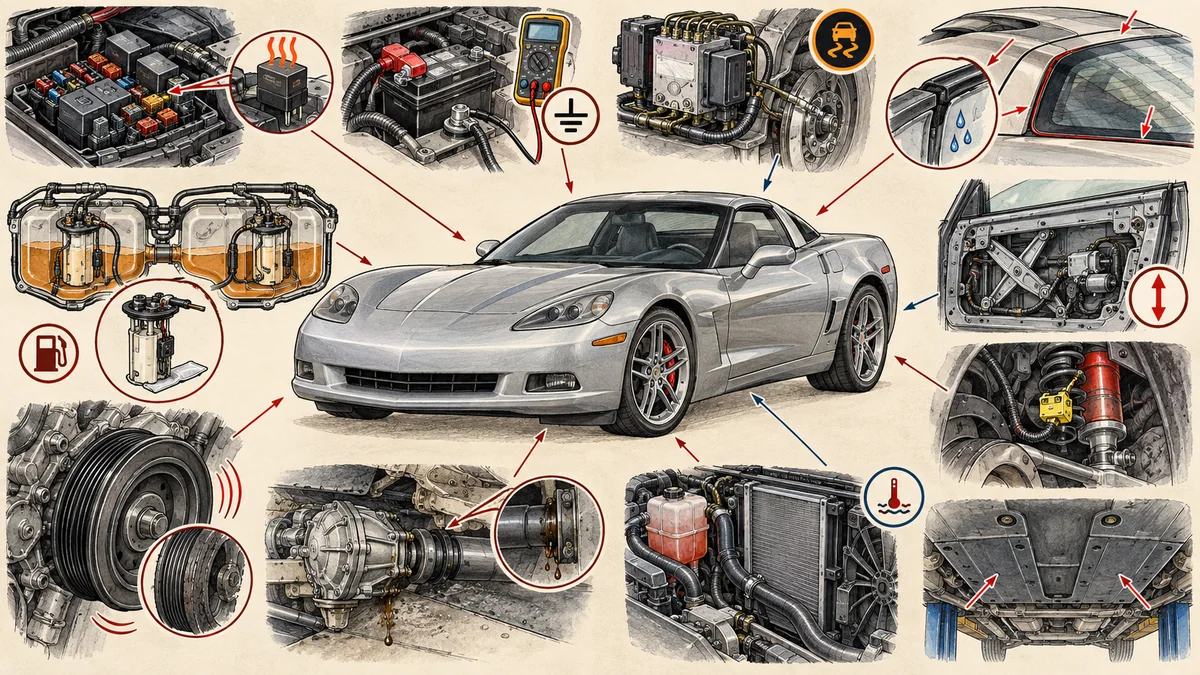
The C6 Corvette is not defined by one universal defect. Its most useful “common problems” list is an inspection plan: verify VIN-specific campaigns, establish battery and ground health, scan every module, test the lighting and fuel systems, inspect the harmonic balancer and cooling system, and evaluate drivetrain, roof, windows, suspension, brakes, and tires. Model year, trim, use, storage, modifications, and repair quality matter more than mileage alone.
To place C6 Corvette Common Problems in a wider ownership and engineering context, continue with C6 Corvette Buyer’s Guide: Trims, Trouble Spots, and Value.
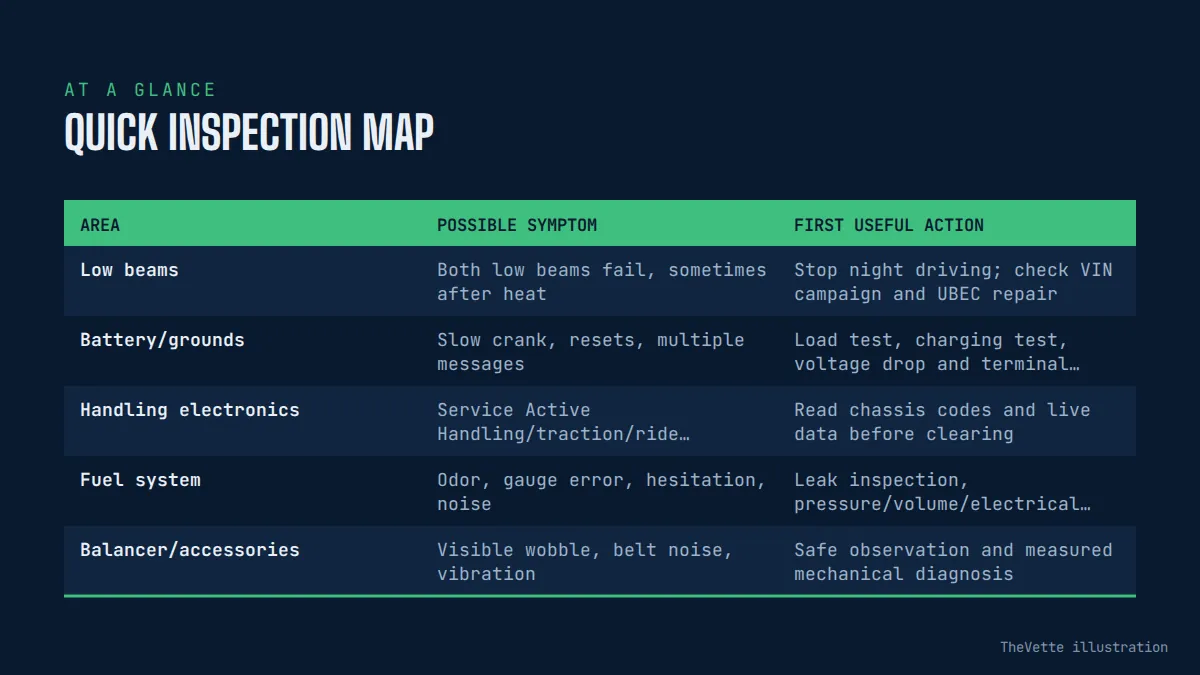
Quick inspection map
| Area | Possible symptom | First useful action |
|---|---|---|
| Low beams | Both low beams fail, sometimes after heat | Stop night driving; check VIN campaign and UBEC repair |
| Battery/grounds | Slow crank, resets, multiple messages | Load test, charging test, voltage drop and terminal inspection |
| Handling electronics | Service Active Handling/traction/ride messages | Read chassis codes and live data before clearing |
| Fuel system | Odor, gauge error, hesitation, noise | Leak inspection, pressure/volume/electrical diagnosis |
| Balancer/accessories | Visible wobble, belt noise, vibration | Safe observation and measured mechanical diagnosis |
| Roof/water control | Rattle, wind noise, damp trim | Panel fit, seals, drains and prior repair |
1. Low-beam headlamp campaign
GM safety recall 14V-251 covered 2005–2007 Corvettes for a condition in the underhood bussed electrical center. GM reported that heat could expand the housing and repeatedly bend a low-beam relay-control wire until it fractured, causing both low beams to stop illuminating. Operation could return after the housing cooled, making an intermittent car appear repaired.
The related GM filing distinguished the 2005–2007 safety recall from a customer-satisfaction program for 2008–2013 cars. It also noted that high beams and fog lamps could remain functional. Do not infer status from the generation or from lamps working during a daytime inspection.
Search the specific VIN at NHTSA and obtain dealer campaign history. If both low beams fail, do not continue normal night driving. Inspect for the documented correction rather than adding an improvised relay or treating temporary recovery after cooling as proof that the wiring is safe.
2. Battery, charging, and ground condition
A low, intermittently used sports car can spend long periods parked. Weak voltage may cause slow cranking, module resets, warning messages, keyless-entry complaints, and misleading diagnostic codes. Replacing controllers before stabilizing the power supply is expensive guesswork.
Load-test the battery, measure charging output at idle and under electrical load, inspect terminals and hold-down, and perform voltage-drop tests across primary grounds and power feeds while circuits operate. Look for aftermarket audio, lighting, trackers, chargers, or poorly routed accessories.
If the battery repeatedly discharges, measure parasitic draw only after modules have entered their sleep states. The Corvette battery-drain guide explains the staged approach. Pulling fuses randomly or disconnecting the battery before recording codes can erase useful evidence.
3. Active Handling, traction, ABS, and ride-control warnings
The 2013 owner manual says a Service Active Handling message means the system is not working and computer assistance will not help control the vehicle. It also documents separate traction and selective-ride messages, including a full-soft damper mode when certain ride-control faults occur.
Use a scan tool capable of the electronic brake, steering, body and suspension modules. Save codes and freeze-frame or live data before clearing. Compare wheel-speed inputs, steering and lateral data where applicable, and inspect wiring, connectors, grounds, bearings, sensors, damper leads, and previous suspension work.
One failed input can affect more than one system. Conversely, several warnings after a poor start can share a voltage cause. Adjust driving, follow the manual, and repair the fault; do not rely on a code-clear button to restore a safety system.
4. Fuel odor, pumps, level senders, and tank hardware
Fuel odor requires immediate attention. Park away from ignition sources, do not smoke or operate unsafe electrical equipment, and inspect through a qualified repair process. A C6 uses a divided/twin-tank arrangement with pumps, transfer behavior, senders, lines, seals, wiring, and control logic that must be diagnosed together.
Chevrolet parts guidance advises checking electrical connections, pressure, and volume before replacing a pump. Hesitation, stalling, excessive pump noise, gauge error, or a warning lamp does not identify one failed part by itself.
During a purchase inspection, start cold, watch the gauge, scan sender information, examine the filling area and underside, and review prior tank or pump work. Fresh fuel smell, stains, improvised access cuts, damaged lines, or non-factory wiring justify stopping the evaluation until a specialist confirms safety.
5. Harmonic balancer and accessory drive
A crank-pulley area that appears to wobble, a belt that tracks inconsistently, chirping, or a new engine-speed vibration deserves inspection. Observe from a safe position with tools, clothing, and hands away from moving parts. Video can help compare the pulley faces without leaning into the engine bay.
Possible sources include the balancer, belt, tensioner, idler, accessory bearings, installation, or another rotating component. Diagnose runout and component condition rather than ordering from a forum description. Replacement needs the specified removal, installation, holding and fastener procedures.
6. Torque tube, clutch, transmission, and differential
The rear-transaxle layout can transmit noise through the torque tube and structure. Document whether a vibration follows engine rpm, road speed, gear, throttle, deceleration, clutch position, temperature, or steering. Tire and wheel issues can resemble driveline trouble.
Inspect for fluid leaks, damaged mounts, exhaust contact, altered ride height, missing fasteners, and evidence of previous clutch or differential work. On manuals, assess engagement, release, pedal behavior and shift quality without abuse. On automatics, check cold and warm operation at light and moderate loads.
A single noise does not prove the torque tube or differential has failed. Use chassis ears, lift inspection, fluid evidence and measured diagnosis. Repair estimates should be based on the identified component and labor access, not the loudest online explanation.
7. Roof-panel movement, seals, and water entry
Removable-roof coupes can develop rattles or wind noise from panel fit, latches, contact points, body adjustment, seals, or prior roof service. Inspect the panel off and on, look for cracks or damage, confirm latches operate correctly, and examine all contact surfaces.
Water tracks, damp carpet, musty odor, stained trim, corroded connectors or fogged glass can reveal leakage. Test with ordinary low-pressure water rather than a pressure washer. Clear designed drains carefully and trace the true entry path before adding sealant.
8. Window regulators, door glass, and keyless entry
Test both windows from every switch, including the small indexing movement used to clear seals where applicable. Slow, tilted, clicking or intermittent glass may involve a regulator, motor, guides, adjustment, switch, wiring, voltage or door module.
Confirm both transmitters, passive entry, hatch release, interior release provisions and emergency procedures in the owner manual. A weak fob battery and a weak vehicle battery create different repair paths. Door work must restore vapor barriers, connector locks and glass alignment.
9. Cooling-system age and airflow
Inspect the radiator and condenser faces for debris, damage and restricted airflow. Check the reservoir, cap area, hoses, water-pump region and underbody for dried residue or fresh coolant. Open the system only when fully cool.
A temperature rise in traffic suggests different possibilities from overheating during highway load. Fans, relays, sensors, airflow, coolant condition, trapped air, cap sealing, thermostat operation and mechanical leakage all require evidence. Do not mask recurring coolant loss with repeated top-offs.
10. Oil leaks and pressure information
Inspect before and after a complete heat cycle. Trace leaks from their highest fresh point because oil travels across covers and the underbody. Review oil level, correct grade, filter, service intervals and any engine work.
An implausible pressure display needs confirmation using the applicable diagnostic procedure. Sensor, connector, wiring, oil condition and real mechanical pressure faults can overlap. Shut the engine down if pressure is lost or mechanical noise develops.
11. Magnetic/Selective Ride Control
On equipped cars, leaking dampers, damaged connectors, altered suspension, incompatible replacement shocks or control faults may produce ride-control messages. The owner manual warns that certain faults place the shocks in a full-soft state and affect handling.
Inspect every damper body, connector and harness, scan the suspension module, and confirm what parts are actually installed. Electronic bypass devices may suppress a message without restoring adaptive damping. Evaluate the repair as a complete system and verify alignment afterward.
12. Tires, brakes, and wheel installation
Low-mileage C6 tires may be old, flat-spotted or mismatched. Read date codes, inspect inner shoulders and sidewalls, verify correct sizes and load/speed capability, and budget for a matched set when condition differs. Run-flat and conventional choices change mobility planning but not the need for safe age and condition.
Inspect all pads, rotors, calipers, hoses and fluid. Uneven wheel-nut torque can contribute to rotor complaints. Use a calibrated torque wrench and the correct sequence. The dedicated C6 brake-pad guide explains package and use differences.
13. Interior controls, seats, and climate operation
Cycle every seat adjustment, mirror, display, audio control, climate mode and defroster. Test after the cabin warms because intermittent faults can be temperature-sensitive. Inspect seat tracks and mounts for unwanted motion and look beneath seats without disturbing restraint wiring.
Weak airflow can involve filters, door actuators, controls, blower or debris, while poor cooling requires refrigerant-system diagnosis rather than automatic charging. Verify operation on both zones where equipped and inspect for evidence of dashboard disassembly.
14. Service records, modifications, and diagnostic evidence
A thick folder is useful only when the invoices identify the car, date, mileage, complaint, diagnosis, parts, and result. Match mileage progression across receipts, inspection records, and history reports. A receipt for a battery does not prove that a continuing draw was diagnosed, and a notation that a warning was cleared does not prove that its cause was repaired.
Ask whether the engine calibration, intake, exhaust, suspension, wheel sizes, lighting, audio system, or electrical accessories differ from stock. Quality modifications can work well, but they change the diagnostic baseline. Confirm emissions legality where the car will be registered, inspect wiring and mounting, identify the calibration provider, and obtain the original parts and software information when available.
Before purchase, photograph warning messages and save a complete scan report rather than accepting a clean dashboard after codes were recently erased. Readiness monitors that are not complete, a recently disconnected battery, or missing historical codes can mean the car needs another drive cycle and inspection. The goal is not to reject every modified or recently serviced C6; it is to understand exactly what changed and whether the evidence supports the seller’s explanation.
How to prioritize repairs after purchase
Separate findings into safety, reliability, and convenience. Fuel leakage, lighting loss, unsafe tires, brake defects, overheating, or a disabled stability system come first. Battery health, fluid leaks, cooling airflow, belt drive, and developing drivetrain symptoms follow. Roof noise, cosmetic wear, and minor trim concerns can wait unless they allow water into electronics.
Establish a baseline with correct fluids, documented inspections, saved scan results, and dated photographs. Change one variable at a time when practical, then verify the result. That discipline prevents a stack of unrelated new parts from hiding the original fault and gives the next technician a usable history.
Pre-purchase sequence
- Check the VIN for open recalls and obtain campaign/service history.
- Inspect the car cold before the seller starts or cleans it.
- Load-test battery, verify charging and scan all modules.
- Test low/high beams after full underhood heat.
- Check fuel odor, sender data, pump behavior and underside.
- Observe the balancer, belts, cooling fans and leaks safely.
- Test roof, seals, windows, locks, seats, climate and ride control.
- Inspect tires, brakes, suspension, drivetrain and underside on a lift.
- Road-test cold and warm while recording when symptoms occur.
- Use an independent C6-experienced technician.
Frequently asked questions
Are all C6 Corvettes subject to the low-beam recall?
No. GM recalled 2005–2007 cars and documented a separate program for 2008–2013. Check the VIN and repair history.
Do warning messages always mean a failed module?
No. Voltage, grounds, wiring, sensors and mechanical inputs can affect several systems. Record module-specific codes before replacement.
Is a harmonic-balancer wobble normal?
Visible abnormal movement or belt-tracking change deserves measured inspection. Do not assume normality or condemn the engine without diagnosis.
Is low mileage the safest purchase?
Not automatically. Storage ages tires, seals, batteries and fluids and can conceal intermittent problems. Condition, use and records matter.
Can a generic code reader inspect a C6?
It usually cannot access every body, chassis, suspension and brake module. A pre-purchase scan needs appropriate platform coverage.
Final assessment
A good C6 is selected through evidence, not fear of a checklist. Resolve campaign status, electrical stability and any fuel or lighting safety concern first. Then evaluate drivetrain, cooling, suspension, water control and wear items in the context of the exact trim.
Prefer a car with consistent cold-to-hot operation, credible records, stock-quality wiring, dry structure and an owner who permits independent inspection. For model and package selection, continue with the C6 Corvette buyer’s guide.