The best brake pads for a C6 Corvette depend first on its brake package and second on how the car is used. A quiet ceramic-style street pad can suit a base-model commuter, while repeated high-temperature track sessions require a dedicated compound, fresh compatible fluid, sound rotors, and careful inspection. Do not order by “2005–2013 Corvette” alone: base, Z51, Grand Sport, Z06, and ZR1 hardware can require different shapes and operating characteristics.
To place Best Brake Pads for C6 Corvette in a wider ownership and engineering context, continue with C6 Corvette Buyer’s Guide: Trims, Trouble Spots, and Value.
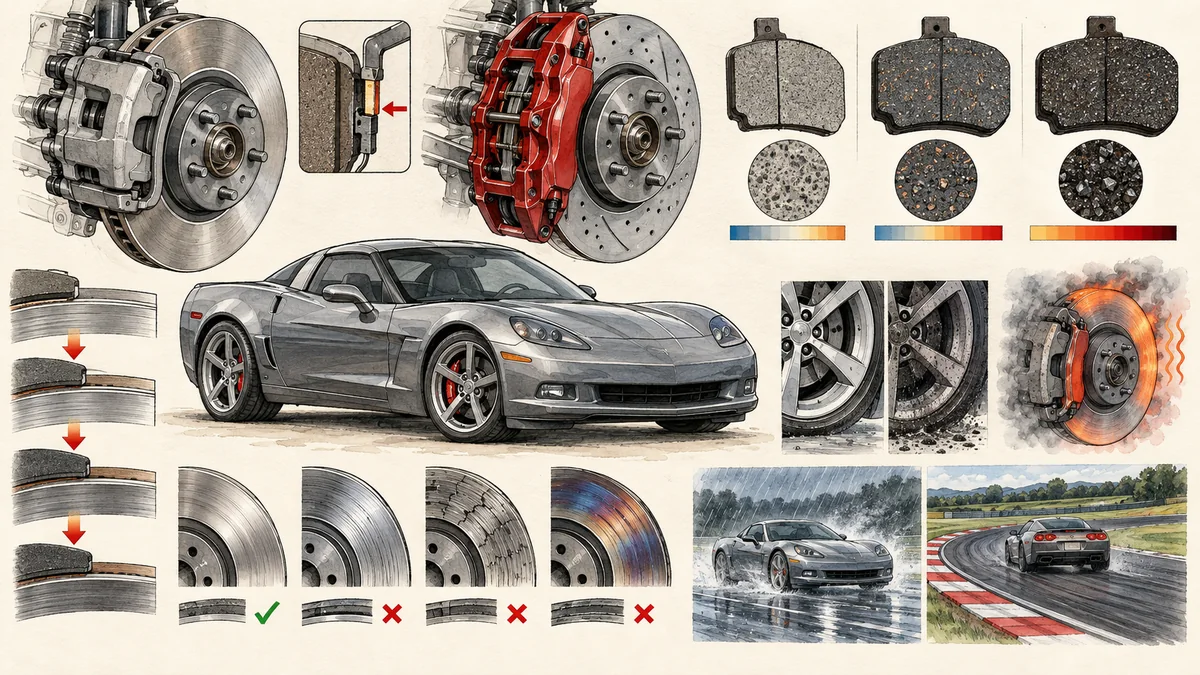
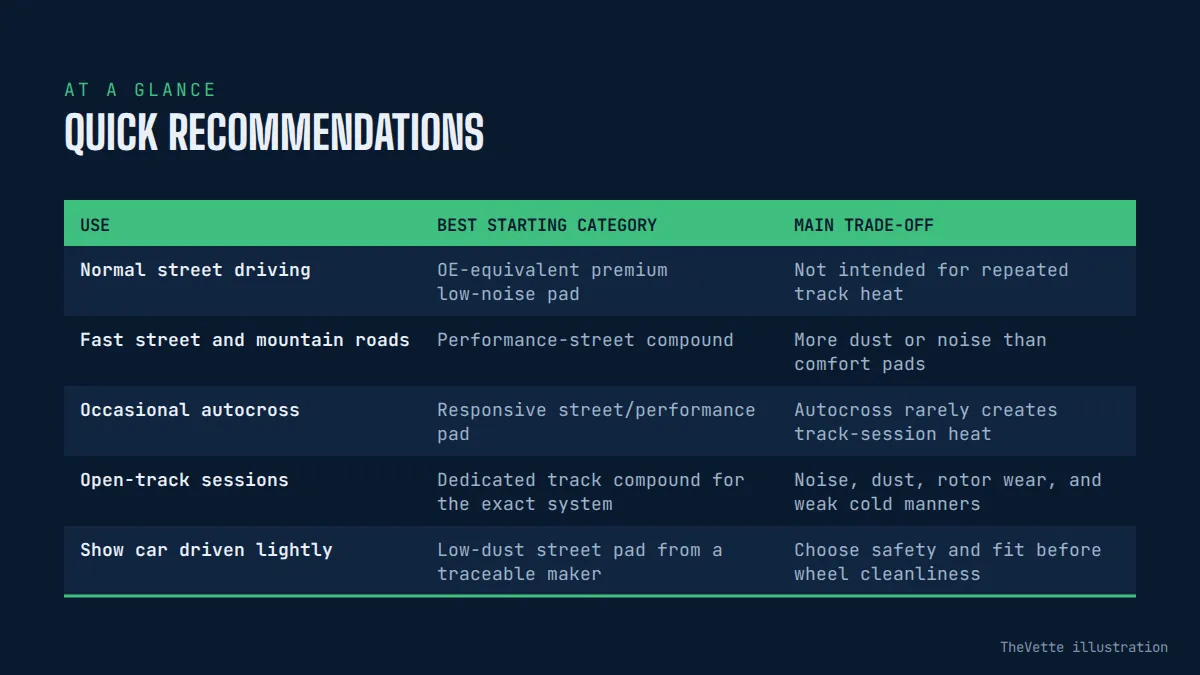
Quick recommendations
| Use | Best starting category | Main trade-off |
|---|---|---|
| Normal street driving | OE-equivalent premium low-noise pad | Not intended for repeated track heat |
| Fast street and mountain roads | Performance-street compound | More dust or noise than comfort pads |
| Occasional autocross | Responsive street/performance pad | Autocross rarely creates track-session heat |
| Open-track sessions | Dedicated track compound for the exact system | Noise, dust, rotor wear, and weak cold manners |
| Show car driven lightly | Low-dust street pad from a traceable maker | Choose safety and fit before wheel cleanliness |

Identify the brakes, not just the model
The C6 generation covers very different performance levels. Confirm year, trim, option codes, front and rear calipers, rotor dimensions and construction, and any previous brake conversion. Use the VIN, build documentation, physical inspection, and the pad maker’s full application notes together.
A catalog can contain several pad shapes for one apparent vehicle. Brembo’s C6 application data, for example, separates standard and reinforced brake configurations and identifies different front and rear FMSI references. Its Z06 listing also distinguishes J56 applications. Those details demonstrate why a marketplace title that simply says “fits C6” is inadequate.
Never assume the front and rear use the same family or that a Z06 part fits a base car. Measure only as a cross-check; pad outline, ears, abutments, backing-plate thickness, wear indicator, and caliper interface all matter.
Best daily-driver category
For a street C6 that is not taken onto a road course, a premium OE-equivalent pad is the sensible baseline. Look for predictable cold response, stable pedal feel, controlled noise, compatible shims and hardware, reasonable dust, and documentation for the exact caliper. A ceramic-style formulation is often selected for cleanliness and quiet behavior, but “ceramic” is a broad label rather than one universal recipe.
Street pads operate through rain, cold mornings, short trips, traffic, and occasional hard stops. Their ability to work immediately matters more than surviving temperatures the car never reaches. Do not sacrifice dependable cold braking for a racing label.
Performance-street pads
A performance-street compound can give stronger initial response and greater resistance to heat during enthusiastic road use. The costs may include more visible dust, occasional squeal, faster rotor wear, and a narrower comfort window. Manufacturer temperature descriptions should be read as system guidance, not as a promise of stopping distance.
Choose this category when the stock-style pad repeatedly feels inconsistent during lawful demanding use after the entire brake system has been verified. A soft pedal, old fluid, sticking caliper, contaminated surface, damaged rotor, or poor tire cannot be repaired by a more aggressive friction material.
Track pads are separate equipment
Repeated road-course braking creates far more heat than street driving or a short autocross run. A dedicated track pad is engineered to remain stable in that environment, but it may perform poorly when cold, generate substantial dust and noise, wear rotors quickly, and leave corrosive deposits on wheels.
Some owners change pads for events and restore street pads afterward. That requires a compatible plan for rotors and transferred friction layers. Mixing compounds without guidance can create uneven deposits, vibration, or unpredictable behavior. Ask both pad manufacturers whether the compounds can share a rotor and what cleaning or re-bedding they require.
A track pad does not make a road car track-ready by itself. Fluid condition, boiling point, hoses, calipers, rotor thickness and cracking, cooling, tires, wheel torque, stability systems, and driver instruction all remain critical. Follow the event organizer’s inspection rules and the Corvette track-day preparation guide.
Understanding friction claims
Initial bite describes the early response as pedal pressure begins. Modulation is the ability to vary brake force smoothly. Fade resistance concerns performance as temperature rises. Release behavior affects how easily the driver comes off the brake. These qualities matter together; the strongest initial bite is not automatically the best street feel.
Coefficient-of-friction graphs are useful only when test conditions are stated. Compare the cold range, working range, maximum range, wear, and intended vehicle type rather than one peak number. A compound that becomes effective only at racing temperature is inappropriate for a rainy commute.
Pad material categories
Non-asbestos organic-style formulations can emphasize smooth, quiet operation but vary widely in heat capability and wear. Semi-metallic compounds often offer firm response and heat tolerance with additional dust, noise, or rotor wear. Ceramic-style street compounds are commonly marketed for clean and quiet use but still differ by manufacturer.
Motorsport compounds use proprietary blends selected for temperature stability and control. The marketing family name is less important than the exact compound code and its documented application. Never use appearance or pad color to identify friction material.
Rotor condition decides whether pads can work
Inspect both rotor faces for thickness, runout symptoms, cracks, heavy scoring, heat checking, grooving, corrosion, and uneven deposits. Compare measurements to current service specifications. A new pad cannot restore a rotor below minimum thickness or correct a mechanical runout problem.
Drilled rotors deserve close inspection around every hole. Fine cosmetic marks and structural cracks are not the same, but uncertainty on a safety component warrants professional assessment. Two-piece and carbon-ceramic systems require procedures and limits specific to those assemblies.
Do not machine or replace rotors automatically based only on a steering-wheel vibration. Hub corrosion, uneven wheel-nut tightening, deposits, bearing play, or tire issues can overlap. Diagnose the cause before purchasing parts.
Electronic and acoustic wear indicators
The 2013 Corvette owner manual states that vehicles equipped with electronic brake-pad wear sensors display a change-pad message when the pads are worn. Other pad applications may use an acoustic indicator. Confirm what the exact car requires and whether the replacement set includes or accepts the correct sensor and hardware.
A dashboard message is not a substitute for physical inspection. Pad wear can be uneven between inner and outer positions or from side to side when a caliper, piston, abutment, or guide mechanism does not move correctly. Inspect every pad on the axle.
Noise, dust, and wheel finish
Squeal can result from friction characteristics, vibration, missing shims, incorrect hardware, contamination, glazed surfaces, poor bedding, rotor condition, or caliper issues. Do not put lubricant on the friction face. Use only the maker-approved product in the exact non-friction locations identified by the service procedure.
Track-oriented dust can become difficult to remove after heat and moisture. Clean wheels after events using products compatible with the finish and brake maker’s instructions. A low-dust pad is convenient, but it should never be chosen if it lacks the temperature capacity for the actual use.
Brake fluid and pedal feel
Brake fluid absorbs moisture over time, lowering its resistance to vapor formation under heat. A long or soft pedal during demanding use may be a fluid or hydraulic problem rather than pad fade. Use only the fluid specification required by the owner and service information; do not mix incompatible types.
High boiling-point fluid still needs an appropriate change schedule and careful bleeding. Inspect hoses, hard lines, calipers, bleeders, master cylinder behavior, and leaks. If the red brake warning appears or fluid is low, stop treating the issue as a pad-shopping problem and have the system serviced.
Bedding and transfer layer
Bedding mates the pad and rotor surfaces and establishes a controlled friction layer. Follow the exact pad manufacturer’s sequence in a safe legal location. Generic instructions can overheat a street pad or fail to condition a track compound.
Begin only after proper installation and system checks. Perform the specified series of controlled stops without coming to rest with very hot pads clamped in one spot, then provide the required cooling. Smoke, severe vibration, fluid symptoms, pulling, or abnormal noise should end the process for inspection.
Installation safety
Brakes are safety-critical. Support the vehicle at approved lift points with rated equipment and never rely on a jack alone. Protect paint from brake fluid, control dust without compressed-air exposure, and use correct protective equipment. Follow current service information for caliper handling, piston retraction, fasteners, thread treatment, sensor routing, and torque.
Do not let a caliper hang by its hose. Inspect boots, seals, pistons, abutments, hardware, lines, and hoses. Replace pads across the complete axle, not on one wheel alone. Confirm free wheel rotation and a firm pedal before moving the vehicle.
Chevrolet’s 2009 manual warns that improper wheel-nut tightening can contribute to brake pulsation and rotor damage. Use clean, undamaged hardware, the specified dry-thread condition, a calibrated torque wrench, and the prescribed crisscross sequence.
What to inspect after the first drives
Recheck the job after the manufacturer’s bedding and cooling process. Look through both front wheels for similar rotor contact patterns, confirm that no hose or sensor lead is rubbing, and inspect the floor and calipers for any fluid. A mild new-pad odor can occur during conditioning, but persistent smoke, pulling, grinding, a sinking pedal, or a wheel that becomes much hotter than its partner requires an immediate stop and inspection.
Listen at low speed with the windows open, then verify normal ABS and stability-system operation only in safe ordinary driving. Do not attempt an emergency-stop “test” on public roads. After wheels have been removed, follow the service information for any specified torque recheck. Keep the pad box, compound code, purchase receipt, installation date, mileage, rotor measurements, and fluid record; those details make the next inspection far more useful.
Comparison checklist
| Field | Evidence required |
|---|---|
| Fit | Year, trim, option code, caliper, axle, FMSI or verified application |
| Use | Street, autocross, time trial, or sustained road-course duty |
| Temperature | Documented cold and working behavior |
| Hardware | Shims, sensor provision, clips, and fitting instructions |
| Companion parts | Rotor material and condition, fluid, caliper requirements |
| Ownership | Noise, dust, wheel care, rotor wear, warranty, support |
Common mistakes
Do not buy by generation alone, confuse Z06 and base hardware, select a race pad for street image, reuse damaged hardware, ignore inner-pad wear, lubricate friction surfaces, mix compounds without a rotor plan, or bed pads on public roads. Avoid promising shorter stops from pads alone; tires, ABS, surface, temperature, and driver input shape the result.
Other errors include pushing contaminated fluid backward without considering service procedure, damaging sensor wiring, twisting hoses, using an impact tool as final wheel torque, and driving before the pedal is firm. If any step is uncertain, use a qualified Corvette brake technician.
Frequently asked questions
Are all C6 Corvette brake pads the same?
No. Brake package, trim, option code, axle, and prior conversions can change the pad. Verify the physical system and a manufacturer’s exact application.
Are ceramic pads best for a C6?
They can be a good low-dust, low-noise street choice, but the label covers different formulas. They are not automatically suitable for repeated track temperatures.
Can I use track pads on the street?
Some are not designed to provide their intended behavior when cold and can be noisy, dusty, and hard on rotors. Use the compound maker’s explicit road guidance.
Should rotors be replaced with every pad change?
Not automatically. Measure and inspect them against service limits and consider surface compatibility. Replace any rotor that is unsafe or outside specification.
Why do new pads vibrate?
Uneven deposits, runout, improper wheel torque, hub corrosion, rotor condition, caliper faults, or poor bedding can contribute. Diagnose rather than repeatedly replacing pads.
Final recommendation
For most road-driven C6 Corvettes, select a premium OE-equivalent or performance-street pad from a traceable manufacturer after verifying the exact brake package. Prioritize cold response, modulation, hardware compatibility, rotor condition, and predictable behavior over the most aggressive marketing claim.
For road-course use, choose a dedicated compound with published temperature guidance and build a complete preparation plan around rotors, fluid, calipers, cooling, tires, inspection, and bedding. The right brake pad is not a universal winner; it is the correct friction material for the exact C6 hardware and heat it will truly encounter.