Corvette insurance is a contract question before it is a price question. Two policies carrying the same premium, deductible, and “full coverage” description can value the car differently, restrict use differently, choose repair parts differently, and respond differently to track activity, modifications, storage, transport, or a total loss. Only the issued forms, declarations, endorsements, exclusions, and applicable law control.
To place Corvette Insurance: Agreed Value, Usage, and Questions to Ask in a wider ownership and engineering context, continue with How Originality, Documentation, and Condition Affect Corvette Value.
This guide is an educational interview checklist, not legal, insurance, or financial advice. Terms vary by jurisdiction and insurer. Ask a licensed professional to explain the exact language in writing, read every document, and contact the state insurance regulator when rights or licensing are unclear.
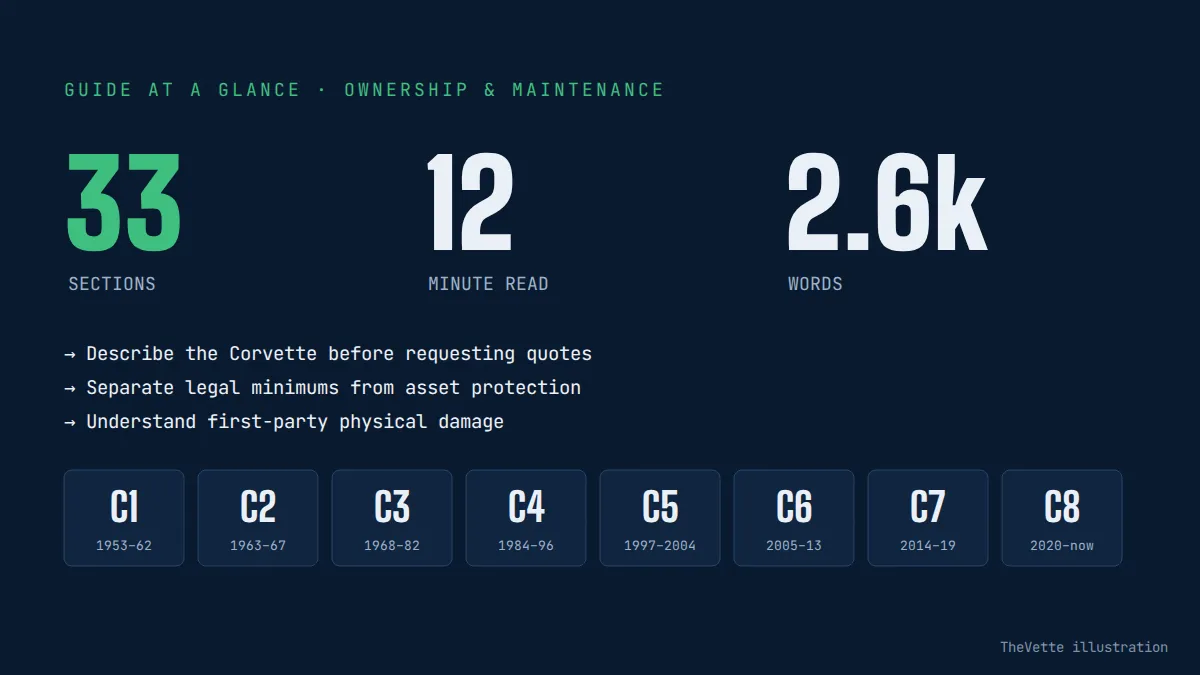
Describe the Corvette before requesting quotes
Record VIN, year, trim, mileage, purchase price, lien, garaging address, annual use, drivers, modifications, restoration, safety equipment, and current photographs. A C4 commuter, low-mileage C2, modified C7 Z06, and financed C8 E-Ray present different values and risks.
Disclose truthfully. An inaccurate address, undisclosed youthful driver, hidden business use, or unreported power modification can create underwriting or claim disputes. Ask which facts must be updated during the term and how quickly.
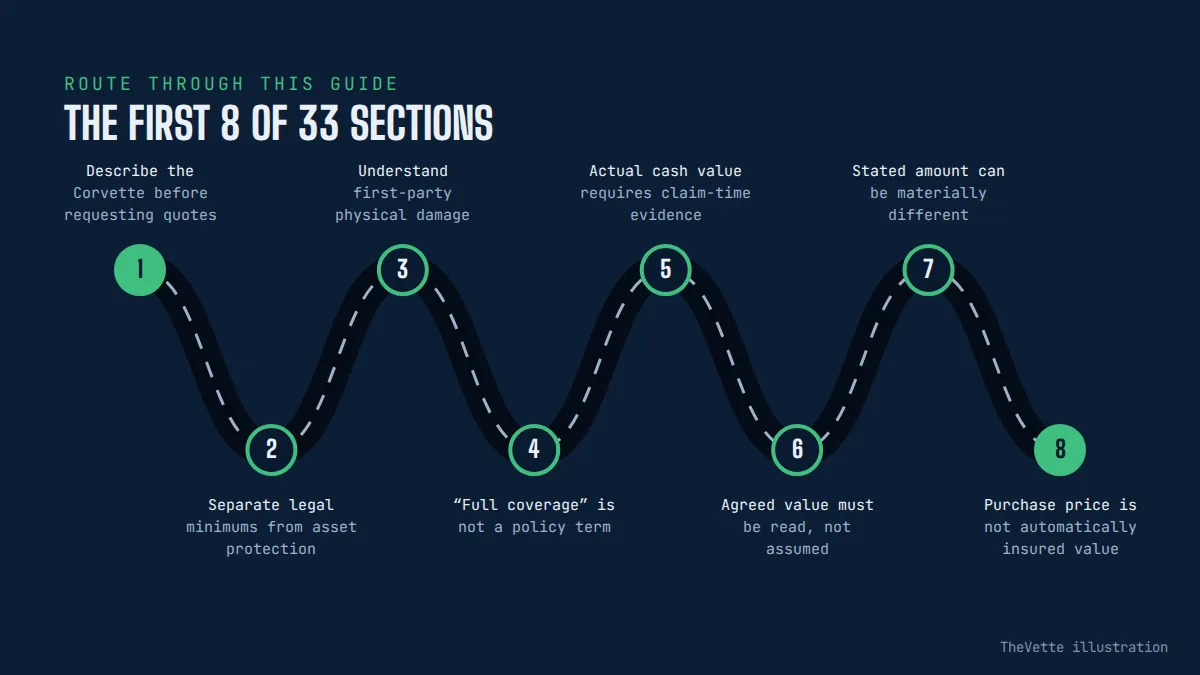
Separate legal minimums from asset protection
Most jurisdictions require specified liability or financial responsibility, but minimum limits may be far below the cost of a serious crash. Liability pays covered injury or property damage owed to others, subject to terms and limits; it does not repair the policyholder's Corvette.
Review bodily injury, property damage, defense, household-driver rules, and umbrella compatibility with a licensed adviser. Limits should reflect the owner's exposure, not the car's market value alone. Confirm whether state rules use split or combined limits.
Understand first-party physical damage
Collision generally addresses covered damage from impact or rollover, while comprehensive—sometimes called other-than-collision—can address listed or broadly defined causes such as theft, fire, weather, vandalism, flood, animals, or glass. NAIC consumer guidance treats these as optional physical-damage coverages, though a lender may require them.
Names are summaries, not guarantees. Read perils, exclusions, limits, deductibles, appraisal, duties after loss, and settlement language. Ask how track paddock damage, falling objects in storage, rodent wiring, transport, and water intrusion are classified.
“Full coverage” is not a policy term
Agents and drivers may use the phrase for liability plus collision and comprehensive, but it does not identify limits, exclusions, valuation, medical coverage, uninsured motorists, roadside assistance, rental, accessories, or gap. No policy covers every event.
Compare declarations and forms line by line. Request a specimen policy before binding if available, then compare the issued contract. Save the quote assumptions; a price screen is not proof of coverage.
Actual cash value requires claim-time evidence
Standard auto physical-damage policies commonly limit a total loss by actual cash value or repair cost. NAIC explains that an insurer may total an older car and pay what it was worth rather than repair it. The method, comparable vehicles, condition adjustments, tax, fees, and dispute rights depend on contract and jurisdiction.
A price guide is evidence, not necessarily the answer. Corvette options, originality, provenance, transmission, color, documentation, mileage, modifications, and regional market can matter. Maintain dated photographs, build information, invoices, appraisals, and comparable sales before a loss.
Agreed value must be read, not assumed
A valued or agreed-value arrangement may establish an amount in advance. California's insurance glossary describes agreed value as a listed amount between insured and insurer, often supported by appraisal for classic autos. Other jurisdictions and forms may define or limit it differently.
Ask whether a covered total loss pays the full scheduled amount, whether deductible applies, and whether provisions for depreciation, coinsurance, market value, salvage, fraud, partial loss, or overinsurance modify the result. The label on a brochure cannot replace the settlement clause.
Stated amount can be materially different
A stated or scheduled amount may function as a maximum while allowing payment of a lower actual value, depending on wording. Do not infer “the number we stated is guaranteed.” Ask the producer to show the operative limit-of-liability provision and explain it with a total-loss example.
Retain the written explanation, but remember the contract controls. If the answer is unclear, compare a true valued form or seek independent professional review. Revisit the amount annually as Corvette markets move.
Purchase price is not automatically insured value
A favorable private purchase does not cap market value, and an emotional or debt-heavy purchase does not force an insurer to pay that amount. Taxes, buyer fees, restoration labor, and modifications may not translate dollar-for-dollar into claim value.
Provide verifiable market evidence and select coverage designed for the car's current status. For a project, ask how value increases during restoration and whether monthly reporting, photographs, or endorsement changes are required.
Gap coverage protects debt, not collectibility
If a financed Corvette is worth less than its loan balance after a total loss, ordinary physical-damage settlement may leave a shortfall. Gap products can address certain differences, subject to eligibility, exclusions, cancellation, deductible, loan terms, and maximums.
Gap does not make the car agreed value and may exclude negative equity, overdue payments, accessories, warranties, or lease charges. Compare lender, dealer, and insurer offerings and understand refunds on early payoff.
Collector eligibility often limits use
Specialty policies may require another regular-use vehicle, secure enclosed storage, licensed experienced drivers, limited annual mileage, club or pleasure use, and acceptable condition. Some allow occasional commuting; others do not. “Unlimited mileage” may still restrict purpose.
Describe shows, tours, errands, vacations, work, school, weddings, rentals, rideshare, social media production, and business display. Ask whether anyone may drive and what happens if the everyday car is unavailable. Choose a form that fits actual behavior rather than changing behavior only on the application.
Mileage limits need an audit method
Determine whether the term is a hard cap, rating estimate, tier, or annual average. Ask how odometer readings are collected, whether transport miles count, and what happens after an unexpected trip. Record beginning and ending mileage.
Low mileage does not guarantee low risk, and exceeding a representation can matter. Notify the insurer before use materially changes and obtain the endorsement or confirmation in writing.
Storage conditions may be warranties
Collector insurers often ask for a fully enclosed locked structure. Clarify detached garage, shared condominium facility, commercial storage, temporary hotel parking, trailer, driveway loading, and overnight travel. Alarm, fire suppression, gate, flood zone, and access may affect underwriting.
Give the correct garaging address and notify a move. Ask whether storage photographs or facility contracts are required. Coverage for a hurricane evacuation or temporary repair shop should be understood before the car leaves its normal location.
Every potential driver must be discussed
Policies can name, rate, exclude, or restrict household members, youthful drivers, employees, mechanics, valet attendants, and permissive users. A spouse listed on another policy is not automatically covered to drive the Corvette.
Ask about occasional lending, test drives during sale, instructor driving at an event, and transport loading. Review license, experience, and territorial requirements. Never let an excluded driver “just move it.”
Modifications require specific scheduling
Wheels, engine work, forced induction, exhaust, paint, protection film, audio, suspension, aero, data equipment, and safety gear may exceed a standard custom-equipment sublimit or affect acceptability. Declaring a total build cost does not prove every part is covered.
Submit invoices, photographs, specifications, and professional appraisal if requested. Ask about emissions or illegal modifications, mechanical breakdown, wear, faulty workmanship, and damage caused by an installed part. Update after each significant change.
Spare parts and memorabilia are separate property
Original wheels, hardtops, take-off exhaust, documentation, tools, trophies, and parts stored away from the car may have limited or no auto-policy coverage. Homeowners coverage can also restrict motor-vehicle parts or business property.
Ask where parts must be stored, whether theft from a trailer or shop is covered, what inventory and valuation are required, and whether a separate schedule is available. Photograph serial numbers and preserve purchase records.
Repair-part language affects authenticity
A policy may permit original-equipment, aftermarket, reconditioned, recycled, or used parts subject to law and availability. Older Corvette components may be unavailable, while later aluminum, carbon-fiber, electronics, and bonded structures need specialized methods.
Ask whether an OEM-parts endorsement exists, how discontinued parts are handled, who pays shipping and fabrication, and whether betterment or depreciation applies. “Like kind and quality” needs a practical explanation for date-coded glass, original castings, rare trim, and carbon wheels.
Repair-shop choice is jurisdiction-sensitive
Owners may have rights to choose a repairer, while insurers may recommend networks and negotiate labor or procedure. Confirm applicable state rules and policy duties. A Corvette-certified or restoration specialist may charge rates and use processes different from a volume collision shop.
Before a loss, identify facilities capable of frame measurement, aluminum or composite repair, high-voltage isolation, paint matching, calibration, and secure storage. Ask how disagreement over labor, scans, OEM procedures, or transport is resolved.
Diminished value is not automatic
A properly repaired Corvette can still sell for less because of recorded damage. Whether diminished value is recoverable depends on first- or third-party claim, policy language, fault, state law, proof, and exclusions. Insurance Information Institute notes substantial state and contract variation.
Preserve pre-loss condition, repair file, measurements, photographs, market evidence, and independent appraisal. Do not accept a generic percentage as universal or assume physical-damage coverage includes it.
Track exclusions must be examined broadly
Policies may exclude racing, speed contests, timed events, preparation, practice, instruction, driving on a surface designed for racing, or any closed-course use. Calling an event “education” does not override wording. Paddock and transport exposure may also be treated differently.
Send the exact organizer, venue, format, timing, and run group to the insurer and obtain a written response. Dedicated track-day physical-damage policies have their own declared value, deductible, event window, liability exclusions, and claims terms. Ordinary road liability may not follow onto course.
Autocross and parade laps still require answers
Low speed or absence of wheel-to-wheel competition does not guarantee coverage. Definitions may focus on location, timing, competition, or performance intent. Club tours, demonstration runs, driver schools, and charity laps need the same inquiry.
Do not rely on an organizer's waiver or participant accident plan as vehicle coverage. Review each event because one insurer's answer can differ by state and form.
Transport changes custody and coverage
Open or enclosed carrier, personal trailer, broker, towing company, ferry, and international shipment create different exposures. Auto coverage, carrier cargo/legal liability, trailer coverage, and homeowners property coverage can leave gaps.
Verify carrier authority, insurance certificate directly with the insurer, limits per vehicle and load, deductible, exclusions, subcontracting, storage, loading damage, diminished value, and claims venue. Photograph every panel and odometer at handoff and note the bill of lading.
Roadside assistance must fit a low car
Standard towing limits may not cover a distant specialist or enclosed transport. Ask about flatbed requirements, mileage, extraction, tire service for staggered run-flats, lockout, lost keys, and reimbursement. C8 transmission and tow-eye procedures require informed handling.
Keep the owner-manual recovery section and provider numbers accessible. Never authorize unsafe hooks or wheel lifting merely because dispatch says it is covered. Insurance payment does not make a recovery method mechanically correct.
Deductibles can be fixed or percentage-based
Collision, comprehensive, glass, windstorm, track, and other causes may carry different deductibles. A percentage of agreed value can be much larger than a familiar fixed amount. Ask whether multiple deductibles apply to one event.
Select an amount affordable without delaying a claim. Compare premium savings against the loss retained. Understand whether deductible is subtracted from total-loss value and how waiver provisions work.
Glass is not simple on every Corvette
Windshields may include head-up-display properties, antennas, coatings, cameras, sensors, or specific acoustic and optical requirements. Replacement can require moldings, adhesives, corrosion repair, and calibration. Older date-marked glass raises originality questions.
Ask about separate glass deductible, OEM part, calibration, mobile installation, water-leak correction, and damage to trim or paint. Save photos and part markings before removal.
Flood and storm exposure need geographic planning
Comprehensive commonly addresses covered flood, hail, falling objects, or wind damage, but exclusions, causation, storage representation, and deductible matter. Track local flood maps and evacuation timing; do not drive through water or enter an unsafe structure to save the car.
After water exposure, avoid starting or energizing the vehicle, especially with high-voltage equipment. Photograph safely, notify the insurer, and obtain trained handling. Hidden contamination can affect wiring, bearings, restraints, fluids, and cabin materials.
Claims duties begin immediately
Policies require prompt notice, protection from further damage, cooperation, proof, and sometimes inspection before repair. Call emergency services first when needed, exchange required information, photograph without entering danger, and avoid admitting or negotiating liability at the scene.
Keep receipts for towing and protective measures, preserve damaged parts when allowed, and maintain a communication log. Do not authorize teardown or disposal beyond emergency protection until claim requirements are understood.
A total-loss file should be ready before a loss
Maintain VIN/build record, title, lien status, purchase documents, photographs of every area, odometer, service history, option evidence, judging records, appraisal, restoration invoices, modification receipts, and recent comparable sales. Store copies away from the car.
At claim time, review the insurer's valuation report for correct trim, transmission, options, mileage, condition, taxes, fees, and comparable adjustments. Use appraisal or dispute mechanisms exactly as policy and state law provide; deadlines matter.
Salvage retention has consequences
After total-loss payment, the insurer may take title and salvage value. Retaining the Corvette can reduce settlement and trigger branded-title, inspection, financing, registration, warranty, and future-insurance issues. Hazardous battery or structural damage can make storage unsafe.
Obtain the buyback amount, title process, permitted repair, parts availability, and future coverage in writing before deciding. Emotional attachment should not replace a structural and financial assessment.
Rental and loss-of-use coverage has limits
Rental reimbursement usually requires a purchased coverage and may have daily and total maximums. A long specialty repair can exceed both. A similar-performance replacement is rarely guaranteed.
Ask when payment begins and ends, whether total loss ends rental at offer, and whether transportation or rideshare is reimbursable. Third-party claims follow different law and liability facts.
International and territorial use can stop at a border
Policies define territory and may provide limited extension into Canada or Mexico only through required endorsements or separate coverage. Shipping, foreign registration, roadside assistance, and liability proof have additional rules.
Discuss every country and transit route before travel. Obtain required cards and local policies from authorized sources. A domestic ID card is not universal proof.
Business and social-media use should be disclosed
Paid rentals, weddings, brand promotions, filming, delivery, client transport, dealer activity, and monetized experiences can fall outside personal or collector use. Even occasional compensation may matter.
Explain who pays, who drives, where the car appears, and whether equipment is carried. Commercial coverage and contracts may be necessary. Do not assume a hobby channel makes every use personal.
Review the policy at least annually
Corvette values, modifications, mileage, drivers, address, storage, lender, and use change. Ask for an updated valuation and endorsements before renewal. Compare insurer financial and complaint information through the state regulator, not price alone.
Read renewal changes; forms and exclusions can change even when the company name stays. Keep evidence of payment and effective dates. Avoid any lapse, especially while the car remains registered or financed.
Use a written quote comparison
For each insurer, list legal entity, policy form, valuation clause, amount, deductibles, liability and uninsured limits, drivers, mileage, uses, storage, parts, shop choice, modifications, spares, roadside, rental, transport, territory, track language, cancellation, and claims contact. Mark every unanswered item.
Then choose the contract whose permitted use and loss settlement fit the actual Corvette. A low premium is not a saving if the policy excludes the way the car is driven or values it as an ordinary used vehicle. The best insurance decision begins with honest disclosure and ends with language you can point to—not a promise remembered from a phone call.