Corvette value is the price a particular buyer and seller can support for a particular car, at a particular time, under particular conditions. Originality, documentation, and condition influence that price, but none acts as a universal multiplier. A preserved base car, restored fuel-injected classic, modified track build, and delivery-mile modern special edition appeal to different buyers and require different comparable evidence.
To place How Originality, Documentation, and Condition Affect Corvette Value in a wider ownership and engineering context, continue with Corvette Insurance: Agreed Value, Usage, and Questions to Ask.
The disciplined approach begins by defining every claim. “Original,” “numbers matching,” “correct,” “survivor,” “restored,” and “concours” are not interchangeable. This guide explains the evidence behind them without appraising a vehicle, predicting returns, or treating an auction headline as a market index.
Identity comes before value
Record VIN, model year, assembly location, body style, trim, engine, transmission, axle, options, colors, market, and production timing. Decode only with sources appropriate to that year. Corvette identifiers moved and formats changed; a modern online decoder may omit exceptions.
Compare title, registration, frame or chassis stamping where applicable, body tags, labels, service records, and physical equipment. Differences do not automatically prove fraud, but they require explanation. Never alter, clean aggressively, or restamp an identifier.
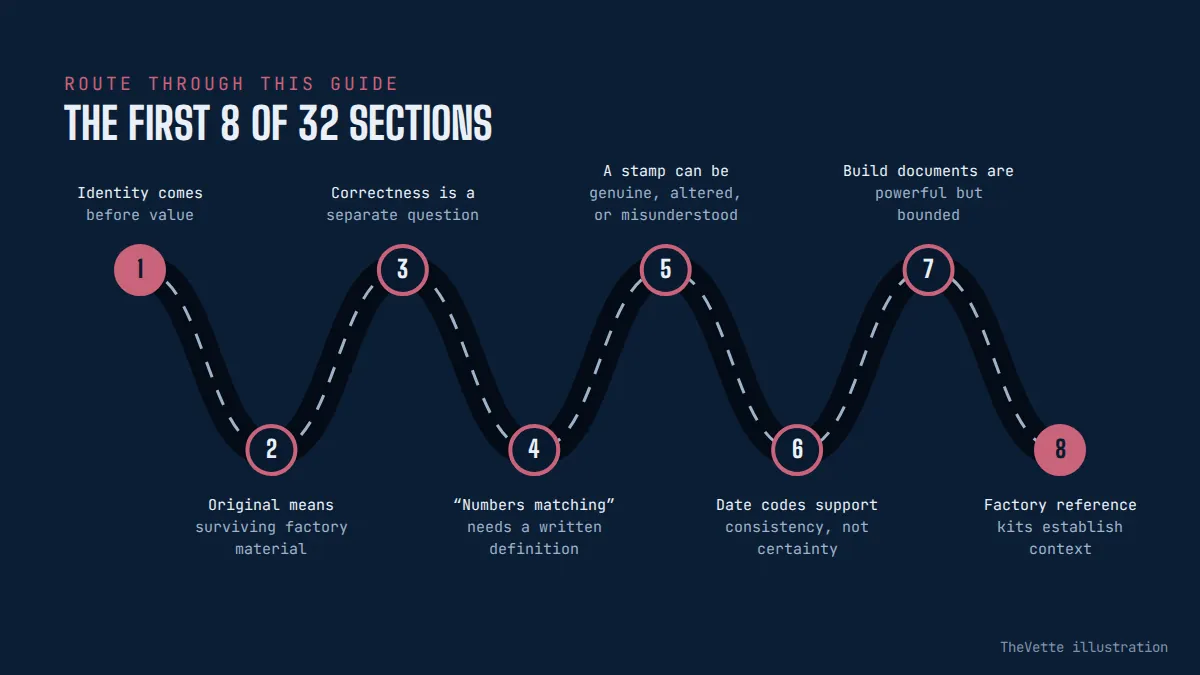
Original means surviving factory material
In its strictest useful sense, an original part is the component installed during production. A correct service replacement may match specification but is not that same piece. A reproduction may look correct yet have different materials or markings. A restored original has received repair or finish while retaining some factory material.
State the scope: original body panels, original paint on selected areas, original drivetrain, or original interior. Claiming “all original” after ordinary decades of tires, battery, belts, exhaust, paint repair, and maintenance invites misunderstanding.
Correctness is a separate question
A component is correct when it conforms to the expected type, configuration, date range, finish, and installation for the judged standard or vehicle. It may be new old stock, reproduction, restored, or sourced from another car. Correctness can improve visual and functional fidelity without creating original provenance.
Year-specific judging guides matter because fasteners, hoses, casting details, labels, and finishes changed during production. Avoid applying one famous restoration recipe to an entire generation.
“Numbers matching” needs a written definition
Sellers use the phrase for original engine, for engine and transmission, or merely for codes appropriate to the model. Ask which stampings and castings were inspected, who inspected them, and what “match” means. A casting number compatible with a year is not proof that the part was installed in one VIN.
Document location, characters, date, surface texture, casting, assembly code, and relationship to vehicle production. Photographs should show context and scale, not just a cropped row of digits. Obtain expert review before purchase.
A stamp can be genuine, altered, or misunderstood
Factory stamping varied in depth, alignment, broach surface, tooling, and human execution. Decking during engine rebuilding can remove or weaken marks. Replacement blocks may carry authorized or different identification. Corrosion and cleaning can change appearance.
Do not declare a restamp from typography alone or accept a fresh stamp because its code decodes correctly. Evaluate metal surface, dates, casting, configuration, history, machine work, and comparison material together. Preserve high-resolution images and the expert's reasoning.
Date codes support consistency, not certainty
Castings, glass, wheels, alternators, carburetors, distributors, and other parts can carry dates. A plausible sequence relative to assembly supports a narrative, but supplier lead times, service stock, production variation, and previous replacement complicate it.
A perfectly clustered set of codes on a heavily restored car may reflect careful sourcing rather than factory survival. Describe it as date-correct unless original installation is supported independently.
Build documents are powerful but bounded
Window stickers, dealer invoices, build sheets, tank stickers, Protect-O-Plates, order forms, and shipping records can establish configuration and ownership history. GM Heritage states that its archive holds certain build documentation and vehicle information, with individual coverage stronger for later production periods.
Not every year or car has recoverable factory records. A document proves what it records, not the current physical state. Compare fonts, paper, aging, sequence, dealer, VIN, options, and provenance; reproductions should be labeled.
Factory reference kits establish context
GM Heritage Vehicle Information Kits include specifications and historical material for many Corvette years. They help verify standard and optional equipment, dimensions, colors, powertrains, and contemporary descriptions. Later manuals, parts catalogs, engineering changes, and judging research add detail.
A sales brochure may describe availability but not prove that one car received an option. Use multiple independent sources and retain page citations. Historical literature can contain preliminary or marketing information that changed before production.
Ownership history is provenance
A chain of titles, registrations, bills of sale, dated photographs, correspondence, show entries, service invoices, and personal records connects the Corvette through time. Continuous evidence can support mileage, configuration, repairs, and significant events.
Stories from prior owners are valuable leads but should be labeled oral history until corroborated. Interview respectfully, preserve dates and contact permission, and scan originals. Do not publish personal addresses or sensitive documents without consent.
Mileage needs more than an odometer
Mechanical odometers can roll over, fail, or be replaced; digital clusters can also be replaced or programmed. “Actual miles” should rest on chronological service, title, inspection, registration, and condition evidence. Some titles use exempt or not-actual brands.
Read the title and disclosure law in the jurisdiction. Describe “miles displayed” when proof is incomplete. Pedal, seat, carpet, steering, hinge, underbody, and mechanical wear can test consistency but cannot calculate exact mileage.
Condition is a system, not a shine score
Evaluate structure, body, paint, trim, glass, weather seals, chassis, suspension, steering, brakes, wheels, tires, engine, fuel, cooling, exhaust, transmission, differential, electrical, cabin, top, and documentation. Separate safety, function, cosmetic presentation, and authenticity.
A deep finish can hide collision repair, corrosion, delamination, or poor gaps. A dusty preserved car may contain more historical material. Inspection should use lifts, lighting, measurements, scans, and qualified specialists without damaging fragile surfaces.
Fiberglass changes the inspection language
Corvette composite bodies can show stress cracks, repairs, delamination, print-through, shrinkage, waves, bonding-strip work, panel replacement, and altered seams. Later composite types and manufacturing differ from early fiberglass. Magnet tests designed for steel bodies have limited relevance.
Use reflected light, panel underside access, tap or imaging techniques only when qualified, paint-thickness tools suited to substrate, and knowledge of factory construction. Fresh paint does not reveal the quality of hidden laminate.
Collision history has degrees
A bolt-on panel replacement, correctly repaired composite skin, straightened structural rail, and reconstructed salvage car are not equivalent. Ask what was damaged, which procedures and fixtures were used, what parts were installed, who performed work, and whether measurements exist.
Inspect alignment points, welds, adhesives, fasteners, overspray, seams, suspension pickups, airbag systems, and electronic calibration. Title brands matter but a clear title does not prove no damage. Value impact depends on quality, disclosure, rarity, and buyer segment.
Preservation and restoration serve different goals
Preservation retains aged factory material and evidence even when imperfect. Restoration renews finish and function toward a chosen historical state. Over-restoration can erase assembly marks, textures, seams, and evidence. Under-restoration can leave unsafe systems.
Before disassembly, photograph every surface, label and bag parts, record fasteners and finishes, and decide which material deserves conservation. Preserve removed original components. The best choice depends on significance and condition, not a blanket rule that untouched is always superior.
Restoration cost rarely equals market gain
Labor, parts research, paint, chrome, machining, upholstery, and specialist work can exceed the finished value. Invoices establish spending and procedure, not a dollar-for-dollar increase. Personal taste or rework also may have little transferable worth.
Create a budget from the target standard, base-car needs, hidden-risk reserve, and comparable completed vehicles. Buying a finished car can be cheaper; restoring the known family car can still be rational for emotional or historical reasons.
Judging awards are defined achievements
Organizations judge under their own manuals, classes, dates, deductions, and eligibility. NCRS identifies a year-specific Technical Information Manual and Judging Guide for originality areas and offers structured evaluations by members. Other concours may emphasize condition, design, preservation, or historical importance differently.
Record organization, award, score, event, date, class, configuration, and judging sheets. An award does not freeze condition forever or certify title, value, hidden structure, or every marketing claim. Verify it with the issuing body when important.
Concours does not have one universal meaning
In casual advertising, concours can mean exceptionally clean. In formal events, it refers to a specific standard and class. A car prepared for visual condition judging may not be factory-original; an originality-focused car may show accepted age.
Replace the adjective with evidence: named award, score, date, judging system, and current inspection. Never price an undocumented “concours restoration” from the word alone.
Modifications can add utility while narrowing buyers
Brakes, cooling, fuel injection, steering, tires, seats, audio, suspension, or power can make a Corvette more usable. Value depends on engineering, legality, documentation, reversibility, workmanship, brand, and the buyer's mission. Peak horsepower is not the same as quality.
Keep original parts and calibrations, use non-destructive mounting, and photograph changes. Disclose emissions, safety, body cutting, track use, and compatibility. A reversible period modification may be viewed differently from a poorly integrated modern conversion.
Resto-mods form their own market
A professionally engineered car with modern chassis, powertrain, brakes, climate control, and custom body can command substantial money, but comparisons should be with similar builders and specifications rather than restored originals. Builder reputation and post-sale support matter.
Inspect structure, wiring, fuel system, thermal management, geometry, software, parts availability, emissions, and title. Construction cost may be high while resale remains taste-sensitive. Verify serial numbers and intellectual-property representations.
Rarity begins with a defined denominator
A color may be rare across total production, common within one trim, or undocumented in surviving population. Option totals do not reveal how options were combined. “One of one” often comes from an unofficial registry or narrowly filtered database.
Ask who compiled the data, which records survive, what population and variables were used, and whether combinations were factory installed. Rarity can support interest but does not rescue undesirable specification or poor condition.
Desirability is not identical to rarity
Buyers may pay more for a common high-performance engine, preferred transmission, iconic color, or documented race history than for a scarce but less desired combination. Market depth matters: one enthusiastic buyer can create an auction result without establishing broad demand.
Analyze repeated transactions and asking-to-sale behavior across time. Separate option rarity, model significance, aesthetic taste, drivability, and historical narrative rather than adding arbitrary premiums.
Comparable sales need adjustment
Use recent arm's-length sales of the same year range, trim, body style, engine, transmission, condition, originality, documentation, mileage, and location. Note auction fees, online buyer premiums, taxes, seller commission, reserve, transport, and whether the result actually closed.
Adjust carefully for differences and show reasoning. An asking price is not a sale. A record result may reflect charity, celebrity, first-production status, or two determined bidders. One outlier should not anchor an ordinary car.
Venue changes the observed price
Specialist auction, general auction, dealer, private sale, club network, and online platform attract different buyers and provide different inspection, warranties, time pressure, fees, and presentation. A no-reserve sale transfers risk differently from a patient private listing.
When building comparisons, record date, venue, seller type, disclosures, bid count, reserve, and post-sale status. Market conditions can change between seasons, interest rates, and generational taste.
Appraisal purpose determines value definition
Insurance scheduling, financing, estate, tax donation, divorce, damage, sale, and internal planning can require different effective dates and value concepts. A report prepared for agreed-value insurance may not satisfy a tax authority or court.
The Appraisal Foundation publishes USPAP across personal-property disciplines. IRS guidance for qualified appraisal emphasizes detailed property description, physical condition, and a qualified appraiser's relevant education and experience. Choose someone competent in the specific Corvette segment and assignment.
An appraisal should expose its reasoning
Expect client and intended use, effective date, value definition, scope, identity, inspection limits, condition, history, sources, comparable analysis, assumptions, photographs, certification, and conclusion. The appraiser should disclose conflicts and extraordinary assumptions.
A one-page certificate with a high number may satisfy neither insurer nor buyer. Review factual errors promptly and keep supporting documents. Update when condition, market, or purpose changes.
Documentation has its own authenticity problem
Reproduction stickers, invoices, stamps, manuals, awards, and build sheets are available. They can complete a display honestly when labeled, but they should not be offered as factory artifacts. Digital files can also lose creation history.
Preserve originals in archival sleeves, scan both sides at high resolution, record source and custody, and avoid laminating or altering. Have significant documents examined by knowledgeable specialists. Consistency with the car is necessary but not sufficient.
Service history supports condition and stewardship
Invoices show dates, mileage, specifications, providers, and recurring issues. They help verify break-in, track use, fluid care, tires, repairs, and modifications. A thick file of cosmetic purchases does not replace structural or mechanical inspection.
Organize chronologically and summarize without discarding originals. Redact personal data in sales copies. Explain gaps rather than inventing continuity.
Photography is a valuation tool
Capture all sides, panel gaps, paint under multiple light angles, glass marks, roof and top, interior, engine compartment, cargo areas, wheels, tires, brakes, suspension, frame or structure, underbody, tags, stampings, casting dates, documents, and flaws. Include scale and location.
Do not enhance away defects. Save original files with metadata and date. Repeat the same views over time to show preservation or restoration progress.
Pre-purchase inspection protects both narratives
Hire specialists independent from seller and broker. Define whether they will authenticate identifiers, assess mechanical safety, measure body and structure, scan electronics, test drive, perform compression or leak-down, and review documents. One technician may not cover every discipline.
Get written observations, photos, limitations, and recommended further tests. Inspection cannot guarantee hidden history, but it converts slogans into evidence. Renegotiate or walk away when a central claim cannot be supported.
Sellers should describe rather than certify casually
Use precise phrases: “engine stamping observed and photographed,” “believed original based on records,” “replacement block,” “repainted in original color,” or “NCRS award earned in 2018.” Attach evidence and disclose uncertainty, damage, title status, and modifications.
Avoid “perfect,” “investment grade,” “never damaged,” or “one of one” without defensible proof. Honest specificity builds more durable value than an exaggerated headline and reduces post-sale conflict.
Tax, estate, and charitable transfers need their own assignment
A family estimate, auction reserve, insurance schedule, and formal tax appraisal serve different users and effective dates. Donation, estate, gift, divorce, or business treatment can trigger statutory definitions, reporting thresholds, retention rules, and independence requirements. Do not recycle a sales appraisal merely because its conclusion is recent.
Tell the appraiser the actual intended use and provide title, ownership interests, restrictions, condition, photographs, prior transactions, and related-party information. IRS qualified-appraisal guidance illustrates the importance of a detailed property description and a practitioner with verifiable education and experience in that property type. Taxpayers should obtain current advice from qualified tax and legal professionals; club judging expertise alone does not establish compliance.
Value follows a chain of evidence
First establish identity. Then distinguish surviving original material from correct replacement, document condition and restoration, verify provenance and awards, define the appraisal purpose, and compare genuinely similar transactions. Each link can strengthen or weaken the conclusion.
Originality is not a moral ranking and modification is not automatic destruction. The important thing is accurate classification for the intended market. A Corvette with visible history and honest records lets buyers decide what they value—and that transparency is itself one of the most transferable assets a car can have.