
A memorable Corvette road trip is not measured by how many miles can be forced into a day. It combines a sound car, a rested driver, roads appropriate to weather and clearance, enough time to stop, and a recovery plan that respects Corvette's tires, low body, and generation-specific procedures. The route should create room for the drive rather than turn every delay into pressure.
To place Planning a Memorable Corvette Road Trip in a wider ownership and engineering context, continue with Corvette Tire Guide: Fitment, Age, Grip, and Touring Comfort.
This planning guide uses no invented journey or personal road-test claim. Exact fuel, luggage, tire mobility, roof storage, towing, and warning instructions belong to the owner manual for the VIN. Official weather, road, border, park, and event authorities must be checked near departure because conditions and rules change.
Choose a purpose before a route
Decide whether the trip centers on scenic roads, a museum, club gathering, family visit, track event, historical site, or unhurried touring. The purpose determines daily distance, luggage, passenger needs, security, service availability, and whether preserving a collectible matters more than avoiding interstate traffic.
Write non-negotiables and optional stops. A flexible secondary list makes a closure or storm an opportunity rather than a failure. Do not build the schedule around an average speed that ignores fuel, food, photography, congestion, and rest.
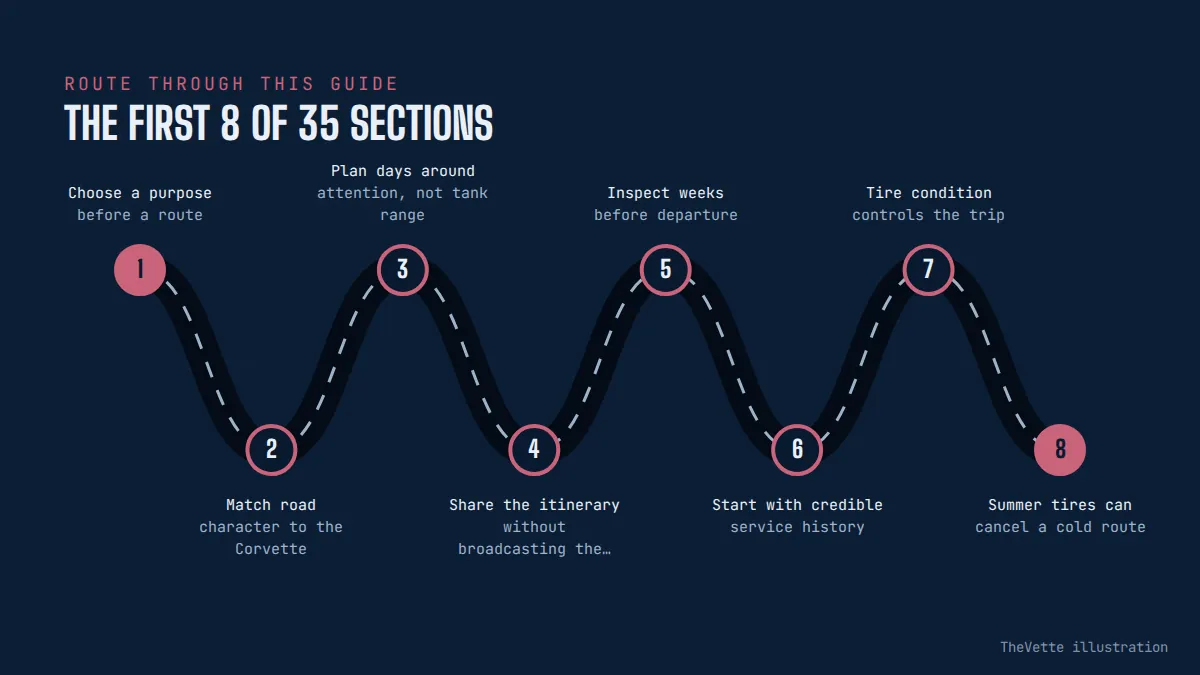
Match road character to the Corvette
Review pavement, grades, switchbacks, construction, seasonal gates, ferry ramps, unpaved sections, low-water crossings, parking entrances, and urban restrictions. A road celebrated by motorcycles may have broken shoulders, blind curves, wildlife, gravel, or limited recovery space.
Check street-view and recent official reports, but expect conditions to change. Avoid routing a low splitter or wide modern Corvette through an obstacle merely because a navigation app says the road connects. Keep a paved, lower-risk alternative downloaded.
Plan days around attention, not tank range
NHTSA advises allowing ample time and stopping to stretch, eat, return communications, change drivers, or rest when drowsy. Set a conservative driving window and a firm arrival buffer before dark or severe weather. Scenic curves demand more attention per mile than a divided highway.
Schedule a break before fatigue, not after lane control deteriorates. If yawning, heavy eyelids, missed signs, or wandering attention appears, stop somewhere safe and sleep or change drivers. Caffeine cannot guarantee alertness.
Share the itinerary without broadcasting the empty house
Give a trusted person route, lodging, vehicle description, passenger contacts, and expected check-ins. Download offline maps and save addresses in plain text. Carry a paper overview because devices break or lose service.
Avoid posting live location, key photographs, storage address, or hotel room. Delay public updates and remove location metadata when security warrants. Agree what the contact should do after a missed check-in.
Inspect weeks before departure
Schedule service early enough to obtain parts and validate repairs. Check open recalls, codes and warnings, leaks, tires, wheels, bearings, steering, suspension, brakes, battery, charging, belts, hoses, cooling, fluids, filters, wipers, lights, weather seals, and air conditioning.
Tell the technician the route, temperatures, altitude, distance, and modifications. A generic oil change is not a road-trip inspection. After service, complete local normal driving and recheck for seepage, vibration, loose hardware, or new messages.
Start with credible service history
Review what will become due during the trip by time, mileage, monitor, or use. Service overdue safety items before departure, but do not replace sound components impulsively the night before. Untested repairs add risk.
Carry a concise record of oil and fluid specifications, tire size, battery type, modifications, recent work, and service contacts. Keep full invoices securely online, not loose with personal information visible in the car.
Tire condition controls the trip
Inspect both sidewalls and full tread of all four tires for date, wear, repairs, cracks, cuts, bulges, cords, punctures, and recurring loss. Corvette's negative camber can hide inner-shoulder wear. Confirm exact size, service description, and seasonal suitability.
Set cold pressure from the placard and manual, not the tire sidewall maximum. NHTSA recommends checking cold pressure before long travel and notes that TPMS is not a substitute for manual inspection. Carry one trusted gauge.
Summer tires can cancel a cold route
High-performance summer compounds lose capability in low temperature and are inappropriate for snow or ice. Check vehicle and tire manufacturer thresholds. Mountain passes can be cold even when the departure city is warm.
Change to an approved all-season or winter set when conditions require, or change the route and date. Tire chains may not fit Corvette clearances and can damage the car; follow the exact manual and road authority.
Know the pressure-loss plan
Identify whether the car has run-flat tires, spare, inflator, sealant, jack, and compatible wheel-lock key. Check sealant expiration and run-flat speed/distance instructions. Mobility after pressure loss is limited and condition-dependent, not a promise to finish the trip.
Map qualified tire shops and roadside coverage. Many Corvettes use staggered or uncommon sizes that are not stocked locally. If replacing run-flats with conventional tires, create a contingency before travel.
Brake evidence matters more than pedal feel
Measure pad material and inspect rotors, hoses, lines, fluid age, leaks, and warning history. Mountain descents can create heat even without track pace. Carbon-ceramic and iron systems have different inspection methods.
Use engine braking appropriately within the manual and never ride brakes continuously. A longer pedal, vibration, pull, smell, smoke, or warning requires a safe stop and inspection. Cooling can mask but not repair a problem.
Cooling should be clean and sealed
Check coolant specification and level by the safe procedure, plus hoses, caps, tanks, pumps, fans, radiators, side inlets, charge coolers, oil coolers, ducts, seals, and debris. C8 heat exchangers distribute across the body; inspect every relevant opening.
Monitor oil, transmission, differential, hybrid, and charge-air temperatures where available, not just engine coolant. Never open a hot pressurized cap. Reduce load and follow warnings rather than attempting to outrun heat.
Oil level must use the correct procedure
Wet- and dry-sump Corvette engines differ. A dry-sump reading may require operating temperature and a defined shutdown window. Check before departure and consistently during travel, recording consumption. Carry only the exact approved oil if the manual permits.
Do not overfill or pour an unknown product into a hot engine at a fuel stop. New leakage, pressure warning, smoke, or sudden consumption demands diagnosis. Protect the cargo area from any carried fluid and secure containers upright.
Battery condition affects access as well as starting
Test the 12-volt battery and charging system, inspect terminals and grounds, and verify physical key and emergency release procedures. Modern Corvettes can become difficult to enter with low voltage. A battery maintainer at home does not prove remaining capacity.
Carry an appropriate jump pack only if its chemistry, rating, storage temperature, and connection procedure are understood. Never clamp randomly or work near high-voltage E-Ray components. Roadside staff should use manual-specified points.
Fuel stops deserve margin
Plan around the required octane, reliable stations, rural operating hours, weather, and potential closures. Do not calculate arrival at nearly empty from an optimistic display. Curves, altitude, heat, traffic, and detours change consumption.
Use approved fuel and keep receipts if quality becomes a concern. Portable fuel inside a Corvette creates vapor, fire, and cargo hazards and may violate rules. In remote areas, choose the route around available safe fueling instead.
Pack to the vehicle's load limit
Read the Tire and Loading Information label and owner manual. Passenger mass and cargo share capacity. Weight distribution, visibility, cooling access, roof storage, and electronic compartments matter; an item that fits is not automatically safely carried.
Make a list, then remove duplicates. Use soft-sided luggage shaped for the compartments. Keep heavy items low and restrained. Never exceed capacity or place cargo where it can move into occupants or controls.
C8 cargo areas have different heat environments
Front and rear compartments differ in shape and thermal exposure. Do not assume food, medicine, electronics, aerosols, camera batteries, or detailing chemicals can tolerate either location. Follow manual cautions and product storage temperatures.
Use clean protective bags without blocking vents or emergency releases. After driving, allow heat to dissipate safely before handling sensitive items. Never store fuel or leaking fluids near hot drivetrain components.
A removable roof consumes planned space
On coupes with a removable panel, the stowed roof may occupy the primary cargo area and require exact latching. Practice removal and storage at home without touching paint, glass, seals, or seats. Inspect seals and retainers.
Pack once with the roof in place and once with it stored. Do not pile luggage on the panel or improvise straps. Weather can change, so a trip plan that only works roof-off is fragile.
Passenger fit is part of route safety
Confirm comfortable seat position, belt routing, head clearance, climate needs, medication timing, mobility, and ability to enter and exit. Corvette has limited recline, low sills, and little space to change posture. Plan more frequent stops when needed.
Do not compromise the driver's seating or mirror position to make cargo fit. All occupants must use appropriate restraints; many Corvettes are not suitable for child seating configurations. The owner manual controls.
Weather planning is a go/no-go process
Review National Weather Service forecasts, watches, warnings, radar, heat, flooding, wind, snow, and visibility for the whole corridor. Mountain and desert conditions can change within hours. Check official road closures and wildfire or park alerts.
Delay rather than drive into flooding, severe storms, ice, wildfire evacuation, or dangerous heat. Never cross water of unknown depth. Create shelter and alternate lodging options before departure.
Altitude changes conditions, not just views
Reduced air density can affect cooling, naturally aspirated power, turbo operation, and driver physiology. Grades raise brake and thermal load. Weather and fuel availability can be less predictable at elevation.
Use lower gears appropriately, watch temperatures, hydrate, and recognize headache, dizziness, or impaired judgment. Descend and seek medical help when symptoms warrant. Do not interpret reduced performance as a reason to press harder.
Navigation must never become a distraction
Load the day's route and alternates while parked. Use voice prompts sparingly and mount devices without blocking vision, airbags, displays, or controls. A passenger can manage changes, but should not pressure the driver into abrupt turns.
If directions fail, continue predictably and stop safely. Never reverse on a highway shoulder or make an illegal maneuver to preserve the route. A missed exit costs minutes; distraction can cost far more.
Security is layered
Choose well-lit visible parking near entrances, lock roof and compartments, close windows, take keys, and remove visible electronics and documents. Factory security, tracking, steering locks, and covers each have limitations.
At lodging, ask about cameras, overnight access, height restrictions, valet policy, and garage ramps before arriving. Photograph the parked car and surrounding vehicles discreetly. Never hand a modified or unfamiliar Corvette to a valet without understanding policy and insurance.
Low clearance changes parking choices
Approach ramps and driveways slowly at an angle only when traffic and geometry permit. Watch splitter, front lift state, side skirts, underbody, wheel width, doors, and rear diffuser. Front-lift memory is assistance, not a guarantee.
Have a passenger spot from a safe visible position without standing in the path. Do not use loose boards on public access. If uncertain, choose another entrance or surface rather than scraping forward.
Road debris deserves distance
Leave space behind trucks, trailers, and vehicles carrying material. Avoid lingering beside them. Fresh construction can throw stones, tar, metal, and loose gravel. Reduce speed without abrupt maneuvers when conditions change.
After a significant strike, stop safely and inspect tires, wheels, splitter, cooling openings, glass, underbody, and leaks. Do not continue because the paint looks intact. Photograph road and damage for maintenance and insurance records.
An emergency kit must fit the Corvette
NHTSA recommends communication, first aid, light, visibility devices, pressure gauge, basic supplies, water, food, medication, maps, clothing, and weather protection. Adapt the kit to climate, passenger health, route remoteness, and cargo capacity.
Secure every item so it cannot become a projectile. Check batteries, medicines, water, and expiration dates. Avoid flares where fire danger or fuel leakage makes them unsafe; learn legal alternatives.
Roadside coverage should reach a specialist
Confirm dispatch number, tow mileage, reimbursement, trip interruption, tire service, lockout, and whether low-clearance flatbed equipment is available. Save local Corvette-capable shops and dealerships along the route.
Coverage payment does not authorize an unsafe tow. Show the operator the exact manual procedure, tow-eye points, transmission release, and lift restrictions. Photograph the car before loading and inspect securement.
Never improvise recovery points
Corvette composite panels, suspension arms, undertrays, aero, and drivetrain can be damaged by generic hooks. Use the specified tow eye or approved points and suitable approach angles. C8 dual-clutch or electrified systems require exact procedures.
If the vehicle cannot enter neutral or has collision or high-voltage damage, tell dispatch. Wait for qualified equipment rather than dragging it. Keep occupants away from traffic during recovery.
Insurance use and territory must match
Review physical damage, liability, drivers, mileage, territory, modifications, roadside, rental, lodging, and transport before the trip. Collector policies may restrict commuting, business use, or annual mileage. Ordinary insurance may not cover a track detour.
Carry accepted proof and claims contact, with secure digital backup. Ask about Canada, Mexico, ferries, and border-specific policies well ahead. Do not infer territorial coverage from an ID card.
Border crossings require documents
Check current passport, visa, customs, vehicle registration, insurance, emissions, food, medication, and temporary-import requirements from official agencies of every country. U.S. Customs and Border Protection notes that officers may request ownership or authorization evidence for borrowed or rented vehicles crossing Canada or Mexico borders.
Carry lienholder, rental-company, or owner permission where required, preferably in the specified form. Rules can change and crossing points have different hours. Do not rely on an old club post.
Scenic roads are shared public space
Expect bicycles, motorcycles, farm vehicles, wildlife, hikers, stopped tourists, residents, and emergency crews. Stay within the visible stopping distance, obey limits and no-passing zones, and never cross the centerline to “straighten” a corner.
Use pullouts for photographs and allow faster legal traffic to pass where safe. Exhaust noise and group behavior affect communities. A responsible Corvette tour should leave no debris, tire marks, or frightened road users.
Group drives need explicit discipline
Brief route, regroup points, fuel, emergencies, communication, and the rule that nobody must keep up. Use small groups with a lead and sweep, not a tight convoy. Maintain normal following distance and allow other traffic to merge.
Each driver navigates independently and is responsible for safety. If separated, continue to the next stop. Radios should be hands-free where legal and should not become chatter during complex traffic.
Photography waits until the car is parked
Mounts can obstruct airbags, vision, or controls and detach in a crash. Configure permitted equipment before movement and let a passenger operate it only when safe. No image justifies distracted driving or stopping on a shoulder.
Respect private property, drone restrictions, wildlife, and other people's plates and faces. Avoid revealing hotel, key, or tracking details in live posts. Preserve original files and label locations accurately.
At each overnight stop, make a short inspection
Look for leaks, tire damage and pressure trend, wheel marks, brake changes, debris in cooling openings, loose aero, glass damage, and warning history. Check oil and other fluids only by the correct temperature procedure. Remove insects safely rather than dry-scrubbing paint.
Plan the next day's weather, closures, fuel, and rest. Charge devices without draining the car battery. If a problem is developing, use the morning buffer for service instead of hoping it survives another leg.
Arrival does not end maintenance
After the car cools, inspect tires inside and out, wheels, brakes, suspension, underbody, cooling inlets, fluids, paint, glass, and cargo areas. Wash road salt or insects appropriately and review warnings and pressure loss. Record mileage and consumption.
Address impacts, vibration, leaks, or service thresholds before the next performance drive. Restore storage maintainer and normal configuration. Organize receipts and photographs while details are fresh.
Design the trip around recoverable choices
A strong plan has fuel before empty, lodging before exhaustion, an alternate before the road closes, service before a marginal part fails, and a tow plan before a flat tire. It lets weather cancel a day without turning the journey into a crisis.
That preparation does not remove spontaneity; it creates room for it. With the exact Corvette understood, cargo restrained, passengers comfortable, and daily pace humane, the car becomes what a grand tourer should be: a way to connect meaningful roads and places without sacrificing the people or machine along the way.