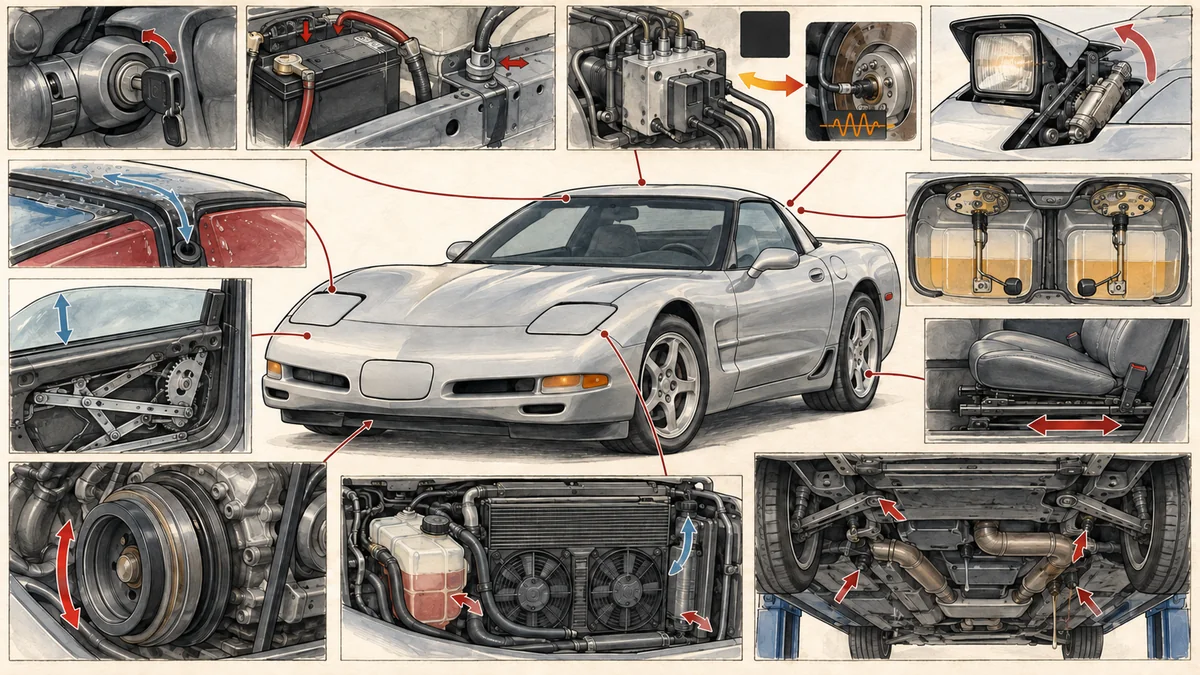
The C5 Corvette can be durable, but age, storage, previous repairs, and neglected electrical systems matter more than odometer mileage alone. The most important C5 concern is the electronic steering-column-lock campaign because it has a documented safety history. Other common inspection areas include battery voltage and grounds, ABS/traction warnings, pop-up headlights, fuel-level readings, window and seat mechanisms, weather sealing, cooling, vibration, and ordinary wear. Diagnose symptoms rather than assuming every car has every problem.
To place C5 Corvette Common Problems in a wider ownership and engineering context, continue with C5 Corvette Buyer’s Guide: Performance Value Explained.
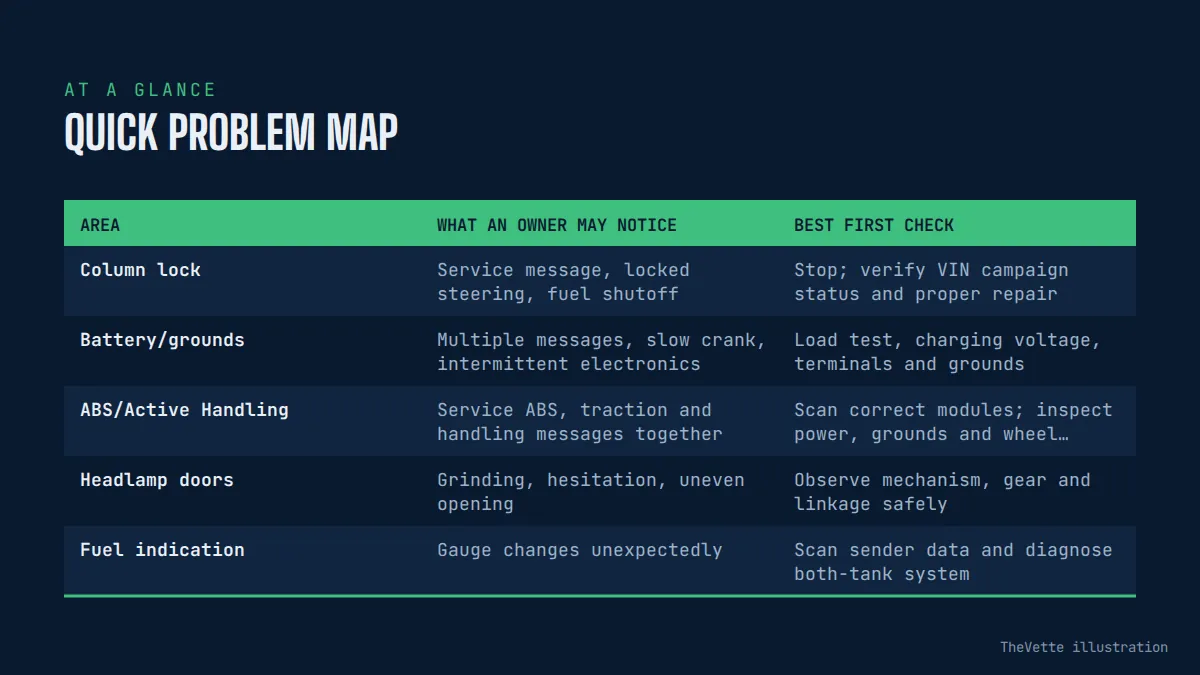
Quick problem map
| Area | What an owner may notice | Best first check |
|---|---|---|
| Column lock | Service message, locked steering, fuel shutoff | Stop; verify VIN campaign status and proper repair |
| Battery/grounds | Multiple messages, slow crank, intermittent electronics | Load test, charging voltage, terminals and grounds |
| ABS/Active Handling | Service ABS, traction and handling messages together | Scan correct modules; inspect power, grounds and wheel circuits |
| Headlamp doors | Grinding, hesitation, uneven opening | Observe mechanism, gear and linkage safely |
| Fuel indication | Gauge changes unexpectedly | Scan sender data and diagnose both-tank system |
| Water control | Damp carpet, odor, corrosion | Weatherstrips, drains, seams and prior body repairs |
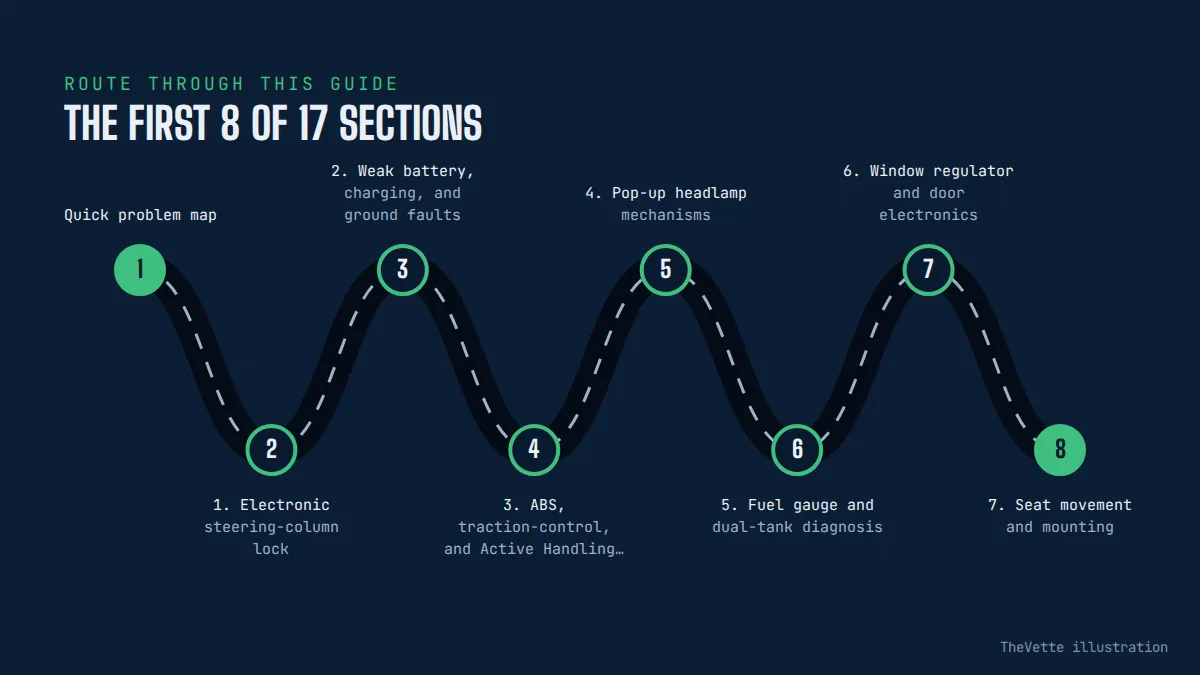
1. Electronic steering-column lock
GM safety recall 04V-060 covered specified C5 populations, including all 1997–2004 manual-transmission Corvettes and certain automatic-transmission cars. GM explained that an electronic column lock could fail to unlock and, under particular low-voltage or reset conditions, the vehicle might move while steering remained locked. Applicability and remedy differed by transmission, market, VIN and campaign revision.
If the steering does not unlock or the Driver Information Center shows a column-lock service message, do not force the wheel or drive. Chevrolet’s 2001 manual directs a manual-transmission owner with a service-column-lock message to have the car towed for service. A seller’s homemade bypass is not evidence that the recall was correctly completed.
Enter the VIN at NHTSA’s recall lookup and ask a Chevrolet dealer to review campaign history. Then inspect the actual repair using applicable service information. Later GM diagnostic guidance for post-campaign messages begins with a fully charged battery that passes a load test and inspection of grounds G201 and G202, illustrating how voltage and grounding can affect diagnosis.
2. Weak battery, charging, and ground faults
A C5 contains modules that react badly to unstable voltage. A weak battery can cause slow cranking, resets, false-looking warnings, and inconsistent security or column-lock behavior. Long storage makes the problem more likely, but replacing the battery without testing parasitic draw or charging output can hide the cause.
Load-test the battery, measure charging voltage under relevant loads, clean and secure terminals, and inspect chassis and engine grounds for corrosion or previous repair. Test voltage drop while the affected circuit operates; an open-circuit reading can look normal across a high-resistance connection.
If the car repeatedly goes flat, follow the staged parasitic-draw process in the Corvette battery drain guide. Do not disconnect modules randomly or replace an expensive controller based on several simultaneous messages after a low-voltage start.
3. ABS, traction-control, and Active Handling warnings
The 2001 owner manual explains that a Service ABS message can also disable traction control and optional Active Handling, producing several messages together. That relationship means three warnings do not necessarily indicate three unrelated failures.
Scan the electronic brake-control system with equipment that can read chassis codes and live data, not only generic engine codes. Record codes before clearing them. Compare wheel-speed signals, inspect connectors and harness routing, then verify power and grounds. Module, sensor, bearing, wiring and voltage faults require different repairs.
When ABS is unavailable, normal hydraulic braking may remain if the red brake warning is not on, but computer assistance is absent. Follow the owner manual, reduce risk and arrange service. If the regular brake warning also appears or pedal behavior changes, stop and have the car evaluated.
4. Pop-up headlamp mechanisms
A headlamp door that grinds, chatters, stops short, or sits unevenly may have gear, linkage, stop, motor, wiring or alignment trouble. Watch both sides through several cycles with the car stationary and keep hands away from moving parts. Continued motor noise after travel ends is a reason to switch the lights off and diagnose.
Check that the assembly raises fully before judging beam aim. A replacement gear may solve one wear condition, but it cannot repair a bent linkage, damaged housing, poor connector or incorrectly adjusted stop. After mechanism or assembly work, aim both lamps using the correct procedure.
Some 2004 vehicles were involved in headlamp recall 04V-560; the GM remedy document describes replacing both assemblies and aiming them. Use the VIN lookup rather than assuming every 2004 car is included or repaired.
5. Fuel gauge and dual-tank diagnosis
The C5’s tank arrangement and transfer system make an erratic gauge more complex than one dashboard needle. A reading that drops, sticks or changes after refueling can involve sender signals, connectors, transfer behavior, wiring or module interpretation.
Begin with scan data from both relevant sender inputs, compare readings through a known fuel-level change, and inspect service history. Avoid dropping tanks or pouring additives into the car based solely on forum anecdotes. Fuel work requires ventilation, fire safety, correct lifting and professional procedures.
A buyer should confirm that the gauge behaves consistently from full through a meaningful drive, not only during a five-minute viewing. An unexplained fuel odor, leak, damaged filler area or evidence of improvised wiring deserves immediate specialist inspection.
6. Window regulator and door electronics
Slow glass, clicking, uneven travel, glass that drops or tilts, and intermittent switches can point to regulator, motor, guides, adjustment, wiring or switch trouble. Test each window repeatedly from both controls and observe sealing against the roof and weatherstrip.
Do not keep operating a binding mechanism; it can damage glass, tracks or trim. Door work should restore water barriers, connector locks and glass alignment. A regulator replacement followed by wind noise or leakage is not a complete repair.
7. Seat movement and mounting
Rocking or shifting during acceleration and braking can come from seat-track wear, fasteners, adjuster components or prior repair. Move each powered function through its range while listening for strain, then check for unwanted motion with the car parked.
Seat mounting is safety-related because it affects driving control and restraint geometry. Do not use loose hardware or improvised spacers. Confirm the correct repair and inspect wiring beneath the seat without disturbing restraint-system connectors.
8. Weatherstrips, drains, and water entry
Roof panels, hatch openings, door glass and body seams depend on clean channels, correctly adjusted closures and healthy seals. Damp carpet, musty odor, fogging, water tracks, connector corrosion or staining can reveal a long-running leak even when the interior is dry on inspection day.
Inspect after rain or a controlled low-pressure water test. Avoid blasting seals with a pressure washer, which can create unrealistic intrusion. Clear designed drains without puncturing hoses, and trace water to its entry rather than sealing every visible gap.
Lift accessible carpet edges and inspect storage areas. Water near electronics can cause intermittent faults later. Replacement weatherstrip needs correct fit and closure adjustment; a thicker seal is not automatically better.
9. Harmonic balancer and accessory-drive vibration
A visible wobble at the crank pulley area, belt tracking change, chirp or unusual front-engine vibration calls for diagnosis. Observe from a safe distance with loose clothing and tools away from rotating parts. Do not reach into a running engine bay.
Confirm whether motion comes from the balancer, pulley, belt, tensioner, accessory or crankshaft-related issue. Replacement requires the right holding, removal, installation and fastener procedure. A painted reference line can help document movement but does not replace measurement.
10. Cooling-system age
Inspect the radiator, condenser stack, fans, hoses, tank, cap area, water-pump region and underbody for debris, staining or leakage. Verify coolant level only when safe and cold. Temperature that rises in traffic but not at speed suggests a different path from overheating under load.
Old coolant, mixed chemistry, trapped air, restricted airflow, a weak cap, fan control or mechanical leakage can overlap. Do not open a hot system. Repeated coolant loss, steam, contaminated fluid or overheating warrants professional diagnosis before further driving.
11. Driveline, mounts, and vibration
The C5’s rear transaxle layout means noises can travel through the structure. Note whether vibration follows road speed, engine speed, gear, throttle, braking or steering input. Tires, wheels, bearings, driveline alignment, mounts and exhaust contact can feel similar from the cabin.
Inspect tires for age and deformation, wheels for damage, mounts for collapse, and the underside for contact or missing fasteners. A low car may have scrape damage. Diagnose before balancing or replacing parts repeatedly.
12. Oil leaks, pressure readings, and service history
A dry engine photographed after cleaning does not prove it stays dry. Inspect from above and below after a complete heat cycle, looking for fresh oil, accumulated dirt, burning odor, smoke, or drops on shields and crossmembers. Trace the highest wet point rather than assuming the lowest drip identifies the source.
Compare the dashboard oil-pressure behavior with model-year information and, when a reading is implausible, verify it with the correct diagnostic procedure before condemning the engine. A sensor, connector, wiring, oil level, viscosity, filter, mechanical wear, or genuine pressure fault can produce very different repair paths. Shut the engine down if pressure is lost or mechanical noise develops.
Receipts should identify oil grade, mileage, date, filter, and any repaired sealing point. Repeated claims that “all LS engines leak there” are not diagnosis. Likewise, adding a thicker oil or stop-leak product can hide evidence without correcting the cause.
13. Tires, wheel sensors, and alignment
C5 tires can age out before their tread is worn, especially on cars driven only in good weather. Read each date code, inspect inner shoulders, sidewalls and flat spotting, and verify that all four sizes and load/speed specifications suit the wheel and model. Old high-performance tires can feel acceptable at low speed while offering little wet or cold grip.
Uneven wear may reflect pressure, alignment, worn suspension joints, ride-height changes or previous damage. A tire-pressure warning or missing reading needs sensor and receiver diagnosis rather than assumption. Budget for a complete matched set when age, type or wear differs substantially across the car.
Pre-purchase inspection sequence
- Run a VIN-specific NHTSA recall search and obtain campaign records.
- Inspect cold start, battery condition, charging and grounds.
- Scan every accessible module before clearing codes.
- Test column unlock, both keys, windows, seats, lamps and climate controls.
- Check roof, hatch, drains, carpets and electronic areas for water evidence.
- Observe fuel gauge and review tank/sender history.
- Inspect balancer, belts, cooling, leaks, tires, brakes and underside.
- Road-test from cold through full operating temperature with the seller’s permission.
- Arrange an independent inspection by a C5-experienced technician.
Frequently asked questions
Are all C5 Corvettes affected by the column-lock recall?
No. The official population varies by model year, transmission and market. Check the specific VIN and documented remedy.
Do multiple handling warnings mean several modules failed?
Not necessarily. Chevrolet documents that ABS trouble can disable traction and Active Handling together. Read chassis codes and test voltage, grounds, wiring and inputs.
Is low mileage always better?
No. Storage can age tires, seals, fluids and batteries, while lack of use can conceal intermittent faults. Condition and documented care matter.
Should I avoid every C5 with modifications?
No, but require receipts, reversible work, sound wiring, correct calibration and an inspection. Poorly documented electrical changes deserve caution.
Can a seller’s scan with no codes prove the car is healthy?
No. Codes may have been cleared, and a generic reader may miss chassis or body modules. Combine a full scan with history, readiness information and physical testing.
Final assessment
A C5 should not be rejected merely because the generation has known inspection points. Verify the safety campaigns first, establish stable voltage and clean grounds, then diagnose each symptom at the system level. Many apparent electronic disasters begin with power, connection or mechanical-input problems.
The best purchase is the car with consistent operation, credible recall and service records, dry electronics, sound structure and a transparent seller—not simply the lowest mileage. Use the C5 Corvette buyer’s guide for the broader model comparison and always obtain an independent pre-purchase inspection.