The best tire for a C8 Stingray is usually one of the two factory-developed Michelin paths: Pilot Sport All Season 4 for wider temperature flexibility or Pilot Sport 4 S for warm-weather performance. The common Stingray fitment is 245/35ZR19 front and 305/30ZR20 rear. E-Ray, Z06, and newer ZR1 models use a much wider 275/30ZR20 front and 345/25ZR21 rear package, so their availability, load, construction, and intended use must be evaluated separately.
To place Best Tires for C8 Corvette in a wider ownership and engineering context, continue with Corvette Tire Guide: Fitment, Age, Grip, and Touring Comfort.
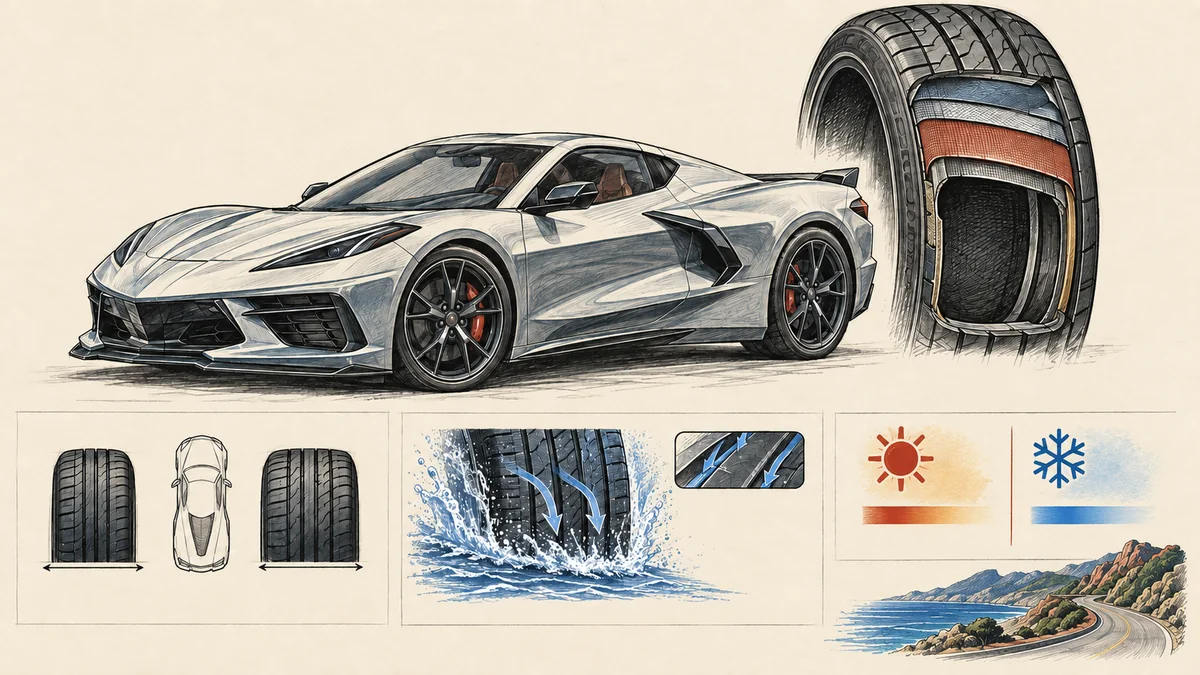
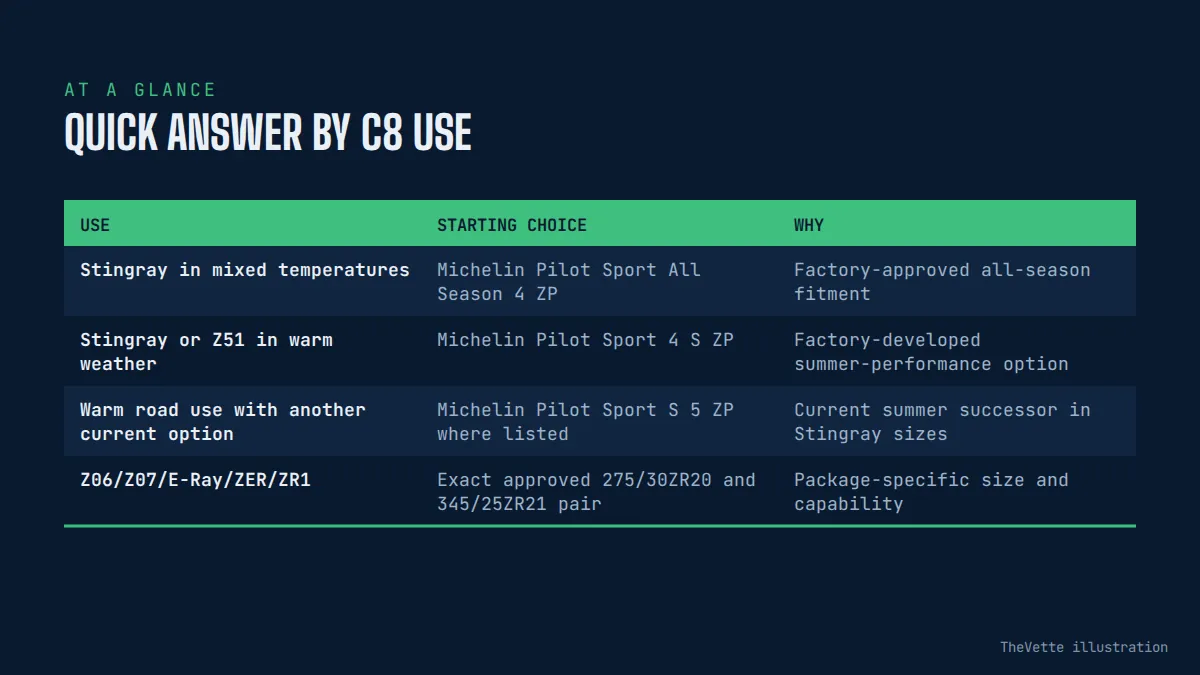
Quick answer by C8 use
| Use | Starting choice | Why | Main caution |
|---|---|---|---|
| Stingray in mixed temperatures | Michelin Pilot Sport All Season 4 ZP | Factory-approved all-season fitment | Not a severe-winter solution |
| Stingray or Z51 in warm weather | Michelin Pilot Sport 4 S ZP | Factory-developed summer-performance option | Avoid freezing conditions |
| Warm road use with another current option | Michelin Pilot Sport S 5 ZP where listed | Current summer successor in Stingray sizes | Verify exact model-year approval |
| Z06/Z07/E-Ray/ZER/ZR1 | Exact approved 275/30ZR20 and 345/25ZR21 pair | Package-specific size and capability | Very limited substitute choices |
Do not order from the table alone. Read the tire-and-loading label, identify the exact model and performance package, and compare the full service description and manufacturer marking. A nominally correct size can still differ in load index, construction, run-flat capability, or vehicle approval.
Two C8 size families dominate the search
Current US fitment pages show the Stingray and Stingray with Z51 at 245/35R19 front and 305/30R20 rear. The wide-body E-Ray, E-Ray with ZER, Z06, Z06 with Z07, and ZR1 are listed at 275/30R20 front and 345/25R21 rear. This makes “best C8 tire” two different questions before compound or price is discussed.
| C8 group | Front | Rear | What changes |
|---|---|---|---|
| Stingray / Stingray Z51 | 245/35R19 | 305/30R20 | Narrow-body wheel package and broader replacement choice |
| E-Ray / ZER | 275/30R20 | 345/25R21 | Wide body, front-drive hardware, package-specific tire approval |
| Z06 / Z07 | 275/30R20 | 345/25R21 | Road versus track mission becomes critical |
| ZR1 / ZTK | 275/30R20 | 345/25R21 | Use current model-year documents and approved specification |
These are common current configurations, not permission to ignore the car. Wheels may have been changed, and later model years can introduce revised products. The driver-door label and exact owner information remain the starting evidence.
Why C8 tire choice is unusually specific
The C8 was engineered around a mid-engine layout, staggered sizes, tire-pressure monitoring, electronic controls, and trim-specific performance missions. Overall diameter, load, casing behavior, and grip balance affect more than appearance. A substitute that physically mounts may still alter steering response, intervention behavior, ride, or clearance.
Chevrolet’s 2021 manual says that when a replacement lacks the vehicle’s TPC specification, it should match the original size, load range, speed rating, and radial construction. Later manuals and track guides add model-specific instructions. This guide therefore favors exact manufacturer-listed pairs instead of creative near sizes.
Michelin Pilot Sport All Season 4 ZP: practical Stingray choice
Michelin’s US selector lists the Pilot Sport All Season 4 in 245/35ZR19 (89Y) ZP GM and 305/30ZR20 (99Y) ZP GM for a 2024 Stingray. The GM marking and ZP construction identify a vehicle-approved extended-mobility fitment, not merely a tire that shares the dimensions.
This is the sensible starting point for a Stingray used across cool mornings, rain, road trips, and a longer driving season. It avoids the cold-temperature restriction of a summer tire, but “all-season” remains a compromise. Ice, deep snow, and severe winter conditions require a different plan, and the C8’s low ground clearance remains a limitation.
Choose it for: broad street usability and preserved zero-pressure capability. Look elsewhere for: repeated warm track work or a dedicated severe-winter setup.
Michelin Pilot Sport 4 S ZP: warm-weather performance choice
Michelin lists the Pilot Sport 4 S in Stingray sizes with XL load descriptions and ZP GM markings. It is the natural road-performance choice when the Corvette operates in suitable warm temperatures. Compared with the all-season route, it prioritizes the responses and warm dry/wet capability expected from a max-performance summer tire.
The boundary is temperature. A powerful sports car on summer rubber should not be treated as an all-calendar vehicle merely because the pavement is dry. Cold can reduce flexibility and grip, and tire makers publish storage and operating cautions that the owner must follow.
Choose it for: warm-season road use and Z51-style priorities. Avoid it when: the car must leave home in freezing conditions or the owner cannot manage seasonal storage or replacement.
Michelin Pilot Sport S 5: verify the newer option carefully
Michelin’s current Stingray selector also lists the Pilot Sport S 5 in 245/35ZR19 and 305/30ZR20 ZP GM versions. This makes it a legitimate newer summer-performance comparison, not an automatic upgrade for every C8. Availability, model-year approval, service descriptions, and the complete axle pair should be confirmed at purchase.
An owner replacing only one damaged tire should not assume the S 5 can be mixed with a Pilot Sport 4 S on the other axle. Product generations can differ in compound and response. Ask Michelin or a qualified installer to define the safe replacement scope, considering tread depth and age.
The wide-body problem: 345/25ZR21 rear tires
The E-Ray, Z06, and ZR1 rear size is exceptionally wide and uncommon. A retailer may show several 275/30ZR20 fronts yet no complete approved pair because the 345/25ZR21 rear is unavailable. Goodyear’s current E-Ray results illustrate this problem: individual fronts appear while no matching rear set is offered.
Do not solve that shortage by buying a front first or substituting a close rear diameter. Confirm the complete set, manufacturer approval, load, and construction before paying. If the desired product is unavailable, speak with the vehicle manufacturer’s service channel and the tire maker rather than relying on a generic size calculator.
E-Ray needs more than an all-wheel-drive assumption
E-Ray adds an electrified front axle, but all-wheel drive does not make any tire suitable for cold, snow, or ice. Braking and cornering still depend on the contact patches. Chevrolet’s track preparation material also gives E-Ray-specific instructions and identifies a ZER performance configuration. The exact package and tire type must be known before track or seasonal advice is applied.
The wide-body size and front-drive hardware make casual changes especially unwise. Preserve compatible rolling diameters and use vehicle-specific guidance. If winter mobility is essential, investigate a complete approved wheel-and-tire package rather than forcing a winter tire onto an unsuitable factory wheel.
Z06, Z07, and track-oriented tires
Michelin lists 275/30ZR20/XL (97Y) and 345/25ZR21/XL (104Y) ZP GM for a 2024 Z06 with Z07. Chevrolet’s track guides distinguish Stingray Z51, Z06, and E-Ray preparation and direct owners back to the manual. That is a warning against treating a track-oriented factory fitment like an ordinary summer replacement.
Track use requires correct warm-up, pressures, alignment, brake preparation, inspection, and temperature management. A highly focused tire can have narrow wet and cold margins and rapid wear. Use the track preparation guide, current Chevrolet guide, and tire-maker instructions together.
Run-flat markings and roadside reality
Michelin’s ZP designation indicates zero-pressure technology. It can provide limited mobility after some pressure-loss events within specified speed, distance, load, and damage limits. It cannot make a cut sidewall, broken wheel, or severe impact safe. Stop and inspect whenever pressure loss is reported.
Switching to conventional construction may change ride and expand choice on some Stingray fitments, but the C8 has no conventional spare. A realistic plan includes compatible sealant and an inflator for limited repairable punctures, plus roadside coverage that can load a low mid-engine car without damage. A mixed run-flat/conventional set is not an acceptable shortcut.
Service description and vehicle marking
The load index, speed symbol, XL designation, ZP construction, and GM marking carry information that size alone omits. Michelin’s selector shows 245/35ZR19 and 305/30ZR20 products with different service descriptions. Compare the complete line against the exact vehicle requirements.
A higher number in one field does not make a product universally better. Construction and vehicle tuning matter. Ask the installer to document why any non-original specification is suitable, including rim-width approval, load capacity, diameter, and pressure basis.
Pressure, monitoring, and high-speed guidance
Use the tire-and-loading label for normal cold pressure. The maximum on the sidewall is not the target. Chevrolet provides separate high-speed and track instructions; do not invent a pressure from an online forum or copy another trim. Pressure should be measured with a reliable gauge and recorded cold and, when relevant, hot.
The monitoring system warns about pressure but cannot evaluate tread depth, puncture repair quality, age, heat cycling, inner-edge wear, or a mismatched tire. Confirm sensor operation and wheel position after installation.
Alignment, lifting, and installation quality
C8 tire replacement belongs at a shop with suitable low-clearance lifting and low-profile mounting equipment. Ask how the vehicle will be lifted and whether the shop regularly handles wide performance wheels. Inspect wheel faces before and after service.
Request an alignment inspection when wear is uneven, the car has seen track use, or suspension settings have changed. Measure across the whole tread because inner-edge wear can hide under the body. Keep before-and-after readings; “within range” is less useful than the actual numbers and intended use.
Tire age and storage
Low annual mileage does not stop tire aging. Record the DOT Tire Identification Number, inspect for cracks, bulges, cuts, flat spotting, repairs, and heat damage, and follow the manufacturer’s age guidance. A C8 stored in cold weather also needs the summer-tire handling and storage instructions observed.
Ask the seller about inventory age before ordering an uncommon rear. Inspect all four codes when delivered. A discounted old tire can compromise the value of an otherwise fresh set and create a replacement problem sooner.
Compare the installed package, not a headline price
A useful quote identifies every product code and marking, mounting, balancing, sensor service, taxes, disposal, alignment inspection, delivery timing, and road-hazard terms. For wide-body cars, require confirmation that the rear is allocated, not merely back-ordered without a date.
Prices change too quickly for an honest evergreen article to promise a fixed range. Compare dated quotes from Corvette-capable installers. The cheapest listing is not cheaper if it omits a rear tire, damages a wheel, or supplies the wrong construction.
Ask the shop to state its remedy if a delivered tire has an unacceptable production date, shipping damage, or a specification that differs from the order. This matters when the 21-inch rear is scarce: accepting the wrong item to avoid another wait can create a much larger problem. At collection, inspect each wheel, compare every sidewall with the invoice, photograph the date codes, verify cold-pressure targets and sensor operation, and keep the alignment sheet with the vehicle records.
Frequently asked questions
Do Stingray and Z51 use different sizes?
Current common listings show the same 245/35R19 and 305/30R20 dimensions, but the intended tire category and factory equipment can differ. Check the exact car and label.
Can Stingray use Z06 wheels?
Not as a simple tire swap. Body width, wheel offset, brakes, suspension clearance, load, and system compatibility require a complete engineered package.
Is E-Ray safe in snow because it has all-wheel drive?
All-wheel drive can assist acceleration but cannot create braking or cornering grip. Tire category, temperature, snow depth, clearance, and driver margin still govern safety.
Can staggered C8 tires be rotated?
Ordinary front-to-rear rotation is impossible because sizes differ. Directional markings may also limit side-to-side movement. Inspect and measure wear instead of relying on rotation to correct it.
Final recommendation
For a street-driven Stingray covering a broad temperature range, start with the GM-marked Pilot Sport All Season 4 ZP pair. For warm-weather Stingray or Z51 use, compare the Pilot Sport 4 S ZP and current Pilot Sport S 5 ZP listings. E-Ray, Z06, Z07, and ZR1 owners should buy only after the complete approved 275/30ZR20 and 345/25ZR21 set is confirmed.
Read the C8 buyer’s guide for model distinctions and the general tire guide for inspection fundamentals. The best C8 tire is the exact, fresh, documented pair built for the car’s package and real operating temperature.