The best C7 Corvette tire depends first on whether the car is a narrow-body Stingray or a wide-body Grand Sport, Z06, or ZR1. For a stock Stingray driven in warm weather, the Michelin Pilot Sport 4 S and Continental ExtremeContact Sport 02 are strong performance-road starting points in the common 245/35ZR19 front and 285/30ZR20 rear fitment. The Michelin Pilot Sport All Season 4 makes more sense when cool-weather flexibility matters. Wide-body cars require a separate 285/30ZR19 and 335/25ZR20 search.
To place Best Tires for C7 Corvette in a wider ownership and engineering context, continue with Corvette Tire Guide: Fitment, Age, Grip, and Touring Comfort.
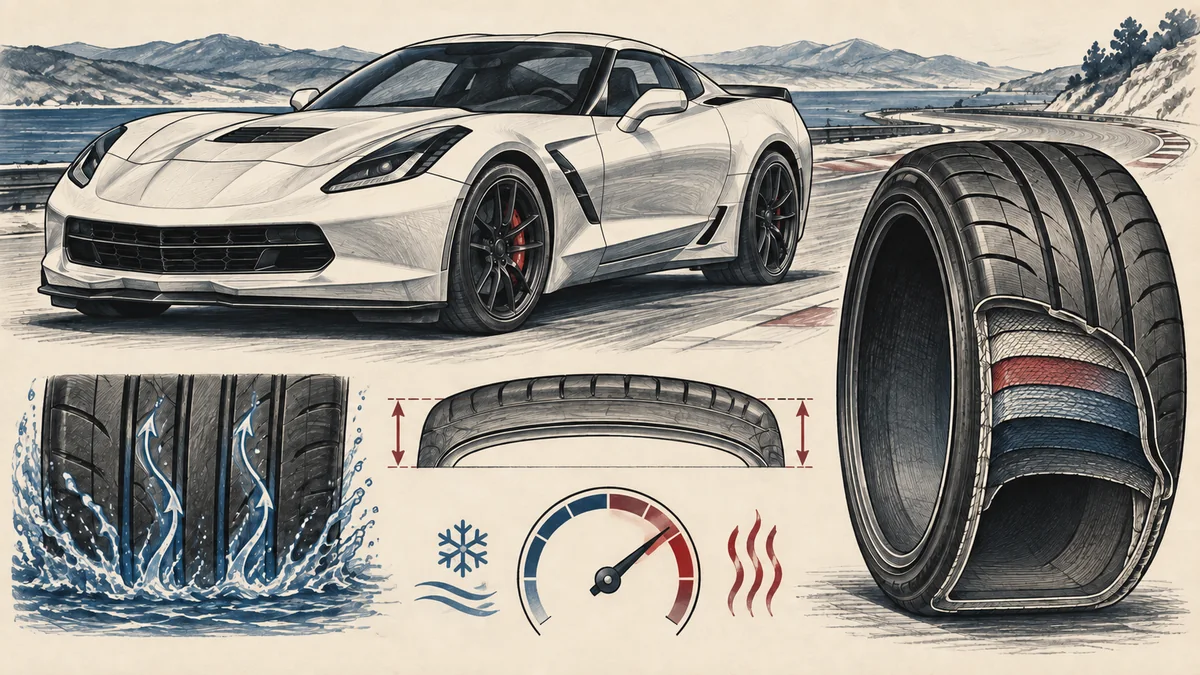
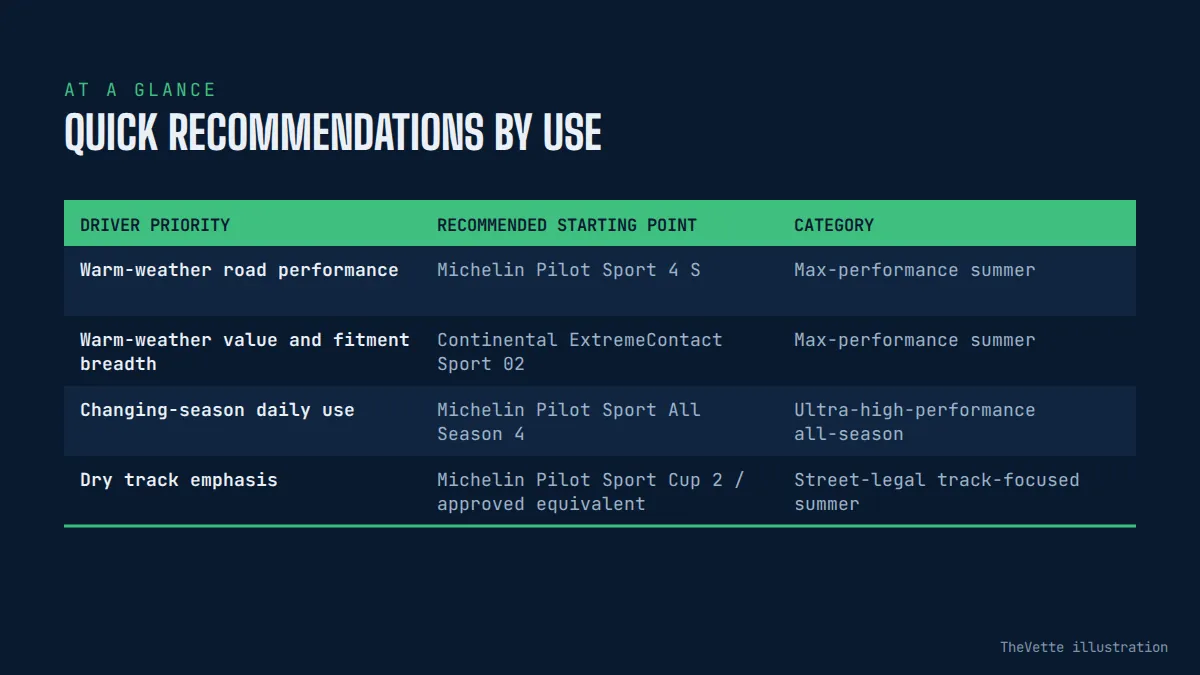
Quick recommendations by use
| Driver priority | Recommended starting point | Category | Important limit |
|---|---|---|---|
| Warm-weather road performance | Michelin Pilot Sport 4 S | Max-performance summer | Not for freezing conditions |
| Warm-weather value and fitment breadth | Continental ExtremeContact Sport 02 | Max-performance summer | Confirm complete axle pair |
| Changing-season daily use | Michelin Pilot Sport All Season 4 | Ultra-high-performance all-season | Not a substitute for a winter tire |
| Dry track emphasis | Michelin Pilot Sport Cup 2 / approved equivalent | Street-legal track-focused summer | Temperature, rain, wear, and skill margins |
This list is not an automatic shopping cart. Confirm the exact tire label, wheel dimensions, service description, and current manufacturer listing. Many C7s have aftermarket wheels, changed alignment, or a factory performance package that alters the correct answer.
Start with the C7 wheel package
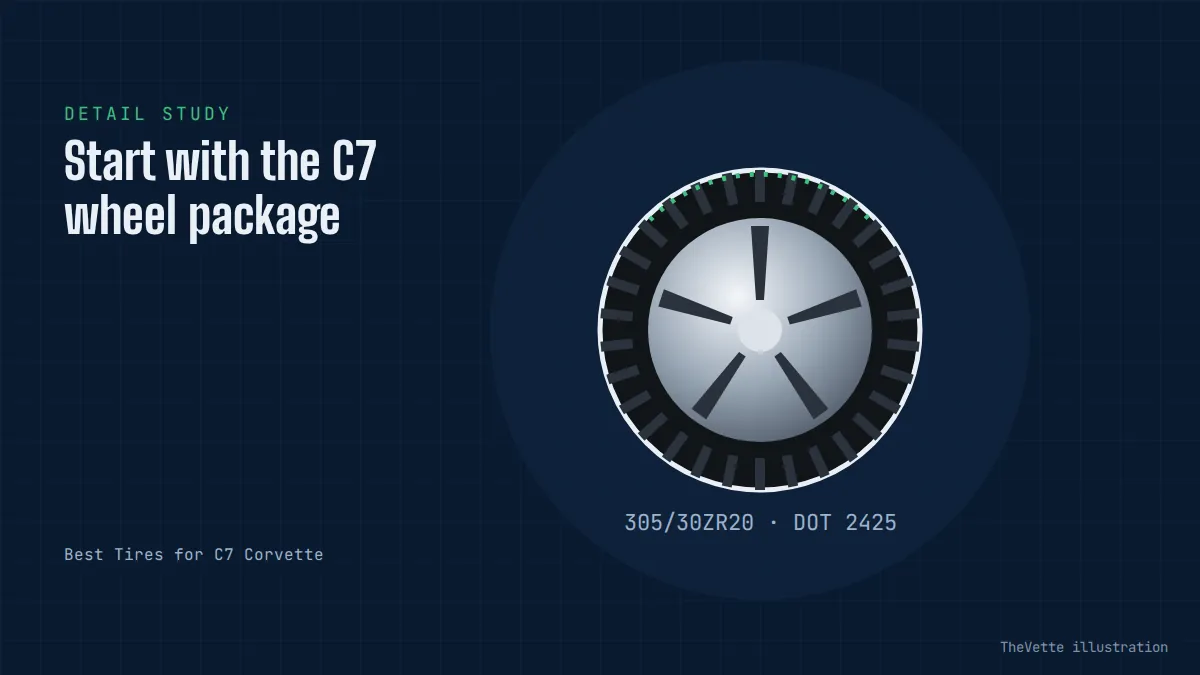
US fitment catalogs list a 2019 Stingray at 245/35R19 front and 285/30R20 rear. The 2019 Grand Sport, Z06, and ZR1 appear with the much wider 285/30R19 front and 335/25R20 rear pair. Those two groups cannot share a generic recommendation. A tire family available for a Stingray may lack the wide rear, while a wide-body fitment may use different load indexes or constructions.
| Configuration | Common front | Common rear | Before ordering |
|---|---|---|---|
| Stingray | 245/35R19 | 285/30R20 | Check Z51, wheel history, and placard |
| Grand Sport | 285/30R19 | 335/25R20 | Confirm wide-body wheels and matching set |
| Z06 | 285/30R19 | 335/25R20 | Account for package and intended track use |
| ZR1 | 285/30R19 | 335/25R20 | Use exact model-year documentation |
The table is a routing guide, not a replacement for the door label. Check all four sidewalls because a previous owner may have changed size. Then verify wheel width and offset. Tire diameter, load capacity, brake clearance, and fender clearance are engineering constraints, not styling preferences.
How the recommendations were chosen
We looked for current manufacturer data, a matching front-and-rear set, a clear temperature and use category, suitable published service descriptions, and US availability evidence. We did not claim personal track testing or rank a tire from advertising language. Price was not used as a fixed fact because promotions and inventory move quickly.
The right category matters more than a small difference in an online score. A premium summer tire used below its temperature range is the wrong tire. A track-focused compound on a cold, wet commute can be a worse decision than a less glamorous all-season. The car’s real calendar and roads should determine the shortlist.
Michelin Pilot Sport 4 S: premium warm-weather road choice
Michelin’s US vehicle selector lists the Pilot Sport 4 S in the common 2019 Stingray pair: 245/35ZR19 front and 285/30ZR20 rear. It is a summer sport tire intended for drivers who prioritize steering response and warm-condition dry and wet performance. It is a logical road-first option for a C7 that does not need to operate near freezing.
The main advantage is a focused road mission without moving directly to a track-oriented product. The main disadvantage is the seasonal boundary. Michelin’s listing also shows different service descriptions from the original-equipment ZP tires, so the buyer must compare load and speed capability, construction, and mobility strategy rather than matching only the size.
Best for: enthusiastic street use and road trips in appropriate temperatures. Skip it when: the Corvette must remain available through a cold winter or the owner cannot store or swap tires seasonally.
Continental ExtremeContact Sport 02: broad summer alternative
Continental publishes relevant C7 sizes including 245/35ZR19, 285/30ZR20, 285/30ZR19, and 335/25ZR20. That gives the ExtremeContact Sport 02 unusual usefulness across both Stingray and wide-body searches. Its specification pages also expose approved rim width, diameter, load index, speed rating, and UTQG data for the individual size.
This tire is a strong starting point when warm-weather road performance and a coherent staggered set matter. Availability still must be checked on the purchase date. A manufacturer size table proves the product exists in a size; it does not guarantee nearby inventory or that every construction detail matches the vehicle’s original tire.
Advantages: broad documented size coverage and a road-performance focus. Trade-offs: no snow or freezing-weather mission, and conventional construction may change the roadside-mobility plan on a car originally equipped with extended-mobility tires.
Michelin Pilot Sport All Season 4: one-set flexibility
Michelin lists the Pilot Sport All Season 4 for the Stingray’s common size pair, including ZP versions in its US selector. The tire fits an owner who drives in rain, shoulder-season temperatures, and occasional light wintry conditions but does not need a dedicated severe-winter solution. Its broader temperature range can be more useful than the last measure of hot-road response.
All-season does not mean all conditions. Deep snow, ice, and sustained severe cold remain winter-tire territory, and the C7’s low clearance limits it even with appropriate rubber. On a wide-body C7, confirm that both large sizes are current in the same product before committing.
Best for: a street-driven Stingray that must cover a wider US climate window. Trade-off: less specialized than a summer tire in heat and a winter tire in snow.
When a track-focused tire is justified
Michelin’s selector lists Pilot Sport Cup 2 variants in Stingray sizes, and track-package C7 models may have been engineered around highly specialized tires. Such a product makes sense only when the owner understands warm-up, rain sensitivity, storage temperature, heat cycles, accelerated wear, and event inspection. It should not be purchased simply because it was associated with a faster trim.
Track tires expose weak preparation quickly. Fresh high-temperature brake fluid, adequate pads, sound hubs, correct torque, clean cooling paths, suitable alignment, and a conservative learning plan are part of the same decision. Read the track-day preparation guide before choosing grip that exceeds the rest of the car or driver.
ZP run-flat versus conventional tires
Michelin marks certain C7 listings “ZP,” its zero-pressure designation. The C7 does not carry a conventional spare, so retaining extended-mobility construction can provide limited travel after some pressure-loss events within the tire maker’s instructions. It cannot make a sidewall cut, bent wheel, or major impact safe to drive on.
A conventional tire may broaden choice and alter ride or steering feel, but it removes that limited mobility. Owners who switch need roadside assistance capable of moving a low, wide Corvette, plus an inflator and compatible sealant for the narrow failures those tools can address. Sealant is not a universal repair and may affect tire-pressure sensor service.
Use one coherent construction across the car. Mixing run-flat and conventional tires between axles can create different response and breakaway behavior. If an exact tire is discontinued, ask the manufacturer or an experienced performance installer about the safest replacement scope.
Load index and speed symbol are part of fitment
A size such as 245/35ZR19 is incomplete without its service description. Michelin’s selector, for example, shows original-equipment and replacement choices with different load indexes in nominally the same size. “XL” identifies an extra-load construction, but it is not proof that the tire is correct.
Do not downgrade load capacity or performance capability without vehicle-specific professional guidance. Compare the door label, manual, and tire manufacturer data. If wheels or sizes have changed, have the installer document load capacity, approved rim width, inflation basis, and clearance.
Pressure and the C7 monitoring system
Set pressure cold from the vehicle label, not the maximum molded into the tire sidewall. Pressure rises as the tire warms, so bleeding a normally hot tire down to its cold target can leave it underinflated later. Check after large ambient-temperature changes and before highway or track use.
The tire-pressure monitoring system is a warning aid. It cannot see inner-shoulder wear, cracking, impact bubbles, old rubber, or a mismatched product. When new tires are fitted, confirm sensor condition and that the displayed wheel positions are correct after any relearn procedure.
Alignment is a tire-cost decision
Wide C7 tires can wear on the inside where a casual walk-around misses the damage. Measure tread at several points across each tire. A performance alignment may add negative camber for track work, but street mileage and shoulder wear will change. Ask for before-and-after readings and keep the sheet.
New tires should not be used to hide vibration, tramlining, or steering play. Inspect wheels, hubs, tie rods, bushings, dampers, and alignment first. A bent wheel or worn component can ruin an expensive set quickly. Road-force balancing may help isolate uniformity issues when ordinary balancing does not.
Age and storage on low-mileage C7s
A C7 can age out a tire before wearing it out. Read the DOT Tire Identification Number and follow the tire maker’s inspection and replacement guidance. Consider storage temperature, sunlight, long periods under load, puncture repairs, track heat, and visible condition. Deep tread is only one part of fitness.
When ordering wide or uncommon sizes, ask the seller about inventory age and return policy. Inspect all four date codes on arrival. A discounted old rear paired with a fresh front is not automatically a good-value set.
How to compare real installed cost
Get a written four-tire quote listing product codes, sizes, service descriptions, mounting, balancing, sensor service, disposal, taxes, alignment inspection, delivery date, and road-hazard terms. Confirm that the shop can lift a C7 correctly and mount low-profile tires without marking the wheels.
Do not trust a fixed price range copied from an old article. Wide-body rear tires can be scarce, and promotions vary. A dated quote from a capable installer is more useful than a national headline that excludes one axle or necessary service.
Ask what happens if one tire is damaged soon after installation. A warranty may pay part of the replacement yet still leave the owner facing a tread-depth mismatch or a discontinued model. The shop should explain whether shaving, axle-pair replacement, or a complete-set change would be considered and who makes that safety decision. Before leaving, compare the invoice with every sidewall, inspect the wheels, confirm pressure and sensor operation, and photograph the date codes for the maintenance file.
Frequently asked questions
Can a Stingray use Grand Sport or Z06 wheels and tires?
Only after wheel width, offset, body clearance, brake clearance, load, diameter, and system compatibility are verified. A wide-body factory size is not automatically safe under a narrow body.
Can C7 tires be rotated?
The staggered front and rear sizes prevent ordinary front-to-rear rotation. Directional designs may also restrict side-to-side movement. Follow the tire maker’s markings.
Should the deeper-tread pair go on the rear?
When only two tires are replaced, tire-industry guidance commonly places the deeper pair on the rear to reduce oversteer risk in wet conditions. All four still need compatible construction, category, and safe condition.
Does Z51 always change the tire size?
Do not infer size from the badge or package name. Check the exact label, current sidewalls, build information, and model-year manual because equipment and later wheel changes matter.
Final recommendation
For a stock Stingray driven only in appropriate warm weather, compare the Michelin Pilot Sport 4 S and Continental ExtremeContact Sport 02 in the exact 245/35ZR19 and 285/30ZR20 pair. For a wider seasonal range, the Pilot Sport All Season 4 is the more practical starting point. Grand Sport, Z06, and ZR1 owners should search their 285/30ZR19 and 335/25ZR20 fitment separately and verify the complete set before buying.
Use the broader Corvette tire guide for inspection and terminology, and the C7 buyer’s guide when tires are part of a used-car decision. The best result is a fresh, matched, correctly rated set for the exact car, climate, and use—not the most aggressive name on the invoice.