There is no single best tire for every C6 Corvette because the generation covers several factory wheel packages and very different jobs. A standard C6 used on warm, wet, and dry roads is well served by a current max-performance summer tire such as the Continental ExtremeContact Sport 02. A driver who needs one set through cooler seasons should compare premium ultra-high-performance all-season options in the exact base-car sizes. Grand Sport, Z06, Z07, and ZR1 fitments must be treated as separate searches.
To place Best Tires for C6 Corvette in a wider ownership and engineering context, continue with Corvette Tire Guide: Fitment, Age, Grip, and Touring Comfort.
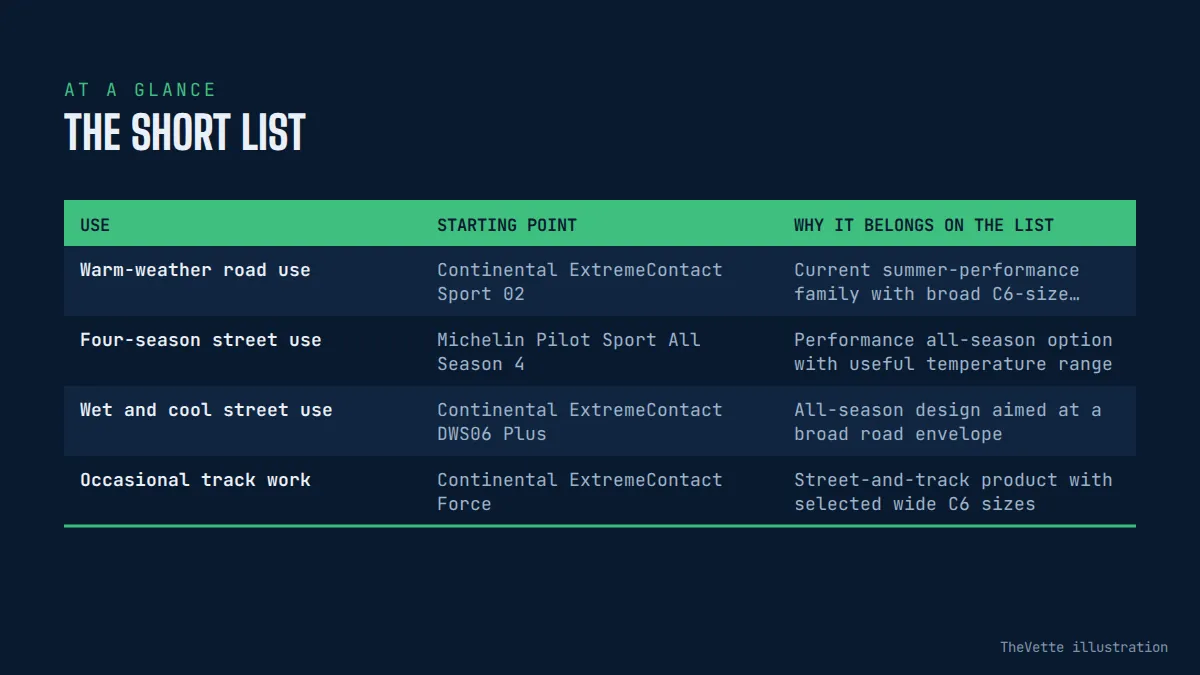
The short list
| Use | Starting point | Why it belongs on the list | What to verify |
|---|---|---|---|
| Warm-weather road use | Continental ExtremeContact Sport 02 | Current summer-performance family with broad C6-size coverage | Both axle sizes and service descriptions |
| Four-season street use | Michelin Pilot Sport All Season 4 | Performance all-season option with useful temperature range | Exact trim availability and current stock |
| Wet and cool street use | Continental ExtremeContact DWS06 Plus | All-season design aimed at a broad road envelope | Matching front/rear model and load ratings |
| Occasional track work | Continental ExtremeContact Force | Street-and-track product with selected wide C6 sizes | Complete fitment, temperature, wear, and event rules |
A recommendation is only valid after it matches the car. Read the driver-door label and all four sidewalls, identify the trim and wheel option, and inspect for aftermarket wheels or spacers. Product lines and inventories change. This guide records useful current starting points, not a promise that a particular set will remain available.
C6 factory-size map
The standard late C6 fitment commonly appears as 245/40R18 front and 285/35R19 rear. The wide-body Grand Sport commonly uses 275/35R18 front and 325/30R19 rear. Many Z06 cars use that same nominal 18/19-inch size pair, while Z07-equipped Z06 examples and the ZR1 can use 285/30R19 front and 335/25R20 rear. Model year and equipment matter, so those examples must never replace the exact label and manual.
| C6 configuration | Common front size | Common rear size | Shopping implication |
|---|---|---|---|
| Standard coupe or convertible | 245/40R18 | 285/35R19 | Broadest choice in the generation |
| Grand Sport | 275/35R18 | 325/30R19 | Wide rear limits some tire families |
| Z06 without 19/20-inch package | 275/35R18 | 325/30R19 | Verify year, wheel, and brake package |
| Z06 Z07 / ZR1 examples | 285/30R19 | 335/25R20 | Specialist sizes with fewer complete sets |
Early cars, optional wheels, and modified cars can differ. A wheel that looks factory may be a reproduction with another width or offset. The markings on the back of the wheel, the build information, and physical measurement can resolve uncertainty. If the car has carbon-ceramic brakes or a track package, brake clearance also belongs in any proposed wheel change.
How we evaluate a C6 tire
The first gate is a matching set in the correct sizes. The second is a suitable load index and speed capability. Only then do compound, wet behavior, ride, noise, tread life, and price enter the decision. We favor manufacturers that publish dimension and service data, and we separate summer, all-season, and track-oriented products because they solve different problems.
No ranking here is based on a road test we did not perform. The conclusions combine documented fitment, tire-category purpose, and the practical demands of a light, powerful, rear-drive sports car. Individual ride and steering impressions remain subjective; pressure, alignment, wheel condition, temperature, and suspension condition can change them substantially.
Best for warm-weather road driving
The Continental ExtremeContact Sport 02 is a sensible first search for a C6 that is parked during freezing weather. Continental lists many of the relevant sizes, including 285/35ZR19, 275/35ZR18, 325/30ZR19, 285/30ZR19, and 335/25ZR20. That unusually broad range helps owners keep one tire family across a staggered setup instead of mixing models.
As a max-performance summer tire, it is intended for responsive dry and wet driving in suitable temperatures. Summer does not mean “dry only.” It does mean the compound should not be used as an all-weather solution when temperatures approach freezing, and it is not designed for snow or ice. Owners in cold states need either seasonal storage, a separate winter setup, or an appropriate all-season compromise.
Reasons to choose it: broad C6-size coverage, published specifications, and performance-focused road behavior. Reasons to look elsewhere: regular cold-season use, a need for winter mobility, or a priority on long touring wear over response. Verify the precise size’s load index and approved rim-width range rather than treating every listing as identical.
Best one-set strategy for changing seasons
The Michelin Pilot Sport All Season 4 belongs on a base-C6 shopping list when the car sees cool mornings, rain, and regular road use outside a summer-only window. It is an ultra-high-performance all-season tire, so its mission is broader than that of a summer product. Its value is convenience and temperature flexibility, not an ability to equal dedicated tires at both extremes.
Availability becomes more complicated on wide-body trims. Search both axles before choosing a brand, and confirm that the rear is not an old or discontinued listing. When only one axle size appears, do not complete the set with an unrelated model without written guidance from the tire manufacturer or a qualified installer.
Reasons to choose it: broad street mission and a premium performance-all-season category. Reasons to look elsewhere: repeated track use, deep winter conditions, or warm-weather steering precision as the only priority. A real winter climate still favors a dedicated winter package, subject to wheel and brake clearance.
Wet and cool-climate alternative
The Continental ExtremeContact DWS06 Plus is another all-season candidate for street-driven C6 models. It is most relevant to an owner who values rain performance, cooler-temperature usability, and everyday comfort more than the last degree of hot-weather sharpness. The decision between it and the Michelin should come from current complete-set availability, specifications, installed cost, warranty terms, and the driver’s priorities.
Do not turn treadwear grades into a grip scoreboard. UTQG figures have limits and are most useful as broad reference points rather than precise cross-brand predictions. A longer-wearing compound can still be the wrong choice if the car’s use demands another temperature range or category.
Track-focused choices need a separate plan
The Continental ExtremeContact Force is designed for street and racetrack driving with an emphasis on dry handling, and Continental lists selected wide C6-relevant sizes such as 325/30ZR19. That does not automatically make it a complete fitment. Check whether the matching front exists for the car’s setup, and read the manufacturer’s temperature, break-in, storage, pressure, and wear guidance.
A track tire will not fix old brake fluid, heat-damaged pads, loose hubs, weak alignment components, or an inexperienced driver. Repeated track work also changes the tire inspection schedule. Measure pressures hot and cold, record shoulder wear, inspect after each session, and follow the event organizer’s rules. For the whole preparation picture, use the Corvette track-day guide.
Run-flat versus conventional construction
C6 Corvettes commonly came with extended-mobility tires and do not carry a normal spare. Keeping run-flats preserves limited mobility after some pressure-loss events within the tire maker’s restrictions. That can be reassuring on interstate trips or in areas where low-clearance towing is difficult.
Conventional tires expand the product choice and may change ride and steering feel. They also require a serious roadside plan. An inflator and compatible sealant may help with a small repairable tread puncture, but neither can repair a torn sidewall, bent wheel, or large impact break. Roadside coverage should specify suitable flatbed transport for a low sports car.
Change construction as a complete set. Mixing run-flat and conventional behavior between axles can make breakaway response inconsistent. Tire-pressure monitoring remains essential but does not replace physical inspection.
Why a matching set matters
The C6 is staggered because front and rear tires do different work, but their behavior still needs to be coherent. Unrelated tread designs can evacuate water differently, warm at different rates, and respond differently near the limit. Even two products from the same brand may use different compounds and casing strategies.
When a damaged tire cannot be replaced with the same model, ask the manufacturer or a qualified performance shop about the safest replacement scope. Consider remaining tread depth, age, construction, and use. Saving one or two tires is not a victory if it leaves the car unpredictable in rain.
Pressure, alignment, and tire wear
Use the vehicle placard for the cold-pressure baseline, not the maximum pressure printed on the sidewall. Pressure rises after driving, so do not bleed a normally hot tire back to its cold number. Recheck after seasonal temperature changes and before any long trip.
Wide C6 rear tires can hide inner-shoulder wear. Measure across the tread rather than looking only at the outer edge. Uneven wear can reflect alignment, pressure, worn bushings, damaged wheels, or track use. A performance alignment may be appropriate for an owner who accepts faster wear, but it should be documented and intentional.
Inspect wheel bearings, tie rods, ball joints, dampers, and bushings before using new tires to mask a vibration or wandering complaint. Road-force balancing can help diagnose some wheel-and-tire uniformity problems, but bent wheels and worn components still need repair.
Tire age matters on low-mileage cars
Many C6s cover few miles each year. Tread can look deep while the tire has spent years exposed to heat cycles, sunlight, long-term loading, and storage conditions. Read the DOT Tire Identification Number, inspect all surfaces, and follow the tire manufacturer’s age guidance. Goodyear states that tires in service for six years or more should be replaced even when legal tread remains.
Ask a retailer about its inventory-age policy before ordering uncommon sizes. When the set arrives, inspect the date codes and confirm all four are the ordered model and specification. Keep the invoice, alignment sheet, and installed date with the car’s records.
Building a complete installed quote
Compare four-tire totals, not a single advertised price. A useful quote lists each size and product code, mounting and balancing, sensor or valve service, disposal, taxes, alignment inspection, road-hazard terms, and delivery date. Ask whether the shop has suitable lifting procedures and equipment for low-clearance Corvettes and wide wheels.
Approximate online prices become stale quickly and vary with promotions, location, and stock. This guide therefore does not publish a made-up “usual” price. Get dated written quotes from more than one capable installer and compare what is included.
Also ask how the installer will handle a tire that arrives visibly old, damaged, or outside the agreed specification. A written answer matters when the rear size is scarce and a replacement would delay the job. Before leaving, inspect every wheel, confirm the directional or outside markings, check the invoice against the sidewalls, and arrange a safe recheck if the shop recommends one after the first heat cycle.
Frequently asked questions
Can a standard C6 use Grand Sport or Z06 tire sizes?
Not on its standard wheels. Wider sizes require a compatible wheel package plus verified offset, brake, suspension, fender, and electronic-system compatibility. Appearance alone is not proof of fit.
Can I rotate staggered C6 tires?
Ordinary front-to-rear rotation is not possible when sizes differ. Directional or asymmetric markings may further restrict side-to-side movement. Follow the tire maker’s instructions and monitor wear closely.
Do I need run-flats?
Not necessarily, but switching removes their limited pressure-loss mobility. Decide how the car will be recovered after damage that sealant cannot repair, and replace the set coherently.
Which tire is quietest?
Noise depends on road surface, wear, pressure, alignment, wheel construction, and the tire. Category and published design can narrow the field, but no honest answer guarantees silence in every C6.
Final recommendation
For a standard C6 used in suitable warm weather, begin with a complete ExtremeContact Sport 02 quote in 245/40R18 front and 285/35R19 rear, after confirming the car’s label. For broader seasonal street use, compare the Pilot Sport All Season 4 and DWS06 Plus in the exact pair. Grand Sport, Z06, Z07, and ZR1 owners should start with their own wheel package and accept that availability may decide which coherent set is possible.
Before ordering, read the general Corvette tire guide and the C6 buyer’s guide. The strongest purchase is not a famous name; it is a fresh, matching, correctly specified set installed on a sound car for the conditions it will actually face.