The best tire for a C5 Corvette is the one that matches its exact wheel package, weather, and use—not simply the tire with the most aggressive name. For a stock base coupe or convertible driven in warm weather, the Continental ExtremeContact Sport 02 is a strong performance-first choice where the correct sizes are available. Drivers who need useful cold-weather flexibility should compare the Michelin Pilot Sport All Season 4 and Continental ExtremeContact DWS06 Plus. A C5 Z06 uses different factory sizes, so it must be shopped separately.
To place Best Tires for C5 Corvette in a wider ownership and engineering context, continue with C5 Corvette Buyer’s Guide: Performance Value Explained.
Quick recommendations
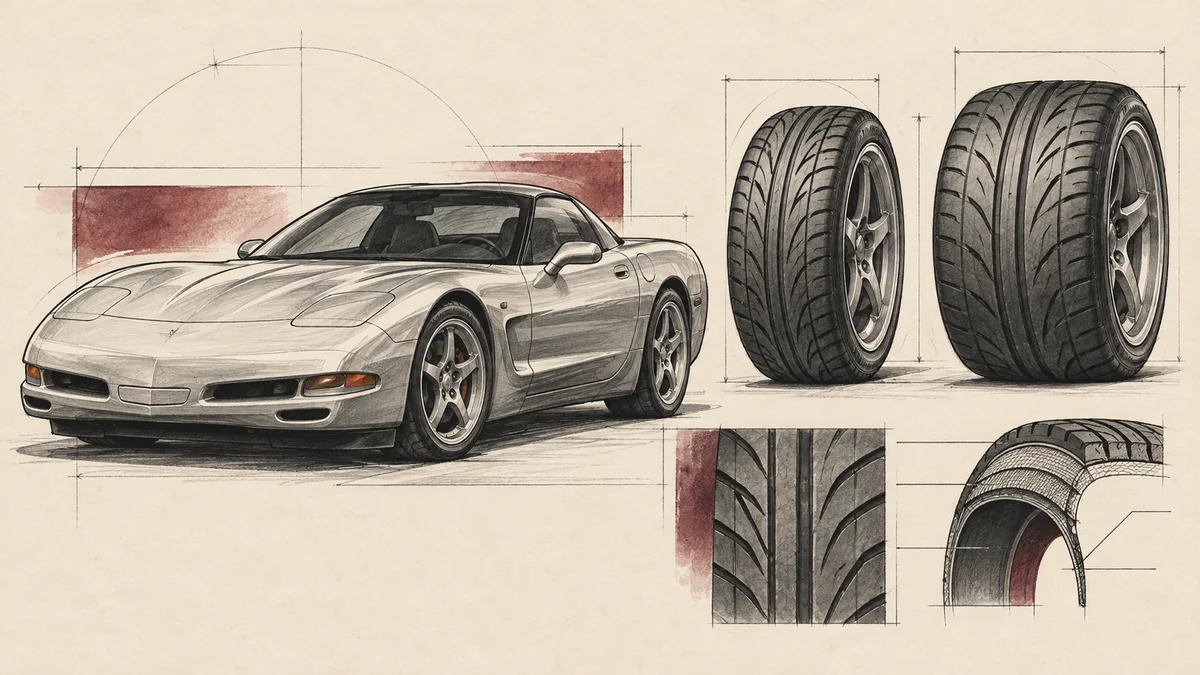
| Tire | Best for | Type | Main trade-off |
|---|---|---|---|
| Continental ExtremeContact Sport 02 | Warm-weather road driving | Max-performance summer | Not intended for freezing conditions |
| Michelin Pilot Sport All Season 4 | Premium year-round flexibility | Ultra-high-performance all-season | Less focused than a summer tire in heat |
| Continental ExtremeContact DWS06 Plus | Wet and cool-climate daily use | Ultra-high-performance all-season | Softer response than the sharpest summer option |
| BFGoodrich g-Force COMP-2 A/S Plus | Value-minded street use | Ultra-high-performance all-season | Verify both axle sizes before ordering |
These are starting points, not universal fitment promises. Tire catalogs change, and a 25-year-old Corvette may no longer have its factory wheels. Confirm the size molded into all four current sidewalls, the driver-door placard, wheel width and offset, load index, speed rating, and clearance before buying. Never assume that a product shown for one C5 trim fits every C5.

Know which C5 you have before shopping
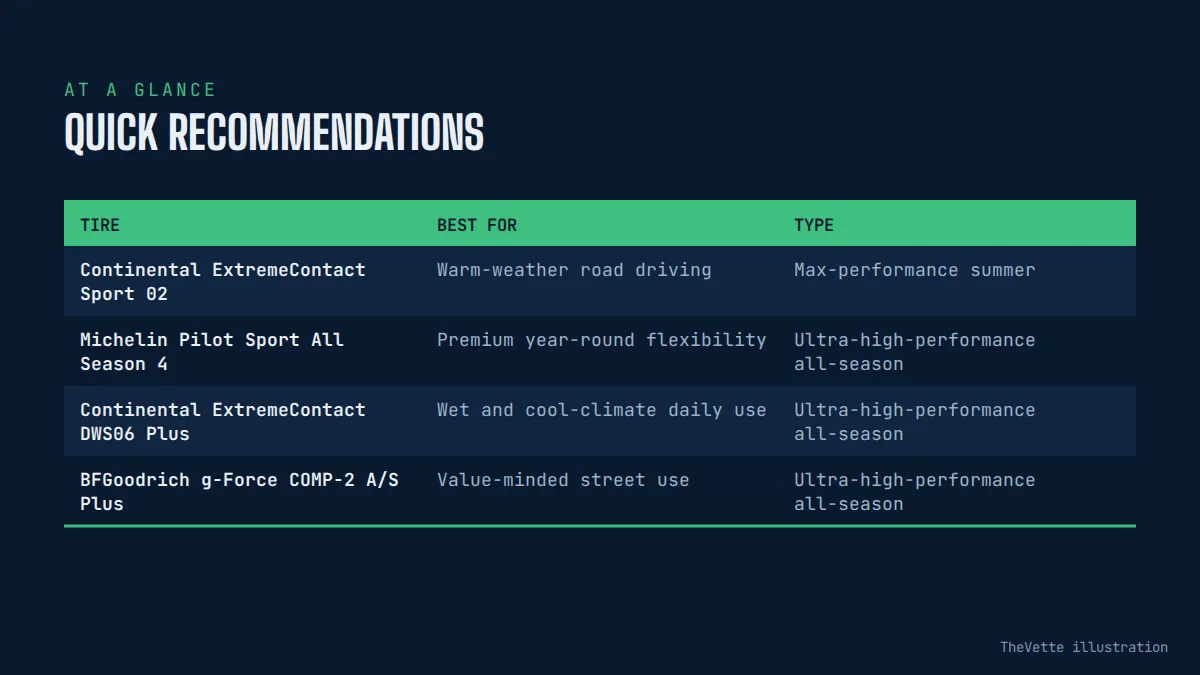
The C5 ran from 1997 through 2004, and the range includes coupes, convertibles, fixed-roof coupes, and the Z06. The familiar staggered base fitment is 245/45ZR17 at the front and 275/40ZR18 at the rear. The 2001–2004 Z06 uses a wider stagger, commonly listed as 265/40ZR17 front and 295/35ZR18 rear. Those numbers describe more than diameter. They affect approved wheel width, load capacity, overall diameter, steering clearance, and electronic-system behavior.
Cars with aftermarket wheels need a fresh fitment review. A seller may have installed C6-style wheels, nonstandard offsets, spacers, or a square track setup. Reading the current sidewalls tells you what is fitted, but it does not prove that the setup is correct. Measure the wheels or find their markings and ask a capable tire shop to inspect inner clearance, fender clearance, brake clearance, and seating surfaces. The safest order begins with the car, not an online shopping cart.
How these choices were selected
This guide favors tire families that manufacturers currently document and that major US fitment catalogs show in relevant C5 sizes. We looked for a coherent front-and-rear set, appropriate performance category, credible wet-weather design, and a clear use case. We did not rank tires from an unperformed road test, and we do not claim that one compound wins every objective.
Availability is especially important for the C5 because its staggered 17- and 18-inch combination is no longer the center of the new-car market. A tire may be excellent in isolation yet useless if only the front size is stocked. Check the manufacture date when the tires arrive, and do not mix unrelated models across axles merely to complete the order without professional guidance.
Best warm-weather choice: Continental ExtremeContact Sport 02
The ExtremeContact Sport 02 is a max-performance summer tire aimed at responsive street driving and wet performance in warm conditions. Continental publishes extensive size data, including load and speed ratings, approved rim-width ranges, tread depth, and overall dimensions. That makes it easier to compare the actual specification with the Corvette rather than relying on a retailer’s headline.
It suits an owner who drives from spring through fall, wants direct steering response, and will park the car when temperatures fall toward freezing. “Summer” does not mean dry-only; this category is designed to work in warm rain as well as dry conditions. It does mean that the compound is not intended for snow, ice, or sustained cold. A garage does not change the temperature of the road once the car leaves home.
Advantages: performance-focused response, a current manufacturer specification table, and a sensible balance for enthusiastic road driving. Disadvantages: seasonal limitations, potentially shorter life than a touring tire, and no substitute for a winter setup in a cold region. Confirm current production in both required sizes before treating it as the answer.
Best premium all-season choice: Michelin Pilot Sport All Season 4
The Pilot Sport All Season 4 is a useful answer for owners who want one set through wider temperature swings and do not routinely drive through deep snow. US fitment listings show it in the standard C5 base sizes. Its appeal is breadth: it aims to retain sporty road manners while adding cold and light-winter capability that a summer compound cannot provide.
That breadth is not magic. An all-season tire is still a compromise. In consistently hot weather and hard driving, a good summer tire can offer the more focused response. In real winter conditions, a dedicated winter tire can provide a much larger safety margin. Choose this Michelin when the car must handle cool mornings, rain, road trips, and occasional light wintry conditions—not as permission to ignore a storm.
Advantages: broad operating range, premium positioning, and relevant base-C5 fitment. Disadvantages: a higher purchase price in many markets and less specialization at either seasonal extreme. Compare total installed price, road-hazard terms, and replacement availability rather than the tire price alone.
Best wet and cool-climate alternative: Continental DWS06 Plus
Continental lists the ExtremeContact DWS06 Plus in 245/45ZR17 and 275/40ZR18, making it a straightforward candidate for a stock-size base C5. It is an ultra-high-performance all-season tire, not a touring tire, and its published specification data includes a 560 AA A UTQG rating for relevant sizes. UTQG can help compare models within limits, but it is not a universal prediction of mileage or grip across brands.
This is the choice to consider when rain, cool shoulder seasons, and everyday usability matter more than the crispest hot-weather response. It can also make sense for a road-trip car that may cross changing weather. It should not be presented as a snow tire. If the Corvette must travel during regular snow and ice, use a properly sized winter package and account for the C5’s low ground clearance.
Advantages: correct base sizes are documented, the use case is clear, and the tire offers a broad street envelope. Disadvantages: some drivers will prefer the sharper feel of a summer tire, and the Z06 requires a separate availability check. Do not substitute a near size simply because it is in stock.

Value all-season option: BFGoodrich g-Force COMP-2 A/S Plus
The BFGoodrich g-Force COMP-2 A/S Plus appears in US fitment catalogs for the standard C5 stagger and can be a sensible price-conscious alternative. It belongs on the list because it answers a real need: an owner who wants performance-oriented all-season capability without automatically buying the most expensive option.
Value should be measured across the whole set. Confirm that the front and rear tires share the same model and suitable service description, then compare mounting, balancing, disposal, taxes, road-hazard coverage, and local replacement access. A low advertised price on one axle is not a bargain if the matching rear is unavailable. Production date also matters; uncommon sizes can remain in inventory longer.
Advantages: accessible positioning and a useful street-focused category. Disadvantages: local stock can vary and the final decision should follow a current four-tire quote. As with every recommendation here, verify the exact listing on the purchase date.
Run-flat or conventional tires?
Many C5s were delivered with extended-mobility tires, and the car does not have a conventional spare-tire well. That makes the run-flat question more important than it is on an ordinary sedan. A run-flat can allow limited travel after a loss of pressure under the tire maker’s stated conditions, which may be valuable on a road trip. It does not make punctures harmless, and sidewall or impact damage can still end the trip.
Conventional performance tires often provide more choice and may improve ride comfort, depending on the tire and pressure. The trade-off is that a flat may leave the car immobile. Owners who switch should carry a realistic plan: a compatible inflator and sealant for repairable tread punctures, roadside-assistance coverage that can transport a low sports car, and a phone and charger. Sealant cannot repair every failure and may complicate sensor or tire service.
Do not mix run-flat and conventional construction casually. Different behavior between axles can make the car less predictable. If changing tire type, replace the complete set unless the tire manufacturer and qualified installer approve another arrangement.
Load index, speed rating, and service description
The size is only the beginning of a tire specification. The service description combines load index and speed symbol. Replacement tires must carry enough load for the vehicle and intended use, and performance capability should not be downgraded without understanding the manufacturer’s requirements and any legal or insurance implications. An “XL” marking identifies extra-load construction; it does not automatically make a tire correct for the car.
Use the placard and model-year documentation as the baseline. Retail filters can be wrong when a trim or wheel option is selected incorrectly. If the car has been modified, ask the installer to document the chosen size, wheel-width compatibility, load capacity, and cold pressure. Keep that record with the vehicle.
Do not shop by price alone
A complete quote should identify all four tire model numbers, manufacture dates or a date policy, mounting method, balance, new valve hardware where appropriate, sensor service, disposal, taxes, alignment inspection, and warranty terms. The C5’s wide, low-profile rear tires require equipment and care that will not damage the wheel. Confirm that the shop can lift the car at the correct points and has experience with low-clearance vehicles.
Very old new-stock tires deserve caution. The DOT Tire Identification Number provides production information, but age must be considered with storage, condition, and tire-maker guidance. Inspect for cracking, distortion, repairs, uneven wear, exposed cords, or impact damage. A tire can age out before its tread is worn out, especially on a weekend car.
Alignment and wear patterns
New tires cannot repair a poor alignment or worn chassis parts. Before installation, inspect tie-rod ends, ball joints, wheel bearings, dampers, bushings, and wheels. After installation, alignment should be checked against the correct specification and the car’s actual use. An aggressive track-oriented alignment can wear the inside shoulders quickly on the street.
Record tread depth across each tire and recheck it periodically. A difference between inner, center, and outer readings tells more than a glance at the outside shoulder. Center wear may point toward pressure or use; one-sided wear can suggest alignment or damaged parts. Diagnosis should consider the full pattern rather than one photograph.
Cold pressure and temperature
Set pressure when the tires are cold, using the vehicle placard as the starting point—not the maximum pressure molded on the sidewall. Pressure changes with ambient temperature and rises during driving. Do not bleed a normally warmed tire back to its cold setting. Recheck after a major weather change and before a long trip.
Some C5s now have replacement sensors or altered wheels, and early monitoring hardware may need service. A warning should trigger an actual gauge check and inspection. The monitoring system is useful, but it cannot judge tread condition, alignment, sidewall aging, or whether the fitted tire is appropriate.
What about the C5 Z06?
The Z06’s wider 265/40ZR17 front and 295/35ZR18 rear sizes narrow the field. Do not assume that a base-car recommendation is sold in the Z06 pair. Search the manufacturer’s current size list for both axles and check wheel-width approval. Some owners move to different wheel diameters to access newer tire choices, but that is a wheel-and-tire engineering decision, not a simple substitution.
A changed package must preserve adequate load capacity and clearance while keeping overall diameters compatible with the car’s systems. Brake clearance, offset, hub fit, fastener seating, and fender clearance all matter. For a valuable or track-used Z06, a Corvette-experienced shop is worth seeking out.
Frequently asked questions
Can I use the same size on all four corners?
Not on stock staggered wheels. A square setup requires compatible wheels and a deliberate clearance and handling plan. It is not achieved by placing the front size on the wider rear wheel or vice versa.
Are all-season tires enough for winter?
They can handle cool temperatures and limited light wintry conditions better than summer tires, but dedicated winter tires remain the appropriate tool for regular snow and ice. Ground clearance is still a limit.
Should I replace only two tires?
Four matching tires are the cleanest performance solution. When only two are replaced, tire-industry guidance generally places the deeper-tread pair on the rear to reduce oversteer risk, but the remaining pair must still be compatible and safe. Ask the installer to assess the complete set.
How long will C5 tires last?
Mileage depends on compound, alignment, pressure, climate, storage, road surface, and driving. A weekend car may reach an age limit before a mileage limit. Follow the tire maker’s inspection and replacement guidance.
Final recommendation
For a stock base C5 used only in warm weather, start with the Continental ExtremeContact Sport 02. For broader seasonal use, compare complete installed quotes for the Michelin Pilot Sport All Season 4 and Continental ExtremeContact DWS06 Plus. Consider the BFGoodrich when value matters, but only if a fresh matching set is available. For a Z06, begin again with its wider factory sizes rather than carrying over the base-car answer.
Before ordering, read the broader Corvette tire guide for age, pressure, and inspection context, and use the C5 buyer’s guide if the tire condition is part of a purchase decision. The right tire is the verified set that fits the exact car and the weather it will actually encounter.