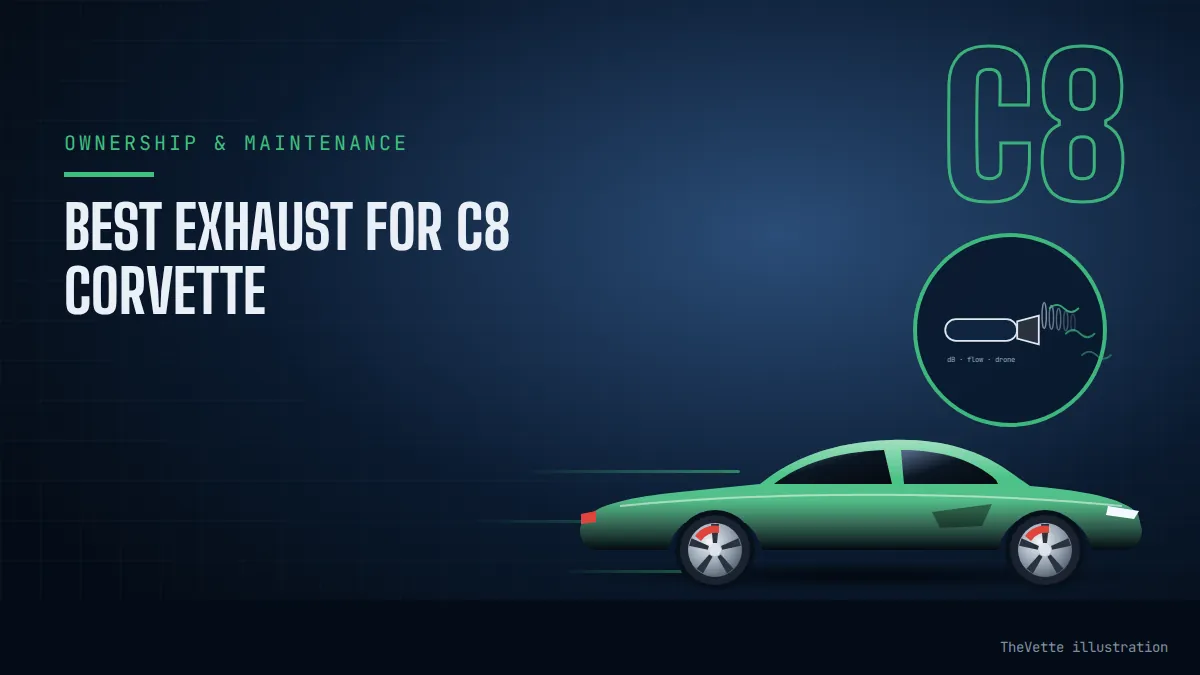
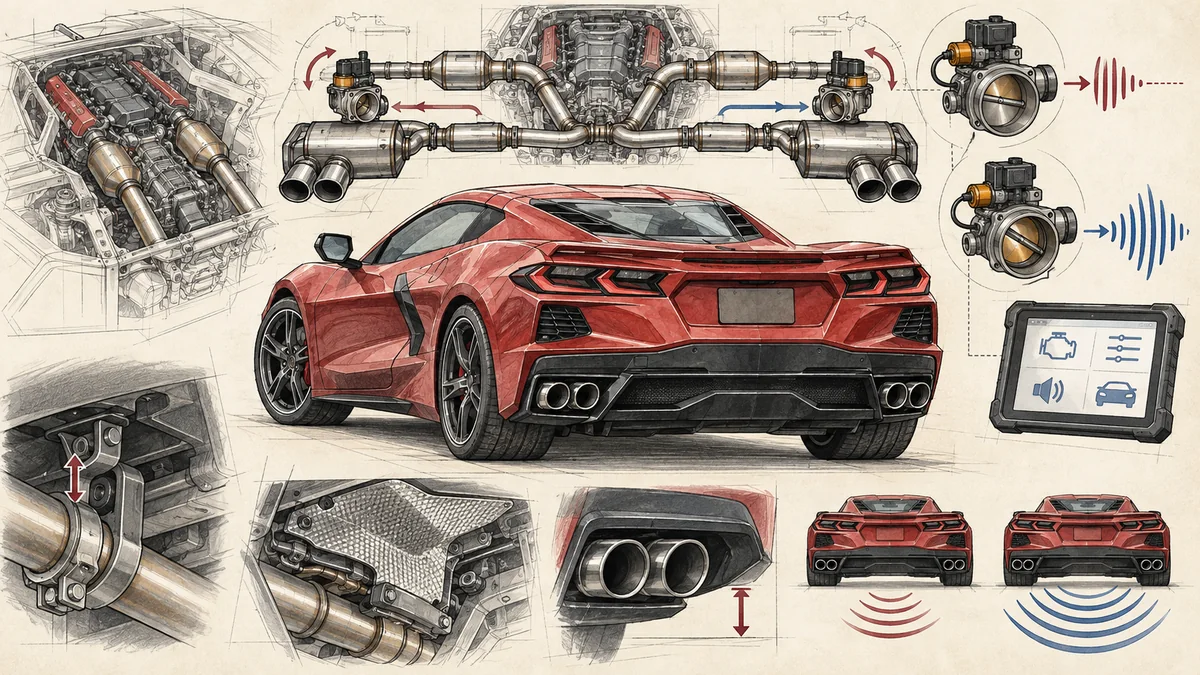
The best exhaust for a C8 Corvette must match more than its model year. Start with the exact trim and engine, whether the car has factory NPP performance exhaust, and the valve strategy used by that application. For most street-driven Stingrays, a documented cat-back that retains every required valve, keeps the original catalysts, and includes a clear recalibration procedure is the balanced choice. Z06, E-Ray, and later variants require their own verified fitment.
To place Best Exhaust for C8 Corvette in a wider ownership and engineering context, continue with C8 Corvette Buyer’s Guide: A Practical Mid-Engine Checklist.
Quick recommendations
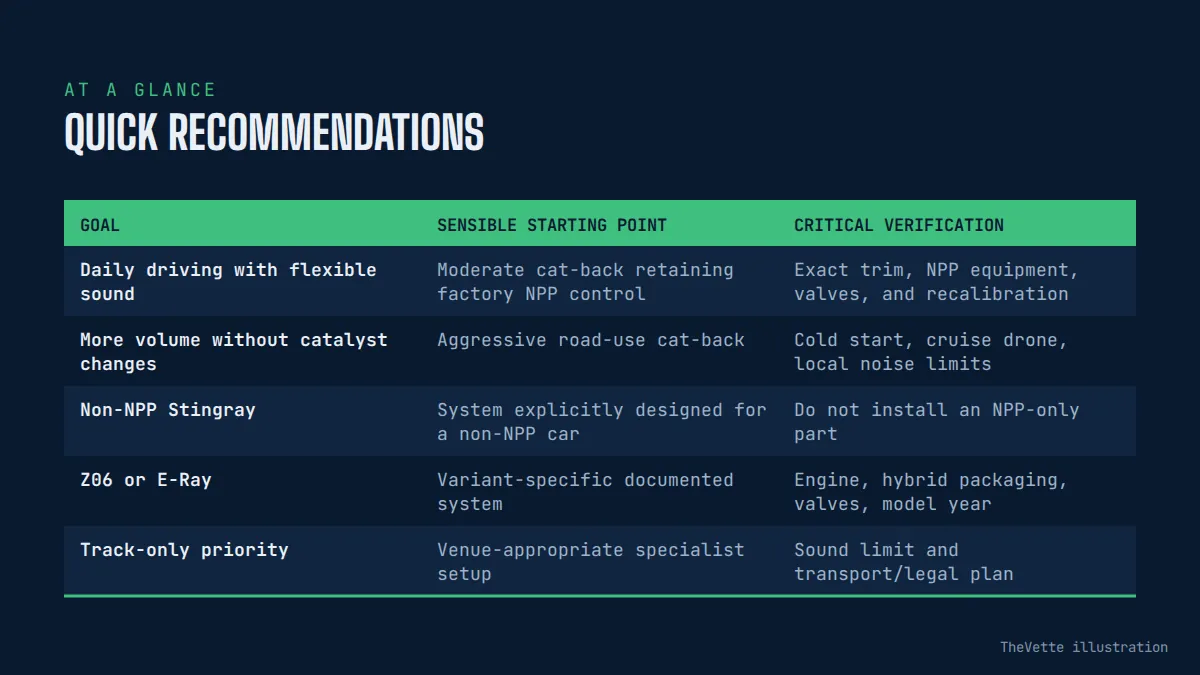
| Goal | Sensible starting point | Critical verification |
|---|---|---|
| Daily driving with flexible sound | Moderate cat-back retaining factory NPP control | Exact trim, NPP equipment, valves, and recalibration |
| More volume without catalyst changes | Aggressive road-use cat-back | Cold start, cruise drone, local noise limits |
| Non-NPP Stingray | System explicitly designed for a non-NPP car | Do not install an NPP-only part |
| Z06 or E-Ray | Variant-specific documented system | Engine, hybrid packaging, valves, model year |
| Track-only priority | Venue-appropriate specialist setup | Sound limit and transport/legal plan |
Why C8 exhaust fitment is unusually specific
The C8 places its engine and exhaust behind the cabin, concentrates heat around the rear structure, and uses electronic strategies that can involve more than one set of valves. A product described only as “2020-plus Corvette” does not provide enough information. Record the model year, Stingray, E-Ray, Z06, ZR1, or other variant, factory NPP status, and any previous engine or exhaust modifications.
Current manufacturer catalogs demonstrate the issue. Borla distinguishes systems that include AFM valves for 2020–2021, DFM valves for later listed years, and NPP valves. Its NPP-specific applications state that they should not be installed on cars without original NPP. That is evidence for those particular products, not a universal promise for every C8 or every brand.
Start with factory NPP status
NPP is the factory performance-exhaust option that changes exhaust-valve behavior to alter sound. Chevrolet’s C8 owner literature describes selectable engine-sound settings when equipped, integrated with drive-mode customization. A replacement system should preserve the control behavior an owner expects unless the loss is deliberately accepted and legally suitable.
Inspect the car and verify its build information. Do not infer NPP solely from tip appearance. A previous owner may have changed outlets or fitted a controller. For a compatible valved system, confirm whether original actuators transfer over, whether valves are included, how harnesses route, and which functions remain visible in the driver interface.
AFM and DFM valves are a separate concern
Some C8 Stingray applications use exhaust hardware related to cylinder-deactivation operation in addition to sound-control valves. Product catalogs may call these AFM or DFM valves according to the covered years. They are not simply another name for NPP.
A complete system must account for all required valve positions, actuators, connectors, and control logic. If a seller says a valve simulator, lockout, or tune is needed, understand the emissions, diagnostic, warranty, and driveability implications before purchasing. Avoid any solution whose main method is hiding a fault rather than matching the vehicle.
Cat-back systems: the practical street category
On the mid-engine C8, “cat-back” generally describes the downstream replacement system while retaining the factory catalytic converters. It can change mufflers, routing, valves, cross-flow elements, tips, and sound without turning the project into a catalyst-delete exercise. Exact contents still differ, so review the parts diagram.
A strong candidate provides a precise application list, material and tube specifications, valve details, installation guide, actuator procedure, included hardware, warranty, and support contact. It should also explain trim exclusions rather than hiding them. Broad compatibility language is less valuable than a narrow, documented fit.
For example, Borla’s current Stingray listings identify valved cat-back products for specific C8 years and equipment, including a required valve-actuator recalibration. Use such documentation to understand the selection process. TheVette has not performed a road test, sound measurement, or durability test of those systems and does not represent manufacturer claims as independent results.
Valve recalibration is part of the installation
Electronic exhaust actuators must know their operating range. A manufacturer may require recalibration after installation so the controls identify the new valve stops correctly. Skipping that step can produce a warning, poor operation, noise, or actuator stress even when the pipes physically fit.
Borla explicitly directs owners of certain C8 systems to have valve actuators recalibrated according to the referenced GM service procedure and recommends dealer service. Before ordering, ask who can perform the procedure, what scan equipment is needed, and whether its cost is included in the installation estimate.
A handheld diagnostic device pictured in marketing is not proof that it can complete the required relearn. Confirm the exact function in the tool maker’s current coverage data. Reading and clearing codes is not the same as commanding a manufacturer-specific actuator setup.
How much sound is enough?
Judge an exhaust in at least four situations: cold start, low-speed neighborhood driving, steady freeway cruise, and full acceleration. The C8’s engine location changes what the occupants hear, while coupe and convertible roof states affect cabin sound. A clip recorded behind the car cannot predict long-distance comfort.
Touring, sport, and aggressive labels are not standardized across brands. Valve-closed behavior is especially important if early starts or long trips are normal. Check whether the system truly retains driver-controlled modes or merely includes passive valves with different behavior.
Local noise rules and track sound limits can use different test methods. A published decibel number is meaningful only with distance, angle, engine speed, throttle, surface, weighting, and environment. Never promise that a part passes every jurisdiction based on one marketing figure.
Drone and cylinder-deactivation behavior
Drone is a sustained cabin resonance at a particular combination of engine speed and load. It is different from general loudness. Cylinder-deactivation operation can introduce a different exhaust character, which is one reason valve-compatible design matters.
Seek evidence from the same engine, model year, roof state, valve setting, and driving speed. A manufacturer may use resonators, muffler chambers, cross-flow design, or valve logic to manage frequencies. “No drone” remains a claim that should be evaluated in the conditions you actually drive.
If an existing car has a booming or fluttering symptom, do not assume a new muffler is the cure. Check valve operation, actuator faults, leaks, loose panels, mounts, heat shields, and software status first. Correcting a malfunction can restore the sound the original system was designed to produce.
Stingray, E-Ray, and Z06 are not interchangeable
The Stingray’s naturally aspirated 6.2-liter V8, the E-Ray’s hybrid packaging, and the Z06’s different engine and performance mission require distinct applications. Routing that fits one may conflict with another powertrain, rear structure, heat shield, or control strategy. Even if tips appear similar from outside, the system behind them may not be.
Use the full part-number application table and confirm the current model-year coverage with the manufacturer. Do not rely on a marketplace compatibility widget alone. For a newly released model year, wait for documented fitment rather than assuming a carryover.
Keep catalytic converters and emissions controls intact
A street exhaust recommendation should not remove, bypass, or defeat emissions equipment. The EPA’s tampering policy addresses the Clean Air Act prohibitions on rendering emissions-related elements inoperative and on aftermarket defeat devices. Catalysts, oxygen-sensor strategies, onboard diagnostics, and calibrations can all be relevant.
California adds vehicle-specific requirements for replacement catalytic converters and many modified parts. CARB explains that an applicable Executive Order allows an approved part for specified vehicles. A generic “49-state” or “race” disclaimer is a warning to investigate, not a workaround for a street car.
Keeping factory catalysts reduces legal and diagnostic uncertainty, but owners must still check local noise and installation rules. If a proposal includes headers, catalyst changes, oxygen-sensor relocation, or tuning, treat it as a separate emissions and calibration project requiring authoritative documentation.
Heat management matters behind the cabin
The C8 packages the exhaust close to powertrain, body, wiring, actuators, and rear cargo areas. Preserve factory heat shields unless the verified instructions state otherwise. Confirm clearance around panels, hoses, harnesses, mounts, and the rear fascia throughout the system’s thermal growth.
Coatings, wraps, or shields change how heat moves; they should not be added casually. A surface-temperature claim needs a documented test. After installation, inspect for discoloration, odor, contact marks, softened wiring protection, or heat-related noises. Stop and correct any unsafe condition.
Materials, construction, and serviceability
Premium systems commonly advertise T-304 stainless steel, mandrel bends, and polished, black, or carbon-fiber-trimmed outlets. Material grade helps corrosion resistance, but it does not by itself guarantee alignment, acoustic quality, or long-term valve reliability.
Review welds, flanges, clamps, hanger geometry, actuator brackets, and drainage. Ask whether replacement valves, actuators, resonators, clamps, and cosmetic tips are sold separately. A serviceable system can be a better long-term purchase than a dramatic design whose smallest failed component requires complete replacement.
Carbon-fiber tip shells need safe heat isolation and care instructions. Dark finishes can reveal scratches or cleaning damage. Choose the finish after deciding fit, sound, valve control, and support; appearance should be the final filter, not the first.
Performance and weight claims
A cat-back should be selected mainly for sound, fit, construction, control integration, and possibly weight. A horsepower number deserves a defined vehicle, fuel, calibration, baseline, installed components, test protocol, atmospheric correction, and full torque curve. Manufacturer results are not automatically transferable to another trim.
Weight comparisons also require equal boundaries. Make sure the stock and replacement figures include the same valves, actuators, tips, clamps, and connecting pipes. Saving mass at the rear can be appealing, but not at the expense of heat protection, durability, or daily sound control.
Buyer’s comparison table
| Evidence | What a useful listing should say |
|---|---|
| Application | Exact years, Stingray/E-Ray/Z06 distinction, and exclusions |
| Factory equipment | NPP or non-NPP; AFM/DFM provisions by year |
| Valve service | Actuator reuse, included valves, wiring, and recalibration procedure |
| System boundary | Every included pipe, muffler, clamp, outlet, and retained catalyst |
| Sound | Comparable operating conditions and valve settings |
| Construction | Material, diameter, welds, hardware, finish, and warranty |
| Compliance | Emissions equipment status plus road-use and noise limitations |
Installation planning
Let the vehicle cool completely. Exhaust pieces are bulky, and the work may require removing covers or braces in a confined rear layout. Use a professional lift or correctly rated stands at approved points; never work under a car held only by a jack. Follow current factory service information and the exhaust maker’s instructions.
Budget for new seals or specified hardware, actuator transfer, alignment, and recalibration. Assemble joints loosely until the entire system is positioned. Check outlet centering, hanger preload, clamp orientation, heat shields, wiring, body clearance, and movement before final tightening to specified values.
Run an initial leak and function check in a ventilated area. Verify each sound mode, scan for faults, and inspect again after heat cycles. Exhaust gas contains carbon monoxide; never run the car in a closed garage. A leak near the rear compartment still deserves immediate correction.
Common mistakes
The biggest mistake is ordering by model year alone. Others include confusing NPP with AFM/DFM valves, overlooking a recalibration requirement, assuming Stingray parts fit Z06 or E-Ray, comparing sound clips recorded under different conditions, and discarding the original exhaust before the new system proves reliable.
Avoid overtightening clamps before alignment, allowing a tip to touch the fascia, removing heat shields for convenience, or using a warning-light suppressor as the first answer. Do not treat a louder cold start as proof of more power or a material label as proof of fit.
Five sensible purchase paths
Healthy factory NPP: keep it when its range already meets your needs. Moderate valved cat-back: the general daily-driver choice. Aggressive valved cat-back: for owners who have evaluated cold-start and cruise behavior.
Non-NPP-specific system: only when explicitly engineered for the car’s original equipment. Variant-specific specialist system: required for Z06, E-Ray, or another powertrain when documented. Catalyst-delete and fault-suppression packages are not included as road-car options.
Frequently asked questions
Does every C8 Corvette have NPP?
No. Performance exhaust is equipment-dependent. Verify build information and installed actuators, then buy a part explicitly matched to NPP or non-NPP configuration.
Why does a C8 exhaust need valve recalibration?
Certain replacement systems require the electronic actuators to learn the valve range after installation. Follow the manufacturer and GM service procedure; basic code clearing is not a substitute.
Will a Stingray exhaust fit a C8 Z06?
Do not assume so. Engines, routing, controls, heat management, and model-year applications differ. Use a Z06-specific documented part.
Can I install a C8 exhaust at home?
Experienced owners with safe lifting equipment, current instructions, torque information, and access to required recalibration may be able to do so. The packaging, weight, valves, and setup needs make professional installation sensible for many owners.
Will a cat-back void the warranty?
Warranty outcomes depend on jurisdiction, the failure, installation, and causal relationship. No article can promise coverage. Preserve documentation and original parts, use a compatible system, and discuss concerns with the relevant warrantor.
Final recommendation
For a street-driven C8 Stingray, the strongest general choice is a moderate or sport cat-back from a traceable manufacturer that explicitly matches the year and NPP status, includes the required AFM or DFM and sound-control provisions, retains the catalysts, and documents valve recalibration. Confirm installation support before paying.
Choose a louder version only after evaluating cold start, highway resonance, roof-off use, neighbors, and local limits. For Z06, E-Ray, or newer variants, demand exact written fitment instead of extrapolating from the Stingray. The best C8 exhaust is a complete, well-supported system whose sound and integration remain enjoyable after thousands of miles.