The best exhaust for a C7 Corvette is the one that fits the car’s exact valve configuration, delivers a sound you can live with at highway speed, preserves emissions equipment, and installs without rattles or warning lights. For most street-driven 2014–2019 Stingrays, an axle-back from a documented manufacturer is the sensible starting point. Cars with factory NPP variable exhaust or automatic-transmission AFM hardware need especially careful fitment checking.
To place Best Exhaust for C7 Corvette in a wider ownership and engineering context, continue with C7 Corvette Buyer’s Guide: Stingray, Z06, or Grand Sport?.
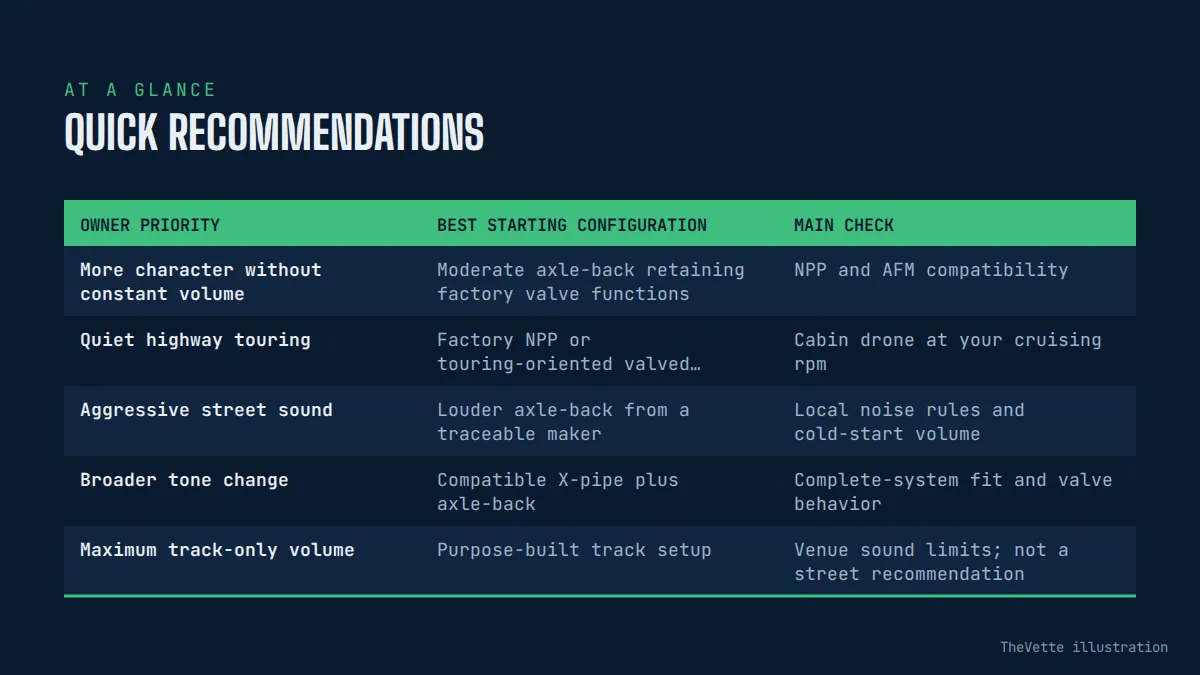
Quick recommendations
| Owner priority | Best starting configuration | Main check |
|---|---|---|
| More character without constant volume | Moderate axle-back retaining factory valve functions | NPP and AFM compatibility |
| Quiet highway touring | Factory NPP or touring-oriented valved axle-back | Cabin drone at your cruising rpm |
| Aggressive street sound | Louder axle-back from a traceable maker | Local noise rules and cold-start volume |
| Broader tone change | Compatible X-pipe plus axle-back | Complete-system fit and valve behavior |
| Maximum track-only volume | Purpose-built track setup | Venue sound limits; not a street recommendation |
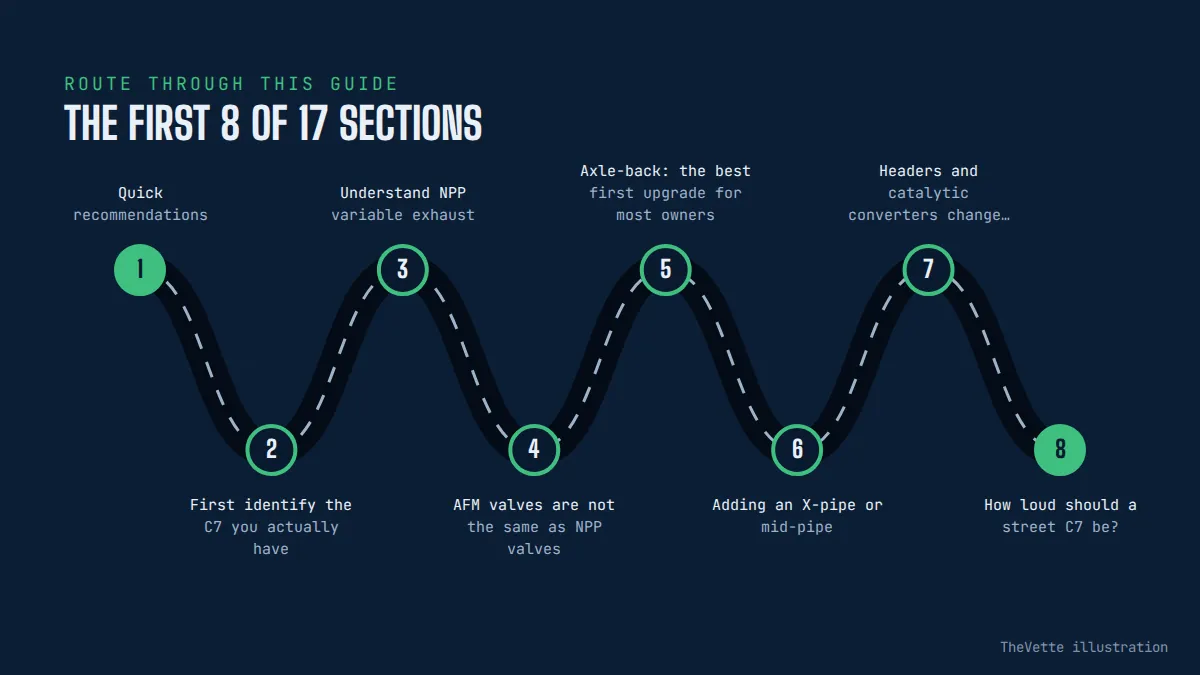
First identify the C7 you actually have
C7 exhaust fitment is not one universal 2014–2019 answer. Record the model year, Stingray, Grand Sport, Z06, or ZR1 configuration, coupe or convertible, engine, manual or automatic transmission, and whether the car has factory NPP variable exhaust. Inspect the existing system because a prior owner may already have changed mufflers, mid-pipe, valves, controllers, or headers.
Manufacturer catalogs illustrate why this matters. Borla lists different C7 applications according to NPP and AFM valves and identifies exceptions such as certain manual Grand Sport combinations. That is useful as fitment evidence for its own products, not permission to assume another brand follows the same part-number logic. Verify the exact candidate on its manufacturer’s current application page before ordering.
Understand NPP variable exhaust
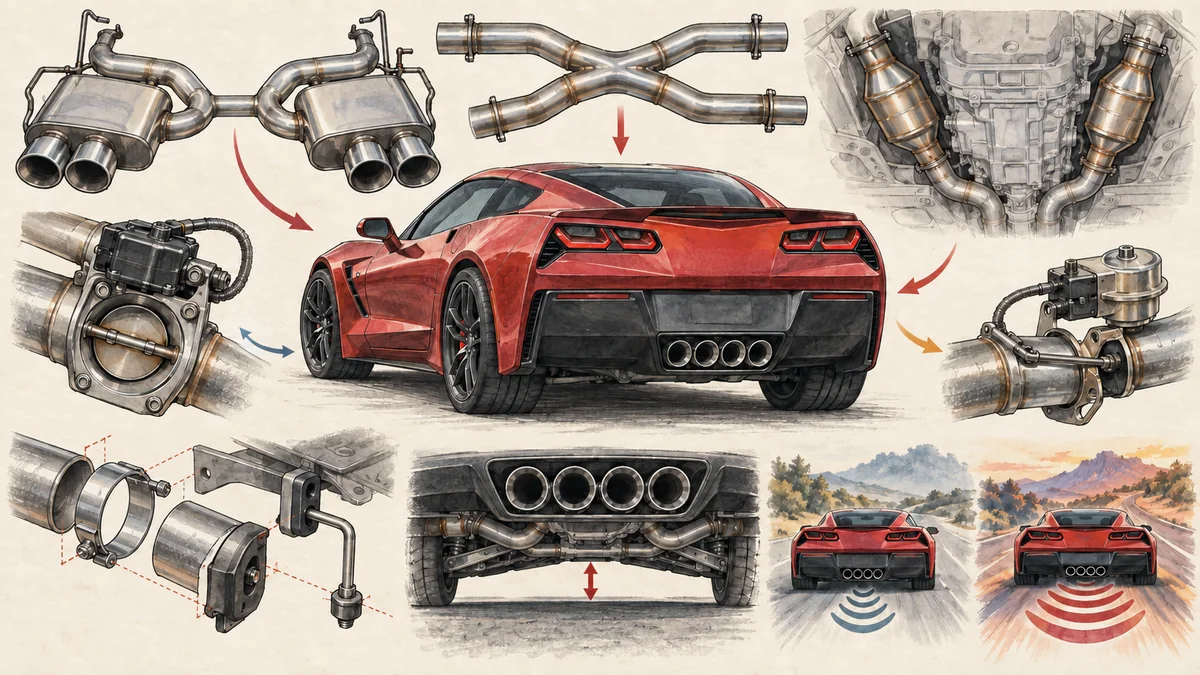
Chevrolet’s 2017 and 2018 owner manuals describe a variable-mode exhaust system whose valve opening changes with driver-mode settings when equipped. Preserving that capability lets a driver combine a restrained setting with a more open performance sound. A compatible aftermarket system needs the required valve provisions, actuator mounts, wiring clearance, and operating range.
Some systems reuse the original actuators; others include their own valves or leave some factory functions inactive. Read the installation guide, not only the product title. Confirm whether the dashboard modes continue to command exhaust behavior and whether any calibration or controller is required. An attractive muffler that disables a feature you use every day may be a downgrade.
AFM valves are not the same as NPP valves
Active Fuel Management can run an automatic C7 in four-cylinder operation under suitable conditions. Exhaust-valve strategies can help manage the resulting sound and vibration. These AFM-related valves and the rear NPP sound-control valves serve different purposes, so “valved exhaust” is not specific enough.
A system advertised for a car without NPP may still discuss AFM hardware. A system for a manual may not match an automatic. If a listing says an actuator mount is non-functioning or a valve is omitted, learn what that means for the precise car, including fault codes, vibration, noise, and warranty. Do not buy based on a photograph shared by several part numbers.
Axle-back: the best first upgrade for most owners
An axle-back changes the rear muffler and outlet section while leaving more of the factory exhaust intact. It can deliver the largest perceived sound change with less scope than headers or catalyst-related work. Installation can also be reversible when clamps, hangers, actuators, and original parts are handled properly.
The trade-off is that sound quality depends on the entire car and system. Two products described by the same marketing adjective can differ sharply at cold start, light throttle, highway load, and full acceleration. Seek recordings made on the same trim, transmission, valve setting, and otherwise comparable exhaust—but remember that microphones and speakers distort volume and bass.
A quality axle-back should document material, tube and tip construction, valve configuration, exact fitment, included hardware, installation method, warranty, and support. Borla’s current C7 catalog, for example, specifies 2014–2019 applications, T-304 stainless construction, axle-back layout, valve-specific versions, and distinct sound levels. Treat those facts as a framework for comparison rather than an automatic winner.
Adding an X-pipe or mid-pipe
An X-pipe connects the two exhaust banks and can change pulse interaction and tone. Replacing more of the center section may increase volume and alter resonance beyond what an axle-back produces. It also creates additional joints whose alignment, clamp load, and clearance must be correct.
Confirm that the X-pipe is designed to work with the chosen rear section and the car’s original front connection. Borla documents a C7 X-pipe with its related axle-back systems, but product compatibility should never be inferred across brands without written confirmation. Mixing components can shift outlet alignment or place stress on hangers.
Headers and catalytic converters change the decision
Headers and pre-catalyst components move the project beyond a simple sound upgrade. They can affect heat, oxygen-sensor placement, calibration, emissions legality, inspection readiness, noise, and warranty. Removing or defeating catalytic converters is not an acceptable street-car recommendation.
The EPA’s tampering policy explains that the Clean Air Act prohibits removing or rendering inoperative emissions-control devices and addresses aftermarket defeat devices. California has additional requirements: CARB says approved aftermarket catalytic converters must have an Executive Order for the specific vehicle application. State and local rules vary, so obtain documentation before buying—not after the car fails inspection.
If a product changes emissions-related hardware, ask for the precise legal basis for use on your model year and engine family. “Race use only” does not turn a street-driven car into a competition vehicle. For the normal road owner seeking better sound, keeping the factory catalysts and choosing a documented downstream system is the lower-risk path.
How loud should a street C7 be?
Sound preference is personal, but the consequences are practical. Evaluate cold start near neighbors, parking-garage reverberation, conversation at steady speed, convertible-top-down use, early departures, and local enforcement. A system that is thrilling for a ten-second clip may be tiring over a three-hour drive.
Manufacturers often offer touring, sport, and aggressive tiers. Those labels are not standardized. Ask for measured test conditions if decibel figures are published. Distance, engine speed, throttle, environment, weighting method, and microphone position can change the result. Local and track limits use their own procedures.
Drone is different from general loudness
Drone is a narrow, sustained cabin resonance that often appears at a particular engine speed and load. A loud exhaust can be acceptable at acceleration yet drone badly on the highway; a quieter one can still produce an annoying frequency in a specific operating zone.
Transmission, gearing, AFM operation, roof position, rear cargo area, tire noise, and added mid-pipe components can alter what reaches the cabin. Look for feedback from the same C7 configuration and ask the maker how its system controls resonance. Claims such as “no drone” should be read alongside fitment and operating conditions.
Material and construction
Stainless grades, wall thickness, weld quality, muffler construction, flex and thermal movement, tip finish, and hanger placement affect durability. T-304 stainless generally offers strong corrosion resistance and is commonly promoted on premium systems. A material name alone does not guarantee precise fit or good acoustic tuning.
Inspect weld consistency, flange flatness, clamp design, actuator brackets, and whether contact surfaces can be serviced. Black or polished tips mainly change appearance and care requirements. Tip geometry must remain centered with safe clearance as the system heats and moves.
Performance expectations
Buy a street axle-back primarily for sound, construction, fit, and weight characteristics—not an unsupported horsepower promise. Meaningful power claims require a defined vehicle, complete configuration, test method, correction standard, and before-and-after conditions. A peak number without the full curve and protocol offers little guidance.
Changing restrictions farther forward can affect performance more, but it also raises emissions, calibration, heat, and legality questions. A stock or mildly modified C7 does not need the largest possible tube merely because larger sounds faster. Velocity, packaging, valve function, ground clearance, and acoustic control are parts of the engineering.
When a manufacturer publishes dynamometer results, confirm whether the test car had the same engine, transmission, catalysts, intake, calibration, fuel, and exhaust sections you plan to use. Look for repeat runs and comparable atmospheric correction. Results from a supercharged Z06 should not be presented as an expected gain for a naturally aspirated Stingray, and a complete header-to-tip system cannot prove what its rear mufflers contribute alone.
Product-selection checklist
| Field | What to verify in writing |
|---|---|
| Vehicle | Year, trim, engine, transmission, coupe/convertible exceptions |
| Valves | NPP provision, AFM provision, actuator reuse, controller needs |
| Scope | Axle-back, mid-pipe, or full system; included and retained parts |
| Construction | Material, diameter, muffler, tips, clamps, hangers, welds |
| Sound | Cold start, cruise, acceleration, valve settings, drone strategy |
| Compliance | Emissions equipment retained and local noise suitability |
| Ownership | Warranty, replacement valves, packing, finish care, support |
Installation and alignment
Exhaust parts are heavy, awkward, and capable of causing burns. Let the car cool fully and use a lift or correctly rated supports on approved lifting points. Never work beneath a vehicle supported only by a jack. Follow the product instructions and factory service information.
Loosely assemble joints first, then align the system from front to rear before final tightening to the specified values. Check tips in the fascia opening, muffler and pipe clearance, hangers, wiring, actuators, heat shields, suspension travel, and nearby composite panels. The system grows when hot, so a small cold clearance may disappear.
After the first heat cycles, inspect for leaks, shifted tips, loose clamps, rattles, and heat contact according to the maker’s procedure. Keep the original system and labeled hardware if storage is practical. Reversibility helps troubleshooting and may support resale value.
Diagnosing rattles and leaks
A metallic rattle can come from a heat shield, valve shaft, actuator, internal muffler part, clamp, hanger, or pipe touching the body. A ticking sound near a joint may indicate leakage. Soot at a connection is another clue, although water vapor and normal condensation alone do not prove a fault.
Inspect cold, then reproduce the symptom safely at the relevant temperature and engine speed. Do not crawl under a running unsupported vehicle or touch hot components. If an active valve chatters, confirm the actuator, mounting orientation, linkage range, and control behavior rather than disabling it.
Five sensible C7 exhaust paths
Keep factory NPP: best when the system is healthy and flexibility matters more than novelty. Moderate valved axle-back: the balanced daily-driver option. Aggressive axle-back: for an owner who accepts louder cold starts and checks local limits.
Axle-back plus matched X-pipe: for a broader tone change after confirming complete-system fit. Headers or catalyst-related work: a specialist project requiring emissions and calibration documentation, not the default affiliate recommendation. None should be purchased before identifying NPP, AFM, transmission, and trim.
Frequently asked questions
Does every C7 Corvette have NPP exhaust?
No. Variable-mode exhaust is equipment-dependent. Check the vehicle’s build information and inspect for actuators rather than assuming from the tips.
Will an aftermarket exhaust cause a check-engine light?
A correctly fitted downstream axle-back that preserves required controls should not inherently create an emissions fault, but damaged wiring, missing valve behavior, leaks, catalyst changes, or incompatible hardware can cause problems. Require model-specific documentation.
Is an axle-back better than a cat-back?
It is usually the simpler choice for sound with less system disturbance. A center or X-pipe can change tone further. “Better” depends on fit, noise, legality, and the owner’s goal.
Can I remove the catalytic converters?
Not as a street-car upgrade. EPA guidance addresses converter removal and defeat devices under federal anti-tampering law, while states can impose additional requirements.
Which exhaust is best for a C7 daily driver?
A moderate, valve-compatible axle-back with documented exact fitment, controlled highway resonance, retained emissions equipment, and strong manufacturer support is the safest general answer.
Final recommendation
Start with the C7’s exact configuration. For most US street owners, choose a well-documented axle-back that matches the trim, transmission, NPP and AFM hardware, preserves catalytic converters, controls drone, and remains serviceable. Keep factory valve flexibility if you value quiet starts and long trips.
Add a matched X-pipe only when you want the additional tonal change and have confirmed full compatibility. Treat headers, catalysts, and calibration as a separate specialist decision. The best exhaust is not the loudest option—it is the one whose sound, fit, legality, heat management, and daily behavior remain satisfying after the novelty wears off.