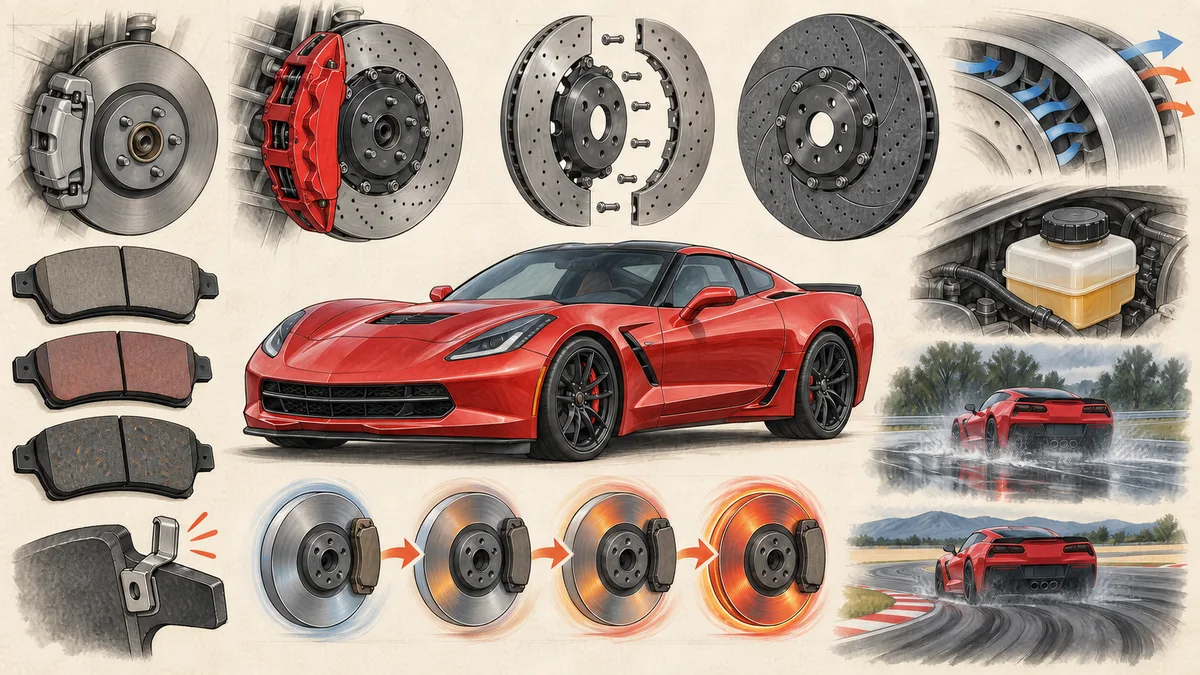
The best brake pads for a C7 Corvette are selected by brake package and operating temperature, not by the generation name alone. A standard Stingray used on public roads needs dependable cold response and civilized noise. A Z51, Grand Sport, Z06, or ZR1 driven on a road course may require a different pad, compatible rotors, fresh specified fluid, and the exact Chevrolet track-preparation procedure. Confirm the installed hardware before ordering anything.
To place Best Brake Pads for C7 Corvette in a wider ownership and engineering context, continue with C7 Corvette Buyer’s Guide: Stingray, Z06, or Grand Sport?.
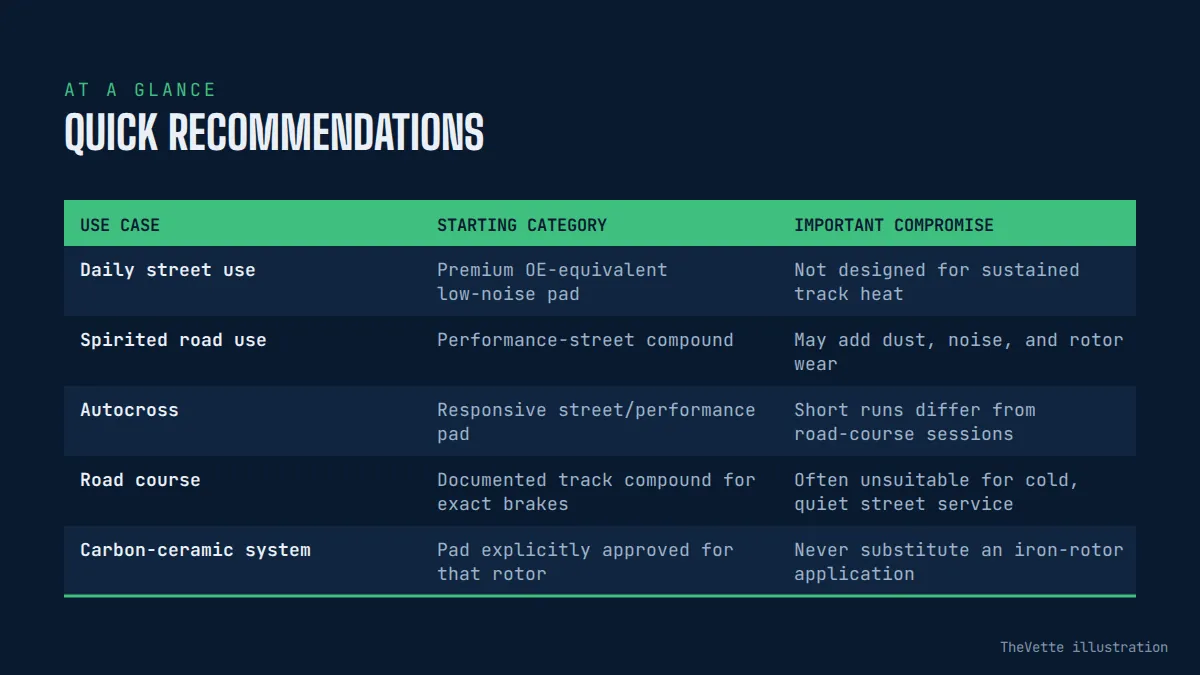
Quick recommendations
| Use case | Starting category | Important compromise |
|---|---|---|
| Daily street use | Premium OE-equivalent low-noise pad | Not designed for sustained track heat |
| Spirited road use | Performance-street compound | May add dust, noise, and rotor wear |
| Autocross | Responsive street/performance pad | Short runs differ from road-course sessions |
| Road course | Documented track compound for exact brakes | Often unsuitable for cold, quiet street service |
| Carbon-ceramic system | Pad explicitly approved for that rotor | Never substitute an iron-rotor application |

Map the exact C7 brake system
The 2014–2019 C7 includes Stingray, Grand Sport, Z06, and ZR1 models, several performance packages, and iron or carbon-ceramic configurations. Record the year, trim, option codes, axle, caliper, rotor material and dimensions, and any prior conversion. Compare physical parts with the manufacturer’s complete application notes.
Brembo’s C7 catalog shows why this matters: it lists separate front applications for reinforced and non-reinforced brakes and identifies different pad dimensions and FMSI references. That is manufacturer-specific evidence, not a universal cross-reference. A seller’s “fits all C7” title is not enough.
Verify both axles independently. A pad can look similar yet differ in backing-plate outline, thickness, ears, counterweights, wear tab, hardware, or radial depth. If the car has an aftermarket big-brake kit, identify that kit’s caliper and rotor rather than searching by Corvette year.
Best road pad for most C7 owners
A premium OE-equivalent pad is the rational default for a street car. It should provide immediate response when cold, smooth modulation, low enough noise for daily use, compatible shims and hardware, and stable behavior in rain and normal heat. Low-dust ceramic-style products are popular, but “ceramic” describes a broad family rather than one predictable formula.
Choose from a traceable maker that publishes the exact application and installation requirements. Wheel cleanliness is useful, but it ranks behind correct fit, safe cold behavior, predictable ABS interaction, and durability. A road pad should not need track temperatures before it works properly.
Performance-street compounds
A performance-street pad can offer firmer initial response and better stability during repeated energetic road braking. Expect possible trade-offs in squeal, dust, rotor wear, and cold refinement. Read the compound-specific description rather than assuming the word “sport” has a standard meaning.
Before upgrading friction, solve hydraulic or mechanical faults. Old fluid, air, a sticking piston, uneven deposits, damaged hoses, worn rotors, poor tires, or incorrect wheel torque can all create disappointing braking. A higher-friction pad cannot repair those conditions.
Track pads require a track plan
Road-course sessions create sustained heat that street and autocross driving normally do not. A racing compound may remain consistent at those temperatures but can be noisy, dusty, abrasive, and weak outside its intended range. Some are explicitly not for road use.
Chevrolet’s 2017 C7 track guide says new pads must be burnished before racing or competitive driving. It provides package-specific procedures and warns that the base brake system can be damaged by a burnish procedure intended for higher-performance hardware. This is why a generic internet bedding routine is unsafe.
The same guide addresses brake fluid, cooling rings, alignment, tire settings, and post-event restoration. Pad choice is only one part of preparation. Use the exact year-and-package guide plus current service information, and review the broader Corvette track-day checklist.
Iron versus carbon-ceramic rotors
Iron and carbon-ceramic rotors use different friction couples and inspection methods. Install only a pad that the manufacturer explicitly approves for the rotor material and brake package. A shape that fits the caliper does not establish material compatibility.
Iron rotors should be checked for thickness, scoring, cracks, heat damage, deposits, and runout-related symptoms. Drilled areas deserve careful inspection. Carbon-ceramic discs require their prescribed visual, dimensional, or weight-based procedures; common iron-rotor resurfacing assumptions do not apply.
Carbon-ceramic replacement cost makes diagnosis especially important. Noise or vibration does not prove the disc is ruined. Pad deposits, contamination, hardware, hub condition, or wheel installation can overlap, so use a technician familiar with the exact system.
How pad characteristics affect the driver
Initial bite is the early response to pedal input. Modulation is how progressively brake force can be controlled. Fade resistance describes stability as heat builds. Release affects how smoothly the car transitions back to acceleration. Selecting only for maximum bite can make a street car harder to drive delicately.
Published friction curves are useful when the test range and compound code are clear. Compare cold behavior, normal working band, upper limit, wear, and rotor compatibility. Do not transfer results between compounds merely because they share a brand.
Noise and brake dust
Squeal can arise from the compound, vibration, absent shims, damaged hardware, contamination, glazing, rotor condition, or incorrect bedding. Lubricant must never touch friction material or rotor faces. Apply only the specified product at the exact non-friction locations named in current service instructions.
Track-pad dust can become aggressive after heat and moisture. Clean wheels promptly using finish-compatible methods. Carbon-ceramic systems can still produce dust from pads, so do not equate rotor material with permanently clean wheels.
Fluid, hoses, and pedal condition
Brake fluid absorbs moisture, and heat can turn degraded fluid into a compressible vapor. A lengthening pedal may be hydraulic fade rather than friction fade. Use the exact fluid specification and service procedure for the car; a high dry boiling point does not excuse old or contaminated fluid.
Chevrolet’s track guide calls for brake-fluid service in its track preparation and after-track instructions for covered configurations. Inspect hoses, hard lines, calipers, bleeders, and the reservoir. A leak, red warning lamp, or sinking pedal requires service, not a pad upgrade.
Wear indicators and uneven wear
Many C7 pads use an acoustic wear indicator, while hardware varies by application. Confirm sensor or tab placement, shims, counterweights, springs, and pins. A wear sound or message should trigger inspection of every pad, not blind replacement of the visible outer one.
Inner-to-outer or left-to-right variation can indicate piston, guide, abutment, hardware, hose, or heat problems. Measure all positions. Replacing pads without correcting the cause can quickly damage the new set and rotor.
Bedding without guesswork
Bedding establishes contact and a controlled transfer layer. Follow the pad maker and Chevrolet procedure that applies to the exact brake system. Complete it only in the safe, non-public environment specified. The official track procedure anticipates temporary fade and increased stopping distance, which makes casual road execution dangerous.
Start with correctly installed parts and a firm pedal. Allow the required cooling without parking with extremely hot pads clamped in one position. Stop for pulling, grinding, severe vibration, fluid symptoms, or unexpected pedal travel.
Rotor cooling rings and ducts
Chevrolet’s 2017 guide states that certain Z51 cars with front dual-cast rotors were delivered with cooling rings recommended for track use, while one-piece rotor versions do not require them. It also says not to leave the rings installed after the event because long-term use can promote corrosion.
This is a model-specific instruction, not permission to improvise a shield. Identify rotor construction and follow the supplied installation procedure. Preserve factory ducts and verify that aftermarket wheels, hoses, sensors, and balance weights do not obstruct clearance.
Installation checklist
- Confirm trim, option codes, caliper, rotor material, axle, and pad number.
- Measure and inspect every rotor and all old pads.
- Check calipers, seals, boots, pins, hardware, hoses, lines, and fluid.
- Support the car at approved points; never rely on a jack alone.
- Keep friction surfaces free of grease, fluid, and fingerprints.
- Use the specified hardware, fasteners, thread preparation, and torque.
- Route wear components correctly and never hang a caliper by its hose.
- Replace pads across the full axle and establish a firm pedal before movement.
- Torque wheels evenly with a calibrated wrench.
- Perform the correct bedding procedure and re-inspect after cooling.
Comparison fields that matter
| Field | Required evidence |
|---|---|
| Fitment | Year, trim, option, axle, caliper, rotor and FMSI/application |
| Use | Street, autocross, road course, or competition-only |
| Operating range | Cold response and documented temperature window |
| Rotor | Iron or carbon-ceramic compatibility |
| Hardware | Shims, weights, tabs, pins, clips, sensors |
| Ownership | Dust, noise, rotor wear, bedding, warranty and support |
How to evaluate product recommendations
A useful recommendation names the exact compound, axle, caliper application, rotor material, and intended duty. It explains what the pad gives up as well as what it improves. A statement that one pad is “best for every C7” ignores the difference between a standard Stingray commuting in cold rain and a Z06 repeatedly braking from high speed on a dry circuit.
Look for current technical data from the pad maker, not a copied marketplace table. Confirm whether included hardware matches the photograph and part number, because sellers sometimes combine reviews from several applications. Treat customer noise reports as context rather than controlled testing: installation, rotor condition, bedding, climate, wheel design, and driving style can change the outcome.
There are no affiliate links in this guide. If commercial links are added later, they should lead to the exact manufacturer application or an accurately identified seller listing, carry a clear disclosure, and never replace fitment verification.
After-installation verification
Once the brakes have cooled after their prescribed conditioning, compare rotor contact patterns and temperatures from side to side without touching hot parts. Check for leaks, displaced boots, loose hardware, rubbing sensor leads, and wheel interference. The car should not pull, grind, or develop a sinking pedal.
Keep an installation record with pad part and compound codes, mileage, rotor measurements, fluid type and date, and the procedure used. Reinspect after the maker’s stated interval or sooner if noise, vibration, smell, smoke, warning lamps, or changed pedal feel appears. A track car needs checks between sessions; a normal street car still deserves periodic visual inspection rather than waiting for metal-to-metal contact.
Common mistakes
Avoid buying by generation alone, installing an iron-rotor pad on carbon ceramic, copying a Z07 burnish routine onto base brakes, choosing a race compound for appearance, reusing damaged hardware, ignoring inner-pad wear, mixing incompatible compounds on one rotor, or treating wheel torque as an impact-gun setting.
Do not promise a shorter stopping distance from pads alone. Tire grip, road surface, temperature, ABS calibration, rotor and hydraulic condition, and driver input all contribute. If installation or diagnosis is uncertain, use a Corvette-experienced brake technician.
Frequently asked questions
Do all C7 Corvettes use the same pads?
No. Standard and reinforced brakes, performance packages, axles, and rotor materials create different applications.
Are ceramic pads best for street use?
A quality ceramic-style pad can provide low dust and quiet operation, but verify cold response, fit, and exact compound. The category alone is not a guarantee.
Can street pads survive one track day?
That depends on the pad, circuit, driver, tires, brake package, weather, and session structure. Use Chevrolet’s track guidance and the pad manufacturer’s explicit approval rather than guessing.
Must new C7 pads be burnished?
Follow the applicable manufacturer procedure. Chevrolet specifically requires burnishing new pads before competitive driving and uses package-specific instructions.
Should I change rotors with pads?
Inspect and measure them. Replace rotors that are unsafe, below limits, damaged, or incompatible; do not replace or machine automatically without diagnosis.
Final recommendation
For a road-driven C7, choose a premium OE-equivalent or performance-street pad after confirming the exact caliper, rotor and package. Favor predictable cold response, modulation, compatible hardware, restrained noise, and documented support over the most dramatic friction claim.
For track use, select a compound explicitly approved for the brake system and temperature, then prepare the complete car with the correct fluid, rotor inspection, cooling provisions, tires, torque, and Chevrolet burnish procedure. The right pad is the one engineered for that C7’s hardware and actual duty—not the most aggressive part that fits inside the caliper.