The best car cover for a Corvette depends first on where the car sleeps. In a clean garage, choose a soft, breathable, custom-fit indoor cover that controls dust without scuffing paint. Outdoors, choose a generation- and trim-specific cover built for UV exposure, precipitation, wind, and secure attachment. A cover is not a substitute for shelter, and the wrong cover on a dirty or wet car can cause more harm than leaving the paint uncovered.
To place Best Car Cover for Corvette in a wider ownership and engineering context, continue with How to Store a Corvette the Right Way.
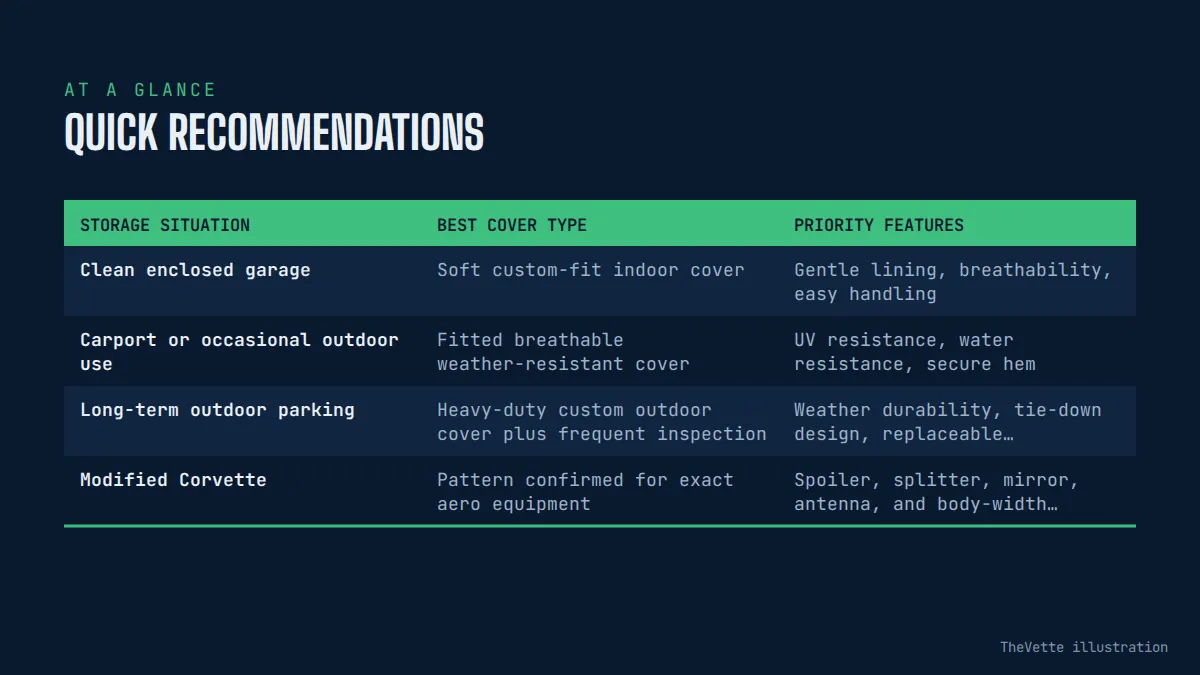
Quick recommendations
| Storage situation | Best cover type | Priority features | Main caution |
|---|---|---|---|
| Clean enclosed garage | Soft custom-fit indoor cover | Gentle lining, breathability, easy handling | Never trap grit between fabric and paint |
| Carport or occasional outdoor use | Fitted breathable weather-resistant cover | UV resistance, water resistance, secure hem | Wind movement can abrade the finish |
| Long-term outdoor parking | Heavy-duty custom outdoor cover plus frequent inspection | Weather durability, tie-down design, replaceable availability | A garage or rigid shelter is still safer |
| Modified Corvette | Pattern confirmed for exact aero equipment | Spoiler, splitter, mirror, antenna, and body-width compatibility | Do not stretch a stock pattern over sharp add-ons |
No single product wins all four situations. Indoor fabric optimized for softness may offer poor storm protection, while a durable outdoor textile can be unnecessarily heavy inside a garage. Define the threat before comparing brands.
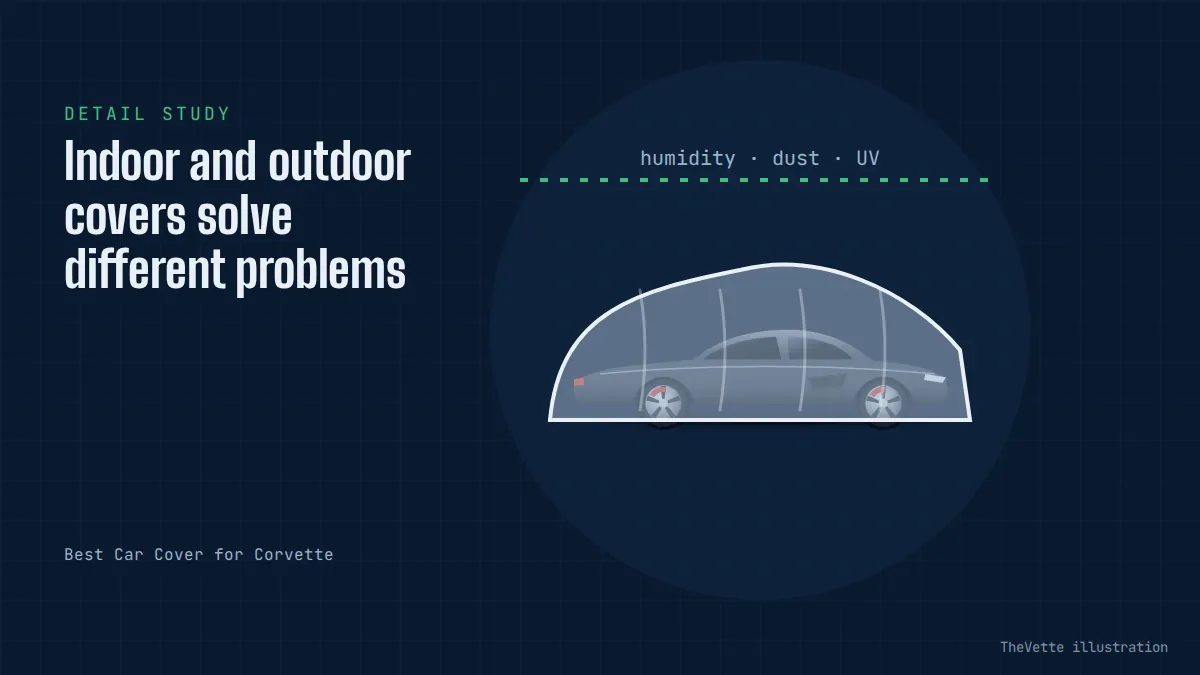
Indoor and outdoor covers solve different problems
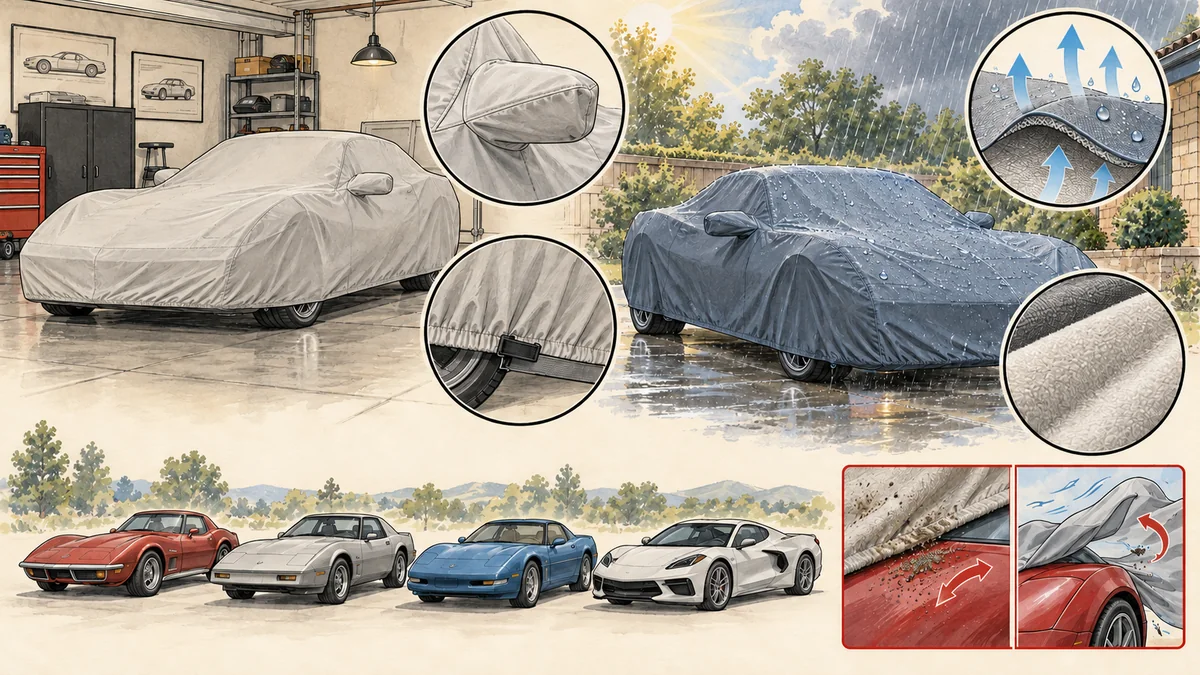
An indoor cover mainly keeps dust, light workshop debris, fingerprints, and accidental brushes away from clean paint. It should be easy enough to remove and install without dragging across the body. A soft inner face matters, but even the finest lining can move abrasive dirt already on the car.
An outdoor cover faces sunlight, rain, airborne dirt, bird contamination, tree material, frost, and wind. It needs weather resistance while allowing moisture to escape. “Water resistant” and “waterproof” are not interchangeable promises. A completely impermeable layer can trap condensation, while seams, vents, and long exposure can allow water through a breathable product.
Best indoor choice: a soft custom-fit cover
For a garaged Corvette, a custom-fit indoor cover with mirror pockets and a soft paint-facing surface is the most sensible starting point. Chevrolet’s current C8 indoor accessory description identifies custom fit, dust and debris protection, a micro-porous layer, an inner cotton layer, breathability, mirror pockets, and a storage bag. Covercraft similarly separates softer indoor materials from weather-focused outdoor fabrics.
Choose a light-enough fabric that one person can guide over the roof and body without dragging. Elastic hems should hold the cover in place without putting excessive tension on spoilers or splitters. Reinforced seams and pockets should lie flat rather than forming hard ridges against paint.
Best for: a freshly cleaned car in an enclosed, dry garage. Not best for: rain, persistent sunlight, or an open structure where wind can move the fabric.
Best outdoor choice: fitted, breathable, UV-resistant material
A credible outdoor cover should describe its resistance to ultraviolet exposure and ordinary weather, not simply call itself “all weather.” Chevrolet’s current C8 outdoor accessory is described as water resistant, UV protective, contoured, equipped with mirror pockets and a storage bag. Covercraft identifies different outdoor textiles for rain, UV, and climate exposure. These sources support comparing fabric by environment rather than marketing tier.
Breathability helps moisture leave, but the car and cover still need inspection after storms. Pooling water, a clogged surface, frozen fabric, or damp debris can defeat the intended behavior. Remove contamination according to the maker’s instructions and allow both car and cover to dry before long storage.
Best for: temporary or unavoidable outdoor parking with regular attention. Limitation: no flexible cover provides the security, impact protection, ventilation control, and paint safety of a sound garage.
Exact fit matters across Corvette generations
A C1, C4, C7 Z06, and C8 coupe do not share the same proportions. Even within one generation, body width, convertible hardware, high wings, splitters, antennas, and aftermarket aero can change the pattern. A cover that fits a base coupe may be wrong for a wide-body or tall spoiler.
Chevrolet’s current C8 indoor and outdoor product pages specifically warn that certain covers are not for use with the accessory High Wing Spoiler. That is a useful general lesson: a listing that says “Corvette” is incomplete until body style, trim, year, and installed equipment are confirmed.
Check mirror pockets, front and rear orientation, antenna treatment, exhaust clearance, and the lowest aero points. Fabric should follow the body without stretching over sharp corners. A tight cover can stress seams or paint; an overly loose one can flap.
Five product categories worth comparing
| Category | Best use | Advantages | Trade-offs |
|---|---|---|---|
| OEM-style indoor custom cover | Clean climate-controlled garage | Vehicle-specific pattern and soft handling | Often expensive; graphics do not add protection |
| Premium aftermarket indoor cover | Frequent indoor storage | Multiple fabric weights and broad generation coverage | Pattern must include exact trim and modifications |
| Light outdoor breathable cover | Short-term mixed weather | Easier handling and useful UV/rain resistance | Less durable in harsh wind or continuous exposure |
| Heavy outdoor custom cover | Unavoidable extended outdoor storage | Stronger weather and abrasion resistance | Bulkier; movement and trapped contamination remain risks |
| Universal emergency cover | Temporary travel backup | Low cost and compact storage | Loose fit, limited protection, greater wind movement |
This category comparison is more durable than ranking five changing stock-keeping units. Once the correct category is chosen, compare current products that explicitly fit the exact car.
Softness cannot compensate for a dirty car
Paint damage usually begins with particles between the cover and finish. Wind, installation, and removal move those particles like fine abrasive. Wash and fully dry the Corvette before covering it for more than a brief period. Pay attention to wheel arches, lower rockers, rear surfaces, and horizontal panels where debris collects.
The cover must also be clean. WeatherTech’s instructions note that accumulated dirt can severely affect fabric performance. Store a dry cover in its bag or a clean container, away from chemicals and rodents. Do not place the paint-facing side on a garage floor and then pull it back across the car.
How to install without dragging fabric over paint
Read the product instructions because the maker may specify an order. Chevrolet’s current cover guidance starts with the mirror areas, then places the front and rear over the bumpers last. Other designs may use a labeled front, an antenna pocket, or a center reference.
- Confirm the car is cool, clean, and dry.
- Remove or secure anything sharp that is not part of the cover pattern.
- Identify the front and keep the clean inner surface off the floor.
- Place and unfold the cover rather than pulling it sideways.
- Seat mirror pockets and follow the maker’s bumper sequence.
- Check splitters, spoilers, exhaust areas, and elastic hems.
- Use only the intended straps or tie-downs.
Never cover a hot exhaust or engine area. Do not cinch a strap against painted edges. If one person cannot control a heavy outdoor cover in wind, wait for safer conditions or ask for help.
Wind is the hardest outdoor problem
A fitted hem and approved underbody attachment reduce movement, but they do not make a fabric cover storm-proof. Repeated flutter can mark paint, and a loose cover can become a hazard. Do not tie improvised rope through weak fabric, around exhaust parts, or across sharp aero.
Choose sheltered parking where possible and inspect attachment before forecast wind. If severe weather is expected, a secure structure is preferable. A cover is designed for environmental exposure within its instructions, not for falling branches, hail impact guarantees, flood water, or hurricane-force conditions.
Moisture, condensation, and freezing
Breathable fabric allows water vapor to escape more readily than a sealed plastic sheet, but evaporation depends on airflow, temperature, humidity, and contamination. Check beneath the cover after rain and whenever weather changes sharply. Do not leave a soaked cover bundled against the car.
Covercraft instructions warn that a cover can freeze to ice between fabric and body when rain is followed by a sharp temperature drop. Never pull a frozen cover from paint. Allow natural thawing and follow the manufacturer’s removal guidance.
UV exposure and hot climates
Outdoor fabric should have a stated UV use case. Sunlight degrades both vehicle surfaces and the cover itself. Lighter colors may absorb less heat, but fabric construction and published outdoor rating matter more than a color assumption.
Inspect fading, brittleness, stretched elastic, seam failure, and worn inner surfaces. Replace a cover before torn material or failed attachment begins moving against the body. No honest manufacturer can promise indefinite life in constant desert sun.
Classic paint and fresh refinishing need extra care
Older Corvette finishes may be thin, checked, repaired, or sensitive to moisture. A fresh repaint may continue curing after it feels dry. Ask the paint manufacturer or refinisher how long to wait and which fabrics are acceptable. Do not rely on a generic “paint safe” label.
Raised edges, loose trim, hood ornaments on early cars, antennas, and repaired fiberglass or composite panels deserve a hands-on inspection before covering. A tight pocket or seam can concentrate load on a fragile detail.
Security features: useful, but limited
A locking cable may discourage casual removal, yet it does not turn fabric into a secure enclosure. Metal hardware must not swing against paint, wheels, brake lines, or underbody parts. A cable routed beneath the vehicle can also create a trip hazard.
For valuable cars, combine appropriate storage with lighting, access control, insurance, and documentation. Do not advertise a rarely monitored storage location by leaving branded packaging or keys nearby.
Cleaning the cover
Follow the textile maker’s instructions exactly. Machine size, detergent, water temperature, rinse method, and drying method vary. Fabric coatings can be damaged by bleach, softener, harsh solvents, heat, or an unsuitable washer. Pretest any spot-cleaning product.
Remove loose debris before washing and make sure the cover is completely dry before folding. If tree sap, oil, paint, or abrasive grit cannot be removed safely, replacement may be less risky than placing the contaminated surface over a valuable finish.
What to compare before ordering
| Field | Question to ask |
|---|---|
| Application | Does it list the exact generation, year, body, trim, and aero? |
| Environment | Is the textile explicitly intended for indoor or outdoor use? |
| Weather performance | What does the maker actually claim for UV, water, and breathability? |
| Paint-facing surface | Is it suitable for the car’s finish and condition? |
| Retention | How do the hem and approved straps resist ordinary movement? |
| Care | Can the owner clean and dry it using available equipment? |
| Warranty | What fabric, seam, fit, and weather exclusions apply? |
Frequently asked questions
Should a Corvette be covered inside a garage?
A soft custom indoor cover is useful when the car is clean and the garage has dust or activity. In a spotless private space with frequent use, careful uncovered storage may be more convenient. Never cover a dirty car simply out of habit.
Can I use an indoor cover outside for one night?
It may lack rain, UV, seam, and retention performance. Unexpected wind can move it across paint. Use an outdoor-rated product when the car is exposed.
Is a waterproof cover best?
Not automatically. Breathability and moisture management matter, while “waterproof” can imply trade-offs. Read the manufacturer’s exact water and vapor claims and inspect the car after weather.
Will a car cover protect against hail?
A normal fabric cover should not be treated as a hail guarantee. Some padded products may reduce minor impact, but rigid shelter and weather planning provide stronger protection.
Can a cover scratch ceramic coating?
A coating does not eliminate abrasion. Dirt, a contaminated inner surface, poor fit, and wind movement can still mark the finish. Ask the coating installer about curing time and acceptable contact materials.
Final recommendation
For a clean garaged Corvette, choose a soft breathable custom indoor cover made for the exact year, body style, trim, and aero equipment. For outdoor parking, choose a fitted weather-rated cover with documented UV and water resistance, moisture escape, secure retention, and a care routine the owner will actually follow.
Do not pay extra for graphics before fit and fabric are correct. Keep both car and cover clean, install without dragging, inspect after weather, and remove the cover during dangerous wind. When long-term outdoor storage is unavoidable, remember that even the best flexible cover is a compromise compared with safe enclosed shelter.