The best battery for a C8 Corvette is a current, direct-fit Group 48/H6 battery that matches the exact model year, powertrain, factory requirements, and physical installation. Current application evidence supports H6 products for 2020–2024 cars, including a 730-CCA AGM option. However, a C8 Stingray or Z06 and an electrified E-Ray must not be treated as identical electrical systems. Confirm the VIN-specific application and owner information before ordering.
To place Best Battery for C8 Corvette in a wider ownership and engineering context, continue with Why Does a Corvette Battery Keep Dying?.
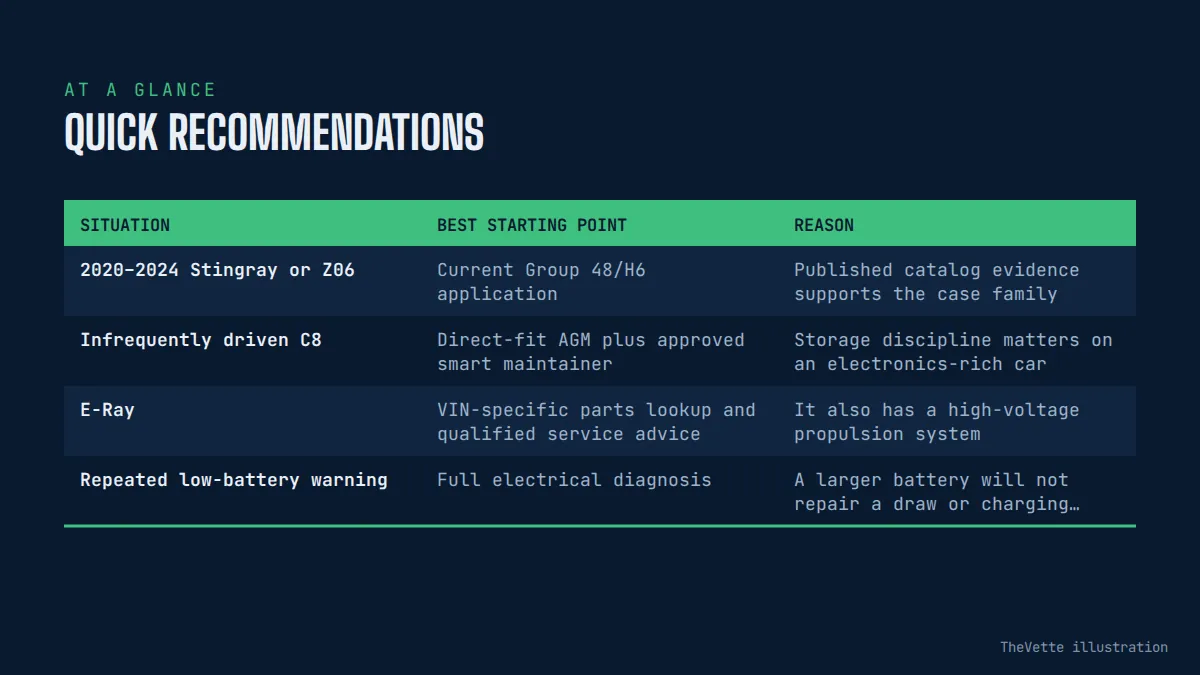
Quick recommendations
| Situation | Best starting point | Reason | Verify first |
|---|---|---|---|
| 2020–2024 Stingray or Z06 | Current Group 48/H6 application | Published catalog evidence supports the case family | Year, trim, construction, ratings, venting, polarity |
| Infrequently driven C8 | Direct-fit AGM plus approved smart maintainer | Storage discipline matters on an electronics-rich car | Charger mode and owner-manual connection point |
| E-Ray | VIN-specific parts lookup and qualified service advice | It also has a high-voltage propulsion system | Do not confuse the 12-volt battery with propulsion-battery work |
| Repeated low-battery warning | Full electrical diagnosis | A larger battery will not repair a draw or charging fault | Battery test, cables, charging, software state, key-off current |
This guide concerns the conventional 12-volt battery that supports starting and vehicle electronics. It does not provide instructions for opening, testing, disconnecting, or servicing the E-Ray high-voltage propulsion battery. High-voltage work belongs to trained personnel using the correct service information and safety equipment.
What the current H6 evidence shows
Interstate currently lists its Group 48/H6 products for multiple C8 model years. Its AGM MTZ-48/H6 record includes 2020 through 2024 Corvette applications and publishes 730 cold-cranking amps, 130 minutes of reserve capacity, 70 amp-hours, and a case approximately 10 15/16 inches long, 6 7/8 inches wide, and 7 7/16 inches high.
Those specifications provide a useful reference, not permission to bypass the vehicle lookup. Catalog coverage can contain qualifiers, later model years can introduce changes, and an individual car may have service history that affects what is installed. Use the exact year, trim, engine, and VIN information available from the seller or service provider.
The C8 battery is under the front compartment covers
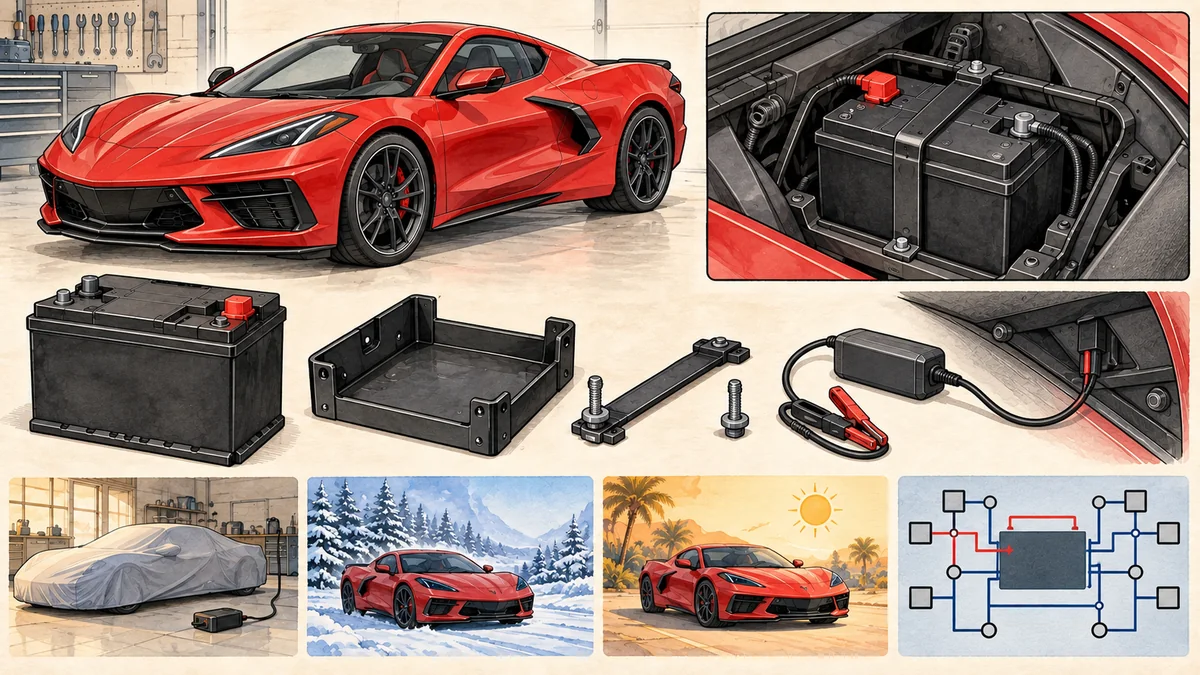
Chevrolet’s 2022 Corvette reference guide places the 12-volt battery under a cover in the underhood compartment. It states that the left- and right-side shields are removed before the cover assembly. That is more involved than lifting a conventional front-engine hood and seeing an exposed battery.
Do not pry trim, force fasteners, or stack removed panels where they can be scratched. Follow the exact model-year instructions and use a qualified technician if the removal sequence is unclear. The battery is heavy, access may be awkward, and a dropped tool near a positive connection can create a serious short circuit.
AGM is a strong candidate, but fitment still decides
An H6 AGM battery is an appealing C8 choice because absorbed-glass-mat construction immobilizes the electrolyte and can provide good vibration resistance and cycling performance. Current application records support an AGM path with documented ratings. That does not mean any H6 AGM sold online is automatically correct.
Compare the case, base hold-down feature, terminal locations, polarity, vent provision, height, and published rating with the exact application. Confirm that the factory restraint engages as designed and the cables lie naturally. The best technology in the wrong physical package remains the wrong battery.
AGM also requires a compatible charging approach. If the maintainer offers separate flooded, AGM, lithium, or repair modes, select only the mode prescribed by its instructions and the battery maker. Never experiment with a high-voltage or lithium setting on a conventional lead-acid support battery.
Can a flooded H6 work?
Some current application pages also list flooded Group 48/H6 products for C8 applications. A flooded battery can provide adequate starting performance when explicitly approved for the exact car, correctly vented, securely installed, and properly maintained. Price and local availability may make it attractive.
Still, construction should not be chosen from price alone. Compare the original equipment specification, current catalog, battery location, storage pattern, and charging method. An owner who parks for weeks may value AGM characteristics; a regularly used car may be well served by a documented flooded option. Neither type survives chronic undercharge or a faulty electrical system.
Cold-cranking amps are only one part of the decision
CCA describes current delivery during a standardized cold test. The cited AGM product publishes 730 CCA, while reserve capacity describes sustained support under another controlled test. Both are relevant because the battery must crank the engine and support modules, but the largest advertised number does not automatically provide the best ownership result.
Meet the current vehicle requirement without sacrificing correct dimensions, terminals, restraint, or charging compatibility. Also compare production date and warranty access. A fresh, properly fitted battery from a seller that can test and replace it locally may be more useful than a high-specification unit with uncertain age and mail-order-only support.
C8 electronics make storage behavior important
A modern connected sports car contains controllers, security systems, keyless-entry hardware, and other modules that can use energy while parked. Normal standby consumption is not automatically a defect, but long intervals without sufficient charging can leave the 12-volt battery below a healthy state of charge.
Chevrolet’s 2022 manual recommends its battery maintainer package for extended storage. The related reference guide says owners who do not drive weekly, or whose battery has been disconnected or drained, should use the optional maintainer through the underhood accessory power outlet. Follow the instructions for the exact car and actual charger rather than connecting to a point shown in an unrelated model-year video.
What a maintainer does—and does not do
A smart maintainer supplies controlled charging intended to preserve a sound battery during storage. It is not the same as a jump starter, and it should not be used to conceal abnormal discharge. Use a reputable unit that explicitly supports the battery’s chemistry, connect through the approved point, and keep the device dry and ventilated.
Route its lead where a closing panel, hinge, latch, tire, or pedestrian cannot damage it. Inspect the cord, plug, and connector before each use. Do not run an unsuitable household extension arrangement through standing water or across a walkway. If the charger or battery becomes hot, swollen, damaged, or produces an unusual odor, disconnect safely and obtain professional help.
Do not confuse the E-Ray’s two battery systems
The E-Ray adds an electrified front axle and a high-voltage propulsion battery, but it still uses a low-voltage electrical system. A “battery problem” therefore needs precise language. A 12-volt no-start or support-system issue is not automatically a propulsion-battery fault, and a conventional battery retailer’s H6 listing is not service information for the high-voltage pack.
Warnings involving the hybrid system, orange high-voltage components, collision damage, water intrusion, or propulsion-battery service require the exact E-Ray manual and trained service personnel. Do not probe, open, disconnect, or relocate high-voltage components based on a general 12-volt battery article.
Why a new C8 battery can still discharge
A replacement battery can go flat when the car is driven only briefly, remains parked too long, has a poor terminal or ground connection, experiences a charging-system problem, or contains an accessory or module that stays awake. Dash cameras, trackers, diagnostic adapters, chargers, and aftermarket electronics deserve attention.
Diagnosis should start with a controlled full charge using the correct mode, followed by a battery test. Then check charging behavior and cable voltage drop. If those are acceptable, key-off current can be measured only after the vehicle has completed its normal shutdown and module-sleep process. Opening a door, approaching with a key, or communicating with the car may wake systems and distort the measurement.
TheVette’s separate article on why a Corvette battery keeps dying provides a fuller troubleshooting sequence. Linking that resource avoids turning this buying guide into a repeated diagnostic article.
How to compare real products
| Comparison field | What matters |
|---|---|
| Exact-car application | Current listing for model year, trim, engine, and relevant options |
| Group and dimensions | H6/48 reference plus measured case and hold-down compatibility |
| Terminals and polarity | Cables reach without stretching, crossing, or adapters |
| CCA and reserve capacity | Meet the vehicle requirement using comparable test ratings |
| Technology | AGM or flooded matches the application and charging strategy |
| Production code | Fresh inventory rather than a battery aged in storage |
| Warranty network | Practical testing and replacement near home or travel routes |
Ask for total installed cost, including the core charge, disposal, testing, panel access, hardware, and warranty. A low shelf price may not include the labor needed to reach the C8 battery or restore the compartment correctly.
There is no honest permanent “top five” list
Battery stock, manufacturing dates, warranties, and vehicle catalogs change. A durable recommendation begins with direct fit and current evidence. Compare reputable H6 AGM choices and any approved flooded alternative available in your area, then inspect the actual unit before it enters the car.
This article has no affiliate links. If TheVette adds them later, they should lead to a clearly identified fitment lookup, include a disclosure, and never replace the exact-car check. Commission cannot turn a mismatched product into a recommendation.
Installation safety checklist
Lead-acid batteries contain corrosive material, can release explosive gas, and can supply dangerous current. Wear eye protection and suitable gloves, remove jewelry, keep flame and sparks away, and follow Chevrolet’s procedure and the battery instructions. Arrange qualified installation when the covers, access, electrical isolation, or lifting position is uncertain.
- Confirm the correct replacement before disconnecting the car.
- Turn the vehicle off and keep keys and connected devices away.
- Document cable, vent, cover, and restraint positions.
- Follow the prescribed disconnect sequence.
- Lift without tipping, dropping, or shorting the case.
- Inspect the tray, cables, grounds, vent pieces, and hold-down.
- Secure the new battery and restore terminal protection.
- Reinstall covers correctly and verify charging and vehicle operation.
Battery power loss can require window indexing or other resets. Chevrolet’s reference guide provides a model-specific window-programming procedure. Do not assume every memory or feature restores itself immediately; consult the manual before disconnecting so the recovery steps are available.
Common buying mistakes
The largest mistake is treating every C8 as the same car. Other errors include ordering by group alone, ignoring the production date, selecting only by CCA, overlooking venting, omitting the restraint, forcing a cable, and choosing a charger by connector shape instead of chemistry and approved connection method.
Another mistake is assuming a larger battery cures a warning or no-start condition. Added capacity may only postpone failure. Diagnose the battery, charging system, connections, standby draw, and aftermarket equipment so the next battery is not asked to support an unresolved fault.
A five-minute purchase check
- Identify model year, trim, powertrain, and VIN.
- Run a current application search from the battery manufacturer or seller.
- Compare H6/48 dimensions, base, terminals, polarity, and venting.
- Confirm CCA, reserve capacity, and approved construction.
- Read the production code and warranty conditions.
- Confirm maintainer compatibility and model-year connection guidance.
- For E-Ray, keep 12-volt selection separate from high-voltage service.
If any field remains uncertain, pause the purchase. A parts professional or Corvette-trained technician can resolve the application more cheaply than damaged trim, a loose battery, a short circuit, or a repeat no-start.
Frequently asked questions
What battery group does a C8 Corvette use?
Current application evidence supports Group 48/H6 for multiple 2020–2024 C8 model years. Verify the exact year, trim, powertrain, and present catalog before purchasing, especially for later model years.
Does a C8 require AGM?
AGM is a strong, currently listed option and suits many C8 ownership patterns. Some catalogs also show flooded H6 products. The exact factory/application requirement, physical fit, and charging method should decide—not a universal slogan.
Where is the C8 battery?
Chevrolet’s 2022 reference guide locates it under covers in the underhood/front compartment and describes removing side shields before the cover assembly. Use the manual for the exact year because trim and fastener details can change.
Should the car use a maintainer?
Chevrolet recommends a maintainer strategy for extended storage and provides an underhood connection method in the cited 2022 information. Use a compatible device and follow the instructions for the exact car.
Is the E-Ray 12-volt battery the hybrid battery?
No. The E-Ray also contains a high-voltage propulsion system. This guide addresses ordinary 12-volt battery selection only and does not authorize high-voltage work.
Final recommendation
Begin with a current direct-fit Group 48/H6 result for the exact C8. A fresh 730-CCA-class AGM with correct dimensions, polarity, venting, and restraint is a well-supported starting point for many 2020–2024 cars, while a listed flooded alternative may suit some applications. Verify later years and every E-Ray through current VIN-specific information.
Pair an infrequently driven healthy car with the approved smart-maintainer method. If the battery repeatedly runs down, test the complete 12-volt system rather than simply buying more capacity. Exact fit, fresh inventory, safe installation, and disciplined storage matter more than the name printed on the case.