For a US-market C7 Corvette, the best replacement battery is normally a fresh Group 48/H6 unit selected through a current application catalog for the exact model year and trim. That group is supported by current 2014–2019 application data, but the label alone is not enough. The case dimensions, top-terminal polarity, cold-cranking rating, reserve capacity, venting, cable reach, and hold-down all need to agree with the car.
To place Best Battery for C7 Corvette in a wider ownership and engineering context, continue with Why Does a Corvette Battery Keep Dying?.
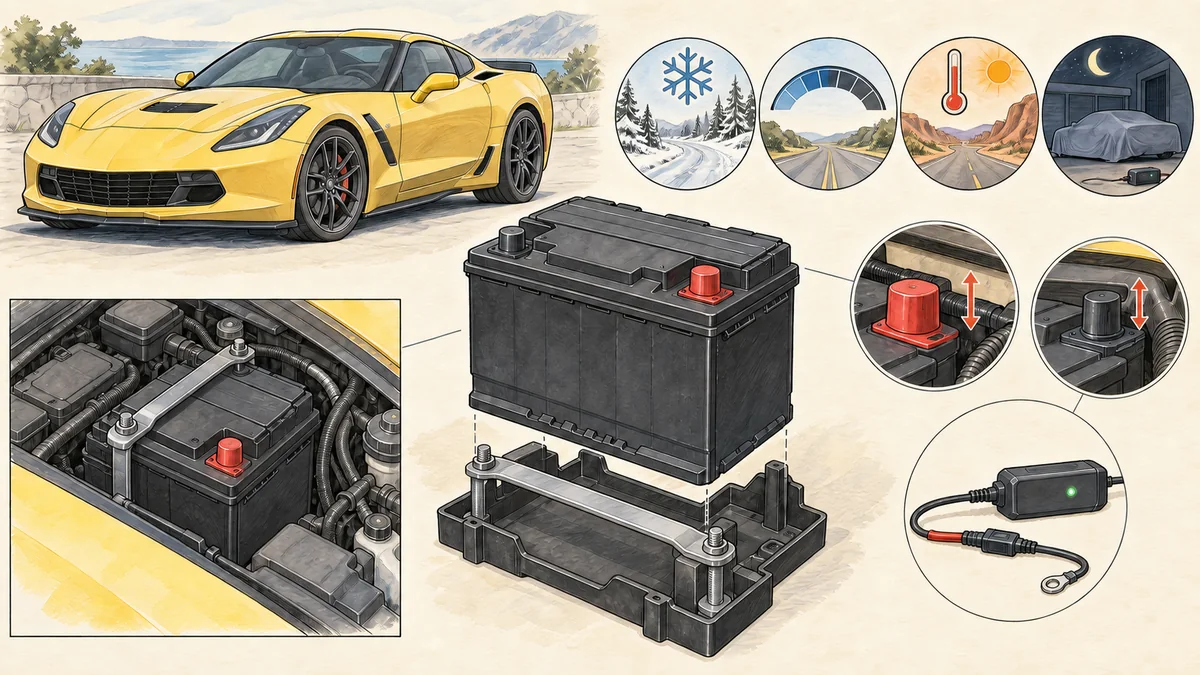
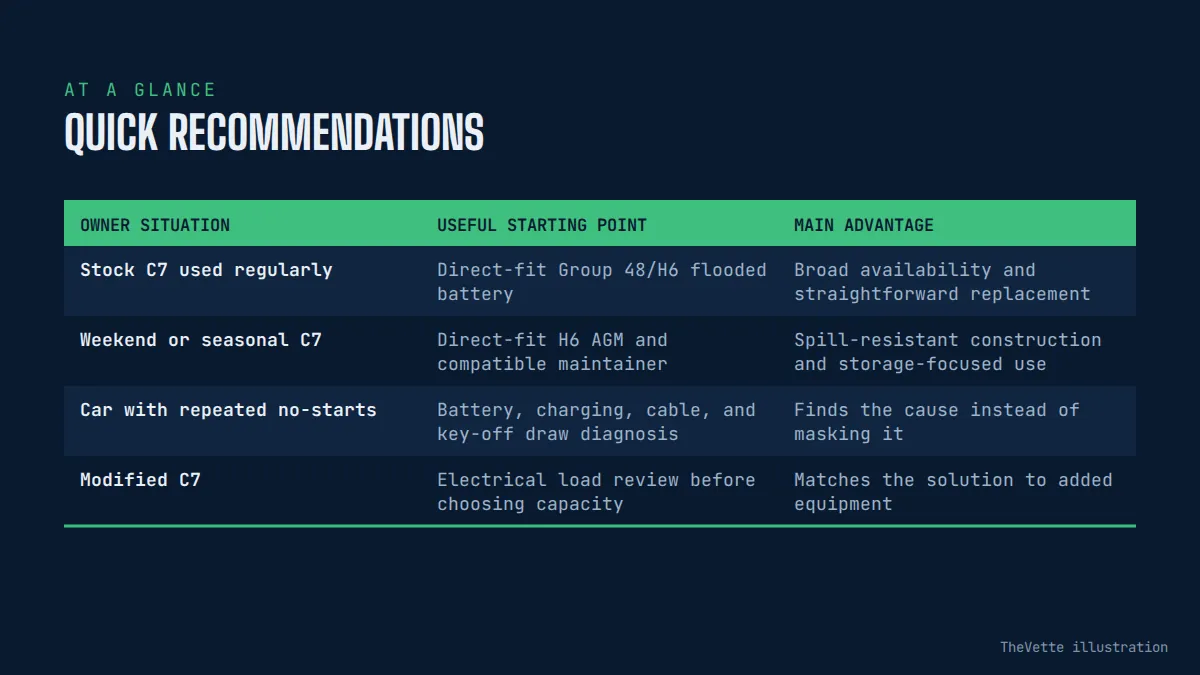
Quick recommendations
| Owner situation | Useful starting point | Main advantage | Confirm before purchase |
|---|---|---|---|
| Stock C7 used regularly | Direct-fit Group 48/H6 flooded battery | Broad availability and straightforward replacement | Exact application, CCA, reserve capacity, vent provision |
| Weekend or seasonal C7 | Direct-fit H6 AGM and compatible maintainer | Spill-resistant construction and storage-focused use | Charging mode, dimensions, polarity, current catalog approval |
| Car with repeated no-starts | Battery, charging, cable, and key-off draw diagnosis | Finds the cause instead of masking it | Resting charge, test result, alternator output, module sleep |
| Modified C7 | Electrical load review before choosing capacity | Matches the solution to added equipment | Wiring, circuit protection, grounds, alternator performance |
The table is a decision aid, not a ranked sales list. Product catalogs and inventories change. Verify the exact car when ordering and compare the new battery physically with the one being removed before completing the installation.
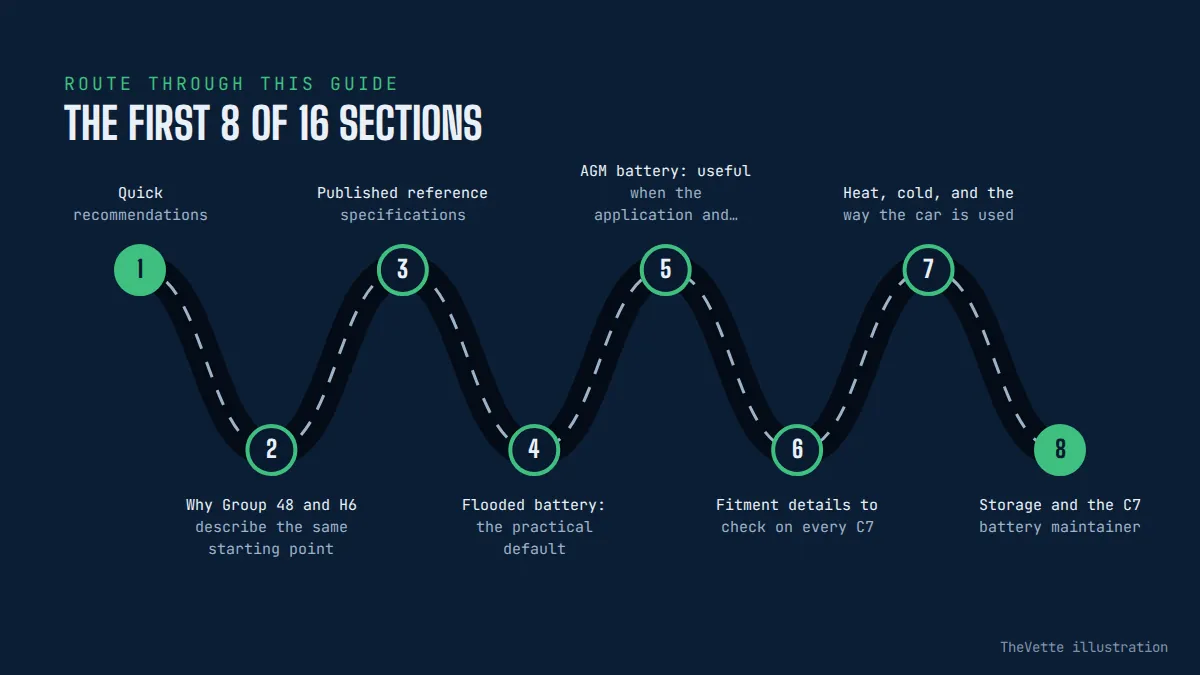
Why Group 48 and H6 describe the same starting point
US retailers commonly use Group 48, while European-style naming often calls the same general case H6 or LN3. A current Interstate application guide lists 2014–2019 Corvette with its Group 48/H6 flooded and AGM product families. That gives the C7 owner a well-supported place to begin.
Names do not guarantee every detail across brands. Published dimensions, bottom hold-down features, terminal position, case height, and vent connections can vary within allowable conventions or product designs. Read the individual manufacturer specification and the exact-car application result instead of searching only for “H6.”
Published reference specifications
Interstate’s current MTP-48/H6 material identifies the H6 group and shows C7 model-year coverage. A separate current application guide identifies 615 CCA for a flooded Group 48/H6 path and lists an AGM alternative. Other reputable H6 batteries may publish different ratings. Use the vehicle requirement as the minimum and compare products on consistent tests.
Cold-cranking amps measure starting delivery in a standardized cold test. Reserve capacity describes how long a fully charged battery can sustain a defined load under test conditions. A higher number may be useful within a correct application, but neither specification makes an oversized or wrongly polarized battery safe.
Flooded battery: the practical default
A quality flooded lead-acid H6 is a reasonable default for a standard C7 that is driven frequently. It is widely stocked, familiar to service facilities, and often costs less than AGM. Select fresh inventory from a seller with a useful local warranty network.
Flooded construction requires care around liquid electrolyte, gas, charging, and corrosion. The case must remain upright and properly secured, and any required venting arrangement must be present. Inspect the battery area and cable ends before installing a clean new case over unresolved corrosion or damage.
Best suited to: a regularly used stock car with a healthy charging system. Less compelling when: the Corvette spends long periods parked or the owner has a documented reason to prioritize AGM construction.
AGM battery: useful when the application and ownership pattern fit
Absorbed-glass-mat construction immobilizes the electrolyte and can deliver good vibration resistance and cycling behavior. It is attractive for an enthusiast car that sits between drives, especially when paired with disciplined charging. The correct direct-fit AGM remains more important than the technology name.
Confirm that the chosen AGM appears in a current C7 application list, engages the factory restraint, accepts the intended vent arrangement, and places its positive and negative terminals exactly where the cables expect them. Also check that the maintainer has a documented AGM program.
AGM does not prevent an abnormal parasitic draw from discharging the car, and it will not repair an alternator, cable, or ground problem. Paying more for a battery without investigating a repeated failure often delays the same no-start rather than solving it.
Fitment details to check on every C7
Write down the complete label from the installed battery. Photograph the cable routing, vent connection, case orientation, and hold-down before removal. Measure the available length, width, and height when anything appears nonstandard. Check the VIN and model year rather than relying on a seller’s description of the car.
- The battery must sit flat in the tray.
- The intended lower or upper restraint must engage correctly.
- Polarity and terminal location must match the cables.
- Cables must reach without tension, crossing, or contact with sharp edges.
- Positive-terminal protection and safe overhead clearance must be preserved.
- Any required vent path must use the correct fitting and routing.
Reject an installation that depends on bending a cable, omitting a clamp, modifying the case, or leaving a live post exposed. The ability to close a panel does not prove adequate electrical clearance.
Heat, cold, and the way the car is used
Cold weather increases the demand placed on a starting battery, which is why CCA matters. High temperatures can accelerate internal aging, so a warm-state owner should not assume that batteries last indefinitely merely because cold starts are rare. Climate is one factor alongside charge level, discharge depth, vibration, and storage time.
A C7 used for short trips may consume more energy starting than the alternator replaces. A car used every few weeks has a different charging pattern from a commuter. Describe the real use to the battery seller or technician rather than selecting only from climate marketing.
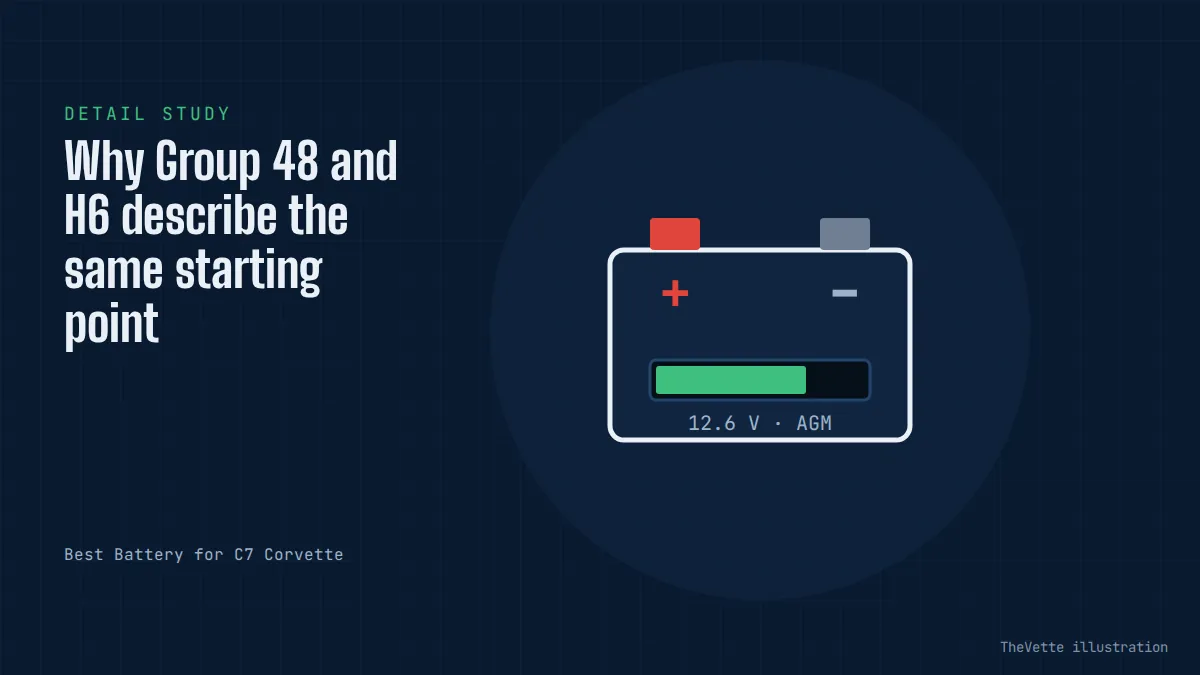
Storage and the C7 battery maintainer
Chevrolet’s 2019 owner manual discusses a battery maintainer package for extended storage and gives vehicle-specific connection guidance. Chevrolet also currently sells a conditioner listed for 2016–2019 Corvette applications. This confirms that maintenance charging is an intended ownership tool, but owners should follow the instructions for their exact device and model year.
A maintainer is different from a jump starter. It supplies controlled charging intended to preserve a healthy battery while the car rests. Choose a reputable smart unit matched to flooded or AGM chemistry, connect it through an approved point, keep it ventilated and dry, and route the lead away from heat, moving parts, sharp edges, and latch hardware.
Do not repeatedly start the engine for a few stationary minutes as a storage routine. That may not recover the starting energy and can introduce other undesirable operating conditions. Either drive the car long enough under suitable conditions or use the documented storage method.
When disconnection is considered
The owner manual should control any decision to disconnect the battery. Loss of power may affect window indexing, learned settings, security, access, or other electronic functions. A generic instruction from another generation should not be transferred to the C7.
If the car cannot be maintained where it is stored, read the exact model-year procedure before removing the negative cable. Plan how the car will be opened and how required settings will be restored. Never improvise a memory-saving connection without confirming it is suitable and protected.
Why a new battery may still go flat
Infrequent driving and short trips are common explanations, but they are not the only ones. A damaged ground, resistance at a terminal, weak charging system, light that stays on, module that does not sleep, or aftermarket alarm, tracker, camera, or audio equipment can drain the battery.
Test in an orderly sequence. Fully charge the battery with the correct charger, then obtain a battery test. Check charging performance and voltage drop across the cables and grounds. If those pass, key-off current can be measured after the car completes its normal sleep period. Opening a door or waking a module during the test can produce a misleading result.
Replacing batteries without this diagnosis can become expensive. See TheVette’s existing guide to why a Corvette battery keeps dying for a fuller troubleshooting framework and safety limits.
How to compare current H6 choices
| Field | What a careful buyer checks |
|---|---|
| Application | Exact model year, trim, equipment, and current manufacturer listing |
| Physical specification | Case dimensions, base feature, top clearance, terminals, polarity, and venting |
| Starting rating | CCA at or above the vehicle application requirement |
| Stored energy | Reserve capacity stated under a comparable test |
| Construction | Flooded or AGM chosen for a documented use case |
| Inventory date | Fresh production rather than a unit aged on the shelf |
| Service | Clear warranty terms and replacements available where the car travels |
Ask for the installed price, including testing, core charge, disposal, hardware, and warranty. The cheapest online listing may become poor value if shipping is slow, warranty return is difficult, or the production date is unknown.
Product recommendations without affiliate theater
There is no responsible single-brand winner for every C7 owner. Stock and production dates vary by region, and retailers sometimes carry closely related product lines under different warranties. Begin with reputable Group 48/H6 flooded and AGM batteries that explicitly list the exact car, then compare the fields above.
TheVette currently has no affiliate link in this guide. If links are introduced later, they should help a reader find a documented application, not replace the fitment check. A commission must never determine the technical conclusion or turn a changing catalog into a permanent claim.
Installation and safety
Automotive batteries are heavy and contain hazardous material. They can produce explosive gas and deliver enough current to cause burns or a fire. Wear eye protection and appropriate gloves, remove jewelry, keep flames and sparks away, and follow the owner and battery instructions. Use a qualified technician if access or procedure is uncertain.
Before disconnecting anything, turn the car off, keep the key away, and record polarity and routing. Use the prescribed disconnect and reconnect sequence. Never bridge the positive terminal to body metal with a tool. Inspect the tray, restraint, cable ends, protective covers, grounds, and vent components before securing the replacement.
After installation, confirm that the battery cannot move, cables are relaxed and protected, terminals are covered, and charging voltage and starting behavior are normal. Recycle the old battery through an authorized seller or collection program.
A five-minute buying check
- Enter the exact year and trim into a current application catalog.
- Match Group 48/H6, dimensions, polarity, terminals, and vent details.
- Confirm the required CCA and compare reserve capacity.
- Choose flooded or AGM based on use and charger compatibility.
- Read the production code and warranty terms.
- Compare the candidate with the installed battery and tray.
- Stop if any part of the installation requires force or improvised hardware.
This short check catches more expensive mistakes than choosing by a “best battery” badge. It also gives an installer a clear record if a catalog result conflicts with the car.
Frequently asked questions
Does every 2014–2019 Corvette use an H6 battery?
Current application evidence supports Group 48/H6 across the C7 years, but every purchase should still be checked against the exact year, equipment, and physical installation. Catalogs can change and cars can be modified.
Is AGM automatically better than flooded?
No. A fresh, correct flooded battery can be an excellent choice for a regularly driven stock C7. AGM may suit storage and vibration priorities, provided it is a documented direct fit and charged correctly.
Should I buy the highest CCA available?
Meet or exceed the application requirement within the correct case, terminals, polarity, and charging compatibility. A bigger headline number should not override fit, freshness, reserve capacity, warranty, or safe installation.
Can a maintainer fix a parasitic draw?
No. It can preserve a healthy battery during expected storage. An abnormal drain, weak alternator, poor connection, or failing battery needs diagnosis.
How long should a C7 battery last?
There is no honest fixed lifespan. Heat, storage, charge level, deep discharge, vibration, driving pattern, and production freshness all influence service life. Periodic testing is more useful than an age promise.
Final recommendation
Start with a current Group 48/H6 application for the exact 2014–2019 C7. Choose a fresh quality flooded battery for straightforward regular use, or a verified direct-fit AGM when storage pattern, vibration resistance, and compatible maintenance charging justify it. Compare the real specifications and warranty rather than relying on a brand slogan.
Safe fit remains the deciding factor: correct dimensions, polarity, terminals, venting, cable reach, protective clearance, and factory-style restraint. Diagnose repeat discharge instead of buying a larger case, and use the owner-approved maintainer procedure when the car sits. That combination gives the C7 a reliable start without turning a simple battery replacement into an electrical risk.