The best battery for a C6 Corvette is the fresh, correctly rated battery that fits the exact model year, tray, terminals, cables, and factory restraint without improvisation. For most 2006–2013 US-market cars, current application data points to a Group T5 battery, also called 90 in some catalogs. The 2005 launch-year car needs a separate lookup: do not assume that a battery listed for later C6 models automatically fits it.
To place Best Battery for C6 Corvette in a wider ownership and engineering context, continue with Why Does a Corvette Battery Keep Dying?.
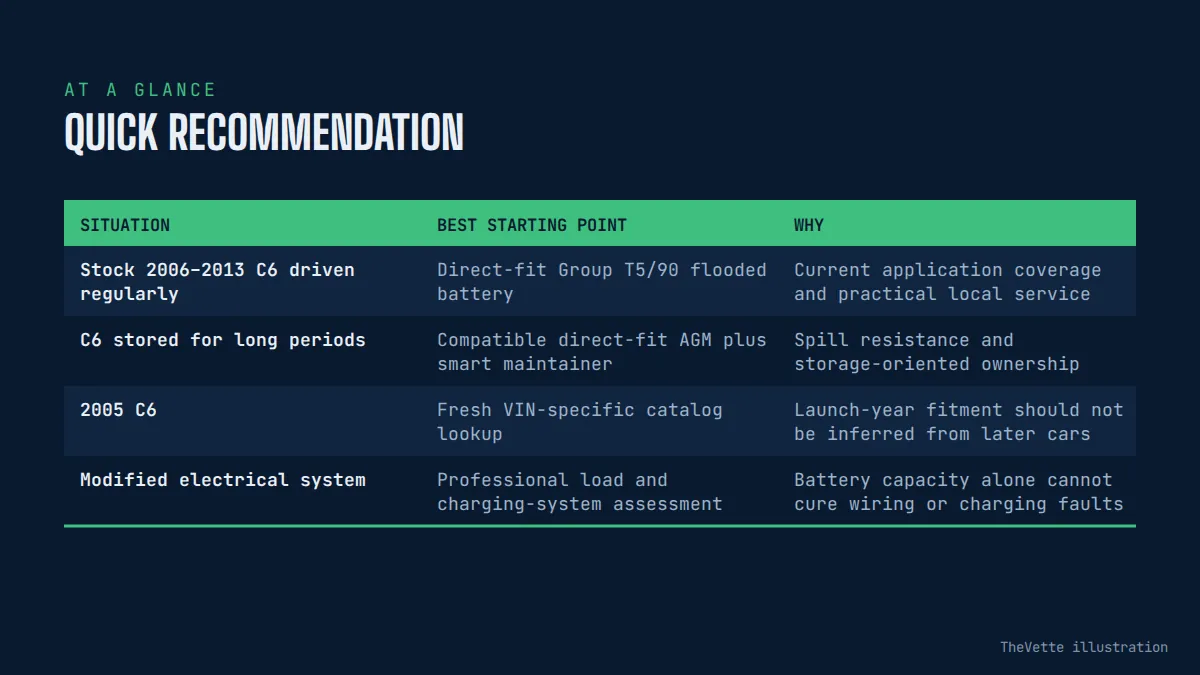
Quick recommendation
| Situation | Best starting point | Why | Verify before buying |
|---|---|---|---|
| Stock 2006–2013 C6 driven regularly | Direct-fit Group T5/90 flooded battery | Current application coverage and practical local service | Exact year, option package, terminals, dimensions, CCA |
| C6 stored for long periods | Compatible direct-fit AGM plus smart maintainer | Spill resistance and storage-oriented ownership | Catalog approval, charger mode, case height, restraint |
| 2005 C6 | Fresh VIN-specific catalog lookup | Launch-year fitment should not be inferred from later cars | Existing case, terminal layout, tray, cable reach |
| Modified electrical system | Professional load and charging-system assessment | Battery capacity alone cannot cure wiring or charging faults | Alternator output, key-off draw, grounds, accessory wiring |
This is a fitment path, not a universal product endorsement. Interstate currently lists its T5/90 product for 2006–2013 Corvette applications and publishes 650 cold-cranking amps, 90 minutes of reserve capacity, and a case measuring about 9.5 by 6.875 by 6.875 inches. Those figures are useful reference points, but the application record for the exact car controls.
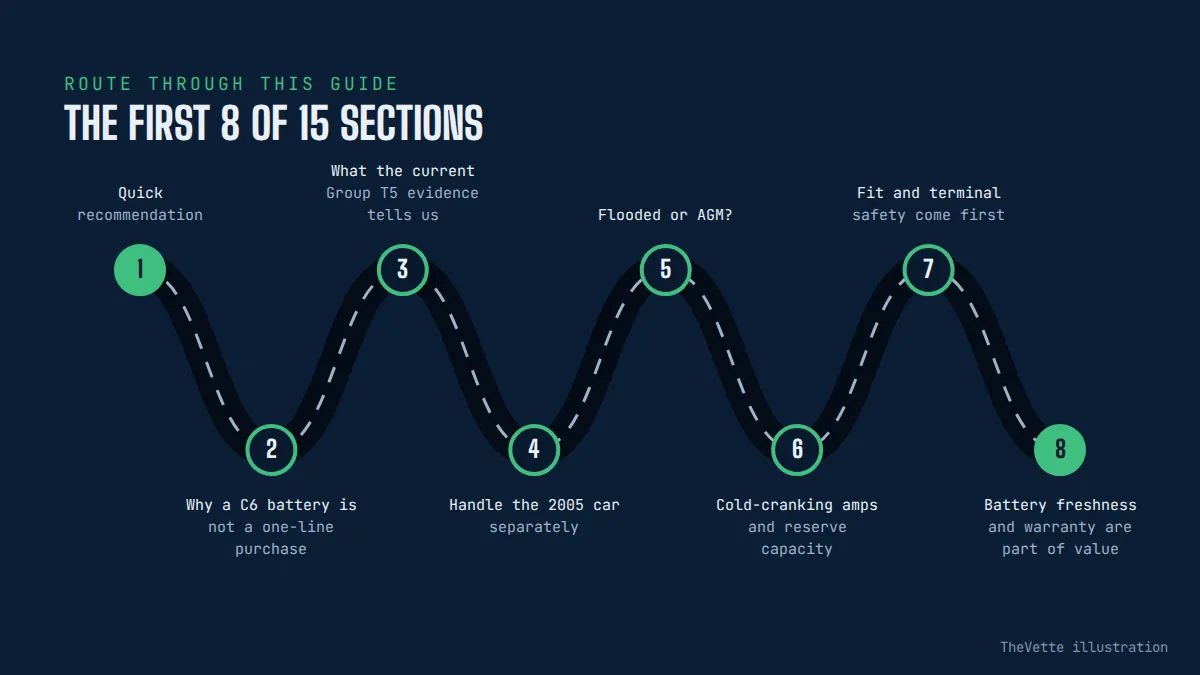
Why a C6 battery is not a one-line purchase
Battery listings often collapse an eight- or nine-year generation into a single answer. That shortcut can produce the wrong terminals, a case that does not engage the hold-down, or cables that only connect when stretched. Model year, equipment, previous repairs, and catalog revisions all matter. A car that has passed through several owners may no longer have its original tray or cable arrangement.
Start by reading the label on the installed battery and photographing the tray, terminals, hold-down, and cable routing. Confirm the model year from the VIN. Then compare at least two current application sources and the vehicle’s owner information. If the current installation looks improvised, treat it as evidence to investigate—not a pattern to repeat.
What the current Group T5 evidence tells us
Interstate’s current US application page for the MTP-90/T5 includes Corvette model years 2006 through 2013. It describes a 12-volt flooded, top-terminal battery with 650 CCA and 90 minutes of reserve capacity. Its published dimensions provide a concrete envelope to compare with the tray and clearance.
The same page contains application qualifiers, including references to particular equipment. That is a reminder that a catalog result should be read fully rather than reduced to the group name. A dry-sump package, performance trim, or other factory configuration may affect the application path. Enter the exact year and configuration into the seller’s current lookup and confirm the result at purchase time.
Handle the 2005 car separately
The 2005 Corvette began the C6 generation, but the current source used for this guide does not establish the later T5 fitment for that year. Some retail databases may present a different group. Rather than copying an uncertain number, this guide recommends a new vehicle-specific lookup and a physical comparison for every 2005 car.
Check the existing terminal style, positive-terminal position, cable length, tray footprint, height, and hold-down feature. If a retailer’s result conflicts with the car, stop and resolve the discrepancy with a knowledgeable parts professional. Never force a cable, remove the restraint, or accept unsafe clearance merely because a website says the battery fits.
Flooded or AGM?
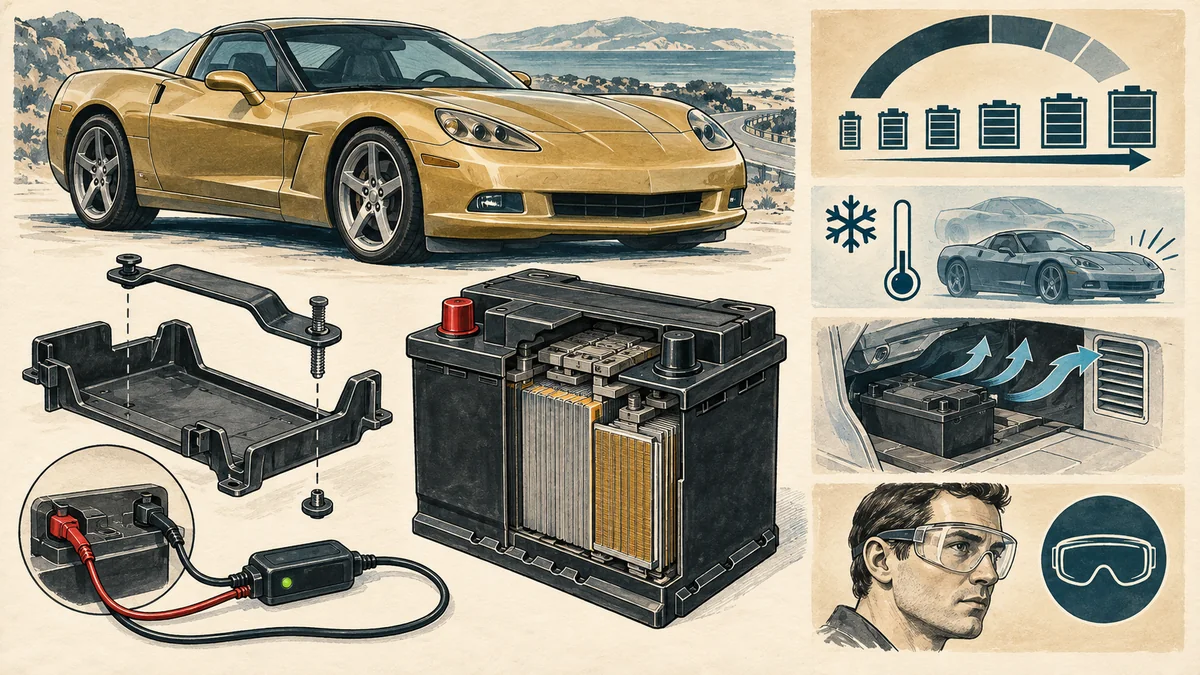
A quality flooded lead-acid battery is a sensible replacement for a stock C6 that is driven often and has a healthy charging system. It is widely available, familiar to service shops, and usually easier to replace during a trip. It still requires correct installation, ventilation, restraint, and protection from leakage or corrosion.
An absorbed-glass-mat battery can be attractive for an enthusiast car that spends time parked. AGM construction immobilizes the electrolyte and can offer strong vibration and cycling characteristics. It does not make fitment optional, and it does not make a battery immune to discharge. The case, polarity, terminals, capacity, charging requirements, and hold-down must remain correct.
Choose AGM because a documented direct-fit product and the way the car is used justify it—not because “AGM” appears on a premium label. Confirm that any charger or maintainer has the mode specified by the battery manufacturer. Using the wrong charging program can shorten life or prevent a complete charge.
Cold-cranking amps and reserve capacity
Cold-cranking amps measure the battery’s ability to deliver current under a standardized cold test. Reserve capacity describes how long a fully charged battery can support a defined load under test conditions. Both help compare suitable batteries, but neither rescues an unsuitable case or terminal arrangement.
Meet the current application requirement and compare like with like. An unusually large advertised CCA number is not automatically better if it comes with poor fit, stale inventory, less practical warranty support, or a mismatched charging requirement. Owners in hot climates should also remember that heat accelerates battery aging even when winter starting is not a concern.
Fit and terminal safety come first
The battery must sit flat and the intended hold-down must secure it against movement. Positive and negative cables should reach naturally without crossing, stretching, or resting against a sharp or hot surface. The polarity and terminal positions must match. Protective covers and routing should be restored exactly as intended.
Check clearance above the terminals and case. A hood that closes does not prove safe clearance under vibration or body movement. Never leave an unused positive post exposed near metal. Do not solve a mismatch with stacked washers, an overly long terminal bolt, a loose adapter, or a homemade strap.
Battery freshness and warranty are part of value
A battery begins aging before installation. Ask the seller to explain the production code and choose fresh inventory. Keep the dated receipt and record the installation date. A long warranty has little practical value if the seller has no nearby replacement stock or the terms are difficult to use.
Compare the installed cost, not just the shelf price. Include the core charge, disposal, terminal service, testing, required hardware, and access to warranty help. A locally supported battery with correct fit and recent production can be a stronger ownership choice than a fashionable model ordered solely by headline specifications.
Storage changes the answer
Many C6 Corvettes are weekend cars. Starting the engine for a few minutes in the garage is not an effective charging strategy and adds moisture and fuel-dilution concerns. If the car will sit, fully charge a healthy battery and connect a reputable chemistry-compatible smart maintainer according to both the vehicle and charger instructions.
Route the lead away from belts, fans, exhaust heat, sharp edges, and hood-latch hardware. Keep the charger dry and ventilated as directed. Inspect the cord and connector periodically. A maintainer preserves a sound system; it is not a repair for a failing battery, alternator fault, poor connection, or abnormal parasitic draw.
Diagnose a battery that keeps going flat
A new battery that repeatedly discharges is evidence, not proof that the battery is defective. Short trips may fail to replace the energy used during starting. A weak alternator, voltage drop, damaged ground, module that never sleeps, interior light, tracker, alarm, audio equipment, or other accessory may be responsible.
Begin with a proper full charge and battery test, then test charging performance and cable voltage drop. If those pass, a technician can measure key-off current after all modules have entered their normal sleep state. Pulling fuses randomly or replacing parts without a baseline can create new faults and erase useful clues. TheVette’s Corvette battery-discharge guide explains this process in more detail.
Five batteries to compare without pretending one wins every car
Product availability and application data change, so a durable guide should teach selection rather than freeze an affiliate ranking. Build a current shortlist from reputable US sellers that explicitly list the exact car. Compare a standard direct-fit flooded option, a premium flooded option with stronger local warranty coverage, and one or more direct-fit AGM options when the catalog approves them.
| Comparison field | Why it matters |
|---|---|
| Exact vehicle application | Confirms the manufacturer or seller intends the battery for that year and configuration |
| Group and measured dimensions | Protects tray, restraint, hood, and cable fit |
| Terminal layout and polarity | Prevents stretched cables and short-circuit hazards |
| CCA and reserve capacity | Establishes adequate starting and stored-energy performance |
| Flooded or AGM construction | Affects price, charging method, spill behavior, and use case |
| Production date | Separates fresh stock from a battery that has aged on the shelf |
| Warranty network | Determines whether replacement help is practical away from home |
TheVette has no affiliate links in this article. If commercial links are added later, the technical criteria and editorial conclusion should remain independent of commission.
Safe replacement checklist
Lead-acid batteries are heavy, contain corrosive material, and can release explosive gas. Wear eye protection and suitable gloves, remove jewelry, keep flame and sparks away, and work with ventilation. Follow the correct model-year procedure and battery instructions. If access, retained settings, or cable routing is unclear, use a qualified technician.
- Save any settings using only a method approved for the vehicle.
- Confirm ignition is off and keep the keys away from the car.
- Record cable routing and polarity before disconnecting.
- Use the prescribed disconnect and reconnect order.
- Lift safely; do not tip or drop the case.
- Inspect and clean the tray, restraint, terminals, cables, and grounds.
- Install the correct battery and secure the factory-style hold-down.
- Protect terminals, check clearance, and verify charging operation.
Never place a tool across the terminals or between positive and body metal. Do not work over a visibly damaged, frozen, leaking, or swollen battery. Arrange professional handling and legal recycling for the old unit.
Mistakes that cost more than the battery
The common mistakes are buying by generation alone, ignoring the 2005 distinction, choosing on CCA alone, accepting old stock, deleting the hold-down, forcing a cable, and using the wrong maintainer mode. Another mistake is fitting a larger battery to hide an electrical drain. That may only lengthen the time before the next no-start.
Performance modifications also deserve scrutiny. Added pumps, controllers, audio equipment, cameras, and trackers need appropriate circuit protection and professional wiring. The starting battery should not be treated as a substitute for an electrical-system design.
Frequently asked questions
What battery group fits a C6 Corvette?
Current Interstate application data supports Group T5/90 for 2006–2013 examples. The 2005 launch year should receive a separate current lookup and physical verification. Equipment and previous modifications can change what is installed.
Is a 650-CCA battery enough?
650 CCA is the published figure for the referenced T5 application product, but sufficiency should be confirmed through the exact current vehicle listing. Do not lower the documented requirement or ignore reserve capacity and fit.
Should a stored C6 use an AGM?
AGM can be a good choice when a direct-fit application exists and its characteristics justify the added cost. A healthy flooded battery with a compatible smart maintainer can also serve well. Storage method and electrical condition matter more than the label alone.
Can I disconnect the battery for storage?
Disconnection may affect learned settings, security, access, and other vehicle functions. Follow the exact owner information and storage guidance rather than applying a universal rule. A compatible maintainer is often the simpler approach.
Why did my replacement battery die quickly?
Possible causes include old stock, chronic undercharge, heat, a charging fault, poor cable connection, abnormal key-off draw, or repeated deep discharge. Test the entire system before blaming or replacing the battery again.
Final recommendation
For a stock 2006–2013 C6, begin with a fresh direct-fit Group T5/90 battery whose current application listing matches the exact year and equipment. A quality flooded battery is the practical default; a documented direct-fit AGM is worth considering for vibration, spill resistance, or storage priorities. For a 2005 car, perform a new VIN-specific lookup and physical comparison rather than borrowing the later answer.
Whichever construction you choose, insist on correct dimensions, polarity, terminals, ratings, cable reach, protected clearance, and a secure factory-style restraint. Test a car that repeatedly discharges, and support an infrequently driven healthy car with the correct smart maintainer. The best C6 battery is the one that fits safely, starts reliably, and belongs to a sound electrical system.