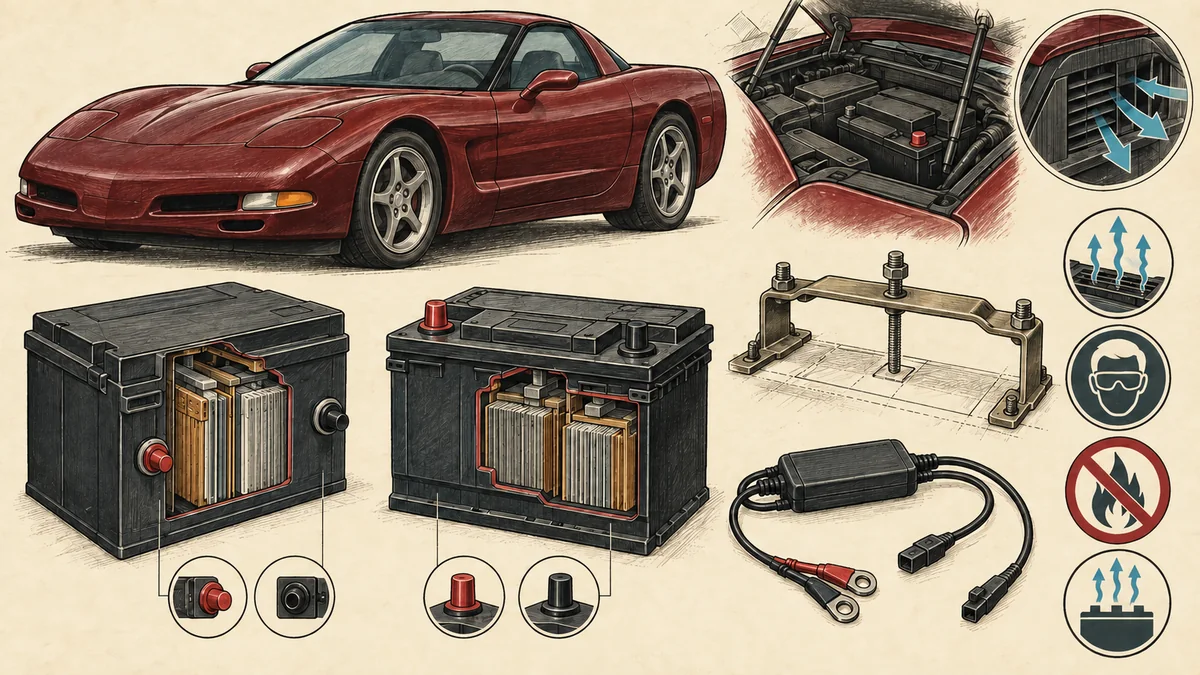
The best battery for a C5 Corvette is a direct-fit unit that matches the car’s actual tray, terminal layout, hold-down, cable reach, and required starting capacity. Do not buy by generation alone: current application catalogs show Group 75 side-terminal fitments for many 2001–2003 cars, while 2004 commonly appears as Group 86 with top terminals. Earlier 1997–2000 listings can differ again. Verify the exact year, installed battery, tray, and owner information before choosing flooded or AGM construction.
To place Best Battery for C5 Corvette in a wider ownership and engineering context, continue with Why Does a Corvette Battery Keep Dying?.
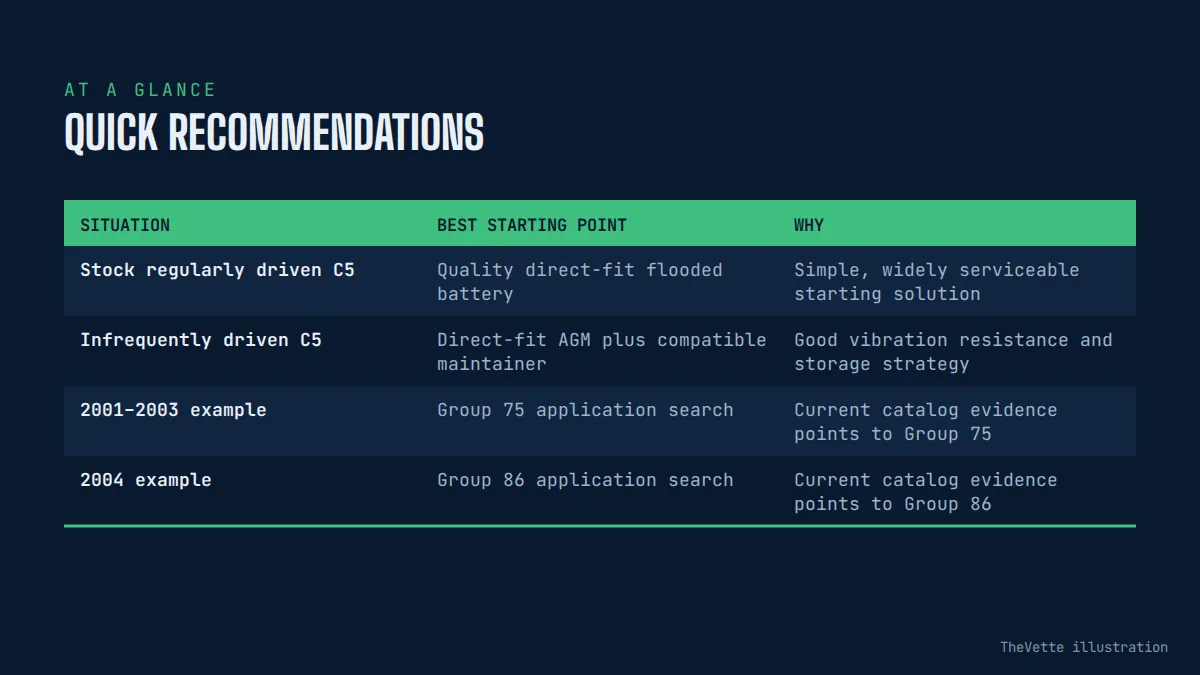
Quick recommendations
| Situation | Best starting point | Why | Verify first |
|---|---|---|---|
| Stock regularly driven C5 | Quality direct-fit flooded battery | Simple, widely serviceable starting solution | Exact group, terminals, CCA, hold-down |
| Infrequently driven C5 | Direct-fit AGM plus compatible maintainer | Good vibration resistance and storage strategy | Charging compatibility and physical fit |
| 2001–2003 example | Group 75 application search | Current catalog evidence points to Group 75 | Side-terminal location and individual car |
| 2004 example | Group 86 application search | Current catalog evidence points to Group 86 | Top-terminal polarity, height, and cable reach |
The table identifies a search path, not a universal part number. Retail catalogs can contain errors, and a previous owner may have altered the tray or cables. A battery that starts the engine on the counter is not a correct fit if its terminals can contact the body, the hood, or the wrong cable.
The C5 model-year split matters
“C5 battery size” is often answered too casually. Interstate’s current application pages associate its Group 75 product with 2001, 2002, and 2003 Corvettes, while its Group 86 product lists 2004 Corvette. Other application records show Group 78 products for some earlier C5 years. These groups differ in dimensions and terminal arrangement.
Before ordering, photograph the current battery from above, record its full label, and note whether the cables attach to side or top posts. Inspect the tray and factory restraint. Confirm the model year from the VIN and registration rather than assuming it from a sale listing. If anything appears modified, measure length, width, and height and let a competent parts professional resolve the fitment.
What “best” means for a Corvette battery
A useful battery must crank the engine in the expected temperature, reserve enough capacity for normal electrical demand, fit securely, place terminals safely, and work with the charging system. Warranty, local replacement access, and production freshness matter too. The biggest advertised cold-cranking number does not correct a wrong case or reversed terminals.
The C5 also spends long periods parked in many households. That changes the decision. A fresh premium battery can still discharge when the car is not driven enough to replace energy used during starting and key-off operation. The solution may include a compatible maintainer and diagnosis, not simply a larger battery.
Best conventional choice: a fresh direct-fit flooded battery
A reputable flooded lead-acid battery in the correct application remains a sensible choice for a stock C5 driven regularly. Interstate’s Group 75 and Group 86 lines illustrate how manufacturers publish dimensions, terminal codes, cold-cranking amps, reserve capacity, voltage, and construction. Compare those fields with the exact car, not only the group label.
A flooded battery is typically easy to source and replace locally. Its disadvantages include liquid electrolyte and possible venting or leakage concerns. The installation must keep the case upright and securely restrained. Inspect the tray and surrounding area for residue or corrosion, and do not install over existing damage without cleaning and repair.
Choose it when: the car is standard, driven often, and local warranty support matters. Look elsewhere when: vibration resistance, unusual storage demands, or a modified electrical load justifies an AGM after compatibility is confirmed.
Best premium path: direct-fit AGM
An absorbed-glass-mat battery can offer strong vibration resistance, sealed construction, and good cycling behavior depending on the product. It is attractive for an enthusiast car that sees irregular use. AGM is a technology, not a fitment. The case, terminal position, polarity, hold-down, capacity, and charging requirements still must match.
Some widely known AGM products use dual terminals or a Group 34/78 case. That does not mean they drop safely into every C5. Extra unused top posts can create clearance or short-circuit risks, and an adapter or improvised clamp can allow movement. Use a manufacturer application listing or a documented professional solution.
Advantages: spill-resistant construction and strong vibration performance. Trade-offs: higher price, greater sensitivity to the correct charger mode, and no immunity to parasitic discharge or neglect.
Group 75 for many 2001–2003 cars
Current Interstate data lists 2001–2003 Corvette applications for a Group 75 battery. Group 75 is commonly a side-terminal format, so cable attachment, bolt length, terminal cleanliness, and sealing deserve attention. A loose side-terminal bolt can produce intermittent no-start symptoms without looking obviously disconnected.
Do not overtighten a side terminal. Follow the battery and service instructions with an appropriate hand tool, and replace damaged bolts or cable ends. Adding washers or an excessively long accessory bolt can damage the internal connection or case. If aftermarket accessories share the terminal, their routing and protection should be reviewed rather than stacked carelessly.
Group 86 for the 2004 transition
Interstate’s Group 86 application page includes the 2004 Corvette and describes a top-terminal flooded battery. That makes 2004 a year to verify carefully rather than grouping it with 2001–2003. Top-post polarity, case height, and cable reach must all be correct.
A top terminal close to metal bodywork needs the original protective arrangement and adequate clearance. Never assume the hood cannot contact it because the hood closes gently. Confirm the proper hold-down is present, the case cannot slide, and positive-cable protection is intact.
Earlier 1997–2000 cars need their own lookup
Application data shows Group 78 products associated with some 1998–2000 Corvettes. Group 78 is generally a side-terminal format, but products may also have dual terminals. The exact early-car installation should be checked against current catalogs and the battery already fitted.
An early C5 may have accumulated decades of repairs. Replacement cables, a modified tray, audio equipment, or a disconnect switch can change what is visible. Restore a safe documented arrangement rather than assuming the modification was intentional or correct.
Cold-cranking amps and reserve capacity
Cold-cranking amps describe a standardized low-temperature starting test. Reserve capacity describes how long a battery can support a specified load under a defined test. Both are useful, but neither should be chased without fitment. Meet or exceed the vehicle and battery-maker application requirement while retaining correct size and terminals.
A warm-climate car still benefits from adequate starting capacity, while high underhood heat can accelerate battery aging. A car with added electronics may need the electrical system evaluated as a whole. A higher-capacity battery cannot compensate for a weak alternator, poor ground, damaged cable, or device that remains awake.
Diagnose repeated discharge before upgrading
If the C5 repeatedly needs a jump, test rather than guess. Fully charge the battery with an appropriate charger, allow it to rest as directed, then perform battery and charging-system tests. Check cable voltage drop and grounds. If those pass, measure key-off current only after the vehicle’s modules have had time to sleep.
Aftermarket alarms, audio equipment, chargers, trackers, and poorly wired accessories can create a drain. So can a light, latch, or module that never enters sleep. Replacing the battery may temporarily hide the symptom. The existing battery-discharge diagnosis guide explains the method and safety boundaries in more detail.
A maintainer is useful, but it is not a repair
A smart maintainer can keep a healthy battery charged when the Corvette sits for weeks. Choose one whose mode matches flooded or AGM chemistry and follow both manufacturers’ connection instructions. Route leads away from belts, fans, sharp edges, heat, and hood-latch hardware.
Do not use a maintainer to conceal an abnormal draw, a failing battery, or a charging fault. It should preserve a sound system between drives. A device that becomes hot, damaged, wet, or incorrectly connected should be disconnected safely and inspected.
Battery age, freshness, and warranty
Ask for the production code and buy fresh inventory from a seller who can explain it. A long warranty is valuable only if the claim process and replacement stock are practical. Keep the receipt and record the installed date and test results.
Battery life varies with heat, discharge depth, charging, storage, vibration, and use. Do not promise a fixed number of years. Periodic test results show more than age alone, especially before a long trip or winter storage.
Safe removal and installation
Lead-acid batteries are heavy, contain corrosive electrolyte, and can produce explosive gas. Wear eye protection and appropriate gloves, remove jewelry, keep sparks and flame away, and work in ventilation. Follow the exact service procedure for disconnect order, retained settings, and any vehicle-specific precautions.
Before lifting, note cable routing and terminal polarity. Clean and inspect the tray, hold-down, cables, and grounds. Never place tools across terminals or from positive to body metal. The new battery must be immovable after the restraint is tightened to specification.
What to compare at the store
| Field | Why it matters |
|---|---|
| Application and group | Case, terminals, and hold-down must fit |
| Terminal type and polarity | Cables must reach without crossing or stretching |
| CCA | Starting performance must meet the application |
| Reserve capacity | Helps compare stored-energy capability |
| Technology | Flooded or AGM affects handling and charging |
| Production date | Fresh inventory protects useful service life |
| Warranty location | A road-trip owner needs practical support |
Compare installed price including core charge, disposal, terminal hardware, testing, and warranty—not an isolated shelf price. There are no affiliate links in this build, and no product is ranked because a seller paid for placement.
A five-minute fitment check before paying
Place the proposed battery beside the application data and work through a short written check. The case group and measured dimensions must agree. Positive and negative terminals must be in the correct locations and use the correct attachment style. Cables should reach naturally without crossing, stretching, or resting against a sharp edge. The factory hold-down must engage the case feature it was designed to restrain, and the finished installation needs safe clearance above every live terminal.
Next, compare cold-cranking amps, reserve capacity, voltage, technology, production code, and warranty. Confirm whether the seller expects a core return and whether warranty service is available near the routes the car normally travels. If an AGM is chosen, verify that the maintainer has a documented AGM mode. If the battery has both side and top terminals, require a safe reason for that configuration and protection for every unused positive connection.
Stop when any answer depends on forcing a cable, omitting the restraint, bending bodywork, stacking improvised terminal hardware, or hoping the hood has clearance. A different battery or professional inspection is cheaper than an electrical short, leaking case, or roadside no-start.
Frequently asked questions
Is every C5 a Group 75?
No. Current application data shows meaningful model-year differences, including Group 86 for 2004 and Group 78 associations for some earlier cars. Verify the exact vehicle.
Is AGM always better?
No. A correct, fresh flooded battery can be an excellent stock replacement. AGM may suit storage and vibration priorities, but it must fit physically and match the charging and maintenance method.
Can I install a battery with extra top posts?
Only if the application, clearance, protection, and restraint are explicitly safe. An unused positive post near bodywork creates a serious short-circuit risk.
Why does a new battery go flat?
Short trips, infrequent use, charging faults, poor cables, or abnormal key-off draw can discharge a new battery. Diagnose the system instead of repeatedly replacing batteries.
Final recommendation
Begin with the exact year and terminal layout. For many 2001–2003 cars, search a quality Group 75 direct-fit battery; for 2004, verify a Group 86 top-terminal application; for 1997–2000, perform a fresh lookup rather than borrowing a later answer. Choose flooded for straightforward stock service or a compatible AGM when its construction and storage benefits justify the cost.
Whatever the brand, insist on a fresh battery, correct polarity, secure factory-style hold-down, protected terminals, adequate ratings, and a tested charging system. Pair an infrequently driven healthy car with a chemistry-compatible smart maintainer, not an improvised oversized battery.